Showing posts with label Where Eagles Dare. Show all posts

Thursday, January 9, 2025

THE 100 BEST WAR MOVIES: 17. Where Eagles Dare (1968)


It was directed by Brian Hutton (“Kelly’s Heroes”). In the late 1960s, Richard Burton was coming off several box office flops and his step-son urged him to dumb it down and make an action picture.  Burton took the idea to producer Elliot Kastner who sought out Alistair MacLean (“The Guns of Navarone”).  MacLean wrote the book and screenplay (his first) in six weeks and took the title from a line from Shakespeare.  Clint Eastwood (fresh off his spaghetti western trilogy) was recruited and it was off to snowy Austria and Bavaria.  Just as importantly, famed stuntman Yakima Canutt brought a cadre of great stuntmen to the production. One of them, Alf Joint, broke three teeth doing the famous cable car jump.  Eastwood would later dub the movie “Where Doubles Dare”.  The movie was a huge hit and firmly took a position among the suicide mission subgenre with “The Guns of Navarone” and “The Dirty Dozen”.

Eastwood was paid $800,000 and Burton $1.2 million. Burton was drinking heavily during the shoot because his marriage to Elizabeth Taylor was failing and his career was on the rocks. He supposedly was downing four bottles of vodka a day. He disappeared for several days with his drinking buddies – Peter O’Toole, Oliver Reed, Trevor Howard, and Richard Harris. Darren Nesbitt (Major von Happen) was criticized by some Jews for playing a Gestapo officer, but he told them he played him badly. He was temporarily blinded during the shoot when a blood squib blew up stronger than expected.  Ingrid Pitt had spent some time in a concentration camp when she was a child. The plane was an authentic Junkers JU-52 that belonged to the Swiss air force. It crashed in 2018, killing 20. Eastwood’s body count in this movie was the highest of his career.

            The movie opens with the iconic theme by Ron Goodwin which is the greatest in war movie history, in my opinion.  We also get our first taste of the wonderful snowy mountain scenery.  The plot revolves around a secret mission to send a commando team to infiltrate the Schlos Adler (“Castle of Eagles”) which is located high in the Alps.  They are to rescue a captured Gen. Carnaby who happens to know the Operation Overlord plans.  The team is led by Smith (Burton) and includes American Ranger Schaeffer (Eastwood).  When they parachute (“Green on – go!”), they are joined surreptitiously by a female MI6 agent named Mary (Mary Ure).  One of the team is found dead on landing.  There is a traitor amongst them!  Smith has his own agenda as he communicates with his superiors (Adm. Rolland and Col. Turner) back in England. “Broadsword calling Danny Boy”.

            Smith and Schaeffer (disguised as German officers) are caught in a night club.  The Germans speak English in an early clue that the movie is aiming for entertainment, not authenticity.  Smith and Schaeffer cause their captor’s car to crash (an early sign that they are indestructible) and they return to booby trap a shed in the town.  They use these really cool dynamite bombs with trip wires.  When the Germans search the shed, someone trips a wire and we get numerous explosions.  This is a noisy movie when it is not going through long stretches of quiet.

            Smith and Schaeffer ride the top of a cable car to reach the aerie-like castle and then they rope-climb into Mary’s room.  She has a job in the castle with fellow agent Heidi.  Let the orgy begin.  Excuse me, I don’t mean a sex orgy.  I mean a violence orgy starting with the silencing (with a silencer) of the radio operator and the knifing of a helicopter pilot.  The Germans are preparing to question Carnaby (who Smith has revealed to us is actually a plant named Cartwright Jones) and the interrogators are joined by three members of the commando team who are German agents.  To add a fly in the ointment, an amorous Gestapo agent (blond hair, blue eyed and charmingly malevolent) has the hots for Mary and ferrets out her undercover nature.  That sounds dirty, sorry.

            Smith and Schaeffer barge the interrogation party and Burton gets to use some of his Shakespearean training.  He tricks the Germans into revealing key intelligence.  The Gestapo guy barges in and the talking is over.  letb the machine gunning and booby trapping begin!

              To get out of the castle requires Schaeffer to slaughter numerous German expendables in a hallway.  (Eastwood had his highest body count in this movie and the movie overall has to be in the top 5 all time).  This leads to the famous cable car fight scene which has Burton’s double fighting two of the traitors on top of a car.  The stunt work is fantastic and includes a leap to another car coming up.  The guys (including Jones) and gals head down on another car (as the Germans try to bash in the outer door ala “Guns of Navarone” – did MacLean sue himself?)  They leap into a river to avoid the welcoming committee, but they provide a gift basket of an exploding cable car that jumps the body count by about twenty.  By the way, the castle has been booby trapped for more cool explosions.

            The trek to the air field is via a bus with a snow plow convenient for tripping roadside explosives.  They are a bit more hands-on for the blowing up of a bridge as a German vehicle crosses.  Why should the guys have all the fun?  The girls get their share of the slaughtering.  When they reach the air field, it turns out the plow is also convenient for clipping fighters lined up on the runaway.  This, of course, leads to more explosions.  At this point our quintet is pretty unpopular with the locals, but fortunately there is a transport plane waiting for them.  Col. Turner is on board.  How nice of him to participate in the rescue of our heroes!  I won’t give away the ending, but it is a nice twist.

ACTING:   A                

ACTION:   A+ (8/10)

ACCURACY: N/A      

PLOT:  B                

REALISM:  N/A

CINEMATOGRAPHY:   A

SCORE:   A+


SCENE:  the cable car fight


QUOTE:  Major Smith:  Broadsword calling Danny Boy.

            “Where Eagles Dare” is the best suicide mission/mystery war movie ever made.  Of course it does not have a lot of competition, but it is well done.  It is meant to be reality-defying for entertainment purposes and it is popcorn entertainment at its finest.  The acting is good and even though he is slumming, Burton seems to be having fun and invests in the role.  Eastwood is Eastwood, ‘nuff said.  The supporting cast is excellent.  The girls hold their own and reduce the testosterone level for the female audience.  Beautiful women killing Nazis - what’s not to like?

            The production is admirable.  They spent a lot of money and effort on this film.  The location shooting took six months partly because of the weather factor, but the snowscapes are a strength of the movie.  The castle is a perfect setting.  It is medieval/Nazi evil.  The score is great.  It is used sparingly, but when it comes on it jazzes up the scene.  The stunt work is stellar. The film was one of the first to use front projection for visuals.

            The movie is highly implausible, but not more than others of the subgenre and less than the most recent entrant “Inglorious Basterds”.  It does not take liberties with history like a “Braveheart”, for instance.  It is what it is and does not claim to be high art.  The thing I admire about it the most is that there are two scenes that have really nice plot twists.  You rarely get that in war movies.  It is one of those movies where you wish you were seeing it for the first time and encourage people who have not seen it to watch it with a wink.  Normally, I do not like to watch twist movies again because you now know what will happen, but in this case the ridiculously over the top actions scenes keep me coming back.  In my opinion, it is better than its rivals. 

Wednesday, July 29, 2015

BOOK/MOVIE: Where Eagles Dare (1967/1968)


                “Where Eagles Dare” is one of the movies adapted from an Alistair MacLean novel.  Others included “Guns of Navarone” and “Ice Station Zebra”. MacLean was basically my generation’s Jack London.  He wrote adventure novels for men and Hollywood loved him.  Note the fact that the movie came out just one year after the book.  “Where Eagles Dare” is one of my favorite movies and I have seen it several times, but I had not read the source novel until recently.  I was curious how the movie differed from the book.  Since the screenplay was written by MacLean, I did not expect much difference.  Based on my professed belief that movies should be better than the books they are based on, I expected the movie to be better.  I have already reviewed the movie.  You can go to “Where Eagles Dare” to read it.  The following concentrates on how the book differs from the movie.  Spoiler alert: don’t read on if you plan on reading the book.

                The mission is the same.  All of the Allied characters are the same, with some name changes for no particular reason.  They parachute from a Lancaster bomber.  No “green on – go!”, but we do get “Broadsword calling Danny Boy”.  One small difference is that Smith (Richard Burton) and Mary (the blonde) return to Harrod’s body to find that he was killed.  In the tavern scene, Heidi (the brunette) turns the men over to the Gestapo rather than Smith giving up.  Smith and Schaffer (Clint Eastwood) escape from their captors in the car by way of Smith conning them into thinking he is Himmler’s nephew.  In the first inkling that the book will differ in tone from the movie, they tie up the Germans and move on.  Smith and Schaffer blow up a truck as a distraction so they can get on top of the cable car for the trip to the Schloss Adler.  The note book scene is recreated in the movie, but with more exposition. Von Brauchitsch (the blonde Nazi)) interrupts and shoots Smith in the hand.  Smith and Schaffer get the upper hand again when  Anne Marie (the secretary) takes Mary into another room to torture her, but Mary kicks her ass and rescues the boys.  Von Brauchitsch and the others are drugged instead of killed.  They go to the radio room and Schaffer holds off the Germans in the corridor without killing anyone.  They put a rope outside a window to trick the Germans.  None of the trio of traitors is killed going down the rope.  Schaffer throws explosives into several rooms and they set fire to the records’ room to create distractions. 

In the famous cable car fight, it’s Smith versus all three agents.  They fire through the roof using a machine gun and the leader Carraciola (the book develops one of the trio as the lead villain) climbs on top and is about to shoot Smith when he is hit by a suspension arm.  He is the first German killed in the book!  Smith plants the explosives and hops onto an ascending car by way of a pylon.  When he, Schaffer, Mary, and Jones go down, they jump off a few feet from the station.  They do not drop into the river.  They leave in the bus and Schaffer throws out bottles to impede the pursuers!  They are fired on by a Tiger tank.  They do blow up a bridge, but after that it is smooth sailing to being picked up by a Mosquito.  They are not fired on at the air field and do no firing.  The face-off with Wyatt-Turner is the same, if a bit more verbose.  The movie closes with Schaffer and Heidi making plans to live happily ever after.

                As predicted the movie is superior to the novel.  If the book had been faithfully rendered, it is safe to say it would not be as memorable.  There is nothing significantly different in the screenplay, but it is obvious Hollywood told screenwriter MacLean to up the violence.  The novelist MacLean is a real humanitarian.  The only important characters that are killed are the three double agents.  Unbelievably, at one point, Smith runs back to untie a German who was in danger of being roasted by the fire that ends up destroying the castle!  When the bus runs into a German vehicle, the occupants are barely injured.  The screenwriter MacLean totals up an incredible body count.  It is hard to believe the novel and movie were written by the same person.  Another advantage of the movie (unless you are a wuss and don’t like to see numerous humans machine gunned to death) is it has half the dialogue of the book.  The book’s strength is not the quality of the dialogue.  There is too much of it and the bantering between the comedy team of Smith and Schaffer is tedious.  I wonder if Clint Eastwood glared at MacLean when he first read the script and then took a black marker to it.  If so, kudos.  It is unimaginable that Eastwood would utter lines like “say a prayer for us, honey.  And if you don’t know any prayers, keep your fingers crossed till they ache.”  There is even a running gag that Schaffer is from Montana, but he does not get along with horses.  Hilarious, not.

                If you have seen the movie but have not read the book I cannot recommend that you read the book.  It does not fill in any blanks and you will be constantly wondering when the killing is going to begin.  You also will be squirming as you imagine Eastwood uttering the lines MacLean puts in Schaffer’s mouth.

BOOK  =  B-

MOVIE  =  A

Thursday, December 29, 2011

BEST AND WORST OF 2011


All About War Movies gave me the idea of a list of the best and worst war movies I reviewed  in 2011.  To qualify, I could not have seen the movie in the last five years.  I saw a lot of war movies in 2011.  Few were great and few were terrible.

THE BEST

10.  Cross of Iron - great performance by James Coburn as one of my favorite characters - Steiner;  gritty combat; very anti-war; set on the Eastern Front in WWII

9.  Army of Crime- the best of the French Resistance movies;  concentrates on the French Communist Resistance in WWII

8.  Beau Geste - old school entertainment; a rare war movie mystery and it works;  great cast

7.  Battle of Haditha - true story of an atrocity in Iraq seen through both perspectives;  thought-provoking and fair-minded

6.  The Train - Burt Lancaster at his peak;  very suspenseful;  Resistance protecting art treasures

5.  Born on the 4th of July -  Tom Cruise's greatest performance;  goes from pro-war to anti-war in a realistic way;  true story of Ron Kovic

4.  Where Eagles Dare -  the best of its type - war/action/adventure;  a kick-ass movie with some great twists and a lot of dead Germans

3.  Three Kings -  a modern war film for modern audiences;  great ensemble cast;  personalizes the Persian Gulf War

2.  Oh, What a Lovely War! -  WWI set to period music;  a remarkable movie with great songs;  very hard on the brass - justifiably so

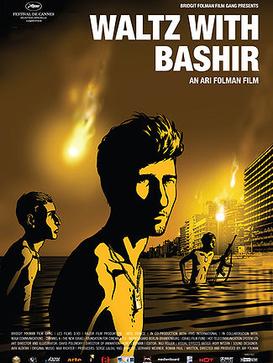
1.  Waltz with Bashir - the most incredible movie I saw last year of any type;  set in Israel's invasion of Lebanon;  the visuals are jaw-dropping

THE WORST

5.  In Harm's Way - bloated star-studded soap opera set around Pearl Harbor;  even John Wayne and Kirk Douglas

4.  Hanover Street -  sappy romance set in WWII with a ridiculous spy plot thrown in

3.  Journey to Shiloh - some friends trek to join the Confederate Army;  series of lame adventures ensue

2.  Tin Drum -  a bizarre movie about a malevolent little boy set in WWII;  many critics patted themselves on the back for praising this piece of crap

1.  Braveheart - my mission to watch the top 100 war movies forced me to watch this abomination again;  the small hope that I had been too hard on it in the past did not come to fruition;  the most egregious falsification of history ever put on film