Showing posts with label Richard Burton. Show all posts

Thursday, January 9, 2025

THE 100 BEST WAR MOVIES: 17. Where Eagles Dare (1968)


It was directed by Brian Hutton (“Kelly’s Heroes”). In the late 1960s, Richard Burton was coming off several box office flops and his step-son urged him to dumb it down and make an action picture.  Burton took the idea to producer Elliot Kastner who sought out Alistair MacLean (“The Guns of Navarone”).  MacLean wrote the book and screenplay (his first) in six weeks and took the title from a line from Shakespeare.  Clint Eastwood (fresh off his spaghetti western trilogy) was recruited and it was off to snowy Austria and Bavaria.  Just as importantly, famed stuntman Yakima Canutt brought a cadre of great stuntmen to the production. One of them, Alf Joint, broke three teeth doing the famous cable car jump.  Eastwood would later dub the movie “Where Doubles Dare”.  The movie was a huge hit and firmly took a position among the suicide mission subgenre with “The Guns of Navarone” and “The Dirty Dozen”.

Eastwood was paid $800,000 and Burton $1.2 million. Burton was drinking heavily during the shoot because his marriage to Elizabeth Taylor was failing and his career was on the rocks. He supposedly was downing four bottles of vodka a day. He disappeared for several days with his drinking buddies – Peter O’Toole, Oliver Reed, Trevor Howard, and Richard Harris. Darren Nesbitt (Major von Happen) was criticized by some Jews for playing a Gestapo officer, but he told them he played him badly. He was temporarily blinded during the shoot when a blood squib blew up stronger than expected.  Ingrid Pitt had spent some time in a concentration camp when she was a child. The plane was an authentic Junkers JU-52 that belonged to the Swiss air force. It crashed in 2018, killing 20. Eastwood’s body count in this movie was the highest of his career.

            The movie opens with the iconic theme by Ron Goodwin which is the greatest in war movie history, in my opinion.  We also get our first taste of the wonderful snowy mountain scenery.  The plot revolves around a secret mission to send a commando team to infiltrate the Schlos Adler (“Castle of Eagles”) which is located high in the Alps.  They are to rescue a captured Gen. Carnaby who happens to know the Operation Overlord plans.  The team is led by Smith (Burton) and includes American Ranger Schaeffer (Eastwood).  When they parachute (“Green on – go!”), they are joined surreptitiously by a female MI6 agent named Mary (Mary Ure).  One of the team is found dead on landing.  There is a traitor amongst them!  Smith has his own agenda as he communicates with his superiors (Adm. Rolland and Col. Turner) back in England. “Broadsword calling Danny Boy”.

            Smith and Schaeffer (disguised as German officers) are caught in a night club.  The Germans speak English in an early clue that the movie is aiming for entertainment, not authenticity.  Smith and Schaeffer cause their captor’s car to crash (an early sign that they are indestructible) and they return to booby trap a shed in the town.  They use these really cool dynamite bombs with trip wires.  When the Germans search the shed, someone trips a wire and we get numerous explosions.  This is a noisy movie when it is not going through long stretches of quiet.

            Smith and Schaeffer ride the top of a cable car to reach the aerie-like castle and then they rope-climb into Mary’s room.  She has a job in the castle with fellow agent Heidi.  Let the orgy begin.  Excuse me, I don’t mean a sex orgy.  I mean a violence orgy starting with the silencing (with a silencer) of the radio operator and the knifing of a helicopter pilot.  The Germans are preparing to question Carnaby (who Smith has revealed to us is actually a plant named Cartwright Jones) and the interrogators are joined by three members of the commando team who are German agents.  To add a fly in the ointment, an amorous Gestapo agent (blond hair, blue eyed and charmingly malevolent) has the hots for Mary and ferrets out her undercover nature.  That sounds dirty, sorry.

            Smith and Schaeffer barge the interrogation party and Burton gets to use some of his Shakespearean training.  He tricks the Germans into revealing key intelligence.  The Gestapo guy barges in and the talking is over.  letb the machine gunning and booby trapping begin!

              To get out of the castle requires Schaeffer to slaughter numerous German expendables in a hallway.  (Eastwood had his highest body count in this movie and the movie overall has to be in the top 5 all time).  This leads to the famous cable car fight scene which has Burton’s double fighting two of the traitors on top of a car.  The stunt work is fantastic and includes a leap to another car coming up.  The guys (including Jones) and gals head down on another car (as the Germans try to bash in the outer door ala “Guns of Navarone” – did MacLean sue himself?)  They leap into a river to avoid the welcoming committee, but they provide a gift basket of an exploding cable car that jumps the body count by about twenty.  By the way, the castle has been booby trapped for more cool explosions.

            The trek to the air field is via a bus with a snow plow convenient for tripping roadside explosives.  They are a bit more hands-on for the blowing up of a bridge as a German vehicle crosses.  Why should the guys have all the fun?  The girls get their share of the slaughtering.  When they reach the air field, it turns out the plow is also convenient for clipping fighters lined up on the runaway.  This, of course, leads to more explosions.  At this point our quintet is pretty unpopular with the locals, but fortunately there is a transport plane waiting for them.  Col. Turner is on board.  How nice of him to participate in the rescue of our heroes!  I won’t give away the ending, but it is a nice twist.

ACTING:   A                

ACTION:   A+ (8/10)

ACCURACY: N/A      

PLOT:  B                

REALISM:  N/A

CINEMATOGRAPHY:   A

SCORE:   A+


SCENE:  the cable car fight


QUOTE:  Major Smith:  Broadsword calling Danny Boy.

            “Where Eagles Dare” is the best suicide mission/mystery war movie ever made.  Of course it does not have a lot of competition, but it is well done.  It is meant to be reality-defying for entertainment purposes and it is popcorn entertainment at its finest.  The acting is good and even though he is slumming, Burton seems to be having fun and invests in the role.  Eastwood is Eastwood, ‘nuff said.  The supporting cast is excellent.  The girls hold their own and reduce the testosterone level for the female audience.  Beautiful women killing Nazis - what’s not to like?

            The production is admirable.  They spent a lot of money and effort on this film.  The location shooting took six months partly because of the weather factor, but the snowscapes are a strength of the movie.  The castle is a perfect setting.  It is medieval/Nazi evil.  The score is great.  It is used sparingly, but when it comes on it jazzes up the scene.  The stunt work is stellar. The film was one of the first to use front projection for visuals.

            The movie is highly implausible, but not more than others of the subgenre and less than the most recent entrant “Inglorious Basterds”.  It does not take liberties with history like a “Braveheart”, for instance.  It is what it is and does not claim to be high art.  The thing I admire about it the most is that there are two scenes that have really nice plot twists.  You rarely get that in war movies.  It is one of those movies where you wish you were seeing it for the first time and encourage people who have not seen it to watch it with a wink.  Normally, I do not like to watch twist movies again because you now know what will happen, but in this case the ridiculously over the top actions scenes keep me coming back.  In my opinion, it is better than its rivals. 

Thursday, September 21, 2017

FORGOTTEN GEM? Alexander the Great (1956)


                Most people do not realize that Oliver Stone’s “Alexander” was not the first biopic about Alexander the Great.  “Alexander the Great” was released in 1956.  The historical epic was written, directed, and produced by Robert Rossen.  Rossen, who had been a member of the Communist Party, was caught up in the Red Scare of the 1950s.  He was called before the House Un-American Activities Committee and took the 5th.  This resulted in his being blacklisted.  Later, he changed his mind and named names.  “Alexander the Great” was made after the blacklist was lifted.  He wanted Charleston Heston for the lead, but Heston was dubious about the potential of an epic biography.  The movie was made with the cooperation of the Spanish military which provided 5-6,000 extras.  The technical adviser was His Royal Highness Prince Peter of Greece.  That credit was the first signal to viewers that there might be problems with the veracity of the film.  For this review, I have decided to concentrate on the historical accuracy of the film while critiquing it.  I do not think anyone who reads this will watch the movie so I am not going to worry about spoilers.  We will treat this as an exercise in examining how Hollywood of the 1950s dealt with a historical biography of one of the most famous men in history.  It ain’t pretty.

                The movie opens in 356 B.C.  with Philip of Macedonia (Frederic March with both eyes – Philip had lost an eye to a slinger) threatening Greece.  Demosthenes argues for standing up to him.  This is a bit early as Demosthenes did not deliver his first philippic until 352 B.C.  Philip is informed of Alexander’s birth and Olympias (Danielle Darrieux) insists he is a god.  She did claim Zeus was his fatherThe movie jumps to Alexander as a teenager with the 29 year old (but looking older) Richard Burton looking ridiculous in an embarrassing training montage.  Philip puts Alexander in charge of pacifying a revolt fomented by Olympias.  This is basically true except Olympias had no role.  Philip remarries to Eurydice and the break with Olympias is complete.  Alexander is on the outs with his father over the break, plus gossip that he is illegitimate and possibly out as heir.  This is true.  Philip and Alexander fight the Battle of Chaeronea against the Greeks.  The opposing armies face each other across a river.  In the battle, Alexander saves his father’s life.  Nothing about this battle is accurate.  There was no river and Alexander did not save his father.  The reenactment is a simplistic mess.  The movie stages a high school play version of the wedding banquet incident where Philip tried to stab his son.  The scene is true.  Olympias plots with Pausanias to kill Philip.  Pausanias stabs the king as he enters a temple and then is killed by Alexander after being captured.  Olympias may have been involved in the assassination, but there is no proof of this.  The murder was similar to as depicted, but Pausanias was killed while fleeing by Alexander’s friends.  The army proclaimed Alexander the new king.  True.

                Alexander invades the Persian Empire.  He throws a spear when he comes ashore in Asia Minor.  This was based on a supposed incident.  The first battle with the Persians is at the River Granicus.  Alexander attacks across a river.  His life is saved by Cleitus (Gustavo Rojo).  The battle ends with the massacre of Memnon’s Greek mercenaries.  Again the battle is ridiculously reenacted, but the basic events are accurate.  Alexander cuts the Gordian Knot in an acceptable rendering of the incident.  The movie skips the Battle of Issus and moves on to Gaugamela.  Alexander refuses to attack at night while Darius III anticipates a surprise attack and keeps his men awake.  Alexander handles the scythed chariots by opening lanes for them to pass through.  Alexander leads a cavalry charge and spears Darius’ chariot driver.  Darius flees.  The movie shows no infantry fighting.  Most of this is accurate except Darius fled from Issus in a chariot.  He was on horseback at Gaugamela.  Alexander captures Darius’ family and later marries his daughter Roxanne.  Darius is killed by his own men but leaves a will that offers his daughter’s hand in marriage to unite the cultures.  Darius’ death is competently handled, but the will is crap.  He did marry one of Darius’ daughters, but the movie is obviously confusing her with his first wife Roxana who he met in India. 

                Barsine (Memnon’s wife) instigates the burning of Persepolis, but Alexander puts a stop to it.  The actual instigator of the burning of the Persian capital was a concubine named Thais and Alexander was on board for it due to alcohol.  A montage of conquests gets the Macedonians to India.  Alexander executes Philotas for plotting, but the movie spends no time giving background on this.  This incident actually happened before India.  As did the murder of Cleitus.  The movie does not clearly explain why Alexander kills him other than it was a dispute over Alexander’s adopting Persian culture.  The death scene is fairly accurate except that Alexander did not spear Cleitus in the back.  It was in the front.  The movie has Alexander turning back from India due to the murder.  This is ludicrous because it does not include the Battle of Hydaspes nor cover the actual cause which was a mutiny by his soldiers brought on by low morale and exhaustion.  Alexander marries Roxane in a mass wedding involving his men and Persian women.  The mass wedding did occur, but Alexander was already married to Roxana.  Alexander did marry Darius’ daughter Stateira (and the daughter of the previous Persian ruler) at the mass wedding.  The movie concludes with Alexander’s death after he collapses at a banquet.  It does not go into the cause(s) of his death.  The movie does not show the excessive drinking at the banquet, but does get the famous last words “to the strongest” right.

                As you have read, the movie is a mixed bag historically.  It manages to hit some of the iconic moments like the cutting of the Gordian Knot.  But then it leaves out Bucephalus and Hephaestion.  There are definitely some head-scratching decisions about what was included in the script and how some of the battles and events were handled.  Some of this may be due to the studio insisting on a shorter cut than what Rossen intended.  This may explain why some of the scenes seem truncated and poorly edited.  It is not surprising the movie does not even hint at Alexander’s homosexuality.  We are talking about 1956 here.  But why would the movie not play up Alexander’s charisma and genius?  Or even hint at his ruthlessness?  His relationship with his soldiers is not covered.  His relationships with the various women in his life are totally screwed up.   Although Chaeronea is a joke, the Battles of Granicus and Gaugamela are satisfactorily done – for a movie.  In sum, the movie has some tutorial value.  You would be better off watching any of the excellent documentaries on Alexander.  Plus the acting is better in the documentaries.

                Nothing about the production is above average.  The acting is poor and Burton is terribly miscast.  It is distracting watching him play Alexander, especially as a teenager.  The sets look fake and the backgrounds are unrealistic. It is painfully clear that you are seeing a painted backdrop on a sound stage. The score is second-rate so it matches the overall vibe.  The dialogue is abysmal.  But as a war movie, the biggest flaw is the laughable battle scenes.  For a supposed epic, the battles are too brief and simplistic.  They are also small scale. This is one of the reasons the movie is boring.  I hate to imagine what Rossen’s directors cut of over three hours would have been like to sit through.  But I still would like to see it.

                “Spartacus” came out just four years after “Alexander the Great” so it was possible back then to do an entertaining epic biopic.  Rossen’s pic is not even close to Kubrick’s.  Both tell the story of charismatic historical figures, but that is the only similarity.  Rossen botches the job and has only himself (and possibly the studio to blame).  After all, he wrote the screenplay and he chose Richard Burton. “Spartacus” had an advantage of a cleaner slate to write on because Spartacus’ biography is sketchy.  But on the other hand, Alexander’s life is well-chronicled and has numerous film-worthy anecdotes.  It should have been more entertaining.


GRADE  =  D

Sunday, October 2, 2016

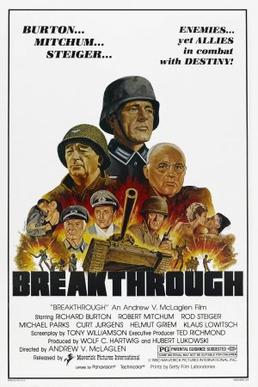
WORTHY SEQUEL? Breakthrough (1979)


            “Breakthrough” is a sequel to the famed “Cross of Iron” which means it continues the adventures of one of the great war movie characters – Sgt. Steiner of the German Army.  The original, directed by Sam Peckinpah, is one of the great war movies and has a cult following.  It certainly called for a sequel – directed by Peckinpah and starring the perfectly cast James Coburn.  The fact that the sequel has neither of them is a major red flag.  Coburn was set to star but backed out at the last minute.  I assume he finally got around to reading the script.  His replacement was a ridiculously too old Richard Burton.  Burton was 53 years old and looked at least ten years older than that.  His heart was not in the project and his drinking was a problem.  Sticking with the decision to hire old has-been actors, the producers tabbed three other “Longest Day” veterans – Robert Mitchum, Rod Steiger, and Curt Jurgens.  This quartet has the dubious distinction of appearing in one of the great war movies and one of the worst.   Director Andrew McLaglen sandwiched this movie between “The Wild Geese” and “The Sea Wolves” so it is obvious he had a fetish for old stars embarrassing themselves in action roles.

            The movie opens in May, 1944 which would be a few months after the events in “Cross of Iron”.  So now we know Steiner survived the climactic fight.  And so did his nemesis Capt. Stransky (Helmut Griem) who is still a thorn in his side.  The movie seems to start off right with a scene with plenty of action, however it does not take long to silliness to set in.  Steiner is sent to destroy a railroad tunnel.  When his men peer in to see the light at the end, it turns out to be a T-34.  Although he takes out the tank, Steiner perplexingly does not blow up the tunnel and follows this up with a confrontation with Stransky.  Steiner once again can’t play nice with generals and gets himself court-martialed.  The punishment is a head-scratching two week leave in Paris!  While there, Steiner steals Stransky’s girl.  I’m not making this up, people. Just as our hero is celebrating his bizarre punishment of being shipped from the Eastern Front, the D-Day invasion occurs.  Look out Allies, Steiner’s band of misfits has joined him and they are assigned the defense of a French village.  This is a seventies war movie, so we need a political subplot of Steiner getting involved with his Hitler-conspiratorial Gen. Hoffman’s (Jurgens) attempt to negotiate surrender of his forces.  The negotiation involves a Col. Rogers (Mitchum) and Gen. Webster (Steiger).  They spend the first half hour complaining about their arthritis.  Just kidding.  Luckily the talking does not prevent the big set piece battle for the village.  Unluckily, there is a battle for the village.  This scene defies polite description.  Make sure you have been drinking heavily by the time you reach this stage of the movie (if you make it this far).  Richard Burton was.

            How do you tarnish a great movie and character?  See this movie.  Thankfully, few did.  It is horrendous.  The acting is wooden. Or should I say geriaratric?  Burton is not even the worst performer.  Just the most disinterested.  Steiger chews the scenery as much as his false teeth will allow.  The dialogue is laughable.  The plot is inane.  The action is ridiculous.  This is one of the worst war movies ever made and one of the most disappointing.

NOTE:  Check out that poster.  The artist does not even bother to make the main stars look younger!  But he does manage to get two women in separate clenches.  Kudos!
 
GRADE =  F-             


Monday, December 30, 2013

Day 6 - The Wild Geese (1978)


On the sixth day of Christmas, my true love gave to me – six wild geese a slaying


                “The Wild Geese” is sometimes referred to as the father of mercenary movies.  How proud it must be to have sired that low quality subgenre!  It was based on an unpublished novel about the rescue of an African leader by an elite force of mercenaries.  The producer dreamed of replicating “The Guns of Navarone” and “Where Eagles Dare”.  Dream big, baby!  The producer rounded up an all-star cast of codgers and took them off to South Africa for filming.   An interesting choice for a movie that has a theme of integration. 

“The Wild Geese” opens with a song that rivals “Soldier Blue” in bizarre crappiness.  Not a good start.  A veteran mercenary leader (he looks old enough to have served with Walker in Nicaragua) named Faulkner (Richard Burton - who agreed not to drink during the shoot) is contracted to rescue the African leader Limbani by a copper industrialist who oozes future betrayal.  Next comes the obligatory recruitment sequence.  Faulkner reunites with tactician Janders (Richard Harris - who agreed to not drink during the shoot), pilot Fynn (Roger Moore), drill sergeant Young (Jack Watson), and kaffir-hater Coetzee (Hardy Kruger - who agreed to stop smoking crack, just kidding).  This is followed by the corollary interviewing of the cannon fodder.  They ask each why they want to slaughter Africans, in so many words.  Oh, and are you over 50 years old?  Interestingly, their net snares a gay medic named Witty (Kenneth Griffith).  Training montage, anyone?

                In case you’re wondering what do mercenaries do to train – jumping off a tower, tossing logs, and bayonet practice.  It’s off to Africa.  They parachute in and no one gets caught in a tree!  They are startled by an exotic animal – an ostrich!  (As far as I know the only appearance by one in a war movie.)  The rescue of Limbani is suspiciously easy what with Coetzee using his crossbow and the cyanide gas used on the guards.  What a boring anticlimax!  But, wait – there are complications due to a double-cross by a copper magnate.  Imagine that.

                The movie transitions to a trek film after one badass Piper Cub strafes and napalms their jaunty victory convoy.  On the way to their alternate egress, Coetzee and Limbani debate colonialism and Coetzee sees the light while carrying his new “don’t call him kaffir” buddy.  Bodies begin to fall and not just expendables.  Even the name actors are vulnerable.  The movie posits the question:  who will survive?  And did their nursing home hold their room?  The first openly gay character in a war movie (as far as I know) gets to kick some ass before being gang-macheted.  (I am quite sure that this is the only time in war movie history that an openly gay character is killed by Africans wielding machetes.)   Get your calculator out to keep track of how many African soldiers are mowed down.  The movie looks like “Zulu” with automatic weapons.  As per war movie rules, the good guys never miss and the bad guys are never just wounded.  The mortality rate is the same as in every other war movie - 100%.  All this leads to a plane piloted by Fynn.  Janders gets his Von Ryan moment.  (I didn’t cry this time.)  Percentage of geezers still alive – 33%.  Percentage of greedy, corrupt industrialists still alive - 0%.

                “The Wild Geese” has become something of a cult classic since it bombed in the U.S. upon release.  I guess I don’t belong to that cult.  It is hard to get past the stunt-casting of old has-beens.  Not only are they too old for their roles, but they act tired.  At least “Grudge Match” is meant to be a comedy.  The film looks cheaply made.  The cinematography is that of a made for TV movie.  Check out the cheesy 60’s sets, fashions, and women in the British scenes.  The dialogue is not bad as you would expect and the movie has a large amount of action in the last 30 minutes.  If you can sit through the build-up, the payoff is pretty visceral.  That is if you consider slaughtering Africans to be action.  It does have a number of classic clichés, but that just allows you to feel good about yourself as you predict a lot of what is going to happen.

                It’s hard to be too harsh with a movie that portrays mercenaries with hearts.  It is entertaining in a mindless sort of way.  Is it a worthy successor to “The Guns of Navarone” and “Where Eagles Dare”?  Ha ha ha ha ha!

Does it spread Christmas spirit?  Fa la la la no.
P.S.  That's one great poster!

Grade =  C       

Tuesday, March 26, 2013

THE BIG RED ONE (3) vs. THE DESERT RATS (14)

 
VS.
 
 
THE BIG RED ONE (3) vs. THE DESERT RATS (14)
ACTING:


     “The Big Red One” is essentially a five actor movie. Lee Marvin plays a grizzled sergeant (he was 56 years old at the time) in charge of a squad that consists of four guys who can not be killed (or even wounded) and a series of cannon fodder replacements. Marvin is very good, as usual. He has the weary father-figure down pat. Unfortunately, he completely dominates the other four who range from barely registering (Kelly Ward as Johnson) to inconsistent (Robert Carradine as Zab ) to semi-charismatic (Bobby Di Cicco as Vinci) and earnestly bad (Mark Hammill as Griff).

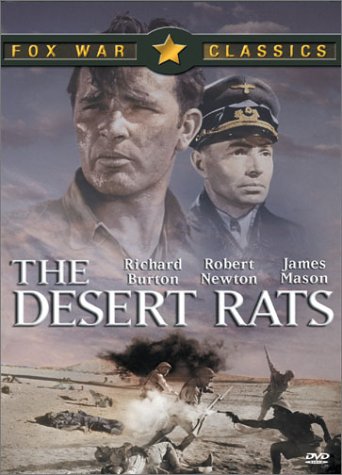
     “The Desert Rats” is a Richard Burton movie. He plays British Capt. MacRoberts who given the task of cracking the whip on an undisciplined Australian unit. Burton is above this kind of material but he is game and takes the role seriously. The only other actor that makes an impression is Robert Newton as MacRoberts ex-scholmaster Bartlett. Newton plays a cowardly drunkard who refuses to run because it would be dishonorable. It is a poignantly effective performance. James Mason makes a welcome appearance as Rommel to (A) showcase an exchange between Mason and Burton (well done) and to (B) scuff up his portrayal from “The Desert Fox” (this Rommel is less likeable).

FIRST QUARTER SCORE:
The Big Red One     7
The Desert Rats       8


CLICHES:

     “The Big Red One” is a small unit (very small unit) movie. The squad (actually 1/3 of a squad) is heterogeneous. Johnson is a farm boy, Vinci is the wise-cracking Italian-American, Zab is the budding writer from Brooklyn, and Griff is the sharpshooter who can’t kill. The group is led by a hero (the Sarge), but they are not moving forward to accomplish a particular objective. There is a chronicler in the form of the narrator Zab (who represents Samuel Fuller). The movie does not alternate between opposites like action and rest, instead it is a series of vignettes. There is a redemption figure in Griff, but that subplot is surprisingly incomplete. There is no conflict within the group or over command. In conclusion, other than the stock characters the film avoids clichés.

     “The Desert Rats” has some familiar characters and situations. There are two redemption arcs: Carstairs who is almost court-martialed by MacRoberts and Bartlett. Both resolutions are predictable. MacNamara is the stock character who builds a unit using tough love which at first causes resentment but eventually results in respect. The unit is not clichely heterogeneous because few characters are developed. MacNamara is the hero and leader, but the role is not really forced upon him. The movie alternates combat with exposition.

HALF TIME SCORE:
The Big Red One       14
The Desert Rats         14


PLOT:

     The plot of BR1 can best be described as: a small squad led by an old sergeant go from Operation Torch to the end of the war while experiencing a series of incidents. The vignettes range from interesting (the liberation of the death camp) to bizarre (the insane asylum) to ridiculous (the ambush at the crucifix). It’s like Samuel Fuller kept a notebook of ideas for war movie scenes and then made a movie that included all of those ideas, good and bad. The scenes could have been put in any order. The movie is entertaining, but several of the mini-stories are painful for an intelligent war movie fan to watch. It’s one of those movies that tends to fall apart upon repeat viewing, but kudos for being different.

      The plot of TDR is much more standard. It flows from green, undisciplined unit being broken and trained by a tough leader to become confident, disciplined veterans led by a more understanding leader. Throw in combat sequences to prove the evolution and to add action. Nothing you haven’t seen before, but well done and not hackneyed. Very predictable, however.

THIRD QUARTER SCORE:
The Big Red One          20
The Desert Rats            21


COMBAT:

     BR1 has surprisingly little combat for such a long movie (I watched the extended version) and the scale is small because of budget constraints. You get the impression this squad is fighting the war by itself. Most of the scenes are the “guns and grenades” variety. When the movie moves into a combat sequence it is usually PG intense, but brief. Compare it to “Cross of Iron” that was made three years earlier and you can see that Fuller was still clinging to Old School combat. There is a fire-fight for the Torch landing, an extended attack on an African town that features a French cavalry charge (WTF) and the smallest tank in war movie history, the D-Day landing featuring a Bangalore Torpedo relay, the ambush at the crucifix, the insane asylum shoot-out, and the liberation of the death camp. Each is fairly intense, but most are too brief. The tactics and weaponry are fine.

      TDR has only two battle set pieces, but they are both excellent. The first is defense against a German Panzer attack during a sand-storm. The artillery barrage is realistic (the movie has great sound and explosion effects). The deaths are reasonable. There is a cool duel between a German tank and an anti-tank gun. The other action sequence involves a commando raid on a German munitions dump. A “guns and grenades” at night spectacle. Both scenes are better than anything in BR1, but BR1 puts the unit in combat more frequently.

SCORE AT THE END OF REGULATION:
The Big Red One        27
The Desert Rats          27


OVERTIME: Director

      BR1 was directed by Samuel Fuller. It is semi-autobiographical as Fuller served in the 1st Division and participated in Operations Torch, Husky, and Overlord. His unit fought through France, Belgium, and Czechoslovakia. He was involved in the liberation of the Falkenau concentration camp. He was awarded the Bronze Star, Silver Star, and Purple Heart. He went on to a legendary career as a filmmaker. He was noted for gritty B-movies which he made with low budgets. These included “Steel Helmet”, “Fixed Bayonets!”, and “Merrill’s Marauders”. “The Big Red One” has many of the attributes of a B-movie even though it was by far his biggest film.

       TDR was directed by Robert Wise. Wise was a much more mainstream director than Fuller. He was also much more highly acclaimed. He won two Best Director Oscars. His other war movies were “Run Silent, Run Deep” and “The Sand Pebbles” (for which he was nominated for Best Director).

FINAL SCORE:
The Big Red One       36
The Desert Rats         33

COLOR ANALYSIS:

      This was a shocker. BR1 has a strong reputation among critics and war movie fans and TDR has been largely forgotten. But the tournament is all about the match-ups. Plot and combat did not play to BR1’s strengths and TDR had just enough talent to take the match to overtime. In the end, Samuel Fuller pulls his movie through to the second round.

Saturday, September 25, 2010

#88 - The Desert Rats

BACKSTORY:   “The Desert Rats” is a black and white old-school war film released in 1953. It is an unofficial sequel to the biopic “The Desert Fox” and James Mason portrayed Rommel in both. “Rats” is set in the siege of Tobruk in 1941. It lauds the 9th Australian Division’s role in the defense of the port. It was directed by Robert Wise who later won Oscars for “The Sound of Music” and “West Side Story”. It stars Richard Burton in only his seventh film.


OPENING SCENE:   The movie opens in the Libyan desert in 1941. Rommel arrives at headquarters and plots the conquest of the Suez Canal, but the port of Tobruk must be taken first. The narrator informs us that we are about to witness the story of Tobruk and the “Desert Rats” who defended it.

SUMMARY:  At the headquarters of the 9th Australian Division, the general (never identified as Major General John Lavarack) goes over his plan. He thinks he knows where the next attack will come and plans to let the German tanks penetrate then hold them with infantry and counterattack with his tanks. He sends “Tammy” MacRoberts (Burton) to take command of a newly arrived green company.

Richard Burton as MacRoberts
MacRoberts finds that his new unit is ill-disciplined and is shocked to be reunited with his old schoolmaster Tom Bartlett who was canned for alcoholism and ended up enlisting although he has neither the mentality nor the skills to be a good soldier.

Our first big set piece is a German tank attack set in a sand storm. The audience can feel the grit in their teeth. The sound effects are also good. The Australians allow the Germans to penetrate as per the plan and then open fire. The movie blends actual footage with the action. Burton gets to play action hero as MacRoberts gets in a damaged tank and destroys a German tank to force the enemy to retreat.

MacRoberts is hard on the men and they gripe about it. He wants to court-martial an officer named Carstairs who left his position to try to rescue another officer. He believes you must follow orders with no sentiment. The schoolmaster informs MacRoberts that he is a coward (as well as a drunkard), but he wants to stay with the unit. He argues that the officer should not be court-martialed, but should be given another chance. Mac reconsiders. This is an interesting scene with its debate of orders versus human nature.

Mac is promoted to command over the battalion. The film shows a montage of raids behind enemy lines to keep the Germans off guard. These are small affairs until Mac proposes a raid on an ammunition dump to foil an anticipated offensive. 53 men in captured Italian trucks sneak into the depo. There is lots of action. MacRoberts is wounded and Carstairs comes back to him set off an explosion but is killed. (War movie cliché #2 – redemption of the shamed soldier) Mac is captured.

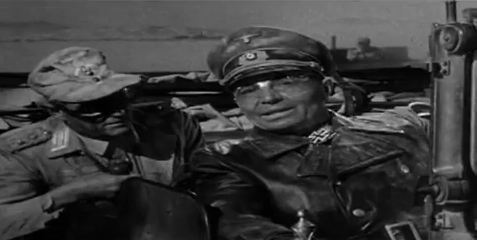
James Mason as Rommel
Mac is being treated by a German doctor when a wounded Rommel (Mason) arrives. They discuss the siege and the British captive cheekily argues that the Germans will not take Tobruk. Rommel is irritated by MacRobert’s gall, but respects him. This scene was supposedly put in the movie after the backlash from veterans over the sympathetic treatment of Rommel in “The Desert Fox”. This explains why Mason plays Rommel as a villain here and gives him a thicker German accent.

The truck transporting MacRoberts and other prisoners is strafed allowing him and Sgt. “Blue” Smith to escape. They walk back to friendly lines through the desert.

The narrator informs us that the siege has now gone well past the two months the Australians had been told they would have to last. MacRoberts’ battalion is given the task of taking and holding a hill that is the key to keeping the anticipated relief route open. The movie skips over the first eight days of the fight on the hill and focuses on the ninth day. The men have been under intense pressure and Mac is given the option by headquarters to withdraw if he sees fit. He sees fit, but Bartlett argues that the men will stay and fight for him even though they don’t like him. Here we encounter once again the war movie theme of a tough disciplinarian earning the respect of his men. Not surprisingly, the men refuse to leave the hill.

FINAL SCENE: The Germans open a ferocious barrage on the hill. The men take refuge in their holes which is realistic to what actually happened at Tobruk when German artillery opened fire. The film shows how men can survive under bombardment. When the explosions end, the men fix bayonets to meet the attack, but they hear bagpipes signifying the arrival of the relief column and a happy ending.

RATINGS:

Action - 7

Acting - 7 Burton is good, the rest are average

Accuracy - 7

Realism - 7

Plot - 7

Overall - 7

WOULD CHICKS DIG IT?    Highly unlikely. There are no female characters. It is an old-school, guy action film.

CRITIQUE: “The Desert Rats” is a classic of its type, but does not hold up well over time. It does its best with the effects available back then. The bombardments are realistic and the sounds are appropriate. Your ears feel like they are in a battle.  The cinematography is very good and the fact that the movie is black and white makes no difference since there would have been little color in the scenes anyway.

The soldiers and their situation are portrayed realistically, although the movie does not violate cliché #9 (soldiers do not sweat). Especially commendable is how the movie shows that humans can survive a vicious bombardment by burrowing.

MacRoberts is a typical movie officer and his transformation from hard-ass to a leader who is willing to listen is believable. He exemplifies clichés #18 and 19. #18 insists that a strict officer will soften at the critical moment of the film. #19 holds that harsh disciplinarians will earn the grudging respect of their men by the end of the film. He also serves as something of a role model for future officers. Not West Point study-worthy, but I could see myself highlighting his evolution as a leader in my Military History class.. Having the schoolmaster thrown in is a bit of a stretch, but necessary for Mac’s transformation. The character fits well into the wise, elderly noncom stereotype. If you are older than the rest of the unit usually you kept getting demoted for misbehavior, but here he enters old as a result of alcoholism. Nice touch.

As a history lesson, the movie has its flaws – beginning with the title! The “Desert Rats” were the British 7th Armoured Division. I wonder what their veterans thought of the movie. When Rommel laid siege to Tobruk, the Germans referred to the British/Australian forces as being “caught like rats in a trap”. The 9th Australians proudly adopted the name “Rats of Tobruk”. Obviously the producers felt “Desert Rats” had a better ring to it and evoked “The Desert Fox”.

The raiding is accurate and did result in preempting several attempts at penetration. However, I could find no evidence of a large raid on an ammo depot. As to the ending, the relief that came from Operation Crusader arrived after the 9th Australian Division had been withdrawn from Tobruk for much needed R&R.

Other than the unnamed Australian general and Rommel, none of the characters are real people (as far as I can tell). MacRoberts is a stock movie character, but carried off with panache by Burton.

CONCLUSION:   “The Desert Rats” is an entertaining old school WWII movie. The acting is pretty good and Richard Burton shows why he was such a big star. It is fairly realistic and does not go over the line on historical accuracy. Given the available war movie effects technology, it does an okay job depicting combat. However, if you are expecting “Saving Private Ryan”, forget it.

It is a good example of how pre-1960’s war movies rarely hold up. There are numerous recent war movies that did not make the Top 100 that are better movies than “Rats”. Once again, I must insist that just because it’s old does not make it better than “Enemy at the Gates”, for instance. And I can assure you from personal experience that no audience of today’s youth would prefer to watch “The Desert Rats” over “Enemy” or “When Trumpets Fade” or “300” or pick a recent war movie that did not make the Top 100.

You will note I skipped #89 - Dunkirk.  I can not find a copy of it to watch.

Next up - #87 - The Life and Death of Colonel Blimp

Coming soon:  Dueling Movies:  "The Desert Fox" vs. "The Desert Rats"