It was directed by Brian Hutton (“Kelly’s Heroes”). In the
late 1960s, Richard Burton was coming off several box office flops and his
step-son urged him to dumb it down and make an action picture.Burton took the idea to producer Elliot
Kastner who sought out Alistair MacLean (“The Guns of Navarone”).MacLean wrote the book and screenplay (his
first) in six weeks and took the title from a line from Shakespeare.Clint Eastwood (fresh off his spaghetti
western trilogy) was recruited and it was off to snowy Austria and
Bavaria.Just as importantly, famed stuntman
Yakima Canutt brought a cadre of great stuntmen to the production. One of them,
Alf Joint, broke three teeth doing the famous cable car jump.Eastwood would later dub the movie “Where
Doubles Dare”.The movie was a huge hit
and firmly took a position among the suicide mission subgenre with “The Guns of Navarone”
and “The Dirty Dozen”.
Eastwood was paid $800,000 and Burton $1.2 million. Burton
was drinking heavily during the shoot because his marriage to Elizabeth Taylor
was failing and his career was on the rocks. He supposedly was downing four
bottles of vodka a day. He disappeared for several days with his drinking
buddies – Peter O’Toole, Oliver Reed, Trevor Howard, and Richard Harris. Darren
Nesbitt (Major von Happen) was criticized by some Jews for playing a Gestapo
officer, but he told them he played him badly. He was temporarily blinded
during the shoot when a blood squib blew up stronger than expected.Ingrid Pitt had spent some time in a
concentration camp when she was a child. The plane was an authentic Junkers
JU-52 that belonged to the Swiss air force. It crashed in 2018, killing 20.
Eastwood’s body count in this movie was the highest of his career.
The movie opens with the iconic
theme by Ron Goodwin which is the greatest in war movie history, in my
opinion.We also get our first taste of
the wonderful snowy mountain scenery.The plot revolves around a secret mission to send a commando team to
infiltrate the Schlos Adler (“Castle of Eagles”) which is located high in the
Alps.They are to rescue a captured Gen.
Carnaby who happens to know the Operation Overlord plans.The team is led by Smith (Burton) and
includes American Ranger Schaeffer (Eastwood).When they parachute (“Green on – go!”), they are joined surreptitiously
by a female MI6 agent named Mary (Mary Ure).One of the team is found dead on landing.There is a traitor amongst them!Smith has his own agenda as he communicates
with his superiors (Adm. Rolland and Col. Turner) back in England. “Broadsword
calling Danny Boy”.
Smith and Schaeffer (disguised as
German officers) are caught in a night club.The Germans speak English in an early clue that the movie is aiming for
entertainment, not authenticity.Smith
and Schaeffer cause their captor’s car to crash (an early sign that they are
indestructible) and they return to booby trap a shed in the town.They use these really cool dynamite bombs
with trip wires.When the Germans search
the shed, someone trips a wire and we get numerous explosions.This is a noisy movie when it is not going
through long stretches of quiet.
Smith and Schaeffer ride the top of
a cable car to reach the aerie-like castle and then they rope-climb into Mary’s
room.She has a job in the castle with
fellow agent Heidi.Let the orgy
begin.Excuse me, I don’t mean a sex
orgy.I mean a violence orgy starting
with the silencing (with a silencer) of the radio operator and the knifing of a
helicopter pilot.The Germans are
preparing to question Carnaby (who Smith has revealed to us is actually a plant
named Cartwright Jones) and the interrogators are joined by three members of
the commando team who are German agents.To add a fly in the ointment, an amorous Gestapo agent (blond hair, blue
eyed and charmingly malevolent) has the hots for Mary and ferrets out her
undercover nature.That sounds dirty,
sorry.
Smith and Schaeffer barge the
interrogation party and Burton gets to use some of his Shakespearean
training.He tricks the Germans into
revealing key intelligence.The Gestapo guy
barges in and the talking is over.letb
the machine gunning and booby trapping begin!
To get out of the castle requires Schaeffer to slaughter numerous German
expendables in a hallway.(Eastwood had
his highest body count in this movie and the movie overall has to be in the top
5 all time).This leads to the famous
cable car fight scene which has Burton’s double fighting two of the traitors on
top of a car.The stunt work is fantastic
and includes a leap to another car coming up.The guys (including Jones) and gals head down on another car (as the
Germans try to bash in the outer door ala “Guns of Navarone” – did MacLean sue
himself?)They leap into a river to
avoid the welcoming committee, but they provide a gift basket of an exploding
cable car that jumps the body count by about twenty.By the way, the castle has been booby trapped
for more cool explosions.
The trek to the air field is via a
bus with a snow plow convenient for tripping roadside explosives.They are a bit more hands-on for the blowing
up of a bridge as a German vehicle crosses.Why should the guys have all the fun?The girls get their share of the slaughtering.When they reach the air field, it turns out
the plow is also convenient for clipping fighters lined up on the runaway.This, of course, leads to more
explosions.At this point our quintet is
pretty unpopular with the locals, but fortunately there is a transport plane
waiting for them.Col. Turner is on
board.How nice of him to participate in
the rescue of our heroes!I won’t give
away the ending, but it is a nice twist.
ACTING:
A
ACTION: A+ (8/10)
ACCURACY:
N/A
PLOT: B
REALISM:N/A
CINEMATOGRAPHY:
A
SCORE: A+
SCENE:the cable car fight
QUOTE:Major Smith:Broadsword calling Danny Boy.
“Where Eagles Dare” is the best
suicide mission/mystery war movie ever made.Of course it does not have a lot of competition, but it is well
done.It is meant to be reality-defying
for entertainment purposes and it is popcorn entertainment at its finest.The acting is good and even though he is
slumming, Burton seems to be having fun and invests in the role.Eastwood is Eastwood, ‘nuff said.The supporting cast is excellent.The girls hold their own and reduce the
testosterone level for the female audience.Beautiful women killing Nazis - what’s not to like?
The production is admirable.They spent a lot of money and effort on this
film.The location shooting took six
months partly because of the weather factor, but the snowscapes are a strength
of the movie.The castle is a perfect
setting.It is medieval/Nazi evil.The score is great.It is used sparingly, but when it comes on it
jazzes up the scene.The stunt work is
stellar. The film was one of the first to use front projection for visuals.
The movie is highly implausible, but
not more than others of the subgenre and less than the most recent entrant
“Inglorious Basterds”.It does not take
liberties with history like a “Braveheart”, for instance.It is what it is and does not claim to be
high art.The thing I admire about it
the most is that there are two scenes that have really nice plot twists.You rarely get that in war movies.It is one of those movies where you wish you
were seeing it for the first time and encourage people who have not seen it to
watch it with a wink.Normally, I do not
like to watch twist movies again because you now know what will happen, but in
this case the ridiculously over the top actions scenes keep me coming back.In my opinion, it is better than its
rivals.
When “Firefox” was suggested as a possible participant
in my dogfighting movies tournament, I had to consider watching it for the
first time since it came out thirty two years ago. I was only in my twenties when I first saw it
and although normally a movie fan tends to be more tolerant in their earlier
years of viewing, I clearly remembered being underwhelmed by the movie. Since I have started this blog, I have
sometimes found that I remembered movies too fondly, but I have rarely found
that my first impression of duds was wrong.
Whenever I have not seen a war movie for decades, it was for good
reason. In this case, it would seem
puzzling that I did not like it. I am a
big Clint Eastwood fan, I love air combat movies, and I enjoy James Bond. “Firefox” is a combination of all three - so
what’s not to like?
Clint plays Vietnam veteran fighter pilot Mitchell
Gant. He is suffering from PTSD (like
all other cinematic Vietnam vets in 1980s movies) and living isolated from
society in a mountain cabin (like all other cinematic Vietnam vets who are not committing
crimes in the cities). The Cold War is
going on and Gant must come out of retirement to save the free world from a
super weapon called the MiG-31 Firefox.
It can go Mach 6, is stealthy, and its armaments are thought controlled. It’s also a Transformer. (Well, in the remake it will be.) In the grand tradition of movies, since Gant
is a fighter pilot, he can thus fly any fighter plane. Even a unique enemy
plane that he has never seen the inside of.
In the grand tradition of the recent “Mission Impossible” movies, no spy
mission is impossible. All he has to do
is infiltrate the Soviet Union with cursory espionage training, avoid the KGB
which is on to him, sneak onto the super secure air base, replace the test
pilot, and escape with the plane. Piece
of cake!
I don't even speak Russian, but this disguise will get me onto the super secure base
“Firefox” makes the most implausible James Bond movie
look like a documentary. This is
possibly the most ludicrous espionage movie ever made. But it is not camp ludicrous, it’s just
terrible ludicrous. I can’t think of
another Clint Eastwood movie that is more embarrassing than this one and to
make it worse, he directed it, too. He
does not even act well in it. His
attempt to portray PTSD symptoms is laughable.
This is not as readily noticeable since the rest of the cast is decidedly
second rate. In fact, a huge percent of
the budget went to special effects. This
was not money well spent because as I was watching the effects seemed cheesy. Apparently I was a fool because the
cinematography used a new technique called “reverse blue screen photography”
which I have been assured is awesome, not lame. Fooled me!
People are going to pay to see this crap and some are going to thing it's good! I love my job.
Much
of the plot makes no sense and not in an overcomplicated Cold War tale sort of
way. It’s just moronic. By the way, the plot is actually based on the
defection of a Soviet fighter pilot to Japan in 1976. Clint would have been much better playing
disgruntled instead of shell-shocked. And maybe something could have happened that
could have happened. At least Eastwood
did not have the cheek to label the movie “based on a true story”. He would have been truthful if he had put in
a warning “based on a ridiculous screenplay”.
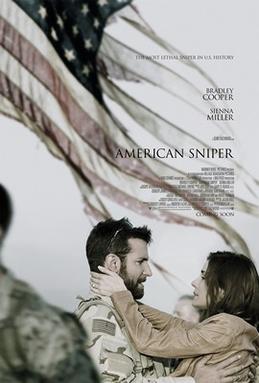
“American
Sniper” is based on the best seller by Chris Kyle which is the autobiography of
the “most lethal sniper in U.S. Military History”.Kyle served four tours in Iraq from 2003-2009
and had 160 confirmed kills.The movie
was directed by Clint Eastwood after Steven Spielberg considered doing it.The Iraq scenes were filmed in Morocco and if
you look carefully you will recognize a setting used in “Black Hawk Down”.The movie is doing well at the box office and
has received six Academy Award nominations:Best Picture (but not director), Actor, Adapted Screenplay, Film
Editing, Sound Editing, and Sound Mixing.Bradley Cooper gained forty pounds for his role as Kyle by consuming
8,000 calories a day.
The
movie opens with the beefy hunk on sniper overlook from a roof top as a Marine
patrol moves through the rubble of an Iraqi town.He has to make a decision as a mother and her
son approach the patrol with what looks like a Russian grenade.Suddenly we flash back to Kyle as a child
being preached to by his father. Mr.
Kyle tells his son there are three types of men:the sheep, the wolves, and the sheep
dogs.Be a sheep dog and protect the
sheep.It takes a while for this to kick
in as Kyle became a rodeo rider until a cuckolding and the embassy bombings in
Africa causes him to enlist in the Navy SEALs.SEAL training montage.Their
drill instructors are as taunt-creative as some of their best cinematic
brethren.Kyle meets his future wife
Taya (Sienna Miller) in a bar and they would have lived happily ever after
except for 9/11 which gives him the chance to do that sheep dog thing.The movie now returns to the opening scene
and we get to find out whether he shot the kid and mom.
The
rest of the film covers Kyle’s four tours and his awkward interludes at
home.Taya has two kids and would prefer
he stay home and take care of his own sheep.She is the classic whiny military wife who hates her country apparently.Kyle is the classic war movie husband who
lives by the war movie maxim:bros
before hoes.In the Iraq scenes, we are
made aware that Kyle is very good at his craft and soon his comrades are
calling him “The Legend”.Every white
hat needs a black hat and Kyle gets his in an Iraqi sniper referred to as
“Mustafa”.Cue the sniper duel as every
sniper movie fan knows that two is better than one.A movie made by an arch-conservative also
needs a hissable villain to bring a face to the ‘’savages”, as the Iraqi
insurgents are called.Kyle and his team
of not Bradley Coopers are tasked to eliminate Al Zarkawi’s second in command
“the Butcher”.He may be second in
command, but he is first in torturing.The Butcher’s weapon of choice is a power drill!(And all we did was water-boarding.)The cat and mouse with the Butcher and the
sniper duel coincide.Along the way, a
SEAL with little knowledge of war movie clichés talks about the ring he has
bought for his impending proposal.Guess
who gets shot?The movie builds to an
Alamo reenactment in a sand storm.“The
fog of war” becomes “the sand storm of war”.Credit Eastwood with a unique take on the “last stand” trope.
“American
Sniper” is well made entertainment for the masses.Eastwood uses his usual spare story-telling
style and the movie has an Old School feel to it.When the Kyle’s get frisky, they go in the
bedroom and close the door behind them.The movie is also unabashedly patriotic and supportive of the war in
Iraq.Eastwood inserts some support for
religion (our religion) although he does not bludgeon us with it.The cinematography is no frills with none of
the hand held frenetics that mark most modern war films.The sniper kills are visceral, but Eastwood
does not indulge in sniper porn like most in the sniper subgenre.We only see a few of Kyle’s 160 kills.The movie was not made for 14 year old
boys.But unfortunately, it was made for
main stream adults.This means that it
oversimplifies the themes for popular consumption.Kyle chooses country over family, but
eventually gets both. Every return home
develops the PTSD theme, but Kyle’s recovery is much too pat.This does a disservice to the men who Kyle
helped after he gave up the game.
The
movie is very well acted by the cast of Bradley Cooper.I think there were some other actors in the
movie.There must have been.To give you an idea of how Cooper dominates
the movie and no one else is able to develop, there is an early scene that
proposes that Kyle overlook an operation.When the soldiers are going to go out of sight, Kyle (Cooper) disobeys
orders and leads the ingress and personally interrogates the suspect and gets
him to collaborate.And by the way, why
waste screen time on Kyle having a spotter to bond with?The movie has virtually no scenes without
Cooper in them. I wonder why so many women
are going see a war movie?
The
movie has given a big boost to the sales of the book.This is partly I would think due to the fact
that people like me come out of the theater wondering whether some of the key
plot points are bull shit.I plan to
read the book and do a “History or Hollywood” post on it in the future, but for
now I will say that it is fairly accurate.Some of the things I thought were very likely Hollywood turned out to be
artistic license.For instance, the
reason for his enlistment was different.There was no boy involved in the Russian grenade incident.There was a Butcher type figure in Iraq, but
Kyle was not involved in a hunt for him.Needless to say, there was no sniper duel.I questioned the ability of a serviceman in
Iraq to call his wife while on a mission and found that he actually did call his wife while waiting for targets
and once was interrupted, resulting in her listening to the noises of a fire
fight and it was a traumatic experience as depicted in the movie.However, the call where he tells her he is
coming home never occurred.On a minor
note (but symbolic of how hero movies work), the movie ups the insurgent bounty
on Kyle to $180,000 compared to the actual unimpressive $20,000 for any sniper.On the other hand, the movie does get some things
right.This is especially true of the
marriage dynamics and the PTSD (but not the resolution).
I
may have come off too harsh on a war movie that is competently done and tells
the story of a true American hero.It
advances its themes well and the combat scenes are among the best in recent war
films.They are edge of the seat and
nicely unpredictable.Cooper deserved
the Oscar nomination and the movie should be titled “Bradley Cooper’s American
Sniper”.Considering the paucity of war
movies, it is a good addition to the genre.It makes a good companion to “Lone Survivor” and shows that there are
some good movies being made about our two most recent wars.Maybe some people will become aware that we
did fight in Iraq and Afghanistan.
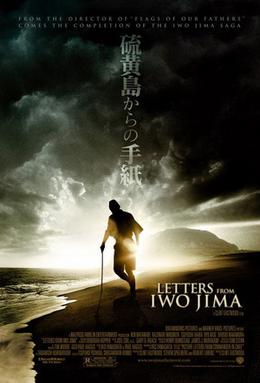
BACK-STORY:“Letters from Iwo Jima” is Clint Eastwood’s
companion piece to "Flags of Our Fathers".They were filmed back to back.It
is the Battle of Iwo Jima from the Japanese perspective.It is based on the letters of the Japanese
commander Gen. Tadamichi Kuribayashi and the book So Sad to Fall in Battle
by Kumiko Kakehashi.The movie was
filmed in California with a one day shoot on Iwo Jima.The film was well received by critics and
made numerous top ten lists.It was a
big hit in Japan, but did not do very well in the States (those damned subtitles!).It was nominated for Academy Awards for
Picture, Director and Original Screenplay and won for Sound Effects.The original title was supposed to be “Red
Sun, Black Sand” ( which was apparently too cool ).
OPENING:A group of Japanese archeologists are excavating
a cave on Iwo Jima in 2005.They uncover
letters written by members of the garrison, including Gen. Kuribayashi.
SUMMARY:In 1944, a sad sack named Saigo (Kazunari
Ninomiya) is digging a trench and cynically grousing about whether the island
is worth fighting for.A flashback
reveals that he is a conscripted baker who was torn from his pregnant
wife.Not all Japanese soldiers were
fanatics.Lt. Tanida (Takumi Bando)
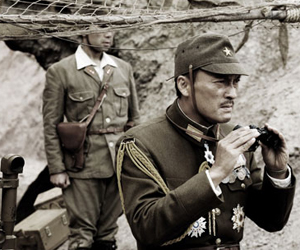
starts caning him but is stopped by the newly arrived Kuribayashi (Ken
Watanabe).The general halts the digging
of trenches on the beaches and changes the defense plan to reflect his belief
that the Americans can not be stopped from establishing a beachhead.He intends a defense in depth (literally,
through caves and tunnels).This change
does not go over well with some of his subordinates who are more the banzai
types.Kuribayashi finds a kindred
spirit in his tank commander.Col. Nishi
is an Olympic hero having competed in the equestrian events.
"I don't see a fleet. What did you say CGI means?"
The movie balances the officers
with the enlisted by introducing a foil for Saigo.Shimizu (Ryo Kase) was a member of the
Kempeitai (Japan’s equivalent of the Gestapo).Better watch what you say around him.He argues that the Japanese will win the battle because the Americans
are undisciplined, inferior, and too emotional.The ensuing bombing and strafing raid by Corsairs (which defy war movie
clichés by actually having bombs to drop) sobers up the defenders.The Americans may be inferior, but they have
a lot of stuff and the garrison can expect no external help.Kuribayashi outlines his plan to the
enlisted.They should be proud to be
defending the homeland.Your goal should
be to take at least ten Americans with you.You will not be going home.In
spite of this gloomy forecast, Saigo puts on his 1,000 stitch belt (senninbari)
for protection.
When the invasion commences,
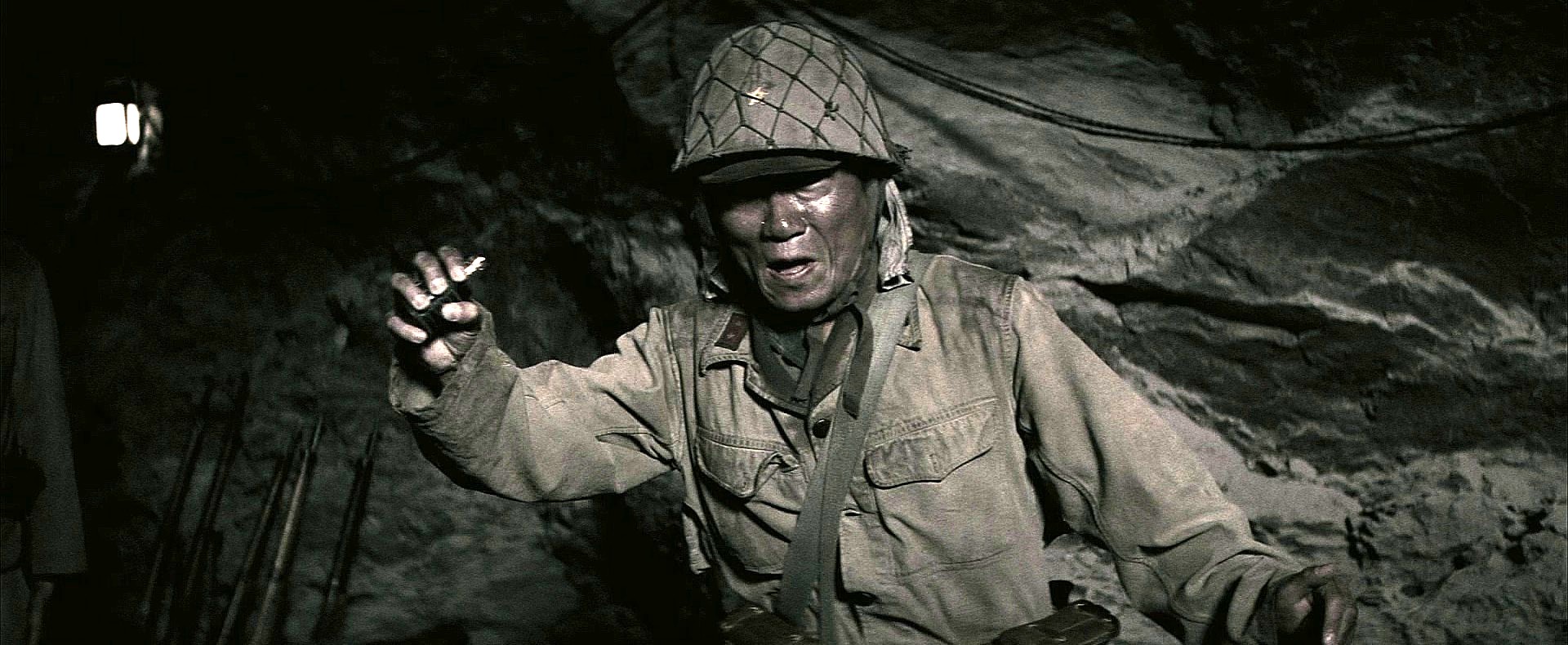
Saigo is an ammunition bearer on Mount Suribachi.When Tanida orders his unit to commit suicide
(against Kuribayashi’s orders), Saigo and Shimizu decide a grenade held to
their chests is not for them.They cross
a bullet-infested no man’s land after dark to reach the other side of the
island.They are about to be executed by
the fanatical Lt. Ito (Shido Nakamura) when Kuribayashi intervenes.Later, Ito straps some land mines across his
chest and goes out to suicide bomb an American tank.Where’s a tank when you need one?He returns frustrated.
Saigo and Shimizu are now with
the noble (literally, he was a baron) Nishi.Nishi insists on treating a wounded American prisoner humanely.He also reads aloud the soldier’s letter to
his mother.If it wasn’t for this war
…(Nishi has been outside Japan and flashbacks
apprise us of Kuribayashi’s pleasant stay in America before the war – good
Japanese officers are not zenophobic.)This contrasts with an earlier scene where a G.I. (Iggy from “Flags of
Our Fathers”?) was bayoneted to death after being captured.Shimizu’s backstory (via flashback) reveals
that he was thrown out of the Kampeitai because he refused to shoot a dog.(In movies, the killing of dogs is the best
measure of a characters morality.)Nishi
is blinded by shrapnel and orders his men to escape.He commits suicide using his big toe to
trigger his rifle.(The movie is a good
tutorial on the various methods of Japanese suicides.Although it surprisingly leaves out seppuku.)
Saigo and Shimizu decide to
surrender.Shimizu manages to get
captured and is about to say “who needs a thousand stitch belt?” when the
Americans guarding him decide they are bored.Saigo meets up with Kuribayashi.He saves Saigo’s life a third time by appointing him burner of documents
including letters.The general goes off
to lead that banzai charge he had been reining in for the whole battle.
CLOSING:Saigo buries the letters because he is a big fan
of archeology.Kuribayashi leads the
attack but is wounded.His loyal minion
Lt. Fujita (Hiroshi Watanabe) carries him from the battlefield.The next morning as the sun rises,
Kuribayashi insists on beheading.Unfortunately, Fujita is sniped mid-stoke.Saigo arrives soon after and assists the
general by giving him the .45 that Kuribayashi had been presented by his
American hosts.Saigo defies all odds (and
the script?) to be taken alive.
WOULD CHICKS DIG IT?Unlikely.It is pretty grim and it is an almost all male cast.The combat is not particularly graphic and
the characters are well developed.The
movie does have less machismo than most war movies.
HISTORICAL ACCURACY:Kuribayashi was from the samurai caste.In the late 1920s, he was a military attaché in
the United States.He toured the country
in a car and was impressed with America’s industrial capacity and felt it would
fight hard in the event of war with Japan. He then served in the cavalry in
China and then was Chief of Staff in Hong Kong.In 1943, he was appointed commander of the Imperial Guard in Tokyo.In 1944, Tojo summoned him and gave him
command of Iwo Jima.Some historians
posit that this was punishment for a fire set in the barracks by one of his
cadets.When he arrived on the island in
June, he was greeted by hundreds of school children waving flags and singing
patriotic songs.(The movie does not
show this.)A few days later, U.S.
fighters attacked and returned the next day for more bombing and strafing.A fortnight later, another raid resulted in
the shooting down of 66 Japanese fighters.Starting in August, the island was bombed almost daily (a fact that is
not shown in the film).By the time of
the invasion, the consistent bombing had deprived the island of almost all its
fighter planes, but had done little damage to the underground defenses.
In August, Rear Admiral Ichimaru
arrived with 2,300 naval reinforcemnents and he took command of the island’s
naval forces.Ichimaru was a disciple of
the standard Japanese doctrine of defending the beaches.Kuribayashi looked at the results of Saipan
and realized that without air and naval support, the beach defenses would not
survive the bombardment and onslaught.He ended up compromising a bit by allowing some pillboxes close to the
beach.The vast majority of the effort
was put into caves, tunnels, and other underground defenses.These were not only extensive and elaborate,
but virtually bomb proof.Nishi’s tanks
were emplaced.
"Thanks, if I ever don't have a sword, this will come in handy"
The movie short-changes the two
day pre-landing naval bombardment.It
was the heaviest of the war.It does a
good job of showing the Japanese soldiers surviving in the caves.It also does a fair job of depicting the lack
of food, water, and ammunition.Also
realistic is the undoubted fact that not all the Japanese were fanatics who
wanted to die.However, Saigo and
Shimizu probably over-represent the soldiers who wanted to survive.Just as the emphasis on Kuribayashi and Nishi
tends to dilute the reality of Japanese officers being martinets.The movie does an excellent job with
Kuribayashi and Nishi.The general’s
tactics are proper.The moment in the
film where he pretends to defend a stretch of the beach while a staff officer
runs around in front of him actually happened.He did allow the Americans to land and held fire until they were
inland.He forbade human wave assaults
and suicides.He encouraged the men to
give up ground as grudgingly as possible.
Nishi is a fascinating
personage.Colonel Baron Takeichi Nishi
(and his famous horse Uranus) won the gold medal in show jumping at the 1932
Los Angeles Olympics.He was a celebrity
and was acquainted with movie stars like Mary Pickford and Douglas
Fairbanks.He went on to compete in the
1936 Munich Olympics, but fell from his horse (possibly to allow Japan’s future
ally to win the event).He naturally was
in Japan’s cavalry and transitioned into the tank corps.When he was a transferring to Iwo, all 26 of
his tanks were sunk.Later, he was able
to get 22 in time for the battle.
The film is not meant to be instructive
as to the battle.In fact, it is
difficult to tell what the big picture is and what the time frame is.The movie is more on a personal level.And many of the characters are actual figures
from the battle.I am referring to the
officers, of course.Several key
incidents in the movie are based on reality.Some officers like Tanida did encourage their men to use grenades to
commit suicide (against Kuribayashi’s orders).In the movie, Ito leads an aborted banzai attack.Ito’s attempt at becoming a human bomb was
based on Lt. Satoru Omagari who was unsuceesful in waiting for a tank to blow
up.In reality, Gen. Senda did lead an
attack to try to recover Mt. Suribachi.The song Kuribayashi listens to from Japanese school children during the
battle really happened.It was called
“The Song of Iwo Jima”.
The small
details are accurate.The Kempeitai,
which means “Military Police Corps” was the Japanese secret police from
1881-1945.It was noted for its
brutality and certainly would have killed a dog for barking.A Senninbari, or “thousand stitch belt”, was
a strip of cloth that had stitches from one thousand different women.It was an amulet that was supposed to protect
the wearer.The various methods of
suicide are instructive.Everyone is
familiar with hari-kari, but the use of grenades and rifles is less well-known.I first encountered these methods in reading
about the Battle of Tarawa when I was younger.After all, regular soldiers would not have had access to katanas and
there rifles were too long to point and fire normally, hence having to use your
big toe to pull the trigger.
I am going to keep my helmet on for protection while I hold this grenade to my chest
The deaths of Nishi and
Kuribayashi are problematical.Nishi
suffered burns to his eyes.He did lead
an attack but it was halted by severe fire and he then probably committed
suicide by shooting himself.He did not
believe in seppuku.It seems likely he
would have used a pistol instead of a rifle.Kuribayashi planned to lead the last attack with 500 men, but he changed
his mind and instead led the men to a new position.He apparently was wounded in the
process.It is unknown how he died, but
the best guess is it was by way of seppuku at the mouth of the cave he was
in.It is extremely unlikely that it
occurred as depicted in the film.In
fact, his death is one of the weakest moments in the film.
CRITIQUE:“Letters from Iwo Jima” is an extremely well made
film.Eastwood obviously was intent on
creating a masterpiece.He does this in
a non-Tarantino way.The cinematography
is a bit artsy with the now familiar washed out look.Appropriate for a volcanic ash island.The combat is of the “Band of Brothers”
style, although the movie is light on action.What there is is intense, but not particularly graphic.The score conforms to this by being
understated.The opposite of the pompous
music of most war epics.You won’t remember
the movie for its sound track.In fact,
there is a notable lack of music in the film.The subterranean sets are amazing.Very claustrophobic.
The movie relies on characterizations to propel
the narrative.The main characters are
well developed and appealing.They are
fleshed out and not just from the flashbacks.This is especially significant because it is so rare to see the war
through Japanese eyes.Plus Eastwood
balances the officers with the enlisted.I feel I have to point out that all the major characters are noble,
which is a pretty ridiculously high percentage for the Japanese Army.The only typical Japanese soldiers are minor
characters.Hell even the kampeitai member
turns out to be unfanatical.Kuribayashi
is virtually saintly.Saigo is likeable
and you want him to live to get back to his wife and newborn.The fact that the audience gets its wish is
evidence that Eastwood pulls his punches on the anti-war theme.The dialogue is fine, but there are few lines
that are memorable.It was a nice touch
to liberally quote from the actual letters.
The
acting by the ensemble is excellent.Wattanabe is perfect as Kuribayashi and was a wise marketing
choice.If the movie had been made twenty
years earlier, the role would have gone to Toshiro Mifune.The surprise is Kazunari Ninomiya as
Saigo.He is a huge pop star in Japan.He plays sad sack conscript well.(His survival in the movie was probably a
recognition of what his death’s impact would have had on Japan’s teenage
girls.)
The film has some obvious themes
that are hard to miss.One is that most
of the soldiers just wanted to survive.This is a bit of a stretch when it comes to the Japanese army, but it’s
a nice change from the way their soldiers were depicted in previous movies.The movie is very sympathetic toward the
Japanese.It’s revisionist in this respect.(As a history buff I should mention that
revisionism is often wrong.)A related
theme is that we’re all humans and have human needs and emotions.The movie is quite humanistic.Possibly more than the dirty war in the
Pacific deserves.An interesting aspect
of the script is how it balances some of the scenes.At one point a captured American soldier is
bayoneted to death and then later, under similar circumstances, another is
treated humanely.The death of Shimizu
and the capture of Saigo are also mirrored.The plot is simplistic, but accomplishes its goal of retelling the
battle from the Japanese perspective effectively.
CONCLUSION:Whenyou
pair off “Flags of Our Fathers” and “Letters from Iwo Jima”, you have a
magnificent achievement for Clint Eastwood.Credit should also be given to the producers who bank-rolled these risky
projects.Only Eastwood could have
pulled off dual films about the Battle of Iwo Jima.They are so different, yet the pair cover the
pivotal battle as well as could ever have been expected.The dual perspective has been done before in
movies like “Tora! Tora! Tora!” and “The Longest Day”, but “Flags” and
“Letters” are unique in covering the same battle not only from different
perspectives, but with totally different themes.Both are commendable for bringing light to
worthy historical topics.So both fit
one of my qualifications for great war movies.The fact that neither is great simply means they fall a little short in
execution.
I am in the distinct minority who
feel that “Letters” is overrated.I
admire it and think it is a significant addition to war movie history.However, partly due to its humanistic themes
and perspective, most critics wanted to love it more than it deserved.As a person who has read a lot on the war in
the Pacific, I can attest to the revisionist nature of the
characterizations.I am not saying that
Kuribayashi and Nishi are unrealistically depicted, but I do feel that the
movie gives an inaccurate depiction of the defenders of the island.No wonder it did well in Japan.It showed the way modern Japanese want to
remember the defenders.
Now I’ll go further on a limb, I
feel “Flags” is the better war movie. It is more accurate and has a more
important story to tell.


_poster.jpg)