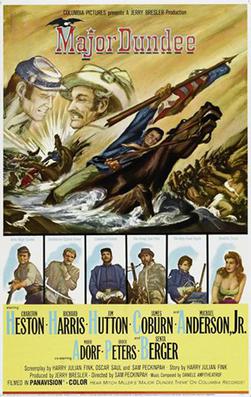
“Major Dundee” is a Sam
Peckinpah film with a very troubled history.
Peckinpah’s version of the film never made it to the theaters. The studio did some substantial cuts after a
disastrous early screening. The film was
cut 12 minutes for its run. Later, those
minutes were added for the restored version that I have reviewed here. If Peckinpah had had his way the movie would
have run 4 hours and 38 minutes! The
film was shot in Mexico and it was an unpleasant production. Peckinpah was drunk most of the time and was
very hard on the cast and crew. At one
point, Charleton Heston actually charged at the director on horse.
The movie is set in 1864 during
the American Civil War. Heston plays a
Maj. Dundee who for unspecified reasons has been demoted to commandant of a
prison camp in the New Mexico Territory.
Not only is he guarding Confederate prisoners, but he is having to deal
with Apache Indian raiders. The movie
opens with Dundee coming upon the scene of an Indian massacre. The raiders are 47 Apache led by Sierra
Charriba. They have taken four boys
captive. Dundee becomes obsessed with
rescuing the boys and more importantly for his career resurrection, harpooning
Sierra Charriba.
Dundee needs the Rebel prisoners
to volunteer for his hunt. The
complication is that the leader of the Rebels is an ex-friend and now bitter
enemy. Tyreen (Richard Harris) resents
the fact that Dundee voted to court-martial him because of a dueling incident
before the war. Dundee pardons Tyreen
from being hanged in order to get his reluctant support. It’s agreed that Dundee and Tyreen will not
claw each other’s eyes out until the mission is completed, but that does not
keep them from evidencing their mutual dislike in every scene.
The motley unit of Yankees,
Rebels, and even some “coloreds” march out on their quest. They head straight into Mexico. Wait, can they do that? (Ask Gen. Pershing) They get ambushed by the Indians while
crossing a river and lose most of their supplies. Dundee decides to attack a French outpost to
resupply and to get the French involved because the more the merrier. While sojourning in the town, Dundee hooks up
with a feisty senorita named Teresa (Senta Berger). Guess who else is interested in her? The extended stay in the town is great, if
you enjoy watching drinking and dancing.
If you are watching for Peckinpah action, not so great. Finally they leave with the French in hot pursuit.
The external threat does not
solve the unit’s dysfunctionality. One
of the rebels (Warren Oates) is caught deserting and Tyreen executes him to
deprive Dundee of the pleasure. Tyreen
swears vengeance, naturally. Teresa arrives to have a tryst with Dundee. During one of their encounters, Dundee takes
an arrow in the leg. Dundee spends
another boring stretch in another village recuperating. He is nursed by a different beautiful
senorita until Teresa discovers them in the act. Dundee goes on a bender because the toughest
guy in the West is ashamed. Tyreen has
to convince him to get over it and come back so the movie can continue.
The Indian problem solved, it’s
just a matter of returning to New Mexico.
Unfortunately, those pesky French are still on their tail and block them
at a river crossing. Peckinpah violence
ensues. Every time a body hits the water
so does a gallon of blood. It’s
redemption time. Do the French win? Do you know anything about history?
Speaking of history, there is a
small germ of accuracy to it. During the
Civil War, the Union did accept service from captured Rebels. These “Galvanized Yankees” were used in the
West for Indian fighting. Most famously,
they helped put down the Minnesota Sioux Uprising of 1862. They also were stationed along the Mexican
border to deal with the Apache, Arapaho, and Navaho. There was no invasion of Mexico for them to
participate in and there were no problems with their service.
Peckinpah meant to make an epic
and blamed the studio for preventing that accomplishment. It is doubtful that his envisioned final product
would have been a masterpiece. The
truncated version has long sections that are boring and one can only imagine what a
four hour version would have been like.
The film got mixed reviews when it came out, but it has gained a
following over the years. I feel the
original opinions are more on target.
The movie could possibly have been great, but even the restored version
is far from great.
The acting is not as big a
problem considering the two leads. These
notorious scene-chewers keep themselves under control for the most part. The supporting cast is fine. There are lots of familiar Peckinpah
faces. James Coburn has fun as a crusty
scout and Warren Oates dies significantly.
James Anderson, Jr. plays the narrator/bugler. As an actress, Senta Berger is lovely.
The screenplay is a mash-up of
“Moby Dick” and “Mutiny on the Bounty”.
Dundee is the obsessed Ahab chasing his white whale. As far as the unit dynamics, Dundee is the
martinet Bligh to Tyreen’s chivalrous Christian. The dynamic between Dundee and Tyreen does
work in spite of the cat versus dog simplicity of it. Heston boldly plays the dislikable Dundee
which certainly went against virtually all his other career choices. Harris is perfect as his more noble
foil. He embodies the Southern spirit well.
The movie is competently made by
the drunken Peckinpah. He takes
advantage of the Mexican landscape for some awesome scenery. The action scenes are harbingers of “The Wild
Bunch”, but only hint at where Peckinpah was heading. One technical flaw is the poor score. Unbelievably, the studio junked Peckinpah’s
music for what we hear in the film. How
bad could the original score have been?
Cracker? No, partly because it does not fit my
definition of a war movie, but mostly because it’s just not that good.
grade = C