Saturday, July 25, 2020

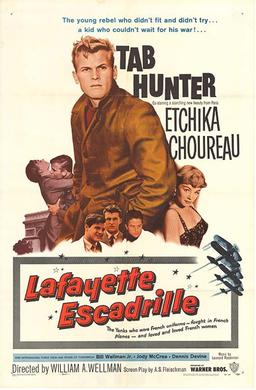
FORGOTTEN GEM? Lafayette Escadrille (1958)


                    “Lafayette Escadrille” was supposed to be William Wellman’s (“Wings”) homage to the unit he was a member of in WWI.  The Lafayette Escadrille consisted of American’s who volunteered to fight for France before the U.S. entered the war.  Wellman, who started out in the French Foreign Legion and switched to the flying unit, was credited with three kills and was awarded with the Croix de Guerre.  He was shot down and survived the crash landing, but walked with a limp the rest of his life.  He wrote the story the movie was inspired by.  It was based on his experiences.  Several characters in the film are based on members of Wellman’s squadron.  The main character was a friend of his who kicked out of the unit for hitting a French officer.  He became a pimp and fell in love with one of his prostitutes.  He met Gen. Pershing and talked his way into the Air Service.  (In the movie, Thad Walker escorts a general to a brothel.  This was based on an experience Wellman had involving Pershing during the war.)  He was shot down and killed, his wife jumped into the Seine.  This was ending Wellman shot, but Jack Warner and Warner Brothers decided the film needed an upbeat ending so the studio took the film away from Wellman and reshot the ending.  It also changed the title. Wellman intended for the movie to be entitled “C’est la Guerre”.  He also intended for Paul Newman to play the lead with Clint Eastwood as his pal.  Newman became unavailable and the studio insisted on teen idol Tab Hunter and bumped Eastwood down to a minor role in favor of David Janssen.  You can’t have a teen idol die.  The studio was not interested in making the film and insisted Wellman make “Darby's Rangers” to get the greenlight.  And then it saddled Wellman with a low budget.  Wellman was so pissed by the whole experience that he gave up making movies.

                    The movie opens with Wellman narrating as the Lafayette Escadrille memorial fills the screen.  He proclaims that this will be the story of a man whose name is not on the memorial.  Flashback to Thad Walker (Hunter) stealing a car and hitting a kid on a bike.  He escapes only to have his father slap him around.  Next thing we know, he’s a stowaway on a ship to France.  He hooks up with a trio of Americans that includes William Wellman (played by his son William, Jr.) and decides to join them in enlisting in the Lafayette Escadrille.  Before that, he locks eyes with a girl in  a bar and it’s love at first sight (probably due to the sappy romantic music).  Renee (Etchika Choureau) is a whore with a heart of gold.  At the barracks, the narrator identifies Walker’s bunkmates (one of whom is a very young Eastwood) and proceeds to tell us most of them are going to die.  Hey, spoiler alert!  They are trained on a French monoplane by a French pilot who only speaks French.  No wonder so many die.  (In fact, the French speak without subtitles, as though the movie is a serious work of art.)  The training montage features silly comic relief with silly music.   Walker ends up going AWOL after slugging a French officer.  He shacks up with Renee.  This dude is in desperate need of redemption and we’ve been promised some dogfighting, so you know where this is heading.
                   
                    It’s hard to assign blame for this fiasco.  Wellman basically disowned the movie, so obviously he blamed the studio for the final product.  But even if you factor in the low budget and the amended ending, he controlled the story for the most part.  He accepted the poor performances by the actors.  Tab Hunter is no Paul Newman.  He created the insipid romance.  He vetted the terrible soundtrack and the silly, slapstick humor.  The humor is absolutely painful to watch, especially in the 21st Century.   Wellman is the one who decided to honor his unit by focusing on a character who is a jerk and did not deserve redemption.  It must have been heartbreaking to have most of his fellow fliers criticize the film, but at least he could argue it was not his fault.

                    There have been some good dogfighting films set in WWI.  It almost deserves its own subgenre.  In 1958 (actually the movie was finished in 1956, but the studio held its release in anticipation of Hunter’s anticipated music stardom), it was gutsy to come out with a movie to challenge Wellman’s own “Wings”, but also “Hell's Angels”, and “The Dawn Patrol”.  In fact, “Lafayette Escadrille” marks the last of the old-style WWI air combat films.  You would expect that the last of the old-school would go out with a lot of dogfighting and you would be wrong.  Nobody fires a tracer until the 1:24 mark and ends with a total of three minutes of forgettable action.  The next significant film in the subgenre was “The Blue Max”.  Talk about a huge jump!  There is not a single pratfall in “The Blue Max”.

GRADE  =  F

Monday, July 20, 2020

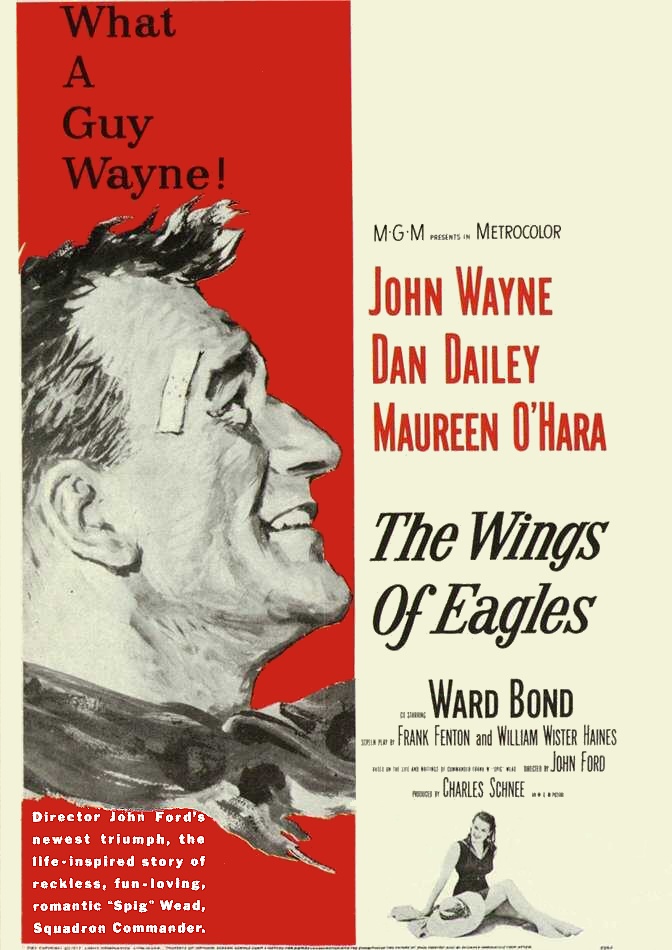
CLASSIC or ANTIQUE: The Wings of Eagles (1957)


            John Ford was talked into directing a movie about his good friend Frank “Spig” Wead.  His reluctance may have been due to the similarity in their personalities.  To reenact the pain Wead put his family through must have been uncomfortable for Ford, but Ford and Wead had been drinking buddies for years and Ford was with his friend at his death in 1947.  Ford visited Wead when he was in the hospital for paralysis and was one of the friends who encouraged him to write.  Later, Ford filmed several of Wead’s screenplays, including “They Were Expendable”.  In “The Wings of Eagles”, long-time Ford posse member Ward Bond plays Ford under the pseudonym John Dodge.  Ford loaned him his pipe, hat, hollowed out booze cane, and his three Oscars.  When Wead met with Dodge, there is a clip of “Hell Divers” playing.  Wead wrote the screenplay to that movie (but it was not directed by Ford).  This was the tenth Ford/Wayne film and the third of five Wayne/O’Hara films.  The movie was based on an article by Wead entitled “We Plastered the Japs”.
                “Anchors Aweigh” plays over the credits.  The Navy cooperated by providing the Naval Air Station at Pensacola and the aircraft carrier USS Philippine Sea.  The movie was dedicated to “the men who brought Air Power to the U.S. Navy”.  Wead played a major role in that.  It paid to be a maverick back in the early naval aviation days.  The first scene establishes the movie as one of the Ford/Wayne tongue in cheek entries, like “The Quiet Man”.  Wead has not even soloed yet, but he takes an Army guy named Hazard (Kenneth Tobey) up for a joy ride and ends up crashing in an admiral’s pool.  He gets court-martialed, but you know how much aviation loves mavericks.  The early flying days transitions to the home life where his wife Min is in the hell that is cinematic serviceman’s spouse.  She complains about the constant moving, but he doesn’t care.  Like she has a choice.  Meanwhile, Wead has this Maverick/Iceman thing going with Hazard (who is based on Jimmy Doolittle).  They compete in air races to prove the superiority of their air branches.  There are not one, but two, of the cliched barroom brawls between naval aviators and air corps pilots.  His neglect of his wife and family (his daughters don’t recognize him) is patched up with a simple “I’ve been a heel”.  Unfortunately, that brief moment of familial caring is interrupted by an accident that leaves him paralyzed.  And no, it’s not because Min hits him on the head with a frying pan.  Wead eventually overcomes his paralysis with the help of his friend Carson (Dan Dailey) and goes on to become an innovator in the development of escort carriers in WWII.
                “The Wings of Eagles” is an uneven blend of comedy and melodrama.  Actually, it starts off as a comedy and then makes a jarring shift to melodrama after the accident.  The good ole boy scenes are intermixed with the Spig and Min scenes.  Although Min is the typical service spouse who is second banana to the service, the relationship is unpredictable.  Wead really is a heal, but unlike a modern biopic, this 1950’s movie has to imply that he was going to mend his ways before the accident.  Wead is clearly more interested in snapping towels with his buddies and trading punches with his rivals.  The relationship with Hazard is your standard Quirt/Flagg rivalry.  You have to wonder how comfortable O’Hara was during the production.  There is a lot of smoking and drinking in the movie and that probably reflected the production as well.  However, the boys are familiar faces and Wayne has one of his better performances.  It helps that he is bed-ridden for a good chunk of the movie.
                As a biopic, the movie air brushes the warts mostly.  You get just a hint that Wead was a bad husband and father.  Maybe that was a good thing because if he had been distracted, we might not have come up with the idea of “jeep carriers”.  According to the film, Wead had a sudden “eureka!” moment that led to this naval innovation.  This is just one of several moments in the movie that seem to be artistic license.  But those moments are largely forgettable and eclipsed by the hospital scenes.  If you have seen this movie, the one thing you probably remember is the line “I’m gonna move that toe”.  Carson says it 31 times and Wead says it 65!  Speaking of biopics, how is it we have one for “Spig”Wead, and not for the much more interesting and significant Jimmy Doolittle?
                As far as the accuracy, two of the sillier moments are supposedly true, according to Ford.  He insists Wead did crash in an admiral’s pool and there was a brawl with cake throwing.  As far as the historical events, it appears to be a fairly realistic depiction of the major moments in Wead’s life.  The rivalry with the infant air force is played for entertainment but there were air races.  The post-accident career is simplified.  He did play a role in the development of jeep carriers (escort carriers) and they were initially viewed as being used to transport aircraft to the fleet carriers.  Unfortunately, the movie leaves the impression that became their key role in the war.  In truth, they played a much more important role as escorts for convoys in the Atlantic and as supplements to the big boys in the Pacific.  You have to feel sorry for the CVE’s  (“combustible, vulnerable, and expendable”) for getting short-changed.
GRADE  =  C  

Friday, July 17, 2020

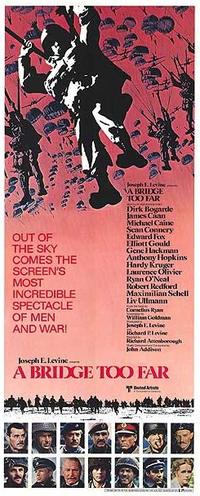
CONSENSUS # 39. A Bridge Too Far (1977)


SYNOPSIS: "A Bridge Too Far" is an all-star battle epic from the subgenre founded by "The Longest Day". It is the story of Operation Market Garden in WWII Europe.  This was an attempt to seize several bridges leading into Germany.  The movie covers both the British and the American effort and also gives the German perspective.  It tends toward being command-centric, but has a lot of combat.

BACKSTORY:
A Bridge Too Far is basically a sequel to The Longest Day and suffers a bit in the comparison. They are both based on books by Cornelius Ryan. ABTF was released in 1977, three years after the book. It has a similar format as its sister film the all-star cast in a war epic. The movie was something of a flop which should not have been a surprise given that it was about a mostly British affair and a loss at that. Given the odds stacked against it, the movie mirrors the event it portrays in that respect.

TRIVIA:  wikipedia, imdb, TCM

1.  It is based on the book by Cornelius Ryan.  He also wrote The Longest Day.

2.  One thousand paratroopers using Dakotas were used in the drop scenes.

3.  Dirk Bogarde had been on Montgomery’s staff .  He was an intelligence officer who was sent to Arnhem during the battle.  He took issue with the portrayal of Gen. Browning, as did Browning’s family.

4.  All the lead actors agreed to work for “favored nation” fees which was $250,000 per week.  Robert Redford was an exception.  He was paid $2 million for two weeks work.

5.  Director Richard Attenborough shot 2.7 million feet of film, equivalent to more than 500 hours.


Belle and Blade  =  2.5
Brassey’s              =  4.0
Video Hound       =  4.4
War Movies         =  3.1
Military History  =  #94
Channel 4             =  #7
Film Site                =  yes
101 War Movies  =  yes
        Rotten Tomatoes  =  no
 
OPINION:
The obvious thing to do is to compare this movie to The Longest Day. In some ways it is a sequel and we all know about sequels they seldom live up to the original. However, ABTF has some big shoes to fill and it is probably asking too much for it to surpass or even equal its parent. Technically, it is a superior film. The airborne landing scene and the fighting in Arnhem are superior to any action in TLD. Compare the combat in Arnhem specifically to the scenes in Ouistreham and you will see what I mean.
Another comparison is ABTF is more command-centric than TLD. There is only one grunt character Dohun. TLD is full of privates. I do not know if it reflects the difference, but Sean Connery portrays a private in TLD and he has been promoted to general by ABTF ( think on that ). It does not have to be either/or as TLD proves with its blend of scenes showing the strategic ( the generals ) and the tactical
( the foot soldiers and their officers ). ABTR does not blend as well.

I admire the guts of the producers in making a movie that is a history lesson and a downer at that. I cannot believe the marketing people were thrilled with that. Kudos for swimming upstream.

The movie came out in the mid-seventies and reflects the transition from old-school war movies ( like TLD ) to the more cynical modern war film ( Patton ). It clearly reflects the post-Vietnam view of the military and warfare in general. The emphasis on SNAFU, clueless strategists, the waste of human lives, and pressing on with flawed plans are apparent in the movie.

"A Bridge Too Far" is sadly underrated, but not here. It is fairly treated on this list.  I can see why people who don't care about history might not be excited about it, but as a war movie lover it is a real treat.

Monday, July 13, 2020

NOW STREAMING: Greyhound (2020)


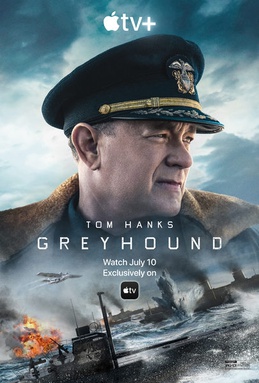
                I had been waiting for this movie for a couple of years.  I heard about it early because they filmed on the USS Kidd which is a floating museum in Baton Rouge, La.  I have been on the ship numerous times and have even slept on board several times.  Those overnites were with my History Club.  It was always a great experience, other than worrying about what those teenagers might be getting into.  Sleeping in a berth on a warship is something every war movie fan should have on their bucket list. 
                It took longer to see the film than I anticipated.  It’s release was delayed by the pandemic and the studio ended up deciding to junk the theatrical opening and go straight to streaming.  It just so happened that the new Apple + TV was hoping to get attention in the crowded streaming market and it bought the film for $70 million (the movie cost $50 million).  I bet Apple is praying people like me go beyond the free trial.  The movie was directed by Aaron Schneider (his second feature film), but I would guess he deferred to star Tom Hanks.  Hanks wrote the screenplay based on the novel The Good Shepherd by C.S. Forester.
                The movie opens with some quotes from Churchill and FDR to set the stage.  The U.S. Navy is helping escort troop and supply ships across the Atlantic.  The convoys are most vulnerable when they are transiting the “Black Pit” which refers to the area in the North Atlantic where there is no air cover.  The USS Keeling (code-named Greyhound) leads a group of four destroyers that are escorting a 37-ship convoy to Liverpool.  Commander Krausse (Hanks) is new to the ship and this will be his first escort mission.  The movie jumps straight into the “Black Pit” and it does not take long for things to heat up.  For the next two days, it will be a cat and mouse game with a wolfpack of German u-boats.  The Keeling is in the thick of the fight and by the time it reaches air cover again it will run the gamut of experiences a destroyer might have in the Battle of the Atlantic.
                There is a thriving subgenre of submarine movies, but few movies from above the surface.  “Greyhound” differs from the similar “The Enemy Below” because it focuses just on the destroyer.  In fact, other than a flashback to Krause proposing to his girlfriend (Elisabeth Shue) which seemed to be thrown in to get a female on the poster, the movie takes place only on the Keeling.  Clocking in at a tidy 91 minutes, the movie eschews character development in favor of almost nonstop action.  Even Krausse is a cipher, although we learn he is religious and a cool customer.  It may be his first escort mission, but he knows his craft.  The movie does not have time for the usual clichés.  The crew does not side eye their new captain.  He does not have to earn their respect.  There is a brief head-scratching moment, but it quickly turns out that Krausse is a u-boat killer.  There is no dysfunction as Krausse’s exec Lt. Commander Cole (the reliable Stephen Graham) is loyal and competent.  In fact, the whole crew performs well.  Hanks’ screenplay makes a point of sub-plotting an African-American messmate, but there is little time to develop anyone.  Hanks and the Greyhound dominate.
                In lieu of character development, the movie concentrates on action.  It helps if you are knowledgeable about WWII submarine warfare and nautical terminology.  The dialogue is heavy on jargon and is not dumbed down for a mass audience.  Kudos to screenwriter Hanks for doing his research.  I had to do a lot of translating for my wife (ex. starboard is right and port is left).  Hanks throws in some cryptic quotes, but the most creative dialogue comes from a u-boat captain that taunts Krausse.  It’s a bit cheesy and unrealistic, but fun and reminiscent of an earlier style of war movie and adds that “USA! USA!” emotion.  The action is a buffet as we see a variety of combat, but if you know anything about the ferocity of wolfpack attacks, the movie does not steer into outrageous.  It all could have happened, just not to one destroyer on one mission.  Hey, it’s a movie.  

                 The CGI is not a problem.  I was not distracted by it.  It helps that a real Fletcher-class destroyer was used for the interiors and exteriors.  Actually, the CGI was mainly used to create the horrific North Atlantic climate conditions the convoys had to battle.  This was no pleasure cruise, u-boats or not.  Besides giving the recliner-sailing audience a feel for the conditions, the movie is an excellent tutorial on anti-submarine tactics.  And a nice homage to the men who risked their lives escorting convoys.  I hope some of the veterans of WWII tin cans get to see it in the museum theater at the USS Kidd memorial.  By the way, the Royal Navy gets its due and there should be no complaining like with “U-571”.
                The year 2020 really sucks, but it has actually been a pretty good year for war movies.  Just in the last week I have seen “The Outpost” and this movie.  And I didn’t have to go to a theater.  Same could be said for the excellent “Danger Close” and the better-than-expected “Da 5 Bloods”.  “Greyhound” is only the third best of that quartet, but it is still a must-see for war movie fans.  This movie has no frills.    It probably should have been longer to allow for fleshing out of the characters, but it is refreshing to see a movie that concentrates on the warfare aspect of a war movie without going the combat porn route.  Get that free trial.  Plus Apple TV + has some other good war movies you can watch in a week.
GRADE = A