Showing posts with label WWI air combat. Show all posts

Saturday, July 25, 2020

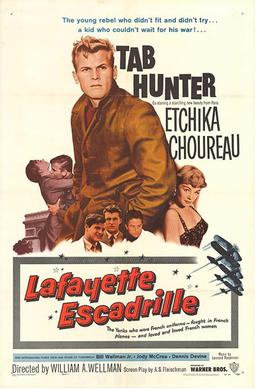
FORGOTTEN GEM? Lafayette Escadrille (1958)


                    “Lafayette Escadrille” was supposed to be William Wellman’s (“Wings”) homage to the unit he was a member of in WWI.  The Lafayette Escadrille consisted of American’s who volunteered to fight for France before the U.S. entered the war.  Wellman, who started out in the French Foreign Legion and switched to the flying unit, was credited with three kills and was awarded with the Croix de Guerre.  He was shot down and survived the crash landing, but walked with a limp the rest of his life.  He wrote the story the movie was inspired by.  It was based on his experiences.  Several characters in the film are based on members of Wellman’s squadron.  The main character was a friend of his who kicked out of the unit for hitting a French officer.  He became a pimp and fell in love with one of his prostitutes.  He met Gen. Pershing and talked his way into the Air Service.  (In the movie, Thad Walker escorts a general to a brothel.  This was based on an experience Wellman had involving Pershing during the war.)  He was shot down and killed, his wife jumped into the Seine.  This was ending Wellman shot, but Jack Warner and Warner Brothers decided the film needed an upbeat ending so the studio took the film away from Wellman and reshot the ending.  It also changed the title. Wellman intended for the movie to be entitled “C’est la Guerre”.  He also intended for Paul Newman to play the lead with Clint Eastwood as his pal.  Newman became unavailable and the studio insisted on teen idol Tab Hunter and bumped Eastwood down to a minor role in favor of David Janssen.  You can’t have a teen idol die.  The studio was not interested in making the film and insisted Wellman make “Darby's Rangers” to get the greenlight.  And then it saddled Wellman with a low budget.  Wellman was so pissed by the whole experience that he gave up making movies.

                    The movie opens with Wellman narrating as the Lafayette Escadrille memorial fills the screen.  He proclaims that this will be the story of a man whose name is not on the memorial.  Flashback to Thad Walker (Hunter) stealing a car and hitting a kid on a bike.  He escapes only to have his father slap him around.  Next thing we know, he’s a stowaway on a ship to France.  He hooks up with a trio of Americans that includes William Wellman (played by his son William, Jr.) and decides to join them in enlisting in the Lafayette Escadrille.  Before that, he locks eyes with a girl in  a bar and it’s love at first sight (probably due to the sappy romantic music).  Renee (Etchika Choureau) is a whore with a heart of gold.  At the barracks, the narrator identifies Walker’s bunkmates (one of whom is a very young Eastwood) and proceeds to tell us most of them are going to die.  Hey, spoiler alert!  They are trained on a French monoplane by a French pilot who only speaks French.  No wonder so many die.  (In fact, the French speak without subtitles, as though the movie is a serious work of art.)  The training montage features silly comic relief with silly music.   Walker ends up going AWOL after slugging a French officer.  He shacks up with Renee.  This dude is in desperate need of redemption and we’ve been promised some dogfighting, so you know where this is heading.
                   
                    It’s hard to assign blame for this fiasco.  Wellman basically disowned the movie, so obviously he blamed the studio for the final product.  But even if you factor in the low budget and the amended ending, he controlled the story for the most part.  He accepted the poor performances by the actors.  Tab Hunter is no Paul Newman.  He created the insipid romance.  He vetted the terrible soundtrack and the silly, slapstick humor.  The humor is absolutely painful to watch, especially in the 21st Century.   Wellman is the one who decided to honor his unit by focusing on a character who is a jerk and did not deserve redemption.  It must have been heartbreaking to have most of his fellow fliers criticize the film, but at least he could argue it was not his fault.

                    There have been some good dogfighting films set in WWI.  It almost deserves its own subgenre.  In 1958 (actually the movie was finished in 1956, but the studio held its release in anticipation of Hunter’s anticipated music stardom), it was gutsy to come out with a movie to challenge Wellman’s own “Wings”, but also “Hell's Angels”, and “The Dawn Patrol”.  In fact, “Lafayette Escadrille” marks the last of the old-style WWI air combat films.  You would expect that the last of the old-school would go out with a lot of dogfighting and you would be wrong.  Nobody fires a tracer until the 1:24 mark and ends with a total of three minutes of forgettable action.  The next significant film in the subgenre was “The Blue Max”.  Talk about a huge jump!  There is not a single pratfall in “The Blue Max”.

GRADE  =  F

Saturday, July 4, 2015

The Blue Max (1966)


                “The Blue Max” recently won my Best Dogfighting Movie tournament.  Now it’s time to see how it holds up as a war movie. 

                Considered one of the definitive WWI air combat films, “The Blue Max” was directed by John Guillerman (“The Bridge at Remagen”).  It is based on the novel by Jack Hunter.  The title is a reference to the German medal officially called “Le Pour le Merite”.  The movie had a big budget and an international cast.  It was a moderate success at the box office and got mixed reviews.

                The movie begins on the Western Front in 1916.  Corporal Bruno Stachel (George Peppard) is an infantryman in no man’s land.  He witnesses a dogfight from a shell crater and dreams.  While the credits roll with a dogfight as a back drop, two years pass and Stachel becomes a trained pilot.  He is sent as a replacement to a Staffel where it is revealed that he is the only commoner amongst the noble German knights of the air.  His first mission is against an observation balloon.  He is flying an obsolete Pfalz D.III  They get bounced and he manages to shoot down a British S.E. 5 in an exciting treetop chase.  When he returns to base, Stachel is obsessed with confirming his kill and not at all concerned with the loss of his wing mate.  His search during a rain storm at night convinces his squadron mates that he cares only about getting the twenty victories necessary to win the Blue Max.  This perception is cemented when Stachel attempts to bring a British reconnaissance plane back to his air field, but is forced to shoot it down at the last moment.  It comes off as him making sure he gets a confirmed kill this time.  His squadron commander Heidermann (Karl Voger) is incensed with this violation of the rules of chivalry and is determined to get rid of this son of a hotel keeper.
                Stachel’s rival in the squadron is an ace named Klugermann (Jeremy Kemp).  Klugermann is the nephew of General Klugerman (James Mason) and is having an affair with the general’s trophy wife Kaeti (Ursula Andress).  The rivalry in the sky becomes a rivalry between the sheets.  Who do you think she will pick – Peppard or Kemp?  As Stachel’s total mounts, General Cuckold sees him as a people’s hero that can be used for propaganda purposes.  This puts him at odds with the moralistic Heidermann who wants to can Stachel.  Heidermann is pushing for a court-martial after Stachel falsely claims two victories scored by another pilot.  Confronted with the possible tainting of his golden boy, Gen. Klugermann needs to find a way to convert the hero into a martyr.
"Willi, I want to make it clear that this medal is
not for sleeping with my wife!"
                “The Blue Max” advances three themes that probably would have perplexed the generation that lived through the Great War.  First, there was a rigid class structure in the German Air Service.  No matter how talented and successful Stachel became, he would never be accepted by the snooty aristocrats that were his squadron mates.  By having Stachel come up from the infantry, the movie is connecting the ground war with the lower classes and the air war with the upper classes.  An underappreciated moment in the movie comes when Stachel is scolded for not celebrating that day's victories and ignoring their losses.  He responds:  “Perhaps it’s force of habit.  In the trenches, we couldn’t even bury the dead; there were too many of them…. I’ve never had the time…to discuss them over a glass of champagne.”   Not an inappropriate analogy.  Second, Gen. Klugermann represents the military’s attempts to manipulate the media.  “Truth is the first casualty in war” was not said about WWI so the movie is backdating that idea.  Third, the movie has a theme of the evils of the military industrial complex.  This may be a bit anachronistic, but Gen. Klugermann being in bed with Anthony Fokker is not a stretch.  WWI was the first industrialized war and thus must have been the first war where industrialists and the military had a symbiotic relationship.  It was not as developed at this stage as the movie implies, though.  The movie reflects a 1960s sensibility on these themes.  Speaking of which, the Kaeti character would be more at home in that decade.

                The movie reflects its big budget.  The interiors are opulent.  Not surprising for a WWI combat movie because the pilots are of course billeted in a chateau.  A lot of the budget went into the small air force of replica air craft the movie employs.  We see Pfalz D.IIIs, Fokker D.VIIs, and Fokker Dr. I triplanes.  The cast of planes is in some ways more impressive than the cast of actors.  Guillermin matched the machines up with a cadre of outstanding stunt pilots.  One of those pilots, Derek Piggott, did the famous flight under the bridge spans more than twenty times.  The dogfighting is the most memorable thing about the movie.  There is nineteen minutes of it to balance the soap opera aspects of the film.  There is a “Hell’s Angels” style melee that shows how modern cinematography had made air combat better.  And then CGI came along, so the pendulum has swung back.  The movie has outstanding sound effects which is an underrated aspect of air combat films.  Similarly, the score by Jerry Goldsmith is superb.  It soars with the planes.  Typical of a WWI air epic, the movie insists on getting down and dirty in the trenches.  There is an extended strafing scene and a large-scale trench battle that is marred by having the British soldiers come out of their trenches to meet the Germans in no man’s land!   This was done to get the Tommies out in the open so the German fighters could drop bombs they did not have.  Talk about insulting your audience’s intelligence.


                 “The Blue Max” is refreshingly devoid of clichés.  It does have the granddaddy of the dogfighting tropes: the main character is obsessed with glory.The acting is fine.  Peppard has taken some criticism, but he does a good job in a difficult role.  (Critics should have been more impressed with the fact that he learned how to fly so he could be in more shots.)  In 1966, the anti-hero had not quite developed into the icon we have today so he had to walk a fine line between jerk and misunderstood jerk.  Amazingly, Jeremy Kemp steals the acting honors.  His Willi is suavely cynical.  And he’s sleeping with his step-aunt!  The best dialogue is the exchanges between Bruno and Willi.  James Mason is perfect as the Machiavellian Gen. Klugermann and Vogler is great as the righteous Heidermann.  (By the way, they both played Erwin Rommel in movies.)  The weak link is Andress, of course.  She is not there for her acting ability obviously.  On the plus side, there is some chemistry between her and Peppard.  On the minus side, she keeps her clothes on, mostly.
Damn you,  towel!

                 In conclusion, although it is  the best movie about dogfighting, it is not a great movie and may not make my 100 Best War Movies list.  In  my opinion, there is still an opening for an outstanding example of this subgenre.  Dogfighting movies are still waiting for their "Das Boot".


GRADE  =  B 

the trailer


a dogfight


Thursday, April 30, 2015

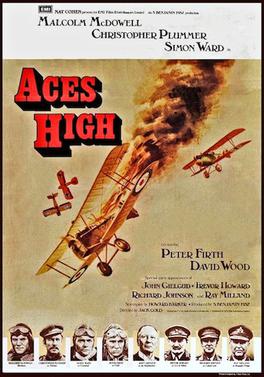
#5 THE BLUE MAX vs. #11 ACES HIGH


The semi-finals are set:
#5 The Blue Max vs. #11 Aces High
#1 Battle of Britain vs. #15 Angel's Wing


VS.


FIRST QUARTER:  Acting

                “The Blue Max” has a fine cast.  George Peppard does a fine job as Stachel.  He is a jerk, but he has his reasons and some of his actions are justifiable due to his treatment by the snooty upper crust officers.  The supporting cast is strong.  Jeremy Kemp is surprisingly good as Klugerman and Karl Vogler develops Heidermann into the most compelling character.  James Mason is perfectly cast as the Machiavellian general.  The one weak link is Ursula Andress partly because she remains clothed mostly.  Considering why she was cast she actually acquits herself well and her scenes with Peppard have some chemistry to them.  A

                “Aces High” does not have a cast as strong as “The Blue Max”, but it gets some fine performances.  Malcolm McDowell is fine as the squadron leader who uses alcohol and cynicism to get by.  His discomfort with the arrival of a young friend who idolizes him is intriguing.  He gets excellent support from the always dependable Christopher Plummer as the stereotypical father figure that you see in many WWI air combat movies.  Simon Ward as the cowardly Crawford and Peter Firth as the neophyte Croft are merely adequate.  B

FIRST QUARTER SCORE:
The Blue Max                        9
Aces High                               8

SECOND QUARTER:  Pilot Behavior

                “The Blue Max” does not break any new ground in portraying WWI fighter pilots as partying hard in spite of the loss of squadron mates.  The movie twists this by having his mates criticize Stachel’s unconcern for a wingman’s death by having him explain that in the trenches they did not have time to mourn.  It does throw in a dynamic appropriate for the German air force.  Stachel is not accepted partly because not only is he coming up from the infantry, but he is from a middle class family.  The camaraderie (aside from the ostracism of Stachel) is clear.  The competition is not friendly because of the crass greed for kills exemplified by Stachel, so that behavior is a bit overplayed for plot purposes.  B

                “Aces High” has a more standard depiction of WWI fighter pilots.  The squadron is a heterogeneous small unit that manages to cover all the archetypes of WWI air combat.  There is the cynical ace who leads the squadron the help of liquor, the class clown, the pilot who can’t take it any more, the naïve newbie.  This being a British squadron, they have an appropriate amount of stiff upper lips.  Where “The Blue Max” attempts to portray the class consciousness between Stachel and the rest of the officers, “Aces High” targets the gulf between the officers and the enlisted.  B

HALF TIME SCORE:
The Blue Max                        17
Aces High                               16

THIRD QUARTER:  Tactics

                “The Blue Max” pays lip service to wing men, but once the action begins it’s every man for himself.  This is a pretty standard mistake in dogfighting movies.  The attack on the observation balloon realistically shows that the balloon would have a fighter patrol protecting it.  The movie puts too much emphasis on fighters strafing infantry and features two scenes of this activity.  Not that it didn’t happen.  The basic tactic of bouncing the enemy by surprise from above and behind is clearly reenacted.  B

                “Aces High” is strong on tactics.  There is an attempt to show the use of wing men.  The attacks are from close in and originate from behind (although seldom from above).  The tactics by both sides in the observation balloon attack are realistic.  The movie includes a rare reenactment of a photo recon mission.  A

THIRD QUARTER SCORE:
The Blue Max                        25
Aces High                               25
               

FOURTH QUARTER:  Entertainment

                “The Blue Max” was intended as an epic WWI air combat movie.  It is a big budget effort, especially in the number of aircraft assembled.  In fact, the biggest misstep in the film is an attempt to go big with a trench warfare scene that comes off as silly because the movie has the British leaving their trench to meet the German attack in no man’s land (and thus open themselves up to strafing).  It differs from most movies of this subgenre in that it features some sumptuous interiors.  The plot has soap opera elements to it.  Most obviously in its love quadrangle.  The main plot line of an ambitious commoner who rocks the boat with his crass quest for glory is interesting and unusual.  Its resolution is satisfactory and not predictable.   B

                “Aces High” is a much smaller movie than its opponent.  It does not complicate the plot with a romance.  It has no subplots.  It makes a good starter movie for anyone wanting a taste of WWI dogfighting.  It moves smoothly from exposition and character development to a variety of combat missions.  The effects and aircraft are satisfactory for a low budget effort.  It is admirably unpredictable, but the basic arc is not radical.  If you like singing, the movie has six songs!  B

FINAL SCORE:
The Blue Max                        33
Aces High                               33

***  As the tie-breaker, I am going to use the quality and quantity of dogfighting.  “The Blue Max” has over 21 minutes of dogfighting and “Aces High” has only 15.  The depiction of actual dogfighting is superior in “The Blue Max” partly because of its more expansive air force.  It also has better stunt flying.  There is no equivalent in “Aces High” to the tree top chase and the bridge competition.  However, “Aces High” has a better variety of combat missions.  On the other hand, “Aces High” has to be scolded for use of footage from previous films.

                I actually personally prefer “Aces High” as a war movie, but considering the parameters of this tournament “The Blue Max” has a stronger claim to a spot in the finals.              

Wednesday, April 22, 2015

#10 VON RICHTHOFEN AND BROWN vs. #11 ACES HIGH


VS.


FIRST QUARTER:  Dialogue

                “Who’s next?  We’re all next.”  “I’m just a technician, I change things.  Put a plane in front of me with a man in it – I’ll change him into a wreck and a corpse.”  Gag!  The dialogue in “Von Richthofen and Brown” is pious and stilted.  It is B-movieish.  D

                The dialogue in “Aces High” is above average.  This is partly due to it being based on a play.  The dialogue is stereotyped like the characters.  The cynical veteran speaks cynically.  The naïve newbie speaks naively.  The cowardly craven whines.  None of it is cringe-inducing, however.  It is effective.  B

FIRST QUARTER SCORE:
Aces High                                               8
Von Richthofen and Brown               6

SECOND QUARTER:  Effects

                VR&B has some fine acrobatics and flight cinematography.  The images tend to be a bit repetitive with guns firing, pilot’s faces, and smoke coming out of crippled planes.  The sound effects don’t keep pace with the visuals.  Director Corman used a helicopter and small plane to get the shots along with cameras placed on the war planes.  The main actors were able to do rudimentary flying  and the facial shots were done with them in the rear seat instead of in front of a screen.  B

                Neither film uses CGI.  The sound and visual effects in “Aces High” are very good.  There’s an excellent stunt scene where the main character stands up to change his machine gun drum.  The flak is realistic, if too accurate (like every other air combat movie).  A

HALF TIME SCORE:
Aces High                                               17
Von Richthofen and Brown               14

THIRD QUARTER:  Aircraft

                Corman bought the “Blue Max” air fleet.  This included replicas of Pfalz D.IIIs, S.E. 5s, Fokker D.VIIs, and Fokker Dr.Is.  Tiger Moths and Stampe SV4Cs were converted to look like WWI era war planes.  The movie uses a total of twelve flyable aircraft.  The quantity is awesome.  A+

                “Aces High” uses three air-worthy Stampes to portray the S.E.5s.   To play the German planes, they used a Tiger Moth and a Finnish Viima II painted red for the Germans.  C

THIRD QUARTER SCORE:
Aces High                                            24
Von Richthofen and Brown               24

FOURTH QUARTER:  Dogfighting

                There is certainly a lot of combat in VR&B.  Ex-RCAF pilot Lynn Garrison coordinated the dogfighting sequences.  Stunt pilots were used for the quality acrobatics.  What the planes do is real, not CGI.  Unfortunately, the final duel is a fizzle with the Red Baron doing a ridiculous inside turn which puts the vastly inferior Brown on his tail.  B

                “Aces High” deserves credit for showing a variety of air combat.  Besides the usual dueling, there is a photo recon mission.  There is a mission to take out an observation balloon that features the observer parachuting.  A

FINAL SCORE:
Aces High                                     33
Von Richthofen and Brown       32

POST-MATCH ANALYSIS:


                These are two underrated movies who have taken a beating from mainstream critics.  VR&B is superior in dogfighting, but AH is better overall.  It does not have the cheesy plot and dialogue.  It also tries to make a statement about the tragedy of the war.  I am glad that VR&B made it this far.  I admire Corman for making the movie.  Not because it is an accurate telling of Von Richthofen’s death.  It isn’t.  But effort was put into the depiction of combat and Corman did not make it as though it was aimed at drive-in movie screens.

Sunday, April 5, 2015

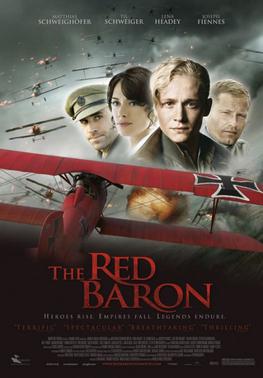
#5 THE BLUE MAX vs. #12 THE RED BARON


VS.


MATCH-UP:  “The Blue Max” (1966) is a fictional story of an ambitious German fighter pilot in WWI who has his sights set on winning the Pour le Merite (known as the Blue Max).  After being falsely accused of violating the unofficial rules for “knights of the air” he becomes a cynical hunter of glory.  His unapologetic quest for kills isolates him from his mates and brings into direct conflict with his squadron commander.  A general makes him into a celebrity, however.  Meanwhile, he is bedding the general’s wife and his competitor’s paramour (who happen to be the same woman).

                “The Red Baron” (2008) is a biopic of Manfred von Richthofen.  It covers just his flying career.  There are two subplots interwoven in the plot.  He meets his eventual vanquisher several times in the air and on the ground.  He also has a romance with a nurse.  This revisionist Red Baron is anti-war and not a cold-blooded killer.  He stands up to the dunderheads that run the air war.

FIRST QUARTER:  Dogfight Quantity

                “The Blue Max”  =  19 minutes
                “The Red Baron”  =  12 minutes

FIRST QUARTER SCORE:
The Blue Max                        10
The Red Baron                        8

SECOND QUARTER:  Plot

                “The Blue Max” has an interesting plot.  Although the basic elements have appeared in other war movies, they are handled differently here.  The ambitious pilot is used by the brass for propaganda purposes, but then they turn on him.  The pilot puts personal glory ahead of teamwork, but the team is a bunch of jerks, too.  These tropes are balanced by a love quadrangle that is soap operaish in its complexity, but at least unpredictable.  Another point in favor of the plot is the fact that there are no likeable characters.   B

                “The Red Baron” is a revisionist biopic meant for a modern German audience.  The softening of his personality works well if you are bringing a date to the movie, but for a war movie lover there is a lot to laugh at here.  It is a very small world for the flying ace.  He encounters both Brown and Kate several times under preposterous circumstances.  Richthofen becomes a post-Vietnam reluctant warrior.  The movie is very predictable.  D

HALF-TIME SCORE:
The Blue Max                        18
The Red Baron                      14

THIRD QUARTER:   Realism and Accuracy

                “The Blue Max” is not based on a true story.  Sachel is a realistic character because some German pilots were obsessed with gaining enough victories (20) to be awarded the Blue Max.  Actually, this was a personality trait of many fighter pilots on both sides.  The higher command and media creating a new type of hero in the fighter ace is a WWI phenomenon.  The love quadrangle is obviously extremely unrealistic. Fokker developing a monoplane late in the war is not tied to reality.  C

                “The Red Baron” is an absolute atrocity as a biography.  It gets Richthofen’s personality and philosophy almost completely opposite of reality.  The real Red Baron had no anti-war qualms and was not the noble knight of the air the film depicts.  In fact, he counseled his pilots to aim for the enemy pilot.  He also was not a particularly daring pilot, preferring to give his target as little chance as possible by diving on him from out of the sun.  Needless to say, there was only one encounter with Brown and most historians do not feel that Brown shot him down.  It should also come as no surprise that he did not have an affair with a nurse.  F

THIRD QUARTER SCORE:
The Blue Max                        25
The Red Baron                      19

FOURTH QUARTER:  Cliches

                “The Blue Max” set the standard for the “pilot obsessed with glory” cliché.  It is the central theme of the film.  The squadron parties hard after Klugermann gets his Blue Max.  Stachel rides on a motorcycle.  Stachel breaks formation against orders to take on an enemy force.  C

                “The Red Baron” begins with a young Manfred watching a plane fly over and dreaming of being a pilot.  (Speaking of inaccuracies, von Richthofen dreamed of fighting in the cavalry, but found it boring.)  He is driven by the thrill of the hunt and competition and has trophies made for each victory.  (In the hagiographic nature of the film, his obsession is toned down.)  The Red Baron loses his Jewish friend and then Voss as part of the movie’s “who will survive?” subplot.  Their air field is attacked which allows the movie to stage a night dogfight.  Von Richthofen courts a nurse.  By the way, in a classic war movie trope, Manfred chooses bros before hos.  D

FINAL SCORE:
The Blue Max                        32
The Red Baron                      25

POST-MATCH ANALYSIS: 


                This match was never close and that should come as no surprise.  This is an exemplification of the downward trend of mass-marketed war movies.  It is obvious that when “The Blue Max” was made in the 1960s, the scriptwriters felt they needed to jazz up the romance component.  However, the rest of the plot is fairly standard.  On the other hand, everything about “The Red Baron” screams “give the masses what they want”.  It is the kind of movie that infuriates war movie fans and historical accuracy sticklers.  Ironically, the movie was a box office bomb.

Friday, April 1, 2011

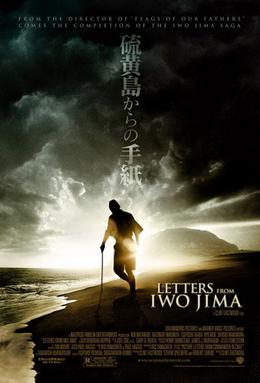
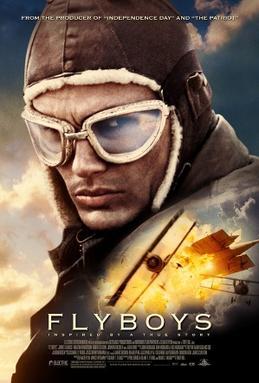
MARCH MADNESS: Letters from Iwo Jima (2) vs. Flyboys (15)


ACTING: “Flyboys” stars James Franco as rancher turned pilot Blaine Richards. It was his first action star turn. His performance is capable, but certainly not noteworthy. The other leads are Martin Henderson as the veteran ace Reed Cassidy and Jean Reno as French Capt. Thenault. No one stands out in this movie. There is a little chemistry between Franco and Jennifer Decker as Lucienne. “Letters” is anchored by Ken Watanabe as Gen. Kuribayashi. He was nominated for the Best Actor Oscar. Kazunari Ninomiya gives a touching performance as the sad sack Private Saigo. The rest of the cast is good.


Score at the end of the first period: Letters – 8 Flyboys – 6

REALISM: “Flyboys” is often ridiculous in its depiction of WWI air combat. It is the U-571 of air combat movies in that it piles every air combat cliché into one movie. The CGI effects are poor. It seems as though every German fighter plane is a red Fokker tri-plane. The squadron is impossibly heterogeneous and the deaths are predictable and foreshadowed clumsily. The scene where Richards lands in no man’s land to rescue a downed comrade is one of the most unrealistic scenes in war movie history. “Letters” is much more realistic, but does have its flaws. It admirably depicts the human frailties and fears of the Japanese soldiers, but probably downplays their fanaticism. The truth is somewhere between the movie and wartime propaganda. The conditions in the tunnels are much too spacious and not nearly appalling enough. The combat is okay, but not intense or brutal enough.

Half-time: Letters – 16 Flyboys – 11

ACCURACY: “Flyboys” purports to be the story of the Lafayette Escadrille which was a squadron of American volunteers who flew for the French air force before U.S. entry into WWI. Some of the characters are based on actual pilots. They are very loosely based on those individuals. For instance, Richards is supposed to be Frank Luke (who was not a member of the Lafayette Escadrille), but other than a western drawl there is little resemblance. Franco does not play him as the lone jerk that Luke was. Cassidy as Raoul Lufbery is closer, but his death is way off. The producers insisted on a black pilot so they jammed Eugene Bullard in as Eugene Skinner, a boxer who retires to be a pilot. The real Bullard was a boxer, but he served in the Lafayette Flying Corps, not the Escadrille. None of the events depicted appear to have happened. “Letters” features two historical figures – Gen. Kuribayashi and Col. Nishi. Their back-stories are accurate. Nishi was an Olympian and both had spent time in the U.S. However, unlike the movie, they were not friends on Iwo and actually were antagonists. Watanabe does a good job portraying the leadership and strategy of Kuribayashi. A key scene where Nishi gives the last of his unit’s morphine to a Marine prisoner surely is not accurate. The movie does not do a good job giving a sense of what is happening in the battle. The plight of the soldiers is accurate, but underplayed.

Score after three periods: Letters – 24 Flyboys – 17

ENTERTAINMENT VALUE: “Flyboys” is definitely aimed at the youth demographic. This explains James Franco as the lead. Since young people have not been exposed to all the clichés, maybe it seems fresh to them. The dialogue is poor. Much of it is ridiculous and some of it is laughable which does make it entertaining in a perverse way. “Letters” is aimed at the exact opposite audience. It attempts admirably to depict the Battle of Iwo Jima in a way sympathetic to the Japanese. The main characters are attractive and you care what happens to them. The combat is above average, but sparse. It does a better job on soldier life.

FINAL SCORE: Letters – 32 Flyboys - 23