“Fixed Bayonets” was
Samuel Fuller’s second Korean War movie after “Steel Helmet”.It was released in 1951 and is dedicated to
the “Queen of Battles – the U.S. Infantry”.Fuller was a decorated veteran of the Big Red One in WWII.His “Big Red One” has autobiographical
elements.The Army insisted that Medal
of Honor winner Raymond Harvey be technical adviser after Fuller had stepped on
Army toes in “Steel Helmet”.Harvey and
Fuller became close friends during production.The theme of the movie is:“It
takes more than brains – you’ve got to have guts to lead”.The film is set in the initial stages of the
retreat from the Chinese intervention of 1951.
The film opens with a general
ordering a platoon of 48 men to fight a rearguard action to screen the
withdrawal of the main unit. As the
rest pull out, the faces on the platoon indicate that they realize they are on
a suicide mission.They set up a road
block and send out patrols.When not on
guard duty, the focus squad of soldiers (which include James Dean in his first
role) huddle in a cave away from the frigid weather.The unofficial commander of the squad is the
crusty Sgt. Rock (you heard me) played by “Steel Helmet”s Gene Evans.The main character is a Cpl. Denno (Richard
Basehart).Denno is tormented by his
inability to kill other human beings.He
had been demoted for this and chastises himself for his reluctance.He also has a great fear of having to command
men in battle.With the chain of command
being whittled down, Denno’s fear is closing in on him.He even risks his life in a minefield to
rescue an officer so he will not have to move up the chain.The dirty rat dies anyhow!Before you know it, Denno is in command.Surprise!He rises to the occasion.Surprise!
Denno is transformed by the
circumstances.He quells a revolt of the
men who want to abandon the road block early.“I’ll clobber the first guy that tries to bug out!”He’s a leader now, but can he kill?An enemy tank provides an opportunity for
redemption.Denno kills a scout and they
take out the tank with several RPGs.Unfortunately, a second tank arrives and it’s time to go.Will they make it back to their main unit?
“Fixed Bayonets!” is gritty partly
because it is low budget.The sound
stages are not going to fool anyone.Neither is the fake snow.However, kudos for being one of the first war movies to emphasize the
effects of freezing weather on combatants.Another effect of the low budget is the feeling that most of the scenes
were done with few takes.The movie has
an almost quaint quality to it.I would
guess that audiences cut it some slack since it was covering events that were
set in the very year that the movie was made.
The acting is fine.Evans builds on his amazing performance in
“Steel Helmet”.The two movies were the
height of his career.Every character
actor should have such on their resume.He gets a great death scene.“I
told you, I’m dead”.Basehart is also
good.His character arc is realistic and
not maudlin.It is very predictable,
however.The rest of the cast is
average.
The dialogue is a strength.The movie is not verbose.The soldier talk is well rendered.Not surprising given the overseeing by Fuller
and Harvey.The interaction in the cave
is a highlight.There is a foot
massaging orgy that only a Fuller film would depict.The unit dynamics are reminiscent of “A Walk in the Sun”.There is a camaraderie that
is evident and does not seem forced.There
is a soldiers’ thoughts segment similar to “Guadalcanal Diary”.A little corny, but with some humor.Speaking of dialogue, one flaw is the
appalling lack of noise discipline by our rearguard heroes.They do a lot of shouting.
The plot is too
predictable.Although the film does not
beat you over the head with clichés, it has some obvious ones.The best example is the redemption
theme.The killing off of the officers
to eventually get to Denno was necessary and somewhat suspenseful.I have to say that for a director who made a
point of insisting his war movies were designed to make future wars more
unlikely, Denno’s quick evolution to a killer tends to dilute that
message.Perhaps he should have remained
the coward that he imagined himself to be.But then, that would have contradicted the main theme of men rising to
leadership when it is thrust upon them.
The movie has some good action
scenes, but the low budget does not lend itself to anything spectacular.There is a realistic artillery bombardment
with good sound effects.The minefield
scene tends to drag on and does not have Denno using proper tactics to avoid
blowing himself up.Surprising since
movie audiences had been tutored on the proper technique of slanted knife
probing from numerous other war movies.And boy, when they set up some dummies to fool the Chinese, those
Chinese mortarmen are incredibly accurate in taking them out.
“Fixed Bayonets!” is an
entertaining war film.It is a step down
from “Steel Helmet”.If you did not know
it, you would assume “Steel Helmet” was made after “Fixed Bayonets!”Where “Steel Helmet” was a revelation and put
Fuller on the map, I find “Fixed Bayonets!” to be a bit disappointing.It is well remembered by critics which means
I feel it is overrated.Considering the
competition from other Korean War movies, it is relatively good.The war did not exactly bring out the best in
Hollywood.
Grade =B-
the full movie
POSTER - Check out that poster. Did the artist even see the movie? It is another example of studios gearing their advertisements to what they think the audience wants to see rather than what is actually on the screen. One has to wonder what Fuller thought of the studio's approach to marketing what he clearly meant to be a film that deglamourized war. "Their story ALL GLORY". Are you kidding me?! Glory is the one word Fuller would not have wanted to be associated with the film. Here is the apporopriate slogan: "Bayonets all bloody... Hearts and feet frozen... Their story ALL SURVIVAL"
Oh, the things a war movie blogger has to do.One of them is going to see the rare war
movie release realizing that it will most likely be terrible (ex.
“Battleship”).I had put off seeing the
new “Red Dawn” because it seems a useless remake of a bad film and I have been
very busy with soccer.However, I could
not let my public down so I bit the bullet and headed for the theater.Being a masochist, I also watched the
original (which I have to admit I had not seen due to the terrible reviews it
got when it came out).What a day!I have cemented my place in war movie heaven
by spending some time in war movie hell.
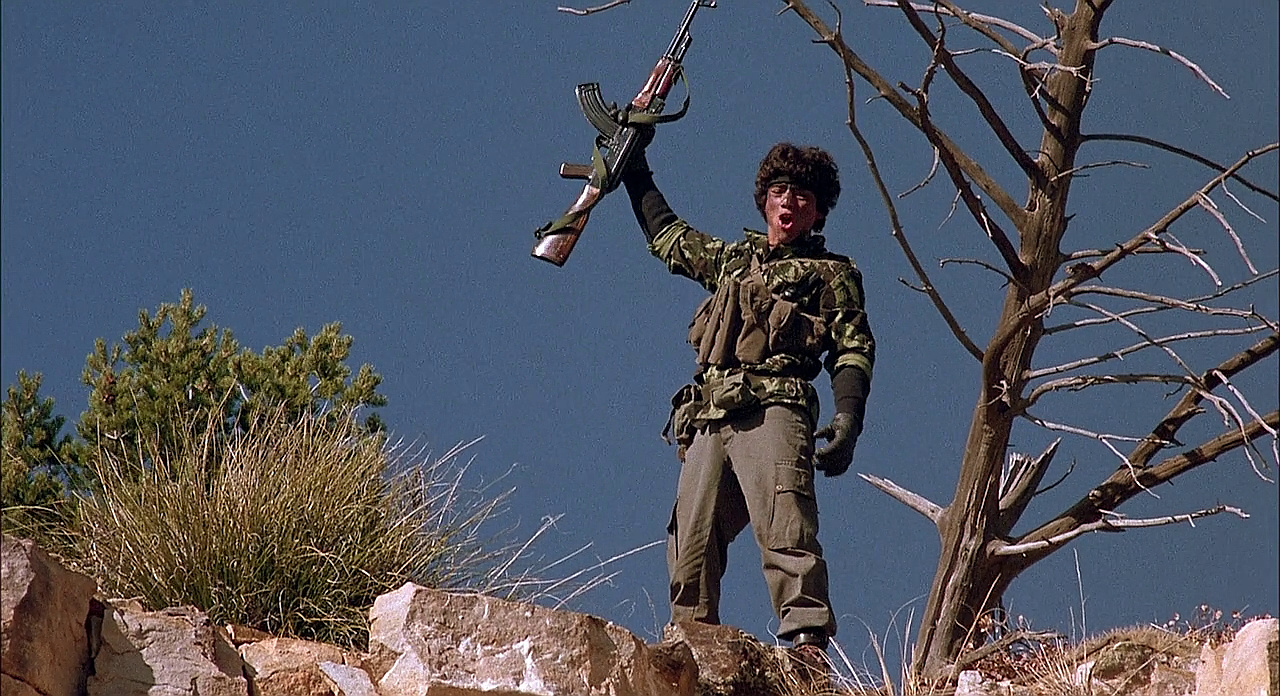
"Wolverines!"
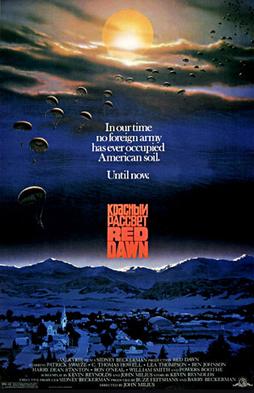
“Red Dawn” (1984) actually has a
pretty good reputation.Apparently there
were a large number of high school boys who saw it in 1984 and there are a lot
of conservatives today that remember it fondly since it fit their fantasy of
World War III.It is definitely a curio
from the Cold War days.Specifically,
the Russians in Afghanistan days.The
opening scrawl confusingly explains that NATO has dissolved, Mexico has gone
communist, and the Warsaw Pact is on the move.Before you know it, Cuban paratroopers are landing in Calumet,
Colorado.An idyllically all-American
town that is of great strategic importance, I suppose.A few high school boys join the slightly
older Jed (Patrick Swayse) in the outdoors.The crew includes his brother Matt (Charlie Sheen).After some hand-wringing (and crying), they
decide to become survivalists.The movie
is probably required viewing for militias.
Dirty Dance with this you commie bastard
The town is under occupation and
any adults (like Jed and Matt’s father) with balls are in a re-education
camp.Books are being burned.The weasely mayor is collaborating (he is a
liberal).There are three villains:the Cuban Col. Bella (who is now on the receiving end of insurgency), a Soviet adviser (who believes in several eyes for an eye), and a
counterterrorist expert Col. Strelnikov (the menacing William Smith) brought in
to hunt down the insurgents.When the
gang (called the “Wolverines”) kills three Soviets, the commies react by
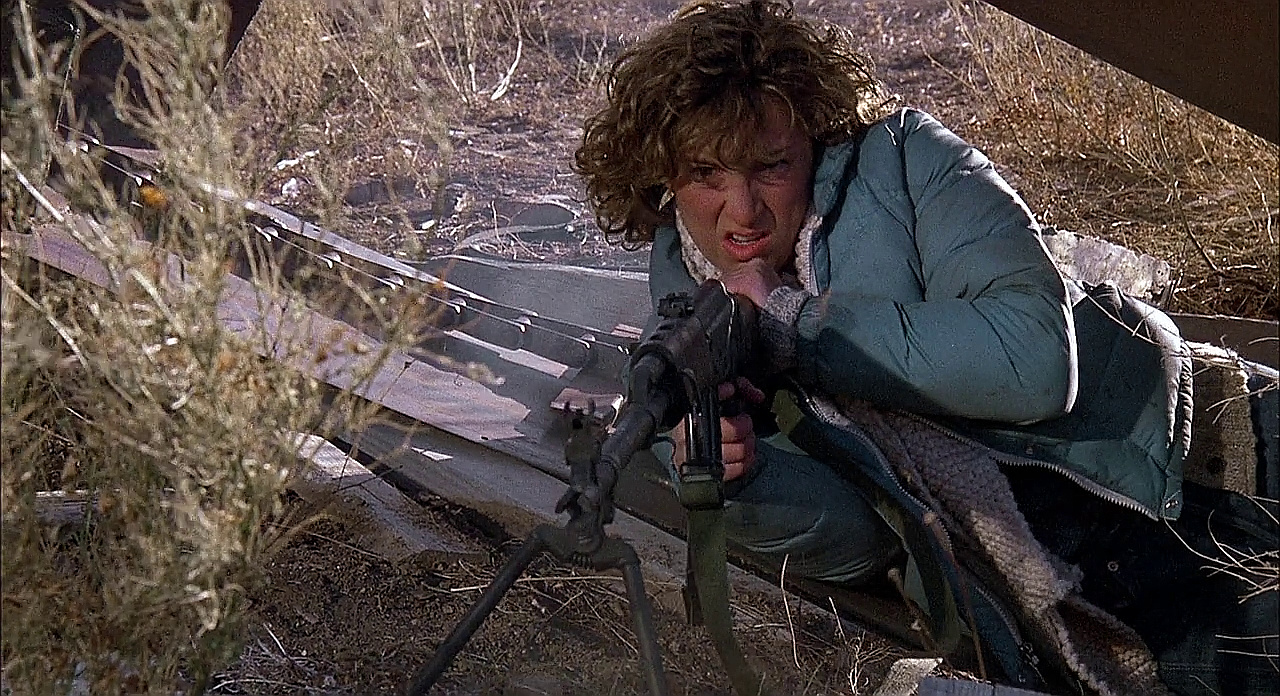
executing civilians including Jed and Matt’s father.It’s on now.They are joined by two girls (Lea Thompson and Jennifer Gray) who
insist on being treated equally and refuse to do the dishes as teenage boys in
the audience snicker.There is a montage
of attacks (including on a Soviet tank crew that stops at a gas station to fill
up with regular).
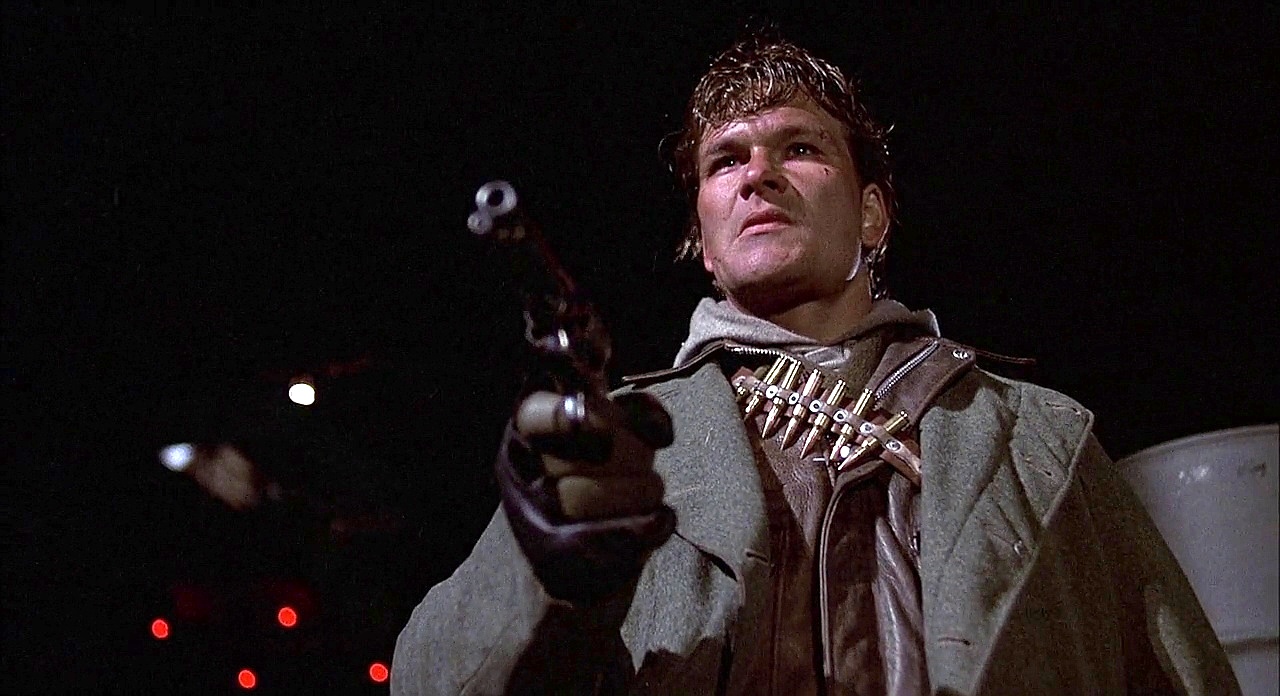
Jed draws down on Strelnikov
The director brings in Powers
Boothe as a downed pilot to provide acting lessons and fill in the audience
with how all this conquest came about.Coming from him it almost seems plausible.There are some bloody fire fights with old
school deaths.The movie supposedly set
a record for body counts, especially for the first PG-13 rated film.They keep getting whittled down, including
the execution of one of their own (the mayor’s son) for swallowing a homing
bug.A couple more go in a surprise
attack by vicious looking Soviet choppers straight out of Afghanistan.The final set piece is Jed and Matt’s two man
assault on enemy headquarters as cover for the escape of Danny and Erica to Free America.Would you believe there is a duel between Jed
and Strelnikov? And an encounter with Bella?
Jed ambushs some Orientals
“Red Dawn” (2012) has the same
basic premise and some familiar elements, but differs in many ways, including
tone.The causes of the war are even
more WTFish.Something about all
American forces being abroad putting out conflicts and this allows the North
Koreans (with their fourth largest army in the world) to swoop in.Their secret weapon is an electro-magnetic
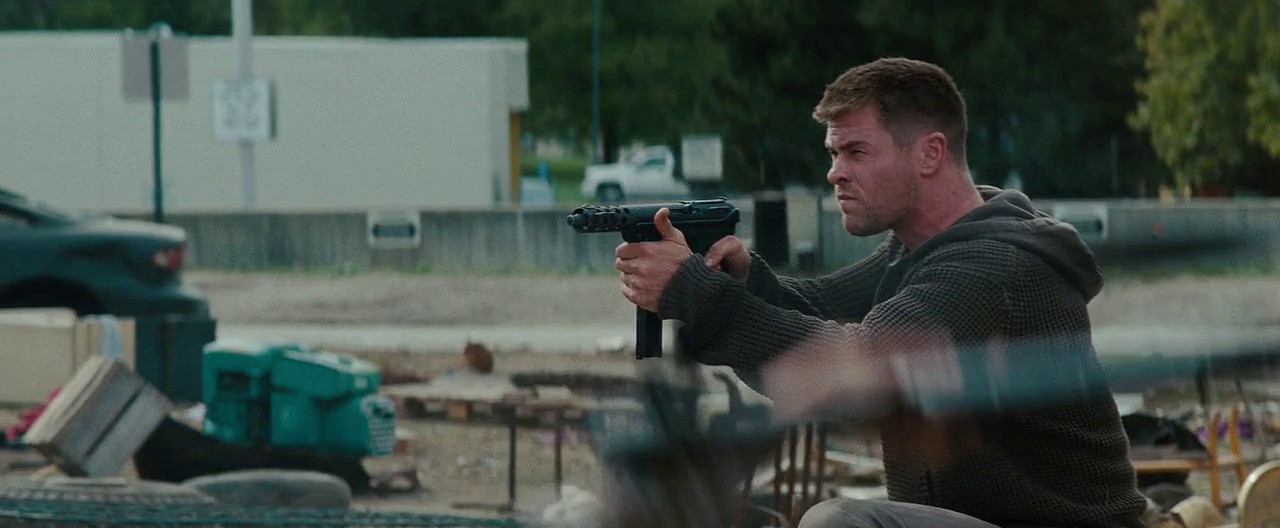
pulse thingy.Who cares?Not 14 year old boys.The brothers are fleshed out a lot more.Jed (Chris Hemsworth) is a Marine on
leave.Matt (Josh Peck) is the starting
high school quarterback.They are at
odds with each other, naturally.Matt is
not a team player.Each is also given a
love interest.Matt’s is the head
cheerleader, surprise!All he cares
about is rescuing her and she isn’t even Megan Fox.The gang is more heterogeneous and the girls
are treated equally from the start.We
get a montage of traininginstead of
attacks.Five minutes of montage can
transform high schoolers into killing machines.
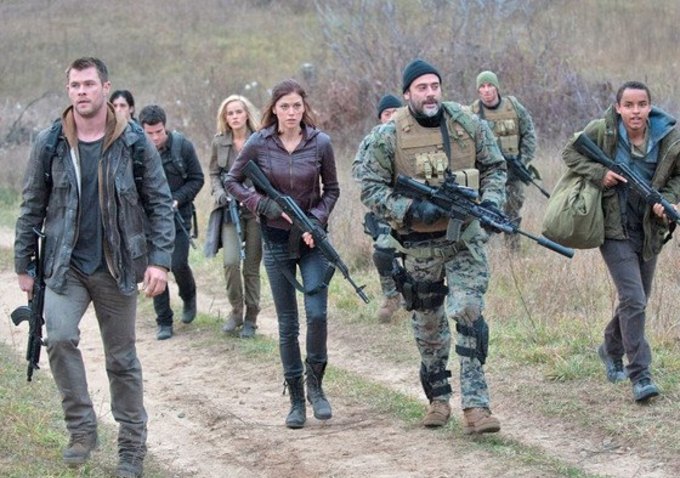
Wolverines + Special Forces
The main villain is a Col.
Cho.He is your typical inscrutable
oriental villain.The kind you can’t
wait to see die in a nasty way.The
movie also throws in a Russian spetsnaz and a slimy collaborating teen. Don’t look forward to their cathartic
deaths.Instead of one downed airman,
this version drops in three crusty Special Forces types to teach and learn from
the Wolverines.
The big finale also involves an
assault on the headquarters, but with the purpose of acquiring a black box that
will change the course of the war.Or so
we are vaguely informed.There is a massive
expenditure of ammo and the grand entrance of a tank through the wall of the
headquarters.Hey, it could happen. There is a much cooler confrontation between Jed and Cho than between Jed and Strelnikov in the original.
How to compare the movies?1984 has more explosions than 2012 (30-23)
which is surprising.2012 has many more
crash-crazy car chases.1984 drowns 2012
in tears.It is one of the weepiest
movies I have ever seen.Even after they
become tough warriors, they still bawl at the drop of a hat.And I’m not talking about the girls.There is a scene where Swayse and Sheen cry
as they see their father for the last time that is hilarious!
1984 has many more terrible acting
performances.You can argue that Swayse
and Sheen became good actors, but they certainly are not there yet.The movie is one of the most poorly acted
films I have ever seen.The dialogue
does not help.At one point one of the
gang actually says “Things are different now”.You think?The acting in 2012 is
tolerable.Hemsworth dominates every
scene.He is charismatic.The rest of the cast does not stand out, but
does not embarrass itself (except Peck who is wooden).The dialogue has some groaners.They are told “you made a difference”.One of the special forces stoically states
“it’s a good day to die”.There’s the
usual “I’m not going to leave you” altruism and the “you fucked with the wrong
family” epithet for a villain.You also
get several talkie dysfunctional brothers’ dialogues.Kudos to 2012 for one unexpected death
similar to Samuel Jackson’s in “Deep Blue Sea”.
Cinematography goes to 2012 unless you get sick
watching hand-held, quick cutting, video gamesque camerawork.1984 is fairly tame in that respect.It doesn’t even have the slo-mo the 1980s are
noted for.The score duel goes to 2012
also.It is revved up and surprisingly
does not have a slew of soundtrack worthy hits.1984 is more cheesily backed.
As far as realism, why argue whether dog shit or cat
poop smells worse?With that said, no
plot could top North f***ing Korea invading the U.S.And you put clips of Obama to imply this
could happen in the near future!In for
a penny…Of course, as you might already
know, the original villains were the Chinese until the makers were contacted by
Walmart (I only made up the Walmart part).Why couldn’t these high schoolers battle aliens or
zombies?Something that could actually
happen.By the way, how does a North
Korean fighter jet participate in a battle in America?Did it launch from one of those North Korean
aircraft carriers? 1984 also featured enemy jets, by the way.
In
conclusion, “Red Dawn” (1984) was worse than I expected and “Red Dawn” (2012)
was better.2012 has some good action of
the modern frenetic variety.The kind
where you don’t have the foggiest idea who just got killed, but you’re pretty
sure it should be everyone. It improves upon the original in almost every way and does not suffer from the common "what the hell is the purpose of this remake" conundrum. It’s just a
shame it had to demonize those nice North Koreans.I hope it doesn’t piss them off to where they
might invade us.The makers of the film
will be held accountable if that happens.It is not wise to poke a chihuahua. Red Dawn (1984) = D Red Dawn (2012) = C+
“Throne of
Blood” was released in 1957 in black and white.It is the retelling of MacBeth by acclaimed Japanese director Akira
Kurosawa.It was originally entitled
“Spider Web Castle”.(“Oh what a tangled
web we weave…”)The film opens with a foggy
view of the destroyed castle, but when the fog lifts the castle is intact –
what a nifty way to flash back!Two
generals named Washizu (Toshiro Mifune) and Miki have just defeated an
invasion.They get lost in “Spider’s Web
Forest”, naturally.They encounter an
evil spirit which predicts that Washizu will become ruler and pass the throne
on to Miki’s son. After an extended silly period of riding back and forth, they
return to Lord Tzusuki castle and are shocked to be promoted just as the spirit
said.
Asaji
Washizu’s wife Asaji (Isuzu
Yamada) is a creepy schemer.She
encourages Washizu to preemptively kill Tzusuki before he finds out about the
prophecy (from Miki).Guess who’s coming
to dinner?The camera stays on Asaji as
Washizu goes off to do the deed.When he
returns with a bloody spear, she puts it with the guards who she had slipped a
mickey to in order to shift the blame.Next up her big sleeved kimono is to remove Miki and his son.She lies and tells Washizu that she is
pregnant.This unhinges Washizu who
hosts a banquet for Miki where he proceeds to hallucinate the appearance of
Miki’s ghost and then proceeds to try to kill it.Could he look more guilty?
Washizu
The chickens come home to roost
as Washizu’s enemies approach his castle.Washizu visits the spirit to get a prophecy update and is assured that
he cannot be defeated unless the trees of the forest attack him.Washizu boosts the morale of his men with
this guarantee of victory.He returns
home to find Asaji feverishly trying to wash bloodstains off her hands.Oh. well, at least there is no chance of
trees attacking.Oops!Here comes the forest.(Actually the enemy has cut down trees and is
using them for cover.)This is the last
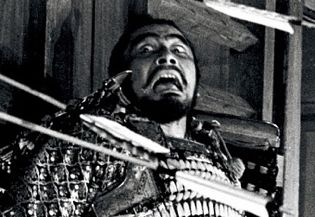
straw for Washizu’s fed-up garrison.They pelt him with a barrage of arrows until one goes through his neck
and he dies looking like a pin cushion.
The movie is bizarrely
interesting.It bears the marks of
Kurosawa’s genius and attention to detail.He filmed much of it on the slopes of Mount Fuji.It is a very foggy movie.There are a lot of shots through the branches
of trees which I am sure has some point to it because the cinematography has
been lauded.Most impressively, the
arrows fired at (but not hitting) Mifune are actual arrows fired by archers
.Mifune’s movements were choreographed and
he waved his arms to show the archers which direction he was heading in
next.This death scene is one of the
most remarkable in movie history.
The acting is top notch,
especially Mifune and Yamada.The plot
is Shakepearean with a Japanese twist. One twist is the spare dialogue.Kurosawa plants the MacBeth plot in Fifteenth
Century Japan during the period called Sengoku Jidai (“The Age of the Country
at War”).This era of political chaos featured
wars between rival clans marked by treachery and assassinations.He also blends in elements of Noh Theater
like the flutish music, bare sets, and the formalized performances.It is a fascinating film, but not really a
war movie. Classic or antique? Definitely a classic.
BACK-STORY:“Zulu” was released in 1964 and
was so successful that it not only resurrected the Battle of Rorke’s Drift, but
molded the modern image of it.The film was a labor of love for Stanley
Baker. It was directed by the
blacklisted Cy Endfield.After The House
Unamerican Activities Committee branded him a communist, he moved to England to
continue his career.The movie was
filmed on location in South Africa.700
blacks were used as extras.Many of them
were descendants of the Zulu who participated in the battle. So many had never seen a movie that Endfield screened
an old Gene Autrey film for them.Because of apartheid, they could not be paid so Endfield let them keep
the cattle.
OPENING:A narrator (Richard Burton) reads
a dispatch outlining the British defeat at Isandlwana on Jan. 23, 1879.We see the aftermath of that disaster in the
corpse-strewn British camp.The scene
shifts to a Zulu village where a missionary named Witt (Jack Hawkins) and his
daughter Margareta (Ulla Jacobsson) witness a marriage ceremony.It’s a fascinating slice of Zulu
culture.They leave for their mission at
Rorke’s Drift when word of Isandlwana arrives.
Chard is in command
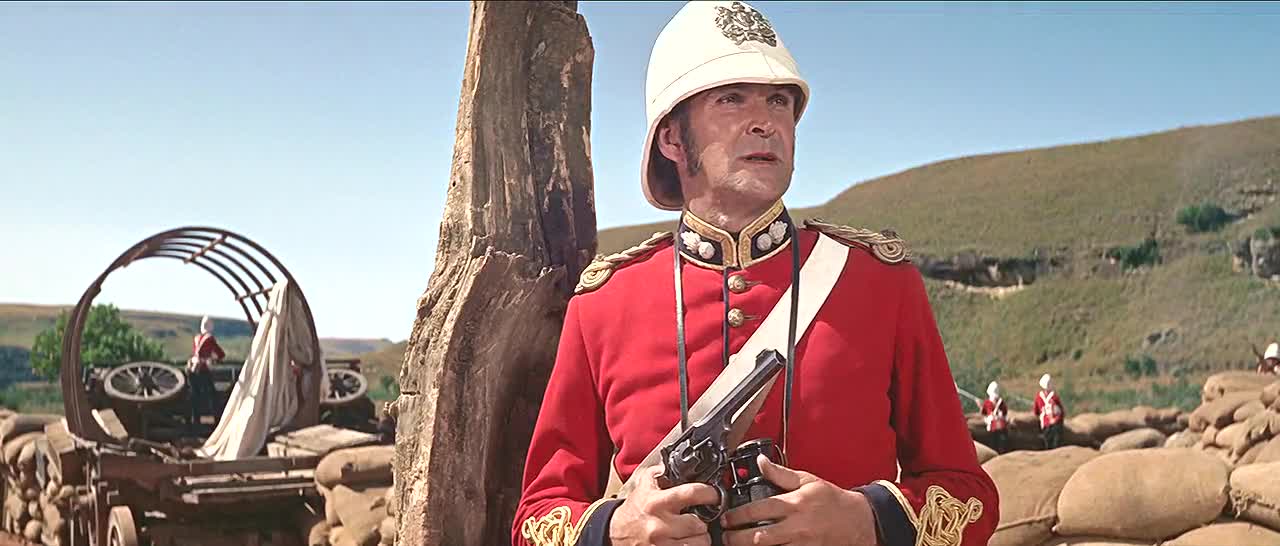
SUMMARY:Back at Rorke’s Drift, Lt. Chard
(Baker) is building a bridge.He meets
Lt. Bromhead (Michael Caine in his first major role) who has been left in
command.Bromhead is your typical upper
class officer who is touchy about his status.When they are alerted to the approach of a large force of Zulu warriors,
Chard assumes command based on being commissioned three months earlier.He orders the position be prepared for
defense using mealy bags, crates, and overturned wagons.He rejects Bromhead’s suggestion of
evacuating the post.The decision to
stay and not even evacuate the wounded sets off Witt who is a pacifist
Bible-thumper who considers the Zulu king to be a member of his parish.He is also a closet alcoholic who gets
himself and his daughter kicked out of the camp while ranting that they are all
going to die.This sobers up the men,
but they continue to prepare calmly for the onslaught.
We
are introduced to some of the soldiers (especially the future Victoria Cross
recipients).The standouts include
Colour Sergeant Bourne (Nigel Green) who stoically ramrods the enlisted.Private Hook (James Booth) serves as the
film’s anti-hero.He is a malingering,
petty thief, malcontent.Will he find
redemption as a real hero?Duh!
Bromhead joins in
An
eerie train-like droning noise heralds the approach of the enemy.The suspense builds as they sneak up and then
launch a frontal charge which comes to a surprise halt within rifle distance of
the British line.A Boer ally named
Adendorff informs Chard that the strange tactic is not to allow for the standard
Gunga Dinish wanton slaughtering of the natives, but in fact is the Zulu
leader’s way of determining the fire power of the defenders.Get your calculators out if you want to find
out whether this movie will approach a “Where Eagles Dare” death count.
there is a Chinese laundry at the post
As
though things are not bleak enough, a unit of the enemy is positioned on a hill
where they can use their newly acquired British rifles to harass the
defenders.When one soldier asks “why
us?”, Bourne responds with “because we’re here”. The second attack breaches part of the wall
and leads to hand to hand (or bayonet to iklwa) combat.There are a series of attacks followed by lulls
in the fighting.The casualties mount,
but none of the Brits panics.They all
have their upper lips stiff or their cheek on (as in the case of Hook).Chard is growing into command and Bromhead
proves an able second.At one point,
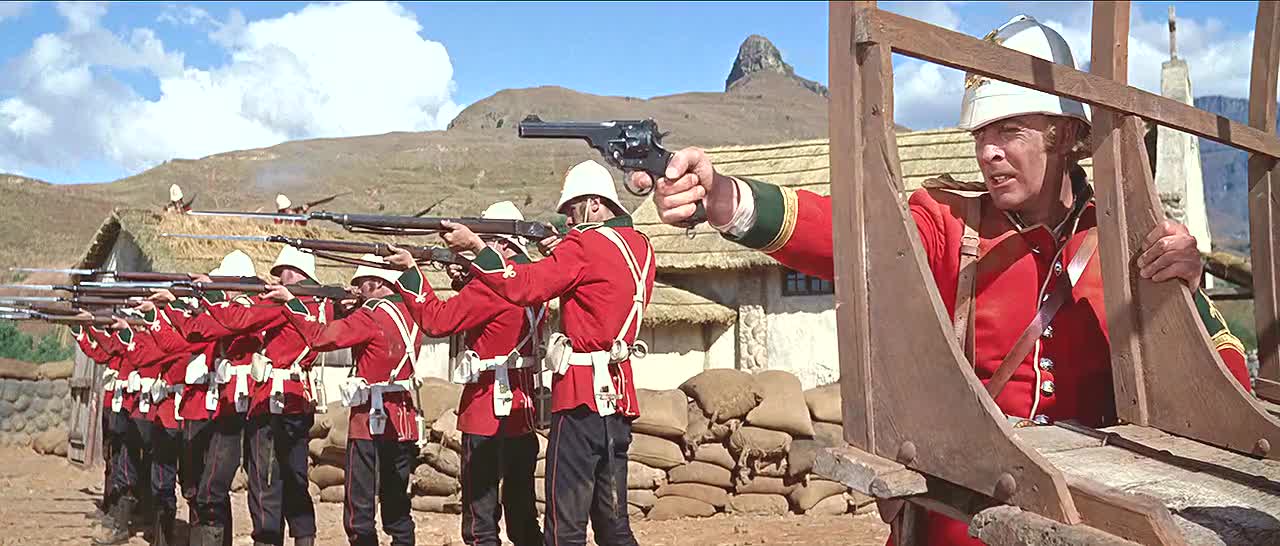
Chard calls for firing by ranks in a mini-counterattack.Discipline and firepower – how an empire was
won.
The
fifth attack reaches the hospital.Bromhead fights on the roof and Hook leads the interior defense.The building catches fire to add to the
chaos.Hooks throws on the mantle of a
hero, but wears it reluctantly as he stops to take a drink of medicinal alcohol
before being the last to leave the burning building.A cattle stampede breaks the momentum of the
assault.Attacks continue in the night,
but we are swiftly in the broad daylight of the second day
CLOSING:The Zulu serenade the British
with a war song so the Brits respond with the regiment’s anthem, “Men of
Harlech”.“Keep these burning words
before ye / Welshmen will never yield”.Could this be a Hollywood moment?The final assault is defeated with three lines of British riflemen using
coordinated volleys.Result:a pile of black bodies.A mad minute of European fire power ends the
native dream of evicting the foreigners from their land.Just when it looks like it’s over, the Zulus
mass again on the hillside.However,
this time it’s to acknowledge respect for fellow warriors.Richard Burton’s voice returns to check off
the eleven VC winners.
RATINGS:
Acting -B
Action – 9/10
Accuracy -C+
Plot -A
Realism -B
Overall -A-
WILL CHICKS DIG IT?Very unlikely.This movie is testosterone-fueled.The one female character is not a positive one and disappears early in
the film.On the plus side, the movie is
not particularly graphic.
HISTORICAL
ACCURACY:The Battle of
Rorke’s Drift took place during the Anglo-Zulu War of 1879.The war was brought about because of British
desire to expand its South African colony into Zululand.They manufactured a threat from the Zulus as
their provocation and used it as justification for an invasion.King Cetshwayo wanted peace, but could not
meekly accept his own overthrow and annexation of his land.The movie does not explain the background to
the war possibly because the British did not want to mar the feel-good aspect
of such a sterling battle.
The
allusions to the Battle of Isandlwana are accurate.The British central invading column did get
wiped out by 20,000 Zulu warriors.However, King Cetshwayo did not follow this up with the attack on
Rorke’s Drift as the movie implies.The
attack was the idea of his glory-seeking half-brother whose unit had not gotten
to Isandlwana in time to participate.In
fact, the King had forbidden his forces to go on the offensive into British
territory.
The
recreation of the hospital/supply depot is accurate.It was leased by the British government from
the missionary Witt, but his depiction is way off.The real Witt was married with two young
kids.He was not a pacifist, nor a
drunkard.He supported British
policies.The Zulu king was not a
parishioner of his.He was not drummed
out of the camp, but left voluntarily to see after his family.His is not the only mischaracterization.The most egregious is Hook.He was not the malingering malcontent
depicted in the film.He was actually a
solid soldier and a teetotaler.His
portrayal was so offensive that his daughters walked out on the premiere.Bourne was actually very young for a Colour
Sergeant and also slight in stature.The
doctor was not cynically anti-war and earned his VC by leaving the hospital to
tend the wounded on the front lines.Not
to mention the unit itself is misidentified.In the movie it is identified as a Welsh regiment when in reality it was
not predominately Welsh.
Some
of the incidents are close to reality.The native levies did flee before the battle, but not because of the
rantings of Witt.They were actually led
out by their British officer who was subsequently court-martialed.The Boer cavalry that refuses to augment the
defense actually stayed for the early festivities, but left after its cavalry
carbine ammunition ran low.Chard was
actually appointed to command by the unit’s captain before he left.This was partly based on seniority, but he
was commissioned three years before Bromhead.They did not disagree on strategy and Chard actually favored a
withdrawal.It was Acting Assistant
Commissary Dalton who pointed out that a small column slowed by wounded would
be easily caught and wiped out.
Although
Adendorf accurately describes the Zulu tactic described as “the horns of the
beast”, the movie does not depict them using this tactic.This might truly reflect the battle as the
attacks are best described as piecemeal.The Zulu spear called an iklwa (the sound it made when being pulled out
of a wound) is authentic.It was a
variation of Shaka’s assegai.They also
carried the cow-hide shields shown in the film.Unfortunately for realism, this force would not have had access to
looted British rifles to snipe with.Like most Zulu units, they would have had an assortment of inferior
guns.Five of the seventeen British
deaths were from gunfire.The British
weaponry is accurate.
The
battle itself has some problems.There
is no evidence for the opening “cannon fodder as intelligence gathering”
gambit.The assaults were more
consistent and not as easily differentiated as in the film.The assault on the hospital, its defense led
by Hook, and its subsequent burning are pretty close.They did cut holes through the walls to go
from room to room.The last survivors
exited from a window, not out the back door.Strangely, the movie foregoes the suspense of the consistent night
attacks which tapered off after midnight.They ended around 2 A.M. and the subsequent gunfire was over by sunrise
thus ending the battle.There was no
climatic charge after dawn.
It
will not surprise that there was no sing-off.Plus the song would not be the unit anthem for another two years.It goes without saying that the Zulus did not
salute the courage of the Europeans.As
far as why they withdrew, a final decisive assault was abandoned with the
approach of a relief force (“the cavalry was coming”).By the way, the movie leaves out the post
script of the British dispatching any wounded Zulu.On a similar note, the British actually lost
only 17 dead in the battle – the movie gives the impression it was quite a bit
more.
CRITIQUE:“Zulu”has many strong elements.The set is authentic and the scenery is amazing.The movie was filmed in a national park
which, although hillier than the real locale, certainly added to the
visuals.The music by John Barry is used
sparingly, but effectively.Some scenes
have little or no background music.A
good example is the opening attack which is allowed to build without
music.The cinematography is
outstanding.It’s old school without the
modern pizazz, but you are in the thick of the fighting.The acting is excellent.Jack Hawkins chews the scenery a bit, but
everyone else controls himself like a proper British soldier would.Baker, Caine, Booth, and Green are
standouts.The most remarkable
performances are by the Zulu extras.They
are naturals.That Gene Autry movie must
have really done the trick.
The
movie gets the small things right.The
soldier behavior is true to British soldiers of that era.Their dialogue is not forced or
cringe-worthy.The comroderie is
evident.There are several friendships
that are highlighted.The soldiers’ bond
is apparent.There is not a lot of
humor, but then there is not a lot to laugh about.There is also very little whining.Hook is the only soldier who appears to be
avoiding combat. A bit unrealistic.The movie does not play up the chasm between
the upper class officers and the lower class enlisted which is often a theme in
movies about the British army of that time period.
The
character development is well done.The
movie does a good job of fleshing out all of the VC winners and several more
roles.Each man is distinct (although
name tags would have been nice).The
evolution of Chard from engineer building a bridge to combat leader is
instructive.There is a quiet moment
when he goes from trembling hand while reloading his revolver to
steadiness.Of course, the most
fascinating arc is that of Hook.It’s a
bit cliché, but it works.He could have
been a tedious character ( he reminded me of some of my students), but Booth
does a good job making him a likeable rogue.His swigging on the broken liquor bottle before fleeing the burning
hospital is another nice touch.
As a
movie about a battle, “Zulu” is one of the best.This is partly because it has few
frills.It concentrates almost totally
on the battle and the men who fought it.The tactics are realistic although some of them have a textbook feel to
them.In reality, it is doubtful the
British used the variety the movie depicts.That’s acceptable for entertainment purposes.The action is intense and edge of your seat.The deaths are swift and not
melodramatic.There are no death
speeches.
The
movie is not without flaws.I have
already expounded on the historical inaccuracies.One problem is the lack of background about
what brought on the war.The audience is
treated to a fair treatment of the Zulu.They are not demonized as the Indians were in most Westerns and they are
shown as brave warriors, but it is not made clear that they were in the
right.We are manipulated to root for
the Europeans instead of the natives fighting for their lands and liberty.A related flaw is the lack of a Zulu
perspective.This is perplexing given
that the movie opens in their village with an interesting take on their
culture.
CONCLUSION: The ranking of “Zulu” at #22
appears to be appropriate.It is not a
great war movie (as some claim), but it is certainly very good and accomplishes
its mission effectively.I am little
uncomfortable with this.As a war movie
lover, I really enjoyed the movie.But
as a military history buff, I can see how the movie used a different medium to
do in the 1960s what the British government used the newspapers to do in the
1870s.Think about it – 11 Victoria
Cross winners!Assuming a Victoria Cross
is equivalent to the Medal of Honor, it should take extreme bravery to be
awarded one.Not taking away from the
defenders, but it would appear the British government was looking for a
civilian morale booster to soften the Isandlwana disaster.The movie does a similar job in glamorizing
the imperial days of England.Unlike its
most obvious equivalent (Wayne’s “The Alamo”), the film does not recreate the
myths, but instead actually creates the myths.
the trailer
the full movie
a neat battle scene
POSTER - Outstanding. A+ TRAILER - Disorganized. Doesn't give a clear picture of what the movie is about. C