Showing posts with label Cheyenne. Show all posts

Monday, August 8, 2011

#55 - She Wore a Yellow Ribbon (1949)


BACK-STORY: “She Wore a Yellow Ribbon” is a western/war movie released in 1949. It was the second of John Ford’s cavalry trilogy and the only one in color. The other two were “Fort Apache” and “Rio Grande”. All three starred John Wayne. The movie was set in Monument Valley. Ford used the paintings of Frederick Remington for inspiration and ideas. The title is a song associated with the U.S. Cavalry and alludes to the cavalryman giving his love a yellow ribbon. One of the stars is the horse “Steel” ridden by Ben Johnson. This horse was popular with western stars. The movie was awarded the Oscar for Best Color Cinematography to Winton Hoch. The film was a big hit.


OPENING: The movie opens with the iconic theme song. A narrator informs us the story takes place after Custer’s Last Stand. Word spreads via the telegraph and Pony Express. The Indian tribes are in rebellion and are uniting “in a common war against the U.S. Cavalry”. At Fort Stark, the elderly Capt. Nathan Brittles (Wayne) is only six days from forced retirement. Sgt. Quinncannon (Victor McLaglan) is also near the end. He is Irish so he drinks a lot, but in a humorous way.

SUMMARY: The death of the paymaster by Indians clues the fort in to the fact that the Southern Cheyenne are on the warpath. They know it’s the Southern Cheyenne due to the markings on their arrows. That night Brittles make his nocturnal visit to his wife and kids’ gravesite. In a touching scene, he talks to her. The commanding officer decides his wife Abby (Mildred Natwick) and niece Olivia (Joanne Dru) need to go back east via the stage coach. He orders Brittles to escort the ladies to the stage station and shoo the Indians back to their reservation. Olivia is wearing a yellow ribbon, but for who? Her suitors are Lt. Cohill (John Agar) and Lt. Pennell (Harry Carey, Jr.). Cohill is the career trooper who is not romantic and Pennell is the wooing easterner who is willing to leave the Army for Olivia. The one time they are going to duke it out over her, Brittles breaks it up. Guess which one she ends up choosing? Hint: the one she argues with the most. Snippiness = love in Hollywood.

Cohill and Olivia hating each other
      The mission takes the unit through some beautiful scenery and they even encounter a buffalo herd. The Indians feel the return of the buffalo is a sign that their medicine is working. Brittles sends ex-Rebel Sgt, Tyree (Ben Johnson) and his horse (Steel) to locate a patrol. When asked for his opinion on matters, Tyree famously responds with: “My mother didn’t raise any sons to be makin’ guesses in front of Yankee captains.” Surprise, Tyree runs into a passel of whooping Indians (the Indians whoop a lot in this movie). There is an exciting chase scene that ends with Steel jumping over a canyon. The patrol also gets chased by Indians, but finds refuge with the column. One of the men is wounded which requires a bullet extraction in a moving wagon with the back drop of a lightning storm. This was not part of the filming schedule, but Ford insisted over the protest of Hoch that the situation be used. Great call!

"Troop, halt!"
     The stage station has been raided, so no stage coach for the gals. One of the dead is an ex-Confederate general serving as a private. The U.S. Cavalry was an institution of reconciliation after the Civil War. Brittles and a few others sneak up on an Indian camp to witness the Indian agent selling repeating rifles to the warriors. Things go bad for the villainous whites and Brittles stoically watches the torture of one of them. Does anyone want a chaw of tobacco?

     The mission is a failure and the unit has to cross a river to return to the fort. Brittles leaves Cohill and two squads behind to guard the ford. The unit slogs back into the fort and the next day Brittles awakes to his last day in the Army. The movie needs a dose of humor and fisticuffs so Brittles has Quinncannon put on his “monkey suit” and go to the canteen for a drink and then orders his arrest for being out of uniform and drinking. (I did not quite follow the reasoning behind this – something about Quinncannon would be better off spending the rest of his enlistment in the brig. Anyway, it was an excuse to have a barroom brawl). The Quinncannon versus six fight is entertaining and worth the ridiculous setup.

Brittles with his watch
     Brittles gets a sentimental farewell from Company C that includes a silver pocket watch. Touchingly, he has to pull out his spectacles to read the inscription. He is off to California (with just the clothes on his back?), but ends up joining Pennell who has been sent to rescue Cohill. Cohill doesn’t need rescuing (in a missed opportunity for gratuitous shooting of whooping Indians off their horses), but there is still that Southern Cheyenne problem. Fortunately, Brittles still has four hours available. He rides into the Indian camp to smoke the pipe with old friend Pony that Walks (Chief John Big Tree in an endearingly eccentric performance). The chief tells Nathan that he has no control over the young men. Oh well, enough talk.

     Brittles locates the Indian pony herd and stampedes it through the Indian village that night. Although it is a surprise, the Indian braves come running out of their tepees fully clothed. No troopers are even wounded and I did not see any Indian casualties either. Indians without horses must return to the reservation. Insurrection over.

CLOSING: Brittles rides off into the sunset (literally) which would be an appropriate ending, but a letter arrives promoting him to Lt. Col. of scouts and Tyree rides off to bring him back. His return interrupts the celebration of the engagement of Cohill and Olivia. Brittles goes to update his wife on his promotion.

RATINGS:

Acting - 8


Action - 6


Accuracy - 6


Realism - 6


Plot - 6


Overall - 6

WOULD CHICKS DIG IT? Probably. It is definitely not hard core. What little violence there is, is tame. The love triangle is lame, but it does not consume the movie. Millard Natwick as Abby is feisty and has some good moments (e.g., the wagon operation scene). Joanne Dru is out of her league here, but is adequate.

ACCURACY: The movie is not based on an historical event, but the opening narration could give that impression to a gullible audience. The narration starts the movie off on a shaky historical footing. The only thing it gets right is Custer was defeated. The Indian tribes seem to be randomly selected. The Kiowa, Comanche, and Apache were not involved in the Battle of Little Big Horn and the statement that the various tribes were united against the U.S. Cavalry is laughable considering the inability of the tribes to unite on anything. There was no Indian uprising. The Indians were simply fighting against white encroachment into their lands.. Custer’s Last Stand did not result in tribes leaving the reservations. The ones that were at war either were already off their reservations or, more likely, had never been confined to one (yet). The reference to the Pony Express spreading the word is very sloppy history. It had ceased to exist fifteen years earlier.

     The depiction of the cavalry is pretty realistic, although a bit idyllic. Ford is paying tribute to the “dog faces” and their thankless task of taming the West, but it is a no warts portrayal. All of the troopers are respectful gentlemen who are dedicated to their duty. They all are dressed for parade. There is no salty soldier talk and that’s not just because Quinncannon tells them to “watch them words”. (Followed by an anonymous “watch them grammar”.) There are no negative characters in the unit. The two suitors are respectful of each other. Brittles gets along well with his commanding officer. There is little tension. The ex-Confederates don’t even get teased. Only one trooper is a drinker and he is shown in a positive light. A typical western fort would not have been as “clean” as this.

     As far as the Indians, they are typical John Ford caricatures. They are all dressed for the Hollywood warpath. Lots of reds and war bonnets. These are the best dressed Indians on the Plains. No poverty here. One accuracy is the inability of the elderly chiefs to control the young men. And there is a travois in one scene.

"Is that whiskey on your breath?"
CRITIQUE: “She Wore a Yellow Ribbon” is a good Western. Ford is Ford. Wayne is not Wayne. Both of those statements are a good thing. This being a typical Ford movie, the use of Monument Valley is awesome. The theme of the selflessness of the cavalry is well done, if a bit overdone. The characters are stock, but entertainingly so. The movie does not force a heterogeneous, multi-ethnic unit on the audience (which is actually not realistic to the post-Civil War Army, by the way). Wayne fans will be comfortable with the familiar faces in the cast, especially McLaglan.

     The movie is well acted. Wayne is outstanding in playing against type. He was only 41, yet plays a 61 year old. Brittles is a grizzled veteran, but he has not been hardened by his experiences. He is a father figure to his men. He takes Olivia under his wing and mentors Cohill and Pennell. He is a loyal friend to Quinncannon. He was obviously a caring husband and father. There is no strutting here and in fact Wayne adds nice touches like arthritis in the joints.

     The score is hit and miss. Invariably, when the Indians appear, we get generic Indian music. You could have your eyes closed and be able to tell who is on screen. However, the music is tempoed according to the action which adds to the scenes that have movement. The theme song is effectively used at strategic moments.

     The movie is beautiful to watch. The cinematography is outstanding. The reds are a bit distracting though. The use of the lightning storm was clever and it is ironic that Hoch complained about the lighting considering that scene probably helped win him the Oscar.

     It is commendable that Ford does not go for mindless action and wanton killing of redskins, but he perhaps went too far. Other than the Indian agent, I cannot recall anyone getting killed. He strands Cohill and the forlorn hope at the river crossing with the implication of dread, then there is no payoff. The stampede of the herd through the village is thundering, yet bloodless. Even the fight between Cohill and Pennell is aborted. The only real fight is a comical one.

CONCLUSION: “She Wore Yellow Ribbon” is an entertaining Western, but it is not a war movie and does not belong on this list. I have a problem with taking a movie that is firmly in one genre and then putting it on a list of great movies in another genre. There are few Westerns that I feel can clearly be considered war movies and Westerns. A rare example of this hybrid would be “Son of the Morning Star” which is specifically and accurately about a battle in the Indian Wars (the Battle of Little Big Horn).


Wednesday, June 1, 2011

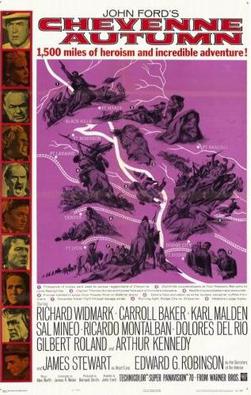
BOOK/MOVIE: "Cheyenne Autumn"


     Cheyenne Autumn is an historical novel about the Northern Cheyenne Exodus from their reservation in Indian Territory back to their homes in Wyoming in 1878. Sandoz starts by describing the appalling conditions in the south and the mood of a people who had been repeatedly lied to by white authorities. When they finally have had enough, they leave on a perilous 1,500 mile trek through hostile territory with little food, weapons, horses, or hope. They start with 284 ragged Cheyenne with only 87 warriors. They are led by Little Wolf (carrier of the Sacred Bundle) and Dull Knife. Both chiefs want to avoid war with the whites, but have trouble constraining the young men who hope to count their first coups and hunger for revenge for white atrocities.


     The Cheyenne are continually dogged by Army units. Even though they are short of guns and ammunition, they manage to beat off numerous attacks. In one battle, Little Wolf sets up a classic ambush and warns the young men to wait until the soldiers are completely in the trap before opening fire. Not surprisingly, one of the braves ruins it by firing an early shot. The white commander then flanks the Indians, but the Cheyenne avoid destruction when he is wounded and the soldiers retreat.

     Sandoz fills the reader in on the previous battles involving the Cheyenne as background to explain the plight of the people and how innocent Cheyenne were killed in past encounters with the whites. It is clear that both sides were to blame for murders on this trek, however. Especially in travelling through Kansas, the Indians do some thieving and killing, most of it justified. These actions enrage the white frontier and it does not help that the media greatly exaggerates the depredations. Ironically, by the end of the trek, many whites have become sympathetic to the “noble red men”.

     The tribe splits when it reaches the edge of their old hunting grounds. Dull Knife decides they have come far enough and the suffering is too great so he wants to go in to Red Cloud’s Agency. Unfortunately, the sympathetic Sioux leader is prevented from accepting them. During a blinding snow storm, Dull Knife’s band is blocked by an unbeatable military force and he surrenders. His people are led to Camp Robinson where they are at first given some freedom, but later the decision comes from the Great Father that they must return South. Dull Knife refuses to go and threatens suicide. “’We will never go back there; we will die first,’” Dull Knife said once more, the words already so worn from repetition they had no life, only the stench of something long dead. The answer they got was the same old, old admonitions to wait, more of the lifetime that they had waited on the Great Father.” Capt. Wessells, in command at Fort Robinson, has them locked in a barracks without food, water, or fire. One unfortunately moonlit night, the desperate Cheyenne break out with the few inadequate weapons they have hidden. A running battle occurs with many of the men, women, and children killed on the snow covered prairie. Many of them are murdered. This culminates in an assault on the last refuge of the last group of survivors in a pit (“The Last Hole”) at Warbonnet Creek. All of the men are killed along with most of the noncombatants. They go down fighting in a hopeless cause.

     Meanwhile, Little Wolf and his band are miraculously moving undetected closer to their destination of the Yellowstone River. They spend over a month recuperating in a secluded valley. Eventually, they must move on and get surrounded by troops led by their friend Lt. Clark. “White Hat” Clark convinces Little Wolf to give up for the sake of the survivors and come in to Ft. Keogh. Little Wolf consents and the trek ends. As a post script, Little Wolf kills Thin Elk, who had been flirting with his youngest wife throughout the journey. Having killed another Cheyenne, Little Wolf gives up his position of carrier of the Sacred Bundle.

     The movie “Cheyenne Autumn” directed by John Ford was “suggested” by the book. It covers the broad outlines of the novel. The movie starts with the Indians leaving the reservation because the last straw is the failure of a congressional delegation to arrive on time. They are led by Dull Knife (Gilbert Roland) and Little Wolf (Ricardo Montalban) carrying the Sacred Bundle. They are joined by a Quaker schoolmarm named Debra portrayed sanctimoniously by Carol Baker. Capt. Archer (Richard Widmark) is sympathetic, but gives chase. By the way, he is in love with Debra. It is unclear what he will do when he catches the Indians, but the arrival of his commanding officer (Maj. Brayton) with two cannons, results in a battle where the Indians are wantonly bombed, but strike back by running off the cavalry horses. Brayton, an obvious Indian hater, is killed thus avoiding the messy court-martial he had threatened Archer with.

     Archer also has his own eager young men to deal with. They are personified by Lt. Scott (Patrick Wayne) who disobeys orders and launches a frontal attack that results in an ass kicking by the Indians who have set the prairie on fire. Later, of course, Scott becomes an admirer of the Cheyenne. The Indians continue on their way, but with little effort by the filmmakers to show the hardships heartbreakingly chronicled in the book. In fact, the Indians all seem to be well-armed with repeating rifles which is the exact opposite of the book.

     The lover’s triangle makes it into the movie in the form of Red Shirt (Sal Mineo) wooing Little Wolf’s wife. To add conflict, Red Shirt is Dull Knife’s son. The movie introduces Secretary of the Interior Carl Schurz (Edward G. Robinson) as a friend of the Indians and defender of them from the machinations of the railroads and their allies, the Army.

     Midway through the film, Ford inexplicably detours to Dodge City for comic relief centering around Wyatt Earp (James Stewart) playing cards and then leading a drunken posse (replete with a portable saloon) after the Indians. The expedition is brought to a chaotic halt when a lone Indian opens fire and a shot sets off the ammunition wagon like fireworks. This segment was mercifully removed from the film for its second and third runs.  (It does have a hilarious line where Earp looks down at the crotch of a prone whore and finally remembers her from Wichita City).

     The Indians break up with Dull Knife going in to Fort Robinson. Archer’s unit arrives soon after. Wessells (Karl Malden) is portrayed as an Indianophile who is just following orders by locking up the Indians. Archer is upset and leaves for Washington to plead the Indians’ case. Wessells goes overboard with the “no food, water, or fire” threat and gets the break-out which is shown as a brief, bloody escape. Next thing we see is Dull Knife reuniting with Little Wolf. There is nothing about all the deaths in the escape. Soon, Archer arrives with Secretary Schurz and they persuade Dull Knife and Little Wolf to take a gamble that Schurz will be able to get them fair treatment. The next scene implies that he does exactly that. In actuality, the real Schurz favored shipping them south. The movie closes with Little Wolf calling out Red Shirt and then gunning him down before he can fire a shot. Little Wolf hands over the Sacred Bundle to Dull Knife and rides off into the sunset.

     The book is much better than the movie. Although a novel, Sandoz has written the definitive history of the Northern Cheyenne Exodus. Sandoz is able to write like the Cheyenne spoke which makes the novel different and intriguing. She uses the sparse Indian way of speaking. She intersperses Indian words like “veho” for whites and Indian similes. The book also is excellent on Indian life, containing many intimate details. It is at its best in putting the reader into the minds of the Native Americans. You clearly see how their way of thinking differed radically from the veho.

     The book is heartbreaking, yet inspirational. I was constantly amazed at how this ragged band was able to survive under such harsh conditions. Not only are they lacking in guns, but some of their cartridges are lacking in gunpowder! They survive encounters with Army units that they had no chance against. Some of it is luck and some of it is moral superiority. You root for them even though you know they are doomed to fail. The chapters on Fort Robinson will bring tears.

     The movie is a lame attempt by Ford to get into Heaven after all his other Westerns portrayed Indians as savages. It was his last Western. The scenery is awesome as usual with Ford sticking with Monument Valley even though it looks little like the terrain the Cheyenne actually crossed. The movie was nominated for an Oscar for cinematography. The acting is adequate with Widmark filling John Wayne’s shoes well. The use of Latino actors for the main Indian characters is a little offensive, but at least most of the extras were Navahos. Notably, the Indians speak their native tongue (actually Navajo) with no subtitles.

     The movie is accurate in its general outline. There was no Debra, of course. That subplot was required by Hollywood. Archer appears to be a composite character, but is close enough to Clark. Wessells is accurately portrayed although the doctor putting him under arrest is b.s. The Indian love triangle is simplified, but is an acceptable rendering. The less excusable inaccuracies involve the virtual absence of depictions of the hardships the Indians went through. There are passing references to hunger, but no mention of diseases or exhaustion or freezing. You feel sorry for the Indians, but do not feel their pain. The military aspects of the story are terribly botched. The only accuracy is the Indian messing up the ambush.

     Read the book. It is important. Shame is not always a negative thing. Only watch the movie as a companion to the book.