Showing posts with label The Great Raid. Show all posts

Sunday, May 11, 2014

The Great Raid (2005)


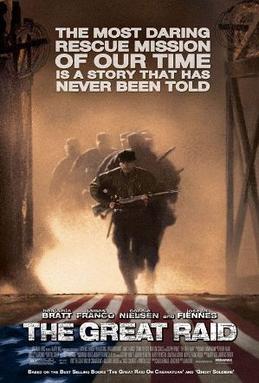
       “The Great Raid” is “inspired by the true events” of the Raid on Cabanatuan in the Philippines in WWII.  The raid by U.S. Rangers was the most successful raid on a prisoner of war camp in American History.  The movie was based on two acclaimed books on the subject:  The Great Raid on Cabanatuan by William Breuer and Ghost Soldiers by Hampton Sides.  It was directed by John Dahl.  Because of financial problems at Miramax, the film did not make it to theaters until three years after completion.
                The movie opens with a necessary summary of the situation in the Philippines connecting its fall with the January, 1945 setting of the film.  Footage from the National Archives is effectively used with the narration.  The opening scene recreates the massacre of American prisoners on the island of Palowan by a unit of the Kampeitei (the Japanese version of the Gestapo) led by Major Nagai (Motoki Kobayashi).  Later, American guerrilla leader Maj. Lapham informs Gen. Krueger (Dale Dye!) that the same type of atrocity could take place at Camp Cabanatuan.  Krueger decides to send part of the 6th Ranger Battalion to rescue the prisoners.  The unit is commanded by Col. Mucci (Benjamin Bratt), but he assigns Capt. Prince (James Franco) as operational head.  The mission will involve going thirty miles behind enemy lines to liberate a camp that there is limited intelligence about.  It is extremely risky, but noone questions the decision to use elite troops to rescue the opposite.
                The movie is a trio of plot lines.  One third of the film is dedicated to life in the camp.  This focuses on a small group of prisoners including the ranking officer Maj. Gibson (Joseph Fiennes).  He is suffering from malaria.  His best friend Capt. Redding (Morton Csokas) is suffering from the desire to escape even though the Japanese have threatened to execute ten prisoners for each escapee.  The prisoners are in terrible shape and things get worse when Maj. Nagai arrives.  This movie does not take the recent approach of sympathy for the other side.  Nagai is malevolent and there is a very powerful execution scene that ramps up his hissability.  In fact, this is not the only execution scene in the movie.
                The second plot line concentrates on Margarat Utinsky (Connie Nielson).  She is an American nurse who is working with the Filipino Underground in Manila.  She is smuggling medicine into the camp.  The movie manufactures an unrequited romance between Gibson and Utinsky.  At one point she is tortured by the Kampeitei and members of her cell are executed.
                The other third is the mission of the Rangers.  Mucci and Prince hook up with Filipino guerrillas led by Juan Pajota (Cesar Montano).  They reach the village of Patero where the final plans are developed.  Prince will lead the assault on the camp under cover of darkness.  The biggest problem will be the daylight approach which requires crawling 800 yards over flat ground to reach the camp.  Pajota suggests the distraction of a fly-over by an American plane.  Part two of the plan involves Pajota’s guerrillas neutralizing a large Japanese unit camped nearby.  Part three has another guerrilla group blocking reinforcements from arriving from Cabanatuan City.  All three parts must work flawlessly for the mission to be successful.
                “The Great Raid” was a terrible flop in the theaters.  It cost $80 million, but made only $11 million.  Although not its fault, sitting on the shelf for three years made it seem like damaged goods.  Plus Miramax did a poor and lackluster job of marketing.  The movie deserved better.  The story of the raid deserved to be publicized and the movie is a worthy attempt to bring the historical event to public attention in an entertaining format.  Unfortunately, most of the public is unaware of the existence of the film and thus is unaware of one of the greatest military tales in American History.
                Critics were unduly harsh on the movie (imagine that!)  Most of the criticism was for the slow build-up to the raid itself.  You know, the same people who would have carped had the movie been just action with little exposition.  The romance was also lambasted and here the critics are on more solid ground.  It feels forced and on first glance it appears that the Utinsky character is fictional and the Underground element was added to make her an action heroine.  Fault was also found with the lack of character development within the Ranger unit.  There is not much coverage of soldier behavior or talk.  However, critics missed that “The Great Raid” was a throw-back to the Old School small unit movies where the unit itself is a character.
                The movie is very underrated.  The acting is serviceable.  Some will complain about the lack of emotion, but we are talking about emaciated prisoners, disciplined soldiers, and secretive Resistance members.  What would you expect?  Franco is almost morose, but the real Prince had that type of personality.  Bratt also underplays, which is less acceptable considering Mucci was charismatic and publicity-savvy.  Nielson does a good job as the feisty Utinsky, but Fiennes is left with little to do other than look prisonerish.  Acting honors goes to Montano.  The movie’s biggest accolade goes to its portrayal of this Filipino hero. 
                The production is nothing special.  The score is understated and has some good suspense when needed.  The cinematography uses muted colors to good effect.  The effects are not mimicking the “Saving Private Ryan / Band of Brothers” style.  TGR is more comfortably placed in the Old School category.  The film builds to the assault which is well worth the wait.  When the first shot is fired, the screen is ablaze with violence unabated for a long stretch.  This scene clearly depicts the American military’s propensity to deal with combat situations via extreme firepower.  It also clearly depicts Hollywood’s love of explosions.
                Ghost Soldiers is one of my favorite books.  When I read it years ago, I was on the edge of my seat for the raid.  I remember thinking what a great movie could potentially come from the book, but I expected the worst.  When I heard TGR had been shelved and then fizzled in the theaters, my fears seemed to be confirmed.  I have to say the movie was a pleasant surprise.  I do not know if it could have been much better without going way off the accuracy reservation.  The sad thing is that by adjusting the original “Missing in Action” type script in favor of accuracy, the studio probably lost a lot of money and has probably vowed not to make that “mistake” again.  How accurate is it?  See History or Hollywood, but beware of spoilers.

 GRADE =  B

HISTORY or HOLLYWOOD: The Great Raid (2005)


          "The Great Raid" (2005) is a sadly forgotten movie about the daring POW rescue raid on Cabanatuan in the Philippines in 1945.  The behind the lines mssion by the U.S. Rangers was one of the great adventure stories of World War II.  The plot is so incredible that you have to wonder just how true is this "true story".
GUESS WHICH OF THE PLOT ELEMENTS IN “THE GREAT RAID” ARE TRUE.
1.  American prisoners on the island of Palawan were forced into air raid shelters and then the Kampeitei poured in aviation gasoline, set it on fire, and machine gunned the survivors. 
2.  Gen. Krueger approved the mission and put Mucci in charge.  He, in turn, gave operational command to Prince. 
3.  The senior camp officer was a malaria-ridden Maj. Gibson. 
4.  Margaret Utinsky was an American nurse who worked with the Filipino Underground to smuggle drugs into Cabanatuan, among other activities. 
5.  The original camp guards left the camp and the prisoners found a large stock of food.  Later, Japanese returned and reestablished control of the camp. 
6.  The Rangers stop at the village of Balincarin and witnessed the results of a massacre of villagers for aiding the guerrillas. 
7.  Pajota suggested the raid be postponed a day because of a temporary increase in Japanese forces and originated the idea of the flyover. 
8.  Capt. Redding was caught escaping and he and ten random prisoners were shot. 
9.  The Rangers crawled 800 yards over open ground in daylight and used a flyover by a plane to get the Japanese to look up instead of out. 
10.  The raid came as a complete surprise to the Japanese and many were killed in their barracks by the intense fusillade. 
11.  A bazooka took out a Japanese tank. 
12.  The Japanese commander was killed in a duel with Sgt. Wojo. 
13.  The two American casualties were a sniper victim and the doctor who was mortally wounded by mortar shrapnel. 
14.  Pajota and his guerrillas held off a large Japanese force at a bridge near the camp. 
15.  Mucci defeated a flanking attempt by Japanese fording the river. 
History or Hollywood?

1.  American prisoners on the island of Palawan were forced into air raid shelters and then the Kampeitei poured in aviation gasoline, set it on fire, and machine gunned the survivors.  HISTORY  The incident did occur, but it was the Japanese 14th Area Army was responsible.  Survivors telling their stories directly led to the idea of the Cabanatuan raid.
2.  Gen. Krueger approved the mission and put Mucci in charge.  He, in turn, gave operational command to Prince.  HISTORY  The movie overplays disagreements between Mucci and Prince about various aspects of the plan.  It underplays Mucci’s “glory hound” reputation.  Prince did have a bad case of jungle rot on his feet.
3.  The senior camp officer was a malaria-ridden Maj. Gibson.  HOLLYWOOD  All of the prisoners are fictional
4.  Margaret Utinsky was an American nurse who worked with the Filipino Underground to smuggle drugs into Cabanatuan, among other activities.  HISTORY  Surprisingly, much of this is true.  Utinsky was the wife of an American soldier who dies in Camp O’Donnell soon after the fall of the Philippines.  She elected to stay in Manila and joined the Resistance.  She did smuggle drugs into Cabanatuan.  She was arrested and tortured by the Kampeitei, but for much longer (32 days) than in the movie.  She then spent six weeks in a hospital suffering from a gangrenous leg.  After that she escaped to the hills and joined the guerrillas.  She did meet the prisoners when they reached American lines.  She was not romantically involved with any of the prisoners.  In 1946, she was awarded the Presidential Medal of Freedom by Pres. Truman
5.  The original camp guards left the camp and the prisoners found a large stock of food.  Later, Japanese returned and reestablished control of the camp.  HISTYWOOD  The Japanese did leave the prisoners for several weeks and they did fatten up on Japanese supplies.  The Japanese who eventually reestablished control were not from the Kampeitei (Nagai is a fictional character), they were mostly retreating Japanese units who basically ignored the prisoners
6.  The Rangers stop at the village of Balincarin and witnessed the results of a massacre of villagers for aiding the guerrillas.  HOLLYWOOD  There was no mention of this incident in my research.  However, these types of atrocities did occur.
7.  Pajota suggested the raid be postponed a day because of a temporary increase in Japanese forces and originated the idea of the flyover.  HISTORY
8.  Capt. Redding was caught escaping and he and ten random prisoners were shot.  HOLLYWOOD  I found no evidence of this particular incident.  It does conform to Japanese policy and was done at the camp.  By the way, most of the time the executions were done via beheadings.
9.  The Rangers crawled 800 yards over open ground in daylight and used a flyover by a plane to get the Japanese to look up instead of out.  HISTORY  The plane was a P-61 Black Widow (the absolute perfect choice for this), but in the movie they had to use a Lockheed Hudson.  The P-61 did twenty minutes of acrobatics and faked engine trouble which allowed the Rangers to transit the field.
10.  The raid came as a complete surprise to the Japanese and many were killed in their barracks by the intense fusillade.  HISTORY  The movie gives the Japanese more of a fighting chance than the Rangers did.
11.  A bazooka took out a Japanese tank.  HISTYWOOD  A bazooka team did take out a shed that was suspected of housing tanks and blew up some trucks, but no tank.
12.  The Japanese commander was killed in a duel with Sgt. Wojo.  HOLLYWOOD
13.  The two American casualties were a sniper victim and the doctor who was mortally wounded by mortar shrapnel.  HISTYWOOD  Doctor Fisher was wounded similar to the movie.  The other death was an accidental friendly fire incident.
14.  Pajota and his guerrillas held off a large Japanese force at a bridge near the camp.  HISTORY  This scene is very accurate.
15.  Mucci defeated a flanking attempt by Japanese fording the river.  HOLLYWOOD  Mucci spent the battle observing from the rear.
 
SCORE:
History =  7
Hollywood =  5
Histywood =  3
 
RATING =  .57     

Tuesday, April 5, 2011

QUARTERFINALS II

The Hurt Locker (1) vs. The Great Raid (14)


CHARACTER DEVELOPMENT: “The Hurt Locker” develops only three characters – the lone wolf Sgt. Will James, the by the book Sgt. J.T. Sanborn, and typical grunt Specialist Owen Eldridge. This trio is fleshed out over the course of the film. We know their attitudes and emotions. The key to the movie is the conflict between James and Sanborn, with Eldridge caught in the middle. “The Great Raid” has more characters to juggle because of the trio of story lines. The movie develops nurse/resistance member Margaret Utinsky, POW Joseph Fiennes, and mission leaders Henry Mucci and Robert Prince. The romance between Utinsky and Fiennes is thrown in and ill-fitting. Mucci is your typical gruff disciplinarian and Prince is the idealistic subordinate. Nothing special about them.

Score at the end of the first period: Hurt – 9 Raid – 7

DIALOGUE: Hurt won the Academy Award for Original Screenplay and deserved it. The dialogue is cracking. The dialogue between James and Sanborn seethes. The dialogue is sparse which is consistent with soldier talk. Raid is an old school style movie in many ways, including the dialogue. There is nothing special here. The words placed in the characters mouths are words a Hollywood screenwriter thinks a soldier would say. That is not to say the dialogue is laughable, it’s just not noteworthy.

Half-time score: Hurt – 18 Raid – 14

PLAUSIBILITY: Hurt has been criticized for making James too much of a adrenalin junkie who gets his fix by flouting common sense safety protocols. There is some truth to this. Although the movie is fictional and thus can go beyond reason to make its case that war is a drug, there are events in the movie that are highly implausible. For example, three bomb techs taking separate alleys at night to chase insurgent bomber(s) makes no sense. It is apparent that bomb disposal experts must be different than normal people, but someone as mentally unstable as James would not last long in the military in that specialty. Raid is based on an actual commando mission and is sourced from two excellent books. The love story is implausible, but the events in the raid itself are close to the real deal. So real, that many viewers probably were disappointed with its “tell it like it was” instead of “rev it up” plot.

Score after three periods: Hurt – 24 Raid – 22

PLOT: “The Hurt Locker” won the Best Picture award. It flows from action scene to action scene propelling the arc of James as an increasingly loose cannon. The suspense is palpable. The opening is memorable in its unorthodoxy. The close book ends it well. In between we learn to admire as well as abhor the main character. The plot of “The Great Raid” reads more like a history lesson with a pedestrian romance throw in. The movie lacks pizzazz, but the build-up to the attack is smooth and the attack itself is well-written and accurate.

Final score: The Hurt Locker  – 33    The Great Raid – 29

Black Hawk Down (4) vs. Flags of Our Fathers (5)

CHARACTER DEVELOPMENT: BHD is not really character driven. It develops the character of the Rangers versus the Delta Force more than individual soldiers. It is a true ensemble cast with Josh Hartnett as the lead, but certainly he does not dominate. We do not get to know the soldiers very well, but the movie does not have time for that. We do recognize some tried and true stereotypes. The gruff sergeant (in this case actually a Lt. Col. McKnight), the sad sack Blackburn, the desk jockey turned warrior Grimes, the lone wolf Hooten, etc. Flags does an excellent job developing the three surviving flag raisers. They are distinct personalities. The tragic decline of Ira Hayes is particularly poignant. The other members of the unit are also well drawn. The government officials are stock characters, however.

Score after first period: BHD – 7 Flags – 9

DIALOGUE: Both movies come from well-respected best sellers and are true to their sources. The conversations feel real and unforced. They also reflect how soldiers talk in and out of combat. If you watch both movies you will get a clear impression of how soldier talk and interact. It is fascinating to see how soldier dialogue has changed from Iwo Jima to Somalia. Slight edge to BHD because it does not have the cynically patriotic handlers that Flags has.

Half-time score: BHD – 16 Flags 17

PLAUSIBILITY: Both movies make sense and have no laughable scenes. They are true to books that have not been criticized for overhyping their topics, Slight edge to BHD for showing the fog of war and the difficulty of hitting moving targets in urban combat.

Score at the end of three: BHD – 26 Flags – 25


PLOT: Flags is a nonlinear retelling of the men who raised the flag as well as the bond tour the survivors went on. the back and forth scenes are effectively arranged. This means the audience is whiplashed from high intensity combat action scenes influenced by Saving Private Ryan and the introspective scenes on the home front. This makes the movie more interesting, but a bit bipolar. BHD is linear in structure. It builds to the battle which dominates the second half of the movie. The shifts from the command centers to the boots on the ground are instructive in clearing up the fog of war for the audience. The Battle of Mogadishu could not have been handled better, unless you question the lack of coverage of the enemy point of view. But then again, Clint Eastwood had to film an entire separate movie to accomplish that for the Battle of Iwo Jima.

Final score: Black Hawk Down – 35 Flags of Our Fathers - 33

Wednesday, March 30, 2011

MARCH MADNESS: Inglorious Basterds (3) vs. The Great Raid (14)


ACTING: “Inglorious Basterds” is a Quentin Tarantino film with his usual eclectic cast. It stars Brad Pitt as Aldo Raines who leads a special commando squad behind enemy lines. The character is over the top and Pitt takes a deep bite into the role (as well as the foreheads of Nazis). He is not even the best actor in the film. That honor goes to the amazing Christophe Waltz as the charmingly malevolent S.S. Col. Hans Landa. The female leads, Diane Kruger as actress Bridget von Hammersmark and Melanie Laurent as the Jewish cinema operator Shoshanna, are amazing. “The Great Raid” has a B-list cast headed by Benjamin Bratt as Col. Henry Mucci and James Franco as his subordinate Bob Prince. It also has a beautiful blond (Connie Nielsen as Margaret Utinsky) who plays the nurse helping the Filipino Resistance. The cast is capable, but unspectacular.


Score at the end of the first period: Basterds – 10 Raid – 7

REALISM: Did I mention Basterds is a Tarantino film? ‘Nuff said. It is one of the most unrealistic war films ever made. It makes the “Dirty Dozen” look like a documentary. It would be hard to find anything that happens in the film that is plausible. But that is not the point. It is meant to be outlandish. For this reason, I give it a default 6. Raid does a good job portraying life in a Japanese prison camp and the difficulties of a raid behind enemy lines. The romance is, of course, unrealistic and you have some other Hollywood contrivances, but on the whole most of it rings true.

Score at half: Basterds – 16 Raid – 15

ACCURACY: Did you know that we killed Hitler and his high command when he attended a movie premier in Paris after D-Day? Did you know that during WWII we had an elite commando unit in occupied France which slaughtered and scalped Nazi soldiers? If you did, you think like Tarantino – get to a psychiatrist immediately! Default 6 again. Raid is based on the books The Great Raid on Cabanatuan by William Breuer and The Ghost Soldiers by Hampton Sides. I have read Sides’ book and it was one of the best books I have ever read. The movie does not live up to it, but none could. I was prepared to be severely disappointed. The movie is actually quite true to the book, other than the romance. Surprisingly, the Utinsky character is faithful to the truth. The raid itself is close to what happened, but with the typical Hollywood bullshit that insists on a showdown with the evil camp commandant. The little touches are right. For example, the fly-over to distract the Japanese. If you did not want to read the books, the movie retells the story in an educational way.

Score after three periods: Basterds – 22 Raid – 24

ENTERTAINMENT VALUE: Basterds was nominated for the Academy Award for Best Picture and Waltz won the Oscar for Best Supporting Actor. It has some amazing scenes, especially the French farmhouse opening, the basement bar showdown, and the explosive and fiery mass assassination. Several deaths are shocking in a good way. Tarantino’s style and homages to familiar movies are mesmerizing. Raid looks like a made for TV movie. A good one, but it lacks the pizazz a great war movie has. The raid itself is one of the best action war scenes in recent memory. It deserves credit for reviving a story that was huge in 1945, but had been forgotten over the decades.

Score at the end of regulation:  Basterds - 31  Raid - 31

FINAL SCORE: Raid 32 Basterds – 31

*** In overtime, Raid wins because it is a pure war movie and honors the most successful rescue mission in American History.