Showing posts with label Tarawa. Show all posts

Wednesday, November 23, 2022

DOCUMENTARY: With the Marines at Tarawa (1944)


76 hours of hell ended on Nov. 23, 1943.  There is a documentary of that hell. 

            “With the Marines at Tarawa” is appropriately titled.  The Second Marine Division invaded the island of Betio in the Tarawa atoll.  The invasion took place from November 21-23, 1943.  The amphibious invasion was the first of the island-hopping campaign and the first landing that was contested.  The 2nd Marine Division had fought on Guadalcanal, but that invasion was not opposed.  Betio was very well-defended and the Marines had trouble just getting to the beach, much less inland.  Some of the Marines had to wade to the beach under heavy fire.  One of those men was Sgt. Norman Hatch who was armed with a .45 pistol and a 35 mm. movie camera.  Hatch and other photographers were embedded with the Marines.  Two of them were killed.  Louis Hayward, an actor who enlisted before the war, was the director.  The footage was brutal and when the film was shown to President Roosevelt, his aides recommended that the film be censored.  They were worried the public was not ready to see what war is really like.  FDR consulted with war correspondent Robert Sherrod (who later wrote a book about Tarawa).  Sherrod told the President that the Marines wanted the public to know what the war was really like.  FDR agreed and gave the green light for the film to be shown in movie theaters. It had the effect of causing many factory workers to work harder.  The movie won the Best Documentary Short Story Oscar.

            The movie has a typical war documentary template.  But this was the first war documentary that many Americans saw, so it was new to them.  The doc begins with the Marine Corps Hymn, naturally.  The music pops up throughout the movie.  Troops board the transport ships.  They view a relief map of the island.  As the camera pans over the Marines, the narrator tells the audience “Many of these men were killed the following morning.”  The Navy warships and planes bomb the island.  “It didn’t seem possible that anyone could live through that bombardment.”  That would have been a conclusion reached by most of the Marines.  They will be wrong.  The combat is intense as the photographers are amazingly close to the action.  There is a lot of gunfire in this movie.  The audience sees Marines wading to shore.  Flamethrowers are used.  The Marines use grenades on the entrenched Japanese.  Before Americans see dead Marines, they see a lot of dead Japanese.  “They are savage fighters.  Their lives mean nothing to them.”  Later, we see American corpses.  “These are Marine dead.  This is the price we have to play.”  (I just recently saw an exhibit of art by Tom Lea.  Lea was an artist who painted scenes he saw when he was on board the carrier Hornet and with the Marines on Peleliu island. One of his most famous paintings is of a Marine who has been shreaded by machine gun fire.  He entitled the painting “The Price.”)  Marines are buried at sea.  The Seabees come in and repair the airfield.  The American flag goes up.

            It’s no surprise the film won an Oscar.  It was groundbreaking.  The color footage would have wowed audiences.  That would have been one emotion.  Others would have been horror and patriotism.  Although Hayward wanted to show the hell of war, he also wanted to Marines effectively defeating the “savage” enemy.  Although that enemy is referred to as Japs and Nips, this is not really a propaganda film.  It is a chronicle of a battle.  The film covers many of the highlights that the battle is famous for.  But it is a little hazy as to strategy and tactics.  The battle comes off as simpler than it actually was.  It omits all the errors the Navy and Marines made.  The narrator says about the bombardment:  “Everything went like clockwork.”  The fact that a force of B-24 bombers failed to show up is not mentioned.  The wading across the coral reef is glossed over.  Seems like Hatch (who provided much of the footage) would have wanted that emphasized.  The most patriotic impact the film could have had would have been to describe how those American boys risked their lives for each other.  (Not for the people in the audience.)

            Tarawa deserved a good documentary and it got one.  The 76 hours of hell are not hellish enough in celluloid, but considering it came close to not being released, it was as hellish as you could get in 1944.  The narration is sparse and it’s not jingoistic.  The film let’s the remarkable footage do the talking most of the time. 

            On a personal note, I used to show a documentary to my American History classes entitled “Seven Views of War.”  It focused on the experiences of seven American servicemen and women in WWII, Korea, or Vietnam.  One of the seven was Hatch.  I can remember him saying that his footage was the first time Americans saw dead Americans.  Do your part, factory worker!

            P.S.  I just was doing some research on the battle for my website (History Anecdotes for Teachers) and I ran across a myth that the documentary perpetuated.  The narrator mentions that the shore guns that the Navy took out was Vickers guns captured by the Japanese at Singapore.  Many years later, historians discovered the guns were sold to Japan in 1905 for the Russo-Japanese War.  The mistake was understandable.

 Here is the documentary:  https://www.youtube.com/watch?v=JolhiCbU_u8

GRADE  =  B

Friday, July 19, 2013

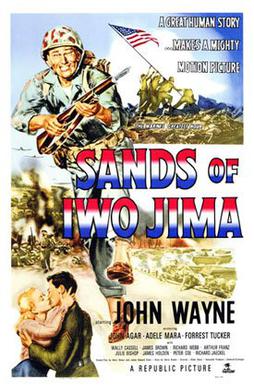
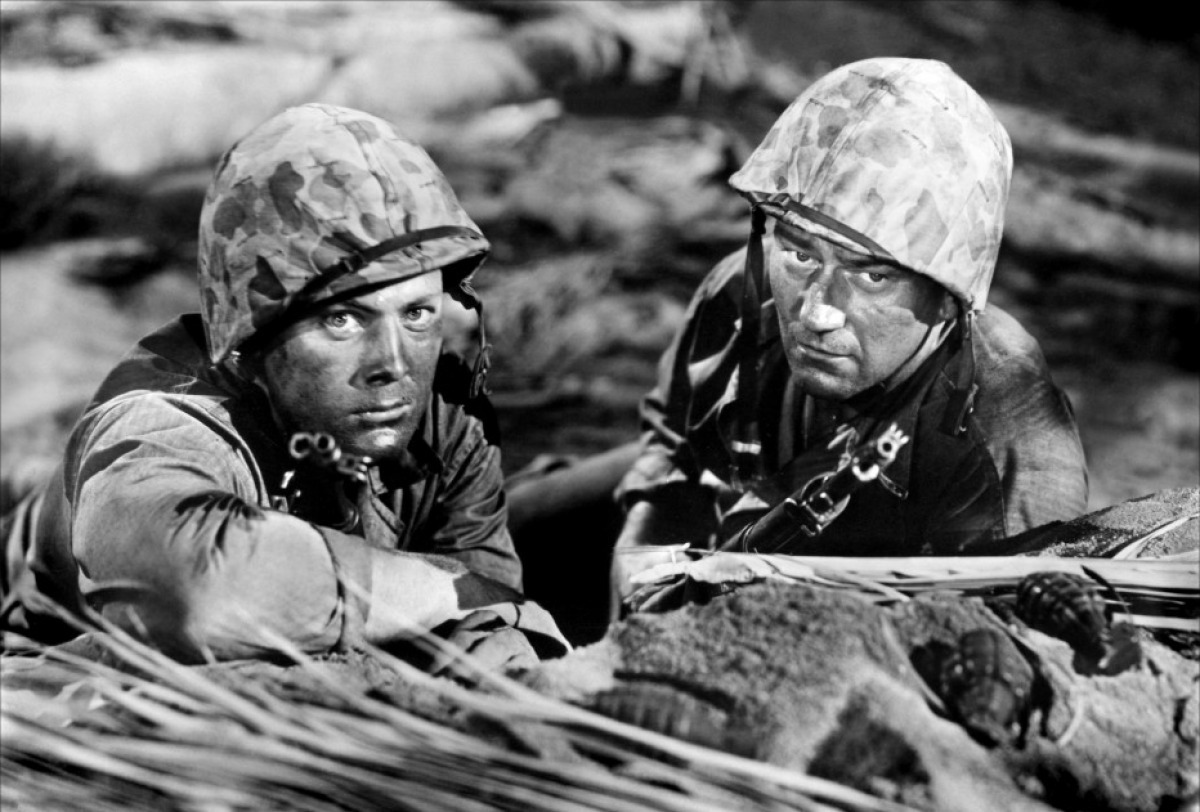
Sands of Iwo Jima (1949)


                “Sands of Iwo Jima” is the greatest recruiting film ever made by a branch of the military.  The U.S. Marine Corps gave full cooperation to the film and had script approval.  The movie was filmed at Camp Pendleton and the Corps provided ample equipment.  The Marine Corps hierarchy knew that a successful film could possibly help it survive potential demotion in the post-war years.    Mission accomplished!  In the process, the film bumped John Wayne up to a screen icon and the great American cinematic soldier.  It began his long run at the top of the box office.


the greatest Marine ever

                You know what you are getting right off the bat as the “Marine Corps Hymn” plays over the credits.  A voice-over informs us that this will be a small unit movie.  It is a heterogeneous squad that is to be trained by the martinet Sgt. Stryker (Wayne).  The squad consists of two squabbling brothers (a running gag) – one of whom is Richard Jaekel (continuing his community service of having to appear in every WWII combat movie).  There is also an Italian wise-guy from Brooklyn – thus fulfilling three of the required clichés.  The unit has not one, but two conflicts.  Thomas (Forrest Tucker) had been demoted by Stryker and Conway (John Agar) is a pacifist with daddy issues who hates Stryker because he stands in for his equally macho father.  How could this impossibly dysfunctional unit ever fight efficiently?  Perhaps tough love in training is the answer.

                The training section of the film establishes two themes.  First, Stryker is not one-dimensional.  He has a broken family, has not seen his kid in years, and he drinks to overcome his unhappiness.  Second, Stryker is a “proper bastard” (as the British would say).  He believes it is better to be feared than loved and the Marines need to hate him more than the ”Nips” (their word).  He rifle butts an incompetent trainee.  However, to reassure the audience, the film tacks on an embarrassing scene where Stryker teaches the guy how to stab Japs by dancing with him! (Come on, Duke!  Hit him again, harder.)


kudos for the sweat!
                The first combat set piece is the Battle of Tarawa.  The men are told the Japanese Marines are tough and “they’d just as soon die as stick a nickel in a juke box.”  Huh?  The invasion is fairly accurate with amphtracs, the sea wall, the use of flame throwers, etc.  The editor deftly blends in actual footage.  Three key plot developments ensue.  First, Stryker goes all John Wayne and takes out a pill box with a satchel charge, thus establishing his heroism.  Second, Thomas lingers for coffee on an ammunition run and this causes the loss of two squad members (redemption anyone?).  Third, that night Stryker declines to allow anyone to go rescue a wounded Marine (?), thus earning the increased enmity of the men, especially Conway.  By the way, the audience is promised a night banzai attack that inexplicably is not delivered.

                Back in Hawaii, there is the inevitable fisticuffs between Thomas and Stryker and of course, the inevitable intervention by a higher officer followed by the inevitable non-snitching by Thomas.  Thomas gets his redemption when he apologizes for his coffee break.  Stryker accepts it and they move on.   One redemption down.

                Finally, after a mercifully short romance and wedding for  Conway, it’s off to Iwo Jima.  On the transport, one of the Marines looks at a picture of his gal.  Stryker smiles at him as though to say – “you stupid sap, you’re dead meat now”. “Saddle up”,  “hit the beach” and “lock and load” (the first recorded use of this phrase).  The fighting is 1940s war movie hellacious.  Squad members die.  Zoom in on a corpse’s book entitled “Our Hearts Were Young and Gay”.  One mortally wounded gyrene jauntily says “I’ll get a good night’s sleep tonight”.  They are dropping like flies.  The deaths are not too Old School.  There is little twirling or touchdown signaling.  Conway saves Stryker’s life and suddenly the heat of combat has forged a bond.  Redemption #2 accomplished.  Conway has a premonition of death, but Stryker doesn’t.  Psych, audience!

preparing for the awesome night banzai
attack that doesn't happen
                The movie closes with the trek up Mt. Suribachi.  Stryker is given a flag (the actual flag, donated by the Marine Corps) to raise, but first he has to stupidly say “I’ve never felt so good in my life.  How about a cigarette?”  A Japanese sniper mistakes “cigarette” for “bullet” and millions of American males are scarred for life.  (But not as badly as Old Yeller.)  In lieu of last dying words, a letter to his son is read aloud.  Jerk those tears!  The survivors watch the flag-raising (which oddly is not the actual footage). Queue Marine Corps Hymn.  Stop at the recruiting table on your way out of the theater. 

If you haven't seen the movie and don't
want to be scarred, stop the movie now!
                “Sands of Iwo Jima” certainly falls into the Old School of war movies, but it is not the template that it is often accused of.  Although truly pro-Marines, it is not overly patriotic or propagandistic.  The Japanese are tamely called “Nips” and remain faceless.  They are not demonized.  The movie does have several clichés,  but it did not invent them.  It would be too much to ask a 1949 movie to forego the redemption angles, for instance.  More importantly, iconoclasm would possibly have tampered with the Marine Corps cooperation that kept the budget extremely reasonable.

cigarette's kill
                The acting is solid.  Wayne gives one of his great performances and earned a Best Actor nod (competing with Peck of “Twelve O’Clock High”;  both losing to Crawford of “All the King’s Men”).  His performance is nuanced and although most remember Stryker as a one-dimensional supersergeant, he actually has some very human flaws.  The rest of the cast is just there to carry Wayne’s combat boots.  Agar does some scene-chewing and Tucker does not embarrass himself.  The actors were put through a three day boot camp by a Marine DI at Camp Pendleton.  This may have been a first.  The stunt-casting of several real war heroes (including the three surviving flag-raisers and David Shoup who earned the Medal of Honor on Tarawa) is fun and emphasized to the public that Wayne was just an actor who never fought in battle.  Just kidding.

the movie's reenactment
                The movie is technically sound.  The score is typical for a 1940s war movie, but it is not intrusive and is sparingly used.  The cinematography is nothing special, but the editing in of the actual footage is outstanding.  This movie possibly uses a higher percentage of actual footage than any other WWII film.  It deserved its Editing nomination as well as its Best Recording for its realistic sounds of battle.  The other nomination was for its screenplay which was written by Harry Brown (“A Walk in the Sun”) and Wayne’s friend James Edward Grant.  The dialogue is not sappy and there are some good lines.  However, they certainly stay within the box.

                The movies’ themes include camaraderie and the benefits of tough love.  The movie is very predictable in its development of these themes.  You get two redemption arcs that are both sappy.  The hatred of Stryker evolving into respect is not exactly ground-breaking.  On Iwo Jima, the film shifts to a “who will survive?” vibe.  Thankfully, the deaths are not maudlin and accurately reflect the randomness of death in battle.  As with all war movies, the percentage of deaths to wounded is shockingly high.  But even the new VioLingo style of movies are noted for this.

                The biggest flaw in the film and the reason why I find it to be overrated is the lack of combat.  The movie builds its raison d’etre around two famous battles yet it shortchanges both.  Tarawa lasted three days and was a fascinating first taste of a disputed landing under extremely difficult combat conditions.  The movie briefly dwells on the chaos at the sea wall and throws in the pill box scene, but otherwise blows the chance to show the horrors of that battle.  The film battle is much too easy.  Bizarrely, the screenwriters prepare the audience for action in the form of a night battle and then simply move on to Hawaii!  Big letdown.  Iwo Jima gets more coverage, but again we get only the opening stages of the battle.  The combat is PG-rated intense with nongraphic deaths.  Compare this to the Iwo Jima episode of “The Pacific” and you can clearly see the vast difference between Old School and VioLingo.

                In conclusion, although I am not willing to kiss it’s ass like many critics, “Sands” belongs on the Military History 100 Greatest War Movies list.  As I have made my journey through that list, I have often been chagrined at some of the inclusions and sometimes I just have to chalk it up to the panel putting a high emphasis on the historical importance of the film.  This might explain including films like “They Were Expendable” and “Guadalcanal Diary”, but how do you explain an important film like “Sands” being left out.  Not only is it better than many of the other films on the list (including the two above), but you could argue it had a great influence on war films made in the 1950s.  Certainly, Stryker is one of the seminal war movie heroes.  Seriously, “Guadalcanal Diary” and not “Sands of Iwo Jima”?!  Give me a break.

GRADE =  B-
the trailer


the flag raising