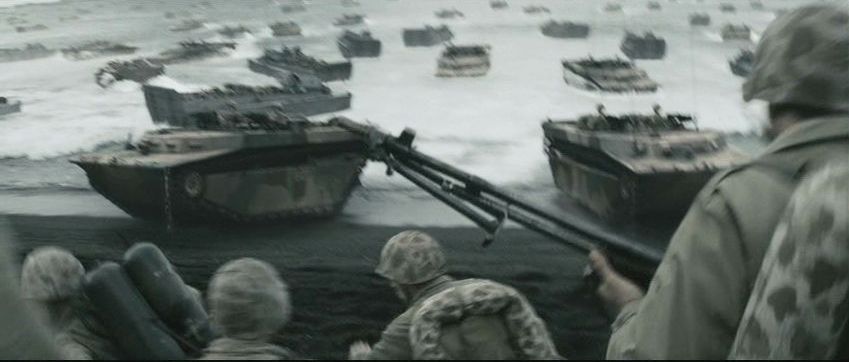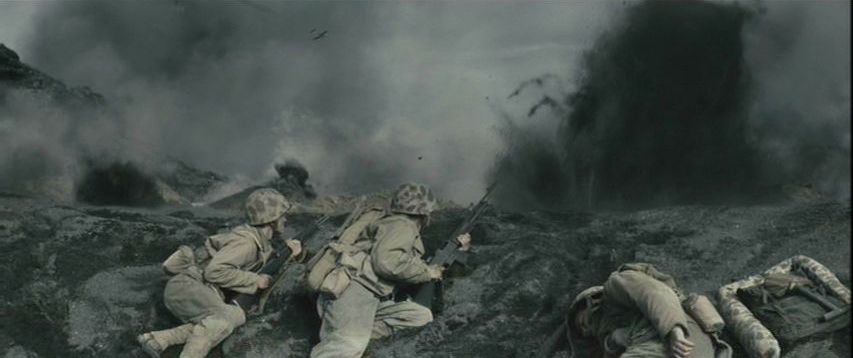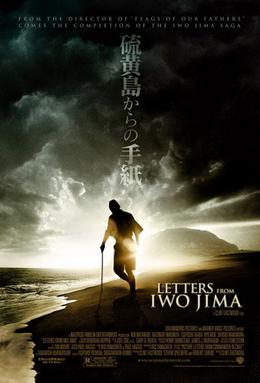
Showing posts with label Iwo Jima. Show all posts

Tuesday, June 10, 2014

#4 - Letters from Iwo Jima (2006)


BACK-STORY:  “Letters from Iwo Jima” is Clint Eastwood’s companion piece to "Flags of Our Fathers".  They were filmed back to back.  It is the Battle of Iwo Jima from the Japanese perspective.  It is based on the letters of the Japanese commander Gen. Tadamichi Kuribayashi and the book So Sad to Fall in Battle by Kumiko Kakehashi.  The movie was filmed in California with a one day shoot on Iwo Jima.  The film was well received by critics and made numerous top ten lists.  It was a big hit in Japan, but did not do very well in the States (those damned subtitles!).  It was nominated for Academy Awards for Picture, Director and Original Screenplay and won for Sound Effects.  The original title was supposed to be “Red Sun, Black Sand” ( which was apparently too cool ).

OPENING:  A group of Japanese archeologists are excavating a cave on Iwo Jima in 2005.  They uncover letters written by members of the garrison, including Gen. Kuribayashi.

SUMMARY:  In 1944, a sad sack named Saigo (Kazunari Ninomiya) is digging a trench and cynically grousing about whether the island is worth fighting for.  A flashback reveals that he is a conscripted baker who was torn from his pregnant wife.  Not all Japanese soldiers were fanatics.  Lt. Tanida (Takumi Bando) starts caning him but is stopped by the newly arrived Kuribayashi (Ken Watanabe).  The general halts the digging of trenches on the beaches and changes the defense plan to reflect his belief that the Americans can not be stopped from establishing a beachhead.  He intends a defense in depth (literally, through caves and tunnels).  This change does not go over well with some of his subordinates who are more the banzai types.  Kuribayashi finds a kindred spirit in his tank commander.  Col. Nishi is an Olympic hero having competed in the equestrian events.
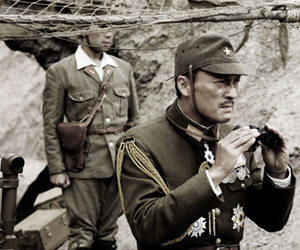
"I don't see a fleet.  What did you say
CGI means?"
                The movie balances the officers with the enlisted by introducing a foil for Saigo.  Shimizu (Ryo Kase) was a member of the Kempeitai (Japan’s equivalent of the Gestapo).  Better watch what you say around him.  He argues that the Japanese will win the battle because the Americans are undisciplined, inferior, and too emotional.  The ensuing bombing and strafing raid by Corsairs (which defy war movie clichés by actually having bombs to drop) sobers up the defenders.  The Americans may be inferior, but they have a lot of stuff and the garrison can expect no external help.  Kuribayashi outlines his plan to the enlisted.  They should be proud to be defending the homeland.  Your goal should be to take at least ten Americans with you.  You will not be going home.  In spite of this gloomy forecast, Saigo puts on his 1,000 stitch belt (senninbari) for protection.

                When the invasion commences, Saigo is an ammunition bearer on Mount Suribachi.  When Tanida orders his unit to commit suicide (against Kuribayashi’s orders), Saigo and Shimizu decide a grenade held to their chests is not for them.  They cross a bullet-infested no man’s land after dark to reach the other side of the island.  They are about to be executed by the fanatical Lt. Ito (Shido Nakamura) when Kuribayashi intervenes.  Later, Ito straps some land mines across his chest and goes out to suicide bomb an American tank.  Where’s a tank when you need one?  He returns frustrated.

                Saigo and Shimizu are now with the noble (literally, he was a baron) Nishi.  Nishi insists on treating a wounded American prisoner humanely.  He also reads aloud the soldier’s letter to his mother.  If it wasn’t for this war …    (Nishi has been outside Japan and flashbacks apprise us of Kuribayashi’s pleasant stay in America before the war – good Japanese officers are not zenophobic.)  This contrasts with an earlier scene where a G.I. (Iggy from “Flags of Our Fathers”?) was bayoneted to death after being captured.  Shimizu’s backstory (via flashback) reveals that he was thrown out of the Kampeitai because he refused to shoot a dog.  (In movies, the killing of dogs is the best measure of a characters morality.)  Nishi is blinded by shrapnel and orders his men to escape.  He commits suicide using his big toe to trigger his rifle.  (The movie is a good tutorial on the various methods of Japanese suicides.  Although it surprisingly leaves out seppuku.)

                Saigo and Shimizu decide to surrender.  Shimizu manages to get captured and is about to say “who needs a thousand stitch belt?” when the Americans guarding him decide they are bored.  Saigo meets up with Kuribayashi.  He saves Saigo’s life a third time by appointing him burner of documents including letters.  The general goes off to lead that banzai charge he had been reining in for the whole battle.

CLOSING:  Saigo buries the letters because he is a big fan of archeology.  Kuribayashi leads the attack but is wounded.  His loyal minion Lt. Fujita (Hiroshi Watanabe) carries him from the battlefield.  The next morning as the sun rises, Kuribayashi insists on beheading.  Unfortunately, Fujita is sniped mid-stoke.  Saigo arrives soon after and assists the general by giving him the .45 that Kuribayashi had been presented by his American hosts.  Saigo defies all odds (and the script?) to be taken alive.

WOULD CHICKS DIG IT?  Unlikely.  It is pretty grim and it is an almost all male cast.  The combat is not particularly graphic and the characters are well developed.  The movie does have less machismo than most war movies.

HISTORICAL ACCURACY:  Kuribayashi was from the samurai caste.  In the late 1920s, he was a military attaché in the United States.  He toured the country in a car and was impressed with America’s industrial capacity and felt it would fight hard in the event of war with Japan. He then served in the cavalry in China and then was Chief of Staff in Hong Kong.  In 1943, he was appointed commander of the Imperial Guard in Tokyo.  In 1944, Tojo summoned him and gave him command of Iwo Jima.  Some historians posit that this was punishment for a fire set in the barracks by one of his cadets.  When he arrived on the island in June, he was greeted by hundreds of school children waving flags and singing patriotic songs.  (The movie does not show this.)  A few days later, U.S. fighters attacked and returned the next day for more bombing and strafing.  A fortnight later, another raid resulted in the shooting down of 66 Japanese fighters.  Starting in August, the island was bombed almost daily (a fact that is not shown in the film).  By the time of the invasion, the consistent bombing had deprived the island of almost all its fighter planes, but had done little damage to the underground defenses. 

                In August, Rear Admiral Ichimaru arrived with 2,300 naval reinforcemnents and he took command of the island’s naval forces.  Ichimaru was a disciple of the standard Japanese doctrine of defending the beaches.  Kuribayashi looked at the results of Saipan and realized that without air and naval support, the beach defenses would not survive the bombardment and onslaught.  He ended up compromising a bit by allowing some pillboxes close to the beach.  The vast majority of the effort was put into caves, tunnels, and other underground defenses.  These were not only extensive and elaborate, but virtually bomb proof.  Nishi’s tanks were emplaced.

"Thanks, if I ever don't have a sword,
this will come in handy"


                The movie short-changes the two day pre-landing naval bombardment.  It was the heaviest of the war.  It does a good job of showing the Japanese soldiers surviving in the caves.  It also does a fair job of depicting the lack of food, water, and ammunition.  Also realistic is the undoubted fact that not all the Japanese were fanatics who wanted to die.  However, Saigo and Shimizu probably over-represent the soldiers who wanted to survive.  Just as the emphasis on Kuribayashi and Nishi tends to dilute the reality of Japanese officers being martinets.  The movie does an excellent job with Kuribayashi and Nishi.  The general’s tactics are proper.  The moment in the film where he pretends to defend a stretch of the beach while a staff officer runs around in front of him actually happened.  He did allow the Americans to land and held fire until they were inland.  He forbade human wave assaults and suicides.  He encouraged the men to give up ground as grudgingly as possible. 

                Nishi is a fascinating personage.  Colonel Baron Takeichi Nishi (and his famous horse Uranus) won the gold medal in show jumping at the 1932 Los Angeles Olympics.  He was a celebrity and was acquainted with movie stars like Mary Pickford and Douglas Fairbanks.  He went on to compete in the 1936 Munich Olympics, but fell from his horse (possibly to allow Japan’s future ally to win the event).  He naturally was in Japan’s cavalry and transitioned into the tank corps.  When he was a transferring to Iwo, all 26 of his tanks were sunk.  Later, he was able to get 22 in time for the battle.   

                The film is not meant to be instructive as to the battle.  In fact, it is difficult to tell what the big picture is and what the time frame is.  The movie is more on a personal level.  And many of the characters are actual figures from the battle.  I am referring to the officers, of course.  Several key incidents in the movie are based on reality.  Some officers like Tanida did encourage their men to use grenades to commit suicide (against Kuribayashi’s orders).  In the movie, Ito leads an aborted banzai attack.  Ito’s attempt at becoming a human bomb was based on Lt. Satoru Omagari who was unsuceesful in waiting for a tank to blow up.  In reality, Gen. Senda did lead an attack to try to recover Mt. Suribachi.  The song Kuribayashi listens to from Japanese school children during the battle really happened.  It was called “The Song of Iwo Jima”.

 The small details are accurate.  The Kempeitai, which means “Military Police Corps” was the Japanese secret police from 1881-1945.  It was noted for its brutality and certainly would have killed a dog for barking.  A Senninbari, or “thousand stitch belt”, was a strip of cloth that had stitches from one thousand different women.  It was an amulet that was supposed to protect the wearer.  The various methods of suicide are instructive.  Everyone is familiar with hari-kari, but the use of grenades and rifles is less well-known.  I first encountered these methods in reading about the Battle of Tarawa when I was younger.  After all, regular soldiers would not have had access to katanas and there rifles were too long to point and fire normally, hence having to use your big toe to pull the trigger.  
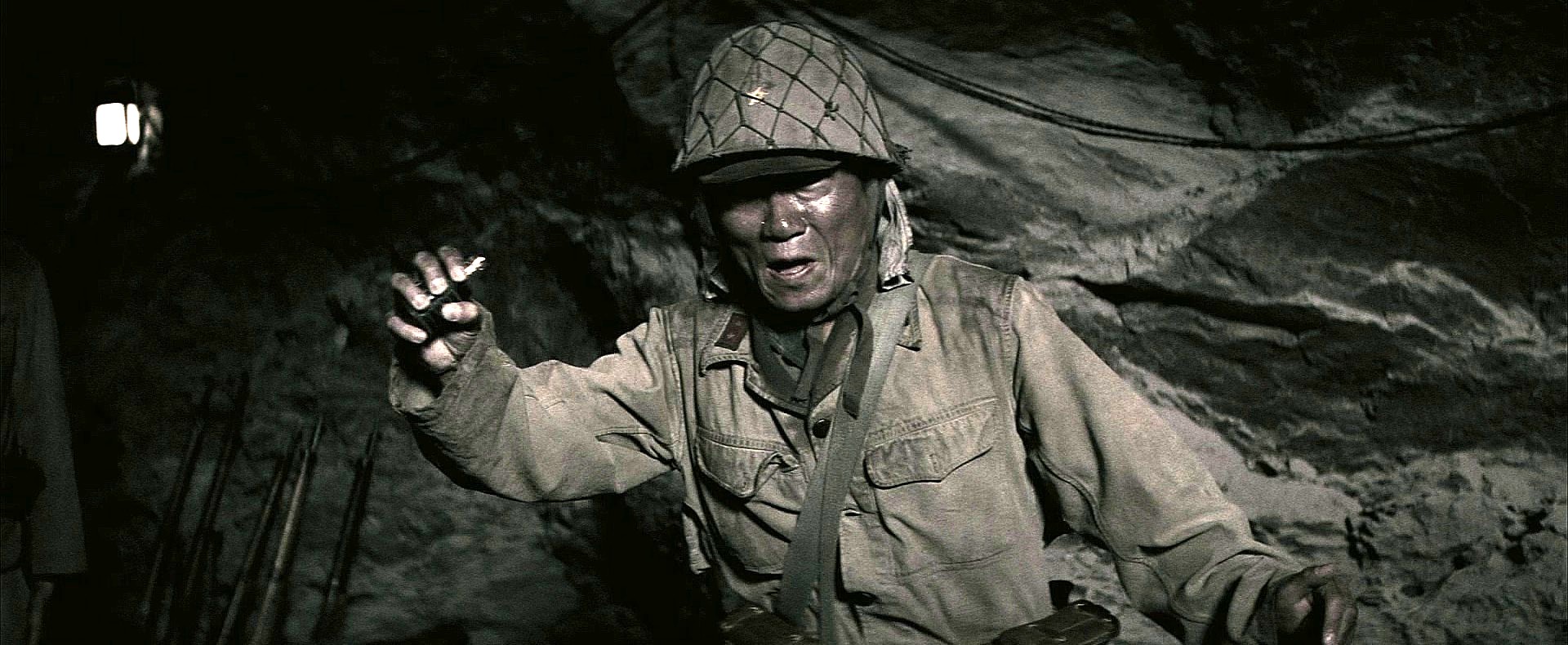
I am going to keep my helmet on for protection
while I hold this grenade to my chest
                The deaths of Nishi and Kuribayashi are problematical.  Nishi suffered burns to his eyes.  He did lead an attack but it was halted by severe fire and he then probably committed suicide by shooting himself.  He did not believe in seppuku.  It seems likely he would have used a pistol instead of a rifle.  Kuribayashi planned to lead the last attack with 500 men, but he changed his mind and instead led the men to a new position.  He apparently was wounded in the process.  It is unknown how he died, but the best guess is it was by way of seppuku at the mouth of the cave he was in.  It is extremely unlikely that it occurred as depicted in the film.  In fact, his death is one of the weakest moments in the film.

CRITIQUE:  “Letters from Iwo Jima” is an extremely well made film.  Eastwood obviously was intent on creating a masterpiece.  He does this in a non-Tarantino way.  The cinematography is a bit artsy with the now familiar washed out look.  Appropriate for a volcanic ash island.  The combat is of the “Band of Brothers” style, although the movie is light on action.  What there is is intense, but not particularly graphic.  The score conforms to this by being understated.  The opposite of the pompous music of most war epics.  You won’t remember the movie for its sound track.  In fact, there is a notable lack of music in the film.  The subterranean sets are amazing.  Very claustrophobic. 

The movie relies on characterizations to propel the narrative.  The main characters are well developed and appealing.  They are fleshed out and not just from the flashbacks.  This is especially significant because it is so rare to see the war through Japanese eyes.  Plus Eastwood balances the officers with the enlisted.  I feel I have to point out that all the major characters are noble, which is a pretty ridiculously high percentage for the Japanese Army.  The only typical Japanese soldiers are minor characters.  Hell even the kampeitai member turns out to be unfanatical.  Kuribayashi is virtually saintly.  Saigo is likeable and you want him to live to get back to his wife and newborn.  The fact that the audience gets its wish is evidence that Eastwood pulls his punches on the anti-war theme.  The dialogue is fine, but there are few lines that are memorable.  It was a nice touch to liberally quote from the actual letters.

                The acting by the ensemble is excellent.  Wattanabe is perfect as Kuribayashi and was a wise marketing choice.  If the movie had been made twenty years earlier, the role would have gone to Toshiro Mifune.  The surprise is Kazunari Ninomiya as Saigo.  He is a huge pop star in Japan.  He plays sad sack conscript well.  (His survival in the movie was probably a recognition of what his death’s impact would have had on Japan’s teenage girls.)


                The film has some obvious themes that are hard to miss.  One is that most of the soldiers just wanted to survive.  This is a bit of a stretch when it comes to the Japanese army, but it’s a nice change from the way their soldiers were depicted in previous movies.  The movie is very sympathetic toward the Japanese.  It’s revisionist in this respect.  (As a history buff I should mention that revisionism is often wrong.)  A related theme is that we’re all humans and have human needs and emotions.  The movie is quite humanistic.  Possibly more than the dirty war in the Pacific deserves.  An interesting aspect of the script is how it balances some of the scenes.  At one point a captured American soldier is bayoneted to death and then later, under similar circumstances, another is treated humanely.  The death of Shimizu and the capture of Saigo are also mirrored.  The plot is simplistic, but accomplishes its goal of retelling the battle from the Japanese perspective effectively.

CONCLUSION:  When you pair off “Flags of Our Fathers” and “Letters from Iwo Jima”, you have a magnificent achievement for Clint Eastwood.  Credit should also be given to the producers who bank-rolled these risky projects.  Only Eastwood could have pulled off dual films about the Battle of Iwo Jima.  They are so different, yet the pair cover the pivotal battle as well as could ever have been expected.  The dual perspective has been done before in movies like “Tora! Tora! Tora!” and “The Longest Day”, but “Flags” and “Letters” are unique in covering the same battle not only from different perspectives, but with totally different themes.  Both are commendable for bringing light to worthy historical topics.  So both fit one of my qualifications for great war movies.  The fact that neither is great simply means they fall a little short in execution.

                I am in the distinct minority who feel that “Letters” is overrated.  I admire it and think it is a significant addition to war movie history.  However, partly due to its humanistic themes and perspective, most critics wanted to love it more than it deserved.  As a person who has read a lot on the war in the Pacific, I can attest to the revisionist nature of the characterizations.  I am not saying that Kuribayashi and Nishi are unrealistically depicted, but I do feel that the movie gives an inaccurate depiction of the defenders of the island.  No wonder it did well in Japan.  It showed the way modern Japanese want to remember the defenders. 

                Now I’ll go further on a limb, I feel “Flags” is the better war movie. It is more accurate and has a more important story to tell.

RATINGS:

Acting  -  A
Action  -  7/10
Accuracy  -  B
Realism  -  B
Plot  -  B
Cliches  -  B

GRADE  =  B

THE TRAILER
   

Friday, July 19, 2013

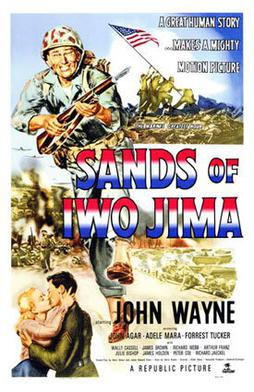
Sands of Iwo Jima (1949)


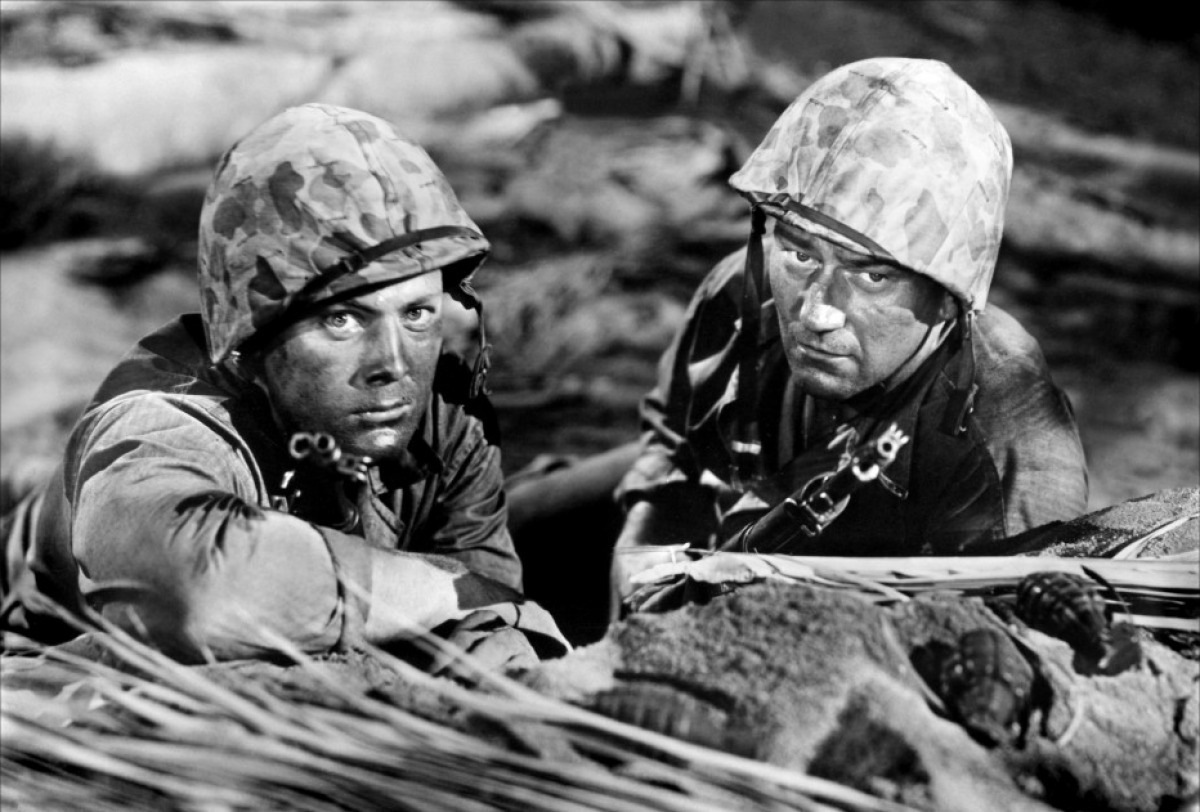
                “Sands of Iwo Jima” is the greatest recruiting film ever made by a branch of the military.  The U.S. Marine Corps gave full cooperation to the film and had script approval.  The movie was filmed at Camp Pendleton and the Corps provided ample equipment.  The Marine Corps hierarchy knew that a successful film could possibly help it survive potential demotion in the post-war years.    Mission accomplished!  In the process, the film bumped John Wayne up to a screen icon and the great American cinematic soldier.  It began his long run at the top of the box office.


the greatest Marine ever

                You know what you are getting right off the bat as the “Marine Corps Hymn” plays over the credits.  A voice-over informs us that this will be a small unit movie.  It is a heterogeneous squad that is to be trained by the martinet Sgt. Stryker (Wayne).  The squad consists of two squabbling brothers (a running gag) – one of whom is Richard Jaekel (continuing his community service of having to appear in every WWII combat movie).  There is also an Italian wise-guy from Brooklyn – thus fulfilling three of the required clichés.  The unit has not one, but two conflicts.  Thomas (Forrest Tucker) had been demoted by Stryker and Conway (John Agar) is a pacifist with daddy issues who hates Stryker because he stands in for his equally macho father.  How could this impossibly dysfunctional unit ever fight efficiently?  Perhaps tough love in training is the answer.

                The training section of the film establishes two themes.  First, Stryker is not one-dimensional.  He has a broken family, has not seen his kid in years, and he drinks to overcome his unhappiness.  Second, Stryker is a “proper bastard” (as the British would say).  He believes it is better to be feared than loved and the Marines need to hate him more than the ”Nips” (their word).  He rifle butts an incompetent trainee.  However, to reassure the audience, the film tacks on an embarrassing scene where Stryker teaches the guy how to stab Japs by dancing with him! (Come on, Duke!  Hit him again, harder.)


kudos for the sweat!
                The first combat set piece is the Battle of Tarawa.  The men are told the Japanese Marines are tough and “they’d just as soon die as stick a nickel in a juke box.”  Huh?  The invasion is fairly accurate with amphtracs, the sea wall, the use of flame throwers, etc.  The editor deftly blends in actual footage.  Three key plot developments ensue.  First, Stryker goes all John Wayne and takes out a pill box with a satchel charge, thus establishing his heroism.  Second, Thomas lingers for coffee on an ammunition run and this causes the loss of two squad members (redemption anyone?).  Third, that night Stryker declines to allow anyone to go rescue a wounded Marine (?), thus earning the increased enmity of the men, especially Conway.  By the way, the audience is promised a night banzai attack that inexplicably is not delivered.

                Back in Hawaii, there is the inevitable fisticuffs between Thomas and Stryker and of course, the inevitable intervention by a higher officer followed by the inevitable non-snitching by Thomas.  Thomas gets his redemption when he apologizes for his coffee break.  Stryker accepts it and they move on.   One redemption down.

                Finally, after a mercifully short romance and wedding for  Conway, it’s off to Iwo Jima.  On the transport, one of the Marines looks at a picture of his gal.  Stryker smiles at him as though to say – “you stupid sap, you’re dead meat now”. “Saddle up”,  “hit the beach” and “lock and load” (the first recorded use of this phrase).  The fighting is 1940s war movie hellacious.  Squad members die.  Zoom in on a corpse’s book entitled “Our Hearts Were Young and Gay”.  One mortally wounded gyrene jauntily says “I’ll get a good night’s sleep tonight”.  They are dropping like flies.  The deaths are not too Old School.  There is little twirling or touchdown signaling.  Conway saves Stryker’s life and suddenly the heat of combat has forged a bond.  Redemption #2 accomplished.  Conway has a premonition of death, but Stryker doesn’t.  Psych, audience!

preparing for the awesome night banzai
attack that doesn't happen
                The movie closes with the trek up Mt. Suribachi.  Stryker is given a flag (the actual flag, donated by the Marine Corps) to raise, but first he has to stupidly say “I’ve never felt so good in my life.  How about a cigarette?”  A Japanese sniper mistakes “cigarette” for “bullet” and millions of American males are scarred for life.  (But not as badly as Old Yeller.)  In lieu of last dying words, a letter to his son is read aloud.  Jerk those tears!  The survivors watch the flag-raising (which oddly is not the actual footage). Queue Marine Corps Hymn.  Stop at the recruiting table on your way out of the theater. 

If you haven't seen the movie and don't
want to be scarred, stop the movie now!
                “Sands of Iwo Jima” certainly falls into the Old School of war movies, but it is not the template that it is often accused of.  Although truly pro-Marines, it is not overly patriotic or propagandistic.  The Japanese are tamely called “Nips” and remain faceless.  They are not demonized.  The movie does have several clichés,  but it did not invent them.  It would be too much to ask a 1949 movie to forego the redemption angles, for instance.  More importantly, iconoclasm would possibly have tampered with the Marine Corps cooperation that kept the budget extremely reasonable.

cigarette's kill
                The acting is solid.  Wayne gives one of his great performances and earned a Best Actor nod (competing with Peck of “Twelve O’Clock High”;  both losing to Crawford of “All the King’s Men”).  His performance is nuanced and although most remember Stryker as a one-dimensional supersergeant, he actually has some very human flaws.  The rest of the cast is just there to carry Wayne’s combat boots.  Agar does some scene-chewing and Tucker does not embarrass himself.  The actors were put through a three day boot camp by a Marine DI at Camp Pendleton.  This may have been a first.  The stunt-casting of several real war heroes (including the three surviving flag-raisers and David Shoup who earned the Medal of Honor on Tarawa) is fun and emphasized to the public that Wayne was just an actor who never fought in battle.  Just kidding.

the movie's reenactment
                The movie is technically sound.  The score is typical for a 1940s war movie, but it is not intrusive and is sparingly used.  The cinematography is nothing special, but the editing in of the actual footage is outstanding.  This movie possibly uses a higher percentage of actual footage than any other WWII film.  It deserved its Editing nomination as well as its Best Recording for its realistic sounds of battle.  The other nomination was for its screenplay which was written by Harry Brown (“A Walk in the Sun”) and Wayne’s friend James Edward Grant.  The dialogue is not sappy and there are some good lines.  However, they certainly stay within the box.

                The movies’ themes include camaraderie and the benefits of tough love.  The movie is very predictable in its development of these themes.  You get two redemption arcs that are both sappy.  The hatred of Stryker evolving into respect is not exactly ground-breaking.  On Iwo Jima, the film shifts to a “who will survive?” vibe.  Thankfully, the deaths are not maudlin and accurately reflect the randomness of death in battle.  As with all war movies, the percentage of deaths to wounded is shockingly high.  But even the new VioLingo style of movies are noted for this.

                The biggest flaw in the film and the reason why I find it to be overrated is the lack of combat.  The movie builds its raison d’etre around two famous battles yet it shortchanges both.  Tarawa lasted three days and was a fascinating first taste of a disputed landing under extremely difficult combat conditions.  The movie briefly dwells on the chaos at the sea wall and throws in the pill box scene, but otherwise blows the chance to show the horrors of that battle.  The film battle is much too easy.  Bizarrely, the screenwriters prepare the audience for action in the form of a night battle and then simply move on to Hawaii!  Big letdown.  Iwo Jima gets more coverage, but again we get only the opening stages of the battle.  The combat is PG-rated intense with nongraphic deaths.  Compare this to the Iwo Jima episode of “The Pacific” and you can clearly see the vast difference between Old School and VioLingo.

                In conclusion, although I am not willing to kiss it’s ass like many critics, “Sands” belongs on the Military History 100 Greatest War Movies list.  As I have made my journey through that list, I have often been chagrined at some of the inclusions and sometimes I just have to chalk it up to the panel putting a high emphasis on the historical importance of the film.  This might explain including films like “They Were Expendable” and “Guadalcanal Diary”, but how do you explain an important film like “Sands” being left out.  Not only is it better than many of the other films on the list (including the two above), but you could argue it had a great influence on war films made in the 1950s.  Certainly, Stryker is one of the seminal war movie heroes.  Seriously, “Guadalcanal Diary” and not “Sands of Iwo Jima”?!  Give me a break.

GRADE =  B-
the trailer


the flag raising

Thursday, March 21, 2013

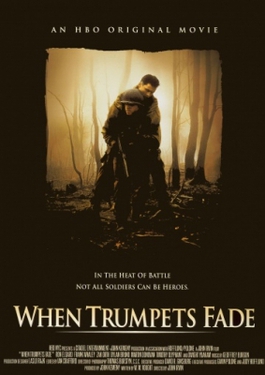
SANDS OF IWO JIMA (8) vs. WHEN TRUMPETS FADE (9)

 
VS.
 
 
ACTING:

                 “Sands of Iwo Jima” is a John Wayne movie and he gives one of his best performances.  He was nominated for Best Actor.  Sgt. Stryker became his most iconic role and he brings the full force of his charisma to it.  The character is a bit more dimensional than his cowboy characters.  He gets to play tough, empathetic, drunk, morose, heroic.  He is outstanding.  The supporting cast is adequate and very old schoolish.  John Agar is the “I can’t live up to my dead father who happened to be a mentor for Stryker” so I will hate Stryker instead guy.  Forest Tucker is the Stryker foe.  Throw in an aggravating Italian Brooklynite for dubious comic relief.  The actual war heroes inserted into the cast can best be described as “not actors”.  

                “When Trumpets Fade” is dominated by Ron Eldard as the anti-hero David Manning.  It is a remarkable performance.  The character is far from stereotypical.  He is a survivor loaded with PTSD and a cynical anti-authority attitude who is thrust into an authority position.  Eldard plays him as a guy who would have despised Stryker.  The supporting cast is satisfactory.  Martin Donovan is excellent as Capt. Pritchett.  Zac Orth does good work as the "dead meat" Sanderson.

FIRST QUARTER:    
Sands of Iwo Jima         8           
When Trumpets Fade    8

CLICHES:

                 “Sands of Iwo Jima” is not an iconoclastic movie.  In fact, it helped set the template for war movies until the 1960s.  It begins with a dedication to the Marine Corps (and is virtually a recruiting film).  The unit is not as clearly defined as heterogeneous as in many similar movies, but it is still a small unit movie.  You have a hero and a defined mission (raising the flag).  Conflict in the unit (actually two – Stryker vs. Thomas, Stryker vs. Conway) is resolved.  You have the redemption in the form of Conway who has daddy issues and is a reluctant warrior.  You get rituals like a marriage and mail call.
                “When Trumpets Fade” was obviously made with cliché-busting in mind.  However, it is a war movie so you do have some familiar elements.  It has a dedication to the men who fought in the Hurtgen Forest.  There is a mission (actually two), but reluctantly led by an anti-hero.  You definitely have the leadership forced on the main character trope, but the twist is that he fights against it and is downright surly.  Does Manning get redemption?  He would certainly have sneered at that.  There are no rituals that I noticed.  Kudos for reversing the “fat guy with glasses must die” cliché.

HALFTIME SCORE: 
Sands of Iwo Jima         14       
When Trumpets Fade    16

PLOT: 

                “Sands of Iwo Jima” is your standard boot camp to battle flic.  Stryker inherits a motley group of Marines and trains them in a tough love way for the realities of battle.  Meanwhile, conflicts within the unit are developed so that combat can resolve them.  There are two battle scenes.  The first to establish heroism and the realities of war (Tarawa).  The second to show the success of the unit evolution as it accomplishes a mission (Iwo Jima).  The flow from training to off base to training to combat is smooth and entertaining, if predictable.
                “When Trumpets Fade” has an anti-hero thrust into command of a squad of replacements.  There is no training or bonding.  Manning does not want to lead and does not care about his charges.  The traditional early arc of a combat film is dispensed with.  The transitions are mainly from Manning encountering authority to combat sequences.  Similar to “Sands”, there are two main combat scenes.  Unlike “Sands”, these episodes are basically the suicide mission variety.  Both movies have the “who will survive?” vibe.

THIRD QUARTER:  
Sands of Iwo Jima        21
When Trumpets Fade   25

COMBAT:
                “Sands of Jima” has two big combat scenes- Tarawa and Iwo Jima.  In the first, Stryker takes out a bunker in typical John Wayne fashion.  Considering the potential inherent in the Battle of Tarawa, the movie is surprisingly lacking in action.  A promised night banzai charge never materializes (WTF?) and only the first day of the three day battle is shown.  Big letdown.  The Battle of Iwo Jima is more intense and satisfying although it relies substantially on actual footage (but very well used).  The violence is very old school.  There is little blood although we do get some bullet wounds.  Nothing women can’t handle.  However, men will probably cry (you know what I’m talking about, guys). 
                “When Trumpets Fade” is from the VioLingo school and intentionally pushes the envelope created by movies like “Sands”.  It also has two major combat sequences.  The first is the mission to take out the artillery battery.  Manning is forced to shoot one of the replacements who has freaked out and is causing the rest to panic.  Sanderson uses a flamethrower to roast the Germans.  The second mission is similar with the target being some emplaced tanks.  This time grenades and Thompsons and Garands are more de rigueur.  The movie throws in two larger group actions involving the graphic results of sustained artillery fire.  The wounds are graphic and bloody and there are numerous delimbings.  Plus two losers of battles with flamethrowers.

FINAL SCORE:  
Sands of Iwo Jima       27         
When Trumpets Fade  34

COLOR ANALYSIS:  This was a great match-up between Old School and VioLingo.  VioLingo is what I am trying out as my name for modern war movies that feature realistic violence and soldier talk and behavior.  The two movies could not be more opposite.  "Trumpets" is over the top in its "war is Hell" theme and "Sands" is one of the few war movies that is not definitively anti-war.  It is almost like Stryker's death was written in because the director decided it was needed to soften the film's glamorization of war.    Certainly, no one who watches "Trumpets" rushes out to join the Army, whereas many joined the Marines due to "Sands".  Another fascinating match-up was that of hero Stryker vs. anti-hero Manning.  The hero vs. anti-hero is a crucial difference between Old School and VioLingo.  It will be interesting to see how future bouts between these schools will turn out.  For example, "Guadalcanal Diary" against "Saving Private Ryan". 


Saturday, August 11, 2012

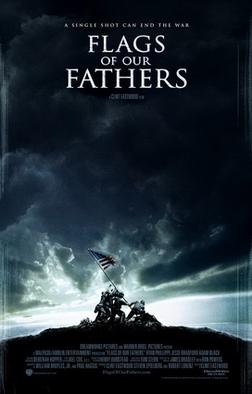
#30 - FLAGS OF OUR FATHERS (2006)


BACK-STORY:  “Flags of Our Fathers” is a war movie directed by Clint Eastwood.  It was released in 2006.  It is based on the bestseller by James Bradley and Ron Powers.  The film tells the story of the famous flag-raising on Iwo Jima and the individual stories of the flag-raisers.  It is the rare Hollywood production that not only came in under cost ($55 million compared to a budget of $80 million), but was filmed in almost half the time scheduled.  Seventy six year old directors apparently don’t like to waste time or money.  (This is movie making by your grumpy old grandpa.)  The Iwo Jima beach scenes were filmed in Iceland.  The film did well with critics, but performed weakly at the box office.  It is a companion piece with “Letters from Iwo Jima” which Eastwood filmed the same year.  “Flags” was nominated for Academy Awards for  Sound and Sound Editing.

the Japanese POV
OPENING:  James Bradley, Jr. (Tom McCarthy) is interviewing veterans to learn more about the story of his father who he found out was one of the Iwo Jima flag-raisers only after his death.  A voiceover from a veteran opines that “every jackass thinks he knows what war is like”.  This movie will apparently try to give us jackasses a cinematic approximation of the real thing.  Our first clue as to the nonlinear nature of the film comes with the development of the famous picture and its dispersal to hometown newspapers throughout the land.  One of those newspapers finds the doorstep of Harlon Black’s home where his mom insists that the caption is wrong and her son is in the picture.
SUMMARY:  Iwo Jima looks like a fireworks show.  Wait, it’s not Iwo – it’s Soldier’s Field in Chicago and three of the flag-raisers are reenacting the raising.  Flashbacks show us how they got there.  The rest of this summary will convert the screenplay into a linear structure.  In reality, the movie jumps around a lot.


Hayes (Beach) intervenes in a bayonetting of buddies
                
           The unit trained at Camp Tarawa in Hawaii in October, 1944.  A few months later they are on a transport off the small volcanic island of Iwo Jima.  The soldier talk is authentic.  The movie nails the ribbing type of humor associated with the American military.  This will be the first piece of pre-war Japanese soil for Americans to target.  They are briefed on how difficult the task will be, but the impressive bombardment lulls many of the Marines into thinking (hoping?) it will be a cake walk.  The easy landing seems to confirm the optimism.  This is no “Saving Private Ryan”, but wait…  Those crafty Nips are hiding in bunkers, pill boxes, and spider holes and open fire when the Marines begin to advance inland.  Here we go.  Few war movies have done a better job showing how peer pressure and the desire to “get it done” motivated American soldiers to walk into the maws of death.   We follow a squad of riflemen as they navigate through the hellish landscape.  “Doc” Bradley (Ryan Phillippe), a Navy corpsman, rescues several wounded soldiers (and is later awarded the Navy Cross).  Their platoon is later ordered to advance up Mount Suribachi to plant a flag.   Six members of the squad put up the second flag and Joe Rosenthal snaps a picture that will resonate across America and make the six men famous and three of them celebrities.  The three non-celebrities are killed on the island, along with other members of the squad.    Especially noteworthy is the death of Bradley’s best buddie Iggy (Jamie Bell) who was sharing a fox hole with Doc when he disappears.  Doc’s subsequent discovery of the body leaves it to our imagination what the Japanese did to him. 

that ought to do it, battle over


                The surviving three are whisked off to the States to participate in a war bonds drive.  They meet Pres. Truman who tells them they “fought for a mountain in the Pacific, now let’s fight for a mountain of cash”.   Bradley is unenthusiastic, but dutiful.  Rene Gagnon (Jesse Bradford) is excited about his celebrity status and hopes to profit from it.  Ira Hayes (Adam Beach) is already suffering from combat fatigue (as PTSD was called back then) and is very uncomfortable with his new role.  Through flashbacks, the film shows incidents that justify Hayes’ mental state.  He starts drinking heavily and becomes a liability and embarrassment to the drive.  The three “heroes” are being handled by an unctuous government flack who is using them to raise money and morale.  The contrast between the hellish war front and the garish home front is jarring.  Hayes, in particular, prefers the dangers of combat to the racism he encounters in America.  He is suffering from a classic case of survivor’s guilt. 
all's fair ...
                In the aftermath of the war, the three men’s paths diverge.  Bradley has a normal life as a funeral director, but refuses to talk about the war and agonizes over Iggy’s death.  Gagnon becomes a has-been school janitor.  Hayes continues his downward trajectory and dies of alcoholism.
CLOSING:  In one last flashback, the remainder of the unit that raised the flag get some down time and are allowed to go swimming at a beach far from the fighting.  They shed their clothes symbolic of shedding the war.
RATINGS:
Acting -  B
Action -  7/10
Accuracy – A
Realism -  A
Plot -  A

Overall -  A-

WOULD CHICKS DIG IT?  Yes.  The movie is balanced between graphic war violence and home front scenes.  It is certainly more balanced than “Saving Private Ryan”, for instance.  Females are underplayed.  You have Gagnon’s gold-digging girlfriend and Black’s grieving mother.

HISTORICAL ACCURACY:  “Flags of Our Fathers” is based on a non-fiction book by one of the flag-raisers.  We can assume Bradley and Powers did their research and since the movie takes few liberties with the book, the film is one of the most accurate war movies ever made.

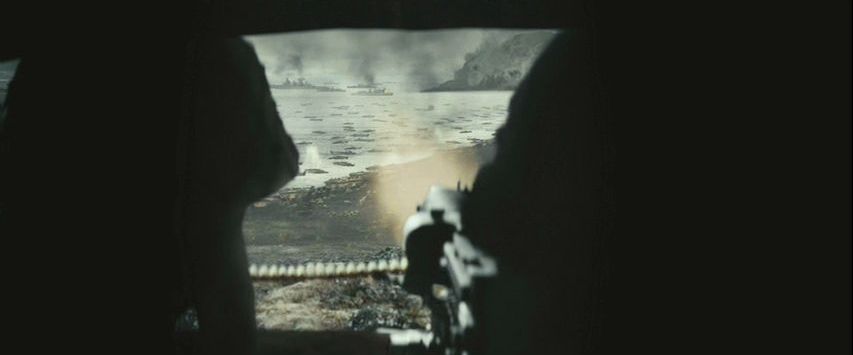
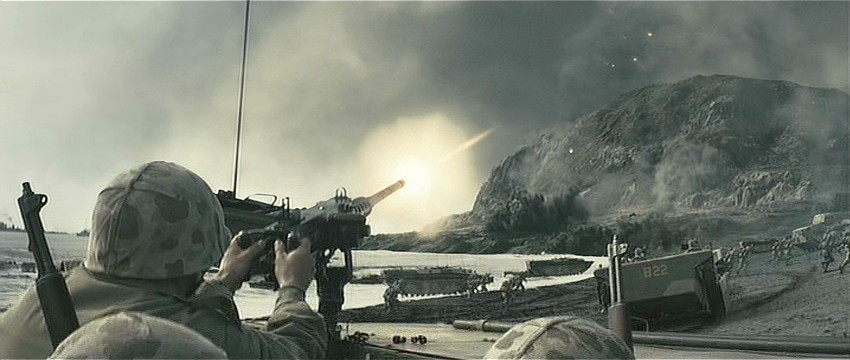
                The Iwo landing by the Marines is close to the real thing.  Eastwood wisely decided not to outdo the opening assault of “Saving Private Ryan”, hopefully because he knew the Iwo landing was unopposed.  The movie accurately depicts how the enemy waited for the Marines to move off the beaches before opening fire.  The POV shots from the pill boxes and from the frowning heights of Mount Suribachi clearly show the lack of cover the Marines faced.  Iceland fills in well for the bleak landscape of Iwo.  The military hardware is authentic.  Even the Japanese weapons are appropriate.  The CGI renditions of the fleet and the Corsairs are satisfactory.

the slope of Suribachi
                The combat is realistic with the night actions standing out.  The randomness of death is apparent.  The film accurately depicts each of the deaths of the main characters.  Eastwood does not give the actors stirring last words.  If the death was instant, it is shown that way in the movie.  None dies heroically.   You have to credit the screenwriters for sticking to the book when it comes to the deaths.

                The flag-raising incident could not have been better.  Even to the extent that the guy who plays Joe Rosenthal is a dead-ringer for the photographer.  This segment of the film could be shown in American History classrooms with no caveats.  The movie includes the subplot of the Harlon Black / Hank Hansen confusion to good effect.  A little surprisingly, only fleeting mention is made to the myth that Rosenthal staged the photo.

                The home front bond tour is well done.  One possible flaw is the movie has the bond director Gerber (John Slattery) giving an impassioned plea that if the trio does not give their all the government will go bankrupt and the war will be lost.  He throws in the claim that the public is tiring of the war and badly needs a morale boost.  It is hard to tell if the writers believed this nonsense or whether Gerber is supposed to be spouting bull shit.  Regardless, it could fool a modern audience.  In fact, the bond drive was important financially, but hardly a tipping point.  As far as civilian morale, the public was definitely tired, but certainly not contemplating giving up when the light at the end of the tunnel was clear.

                The attitudes and personalities of the trio are true to life.  They seem to be stereotypes, but they reflect their portrayals in the book.  Gagnon does come off as a bit slimy, but it is not surprising that one of the three would be selfish and blinded by celebrity.  Bradley is a little saintly, but that sounds like many medics.  Hayes is the most famous of the three so there was less chance to tamper with his life.  He even had his own movie called “The Outsider”.  The movie has him turning to alcohol because of the bond tour when in reality he was already a heavy drinker.  I also found evidence that he did not mind participating in the drive, but did not like the speeches and press.  His mistreatment as a Native American reflects the prejudice of the times.   The seemingly unbelievable 1,300 mile trek to inform the Blacks of their son’s role is based on fact.  Sadly, his death is the way it happened.


wow, the military loaned a lot of landing craft
                There are a few incidents that I can comment on.  There really was a man overboard incident where the fleet could not stop to pick him up.  Iggy’s death (which had such a long-term impact on Bradley) follows the book, but leaves out the torture aspect (only hinting at it).  The movie uses CGI to hit one of the battleships supporting the landing.  No battleship was actually hit.  Here’s another inaccuracy – noone lights up a cigarette until the 1:17 mark!  War movies have come a long way.

                Now let me address the Spike Lee controversy.  Lee criticized the movie for ignoring the participation of African-American Marines in the Battle of Iwo Jima.  This may have been a publicity stunt to create buzz for his upcoming "Miracle at St. Anna" ( a vastly inferior war film, by the way).  Eastwood took umbrage and there was a rather silly snit.  Lee pointed out that no blacks appear in the movie and this denigrates their role in the battle.  Eastwood countered with the argument that his film was about the flag-raising and there were no blacks involved in that.  I come down on Eastwood’s side on this.  Lee is correct that there were African-Americans on Iwo, but unfortunately they were relegated to supply roles.  Had Eastwood thrown in a shot of blacks unloading ammunition, that would have been condescending and too obviously an example of political correctness.  Having blacks in the thick of the fighting and/or involved in the flag-raising would have been a feel good mockery of history.  Of course, it doesn’t help Eastwood’s case when he showcases some war dogs.


CRITIQUE:  The structure of the film is interesting.  It is a good example of the method of "in media res".  This is when a director starts the movie in the middle or end and then uses flashbacks and flashforwards.  “Flags” is very non-linear and actually follows three threads – the battle, the bond drive, and Bradley’s quest to research the book.  This concept works well and is not confusing.  The Bradley interviewing veterans scenes are the weakest, but necessary.  One questionable decision was to reveal the three survivors early on.  From that point on the suspense was not who would survive but how the other members of the squad would die.

                There are several themes that pop up.  One is the use of patriotism to manipulate individuals and the public as a whole.  In this case the media is a willing partner of the government.  We see the power of these two to create heroes.  If you think things have changed, remember Jessica Lynch and Pat Tillman?  A second is the gap between the war front and the home front.  What the soldiers face and what the home front is going through and what the home front imagines the soldiers are going through is a wide gap.  I might add that although I doubt it was a conscious decision by the makers, the movie clearly contrasts the WWII home front involvement in the war with the lack of involvement of the home front during the Iraq War.  Necessity versus ignorance.  By far the biggest theme is “what is heroism?”   The film strongly suggests that the three flag-raisers who died were heroes and the three survivors were not (which all three would have agreed with).  This “only the dead were heroes” approach is standard, but belies reality.  Bradley, for example, won the Navy Cross for his bravery in saving wounded.  He was definitely a hero!

                The movie is very technically sound.  Eastwood is a great director and it shows in this movie.  The cinematography is great.  He uses a variety of shots.  There is some off-center, hand-helds, and POVs.  The scenes on the island are muted in color and this contrasts with the colorful home front scenes.  The sound effects are amazing.  This must have been close to the way the battle actually sounded.  Eastwood’s soundtrack is sparse, but effective (like the man himself).  Some good period songs (ex. “Any Bonds Today”) are included.

                The acting is top notch.  Adam Beach deserved an Academy Award nomination for his portrayal of Hayes.  Bradford is also strong as the star-struck Gagnon.  This “hero” takes a beating in the screenplay and I felt sorry for him.  He is used to hammer home the theme that just raising a flag does not make you a hero.  One good thing – Gagnon gets to make the strongest “we’re not the real heroes” comment in the film.   The rest of the cast is solid.

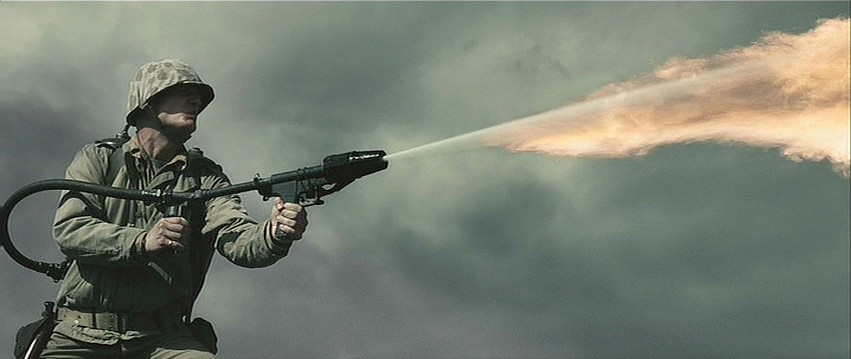
                The action is excellent.  Once the bullets start flying, it’s very reminiscent of the “Saving Private Ryan” style and foreshadows combat in the miniseries “The Pacific”.  The violence is graphic, but not outlandish.  A flamethrower takes out a pill box.  A severed head lands on Hayes.  Horrific sights abound.

CONCLUSION:  “Flags of Our Fathers” seems to be nestled in an appropriate position at #30.  It is a very good, but not great war film.  Eastwood took a bestselling nonfiction book about the most famous photo of WWII and did it justice.  The movie did not get a lot of love from critics, but it is hard to imagine how the movie could have been better in interpreting the book.  In fact, the movie is better than the book.  I liked the nonlinear structure.  It added some pizzazz.  The book was boring after they left the island.


                The greatest strength of the movie and its main claim to a potentially high spot on my eventual 100 Best War Movies list is it accurately brings to the screen an important military event that the public should know about.  The movie may be criticizing hero worship, but several of the protagonists were legitimate heroes and deserve to be known.  More than sixty years after Iwo Jima, it is doubtful many Americans have heard of Ira Hayes much less the other five men.  Hell, many are probably not that familiar with the flag raising itself.
 
POSTER:  Excellent!  Could not be better.  How can you go wrong using that photo?  A+

TRAILER:   Well balanced.  Hits the themes effectively.  Only hints at the combat so it's not your typical adrenalin-fueled trailer.  That's a good thing.  A+