Saturday, August 11, 2012

#30 - FLAGS OF OUR FATHERS (2006)


BACK-STORY:  “Flags of Our Fathers” is a war movie directed by Clint Eastwood.  It was released in 2006.  It is based on the bestseller by James Bradley and Ron Powers.  The film tells the story of the famous flag-raising on Iwo Jima and the individual stories of the flag-raisers.  It is the rare Hollywood production that not only came in under cost ($55 million compared to a budget of $80 million), but was filmed in almost half the time scheduled.  Seventy six year old directors apparently don’t like to waste time or money.  (This is movie making by your grumpy old grandpa.)  The Iwo Jima beach scenes were filmed in Iceland.  The film did well with critics, but performed weakly at the box office.  It is a companion piece with “Letters from Iwo Jima” which Eastwood filmed the same year.  “Flags” was nominated for Academy Awards for  Sound and Sound Editing.
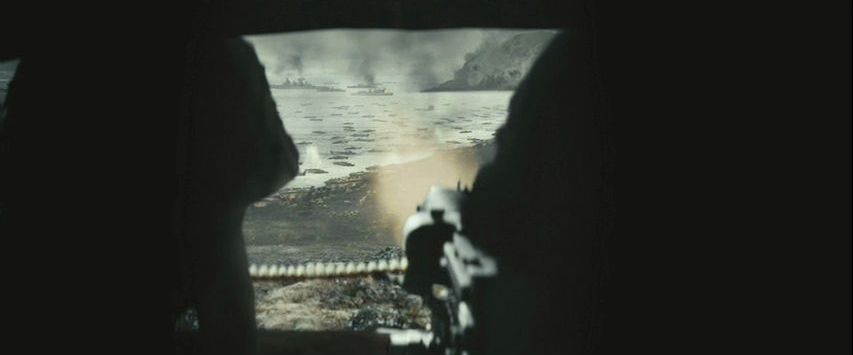
the Japanese POV
OPENING:  James Bradley, Jr. (Tom McCarthy) is interviewing veterans to learn more about the story of his father who he found out was one of the Iwo Jima flag-raisers only after his death.  A voiceover from a veteran opines that “every jackass thinks he knows what war is like”.  This movie will apparently try to give us jackasses a cinematic approximation of the real thing.  Our first clue as to the nonlinear nature of the film comes with the development of the famous picture and its dispersal to hometown newspapers throughout the land.  One of those newspapers finds the doorstep of Harlon Black’s home where his mom insists that the caption is wrong and her son is in the picture.
SUMMARY:  Iwo Jima looks like a fireworks show.  Wait, it’s not Iwo – it’s Soldier’s Field in Chicago and three of the flag-raisers are reenacting the raising.  Flashbacks show us how they got there.  The rest of this summary will convert the screenplay into a linear structure.  In reality, the movie jumps around a lot.
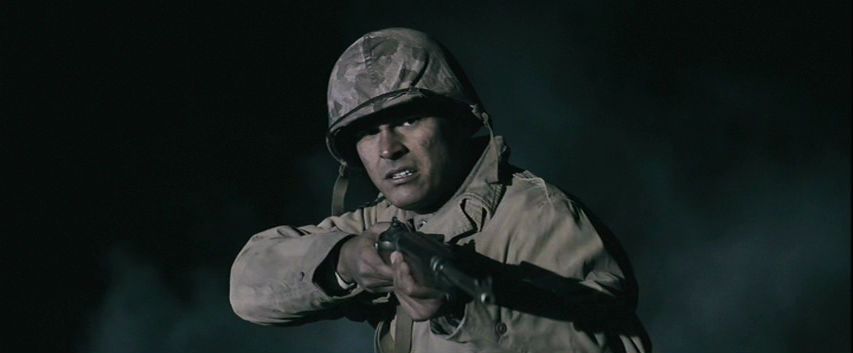


Hayes (Beach) intervenes in a bayonetting of buddies
                
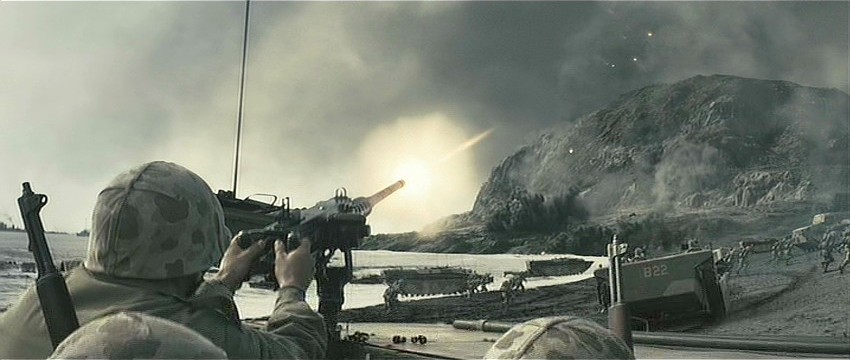
           The unit trained at Camp Tarawa in Hawaii in October, 1944.  A few months later they are on a transport off the small volcanic island of Iwo Jima.  The soldier talk is authentic.  The movie nails the ribbing type of humor associated with the American military.  This will be the first piece of pre-war Japanese soil for Americans to target.  They are briefed on how difficult the task will be, but the impressive bombardment lulls many of the Marines into thinking (hoping?) it will be a cake walk.  The easy landing seems to confirm the optimism.  This is no “Saving Private Ryan”, but wait…  Those crafty Nips are hiding in bunkers, pill boxes, and spider holes and open fire when the Marines begin to advance inland.  Here we go.  Few war movies have done a better job showing how peer pressure and the desire to “get it done” motivated American soldiers to walk into the maws of death.   We follow a squad of riflemen as they navigate through the hellish landscape.  “Doc” Bradley (Ryan Phillippe), a Navy corpsman, rescues several wounded soldiers (and is later awarded the Navy Cross).  Their platoon is later ordered to advance up Mount Suribachi to plant a flag.   Six members of the squad put up the second flag and Joe Rosenthal snaps a picture that will resonate across America and make the six men famous and three of them celebrities.  The three non-celebrities are killed on the island, along with other members of the squad.    Especially noteworthy is the death of Bradley’s best buddie Iggy (Jamie Bell) who was sharing a fox hole with Doc when he disappears.  Doc’s subsequent discovery of the body leaves it to our imagination what the Japanese did to him. 

that ought to do it, battle over


                The surviving three are whisked off to the States to participate in a war bonds drive.  They meet Pres. Truman who tells them they “fought for a mountain in the Pacific, now let’s fight for a mountain of cash”.   Bradley is unenthusiastic, but dutiful.  Rene Gagnon (Jesse Bradford) is excited about his celebrity status and hopes to profit from it.  Ira Hayes (Adam Beach) is already suffering from combat fatigue (as PTSD was called back then) and is very uncomfortable with his new role.  Through flashbacks, the film shows incidents that justify Hayes’ mental state.  He starts drinking heavily and becomes a liability and embarrassment to the drive.  The three “heroes” are being handled by an unctuous government flack who is using them to raise money and morale.  The contrast between the hellish war front and the garish home front is jarring.  Hayes, in particular, prefers the dangers of combat to the racism he encounters in America.  He is suffering from a classic case of survivor’s guilt. 
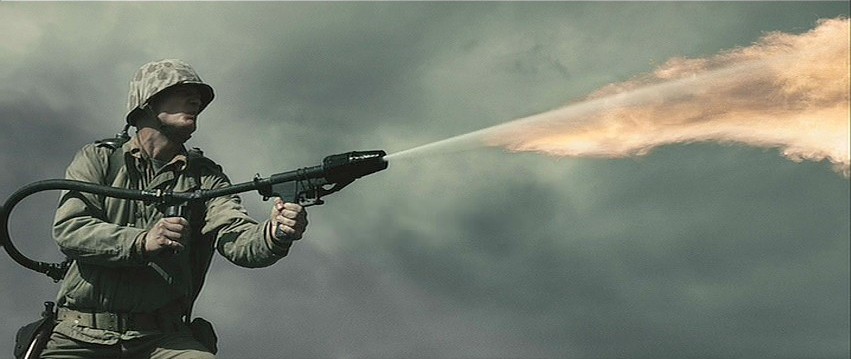
all's fair ...
                In the aftermath of the war, the three men’s paths diverge.  Bradley has a normal life as a funeral director, but refuses to talk about the war and agonizes over Iggy’s death.  Gagnon becomes a has-been school janitor.  Hayes continues his downward trajectory and dies of alcoholism.
CLOSING:  In one last flashback, the remainder of the unit that raised the flag get some down time and are allowed to go swimming at a beach far from the fighting.  They shed their clothes symbolic of shedding the war.
RATINGS:
Acting -  B
Action -  7/10
Accuracy – A
Realism -  A
Plot -  A

Overall -  A-

WOULD CHICKS DIG IT?  Yes.  The movie is balanced between graphic war violence and home front scenes.  It is certainly more balanced than “Saving Private Ryan”, for instance.  Females are underplayed.  You have Gagnon’s gold-digging girlfriend and Black’s grieving mother.

HISTORICAL ACCURACY:  “Flags of Our Fathers” is based on a non-fiction book by one of the flag-raisers.  We can assume Bradley and Powers did their research and since the movie takes few liberties with the book, the film is one of the most accurate war movies ever made.

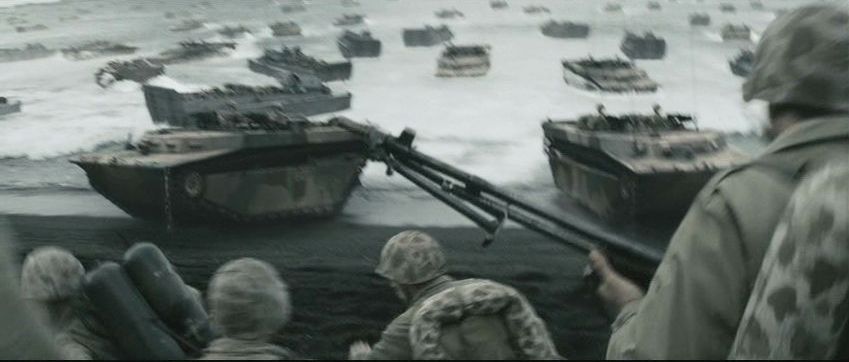
                The Iwo landing by the Marines is close to the real thing.  Eastwood wisely decided not to outdo the opening assault of “Saving Private Ryan”, hopefully because he knew the Iwo landing was unopposed.  The movie accurately depicts how the enemy waited for the Marines to move off the beaches before opening fire.  The POV shots from the pill boxes and from the frowning heights of Mount Suribachi clearly show the lack of cover the Marines faced.  Iceland fills in well for the bleak landscape of Iwo.  The military hardware is authentic.  Even the Japanese weapons are appropriate.  The CGI renditions of the fleet and the Corsairs are satisfactory.

the slope of Suribachi
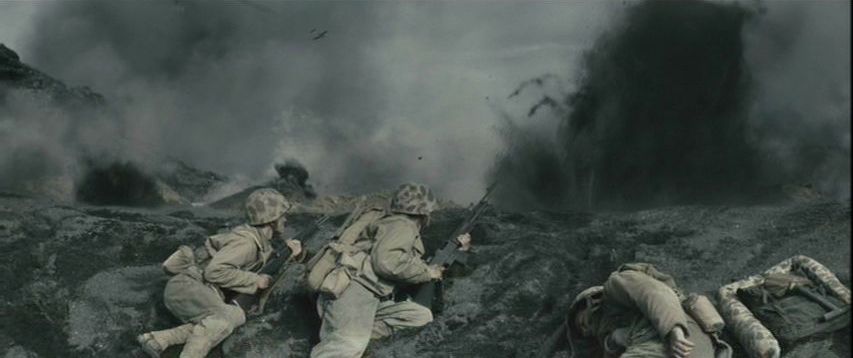
                The combat is realistic with the night actions standing out.  The randomness of death is apparent.  The film accurately depicts each of the deaths of the main characters.  Eastwood does not give the actors stirring last words.  If the death was instant, it is shown that way in the movie.  None dies heroically.   You have to credit the screenwriters for sticking to the book when it comes to the deaths.

                The flag-raising incident could not have been better.  Even to the extent that the guy who plays Joe Rosenthal is a dead-ringer for the photographer.  This segment of the film could be shown in American History classrooms with no caveats.  The movie includes the subplot of the Harlon Black / Hank Hansen confusion to good effect.  A little surprisingly, only fleeting mention is made to the myth that Rosenthal staged the photo.

                The home front bond tour is well done.  One possible flaw is the movie has the bond director Gerber (John Slattery) giving an impassioned plea that if the trio does not give their all the government will go bankrupt and the war will be lost.  He throws in the claim that the public is tiring of the war and badly needs a morale boost.  It is hard to tell if the writers believed this nonsense or whether Gerber is supposed to be spouting bull shit.  Regardless, it could fool a modern audience.  In fact, the bond drive was important financially, but hardly a tipping point.  As far as civilian morale, the public was definitely tired, but certainly not contemplating giving up when the light at the end of the tunnel was clear.

                The attitudes and personalities of the trio are true to life.  They seem to be stereotypes, but they reflect their portrayals in the book.  Gagnon does come off as a bit slimy, but it is not surprising that one of the three would be selfish and blinded by celebrity.  Bradley is a little saintly, but that sounds like many medics.  Hayes is the most famous of the three so there was less chance to tamper with his life.  He even had his own movie called “The Outsider”.  The movie has him turning to alcohol because of the bond tour when in reality he was already a heavy drinker.  I also found evidence that he did not mind participating in the drive, but did not like the speeches and press.  His mistreatment as a Native American reflects the prejudice of the times.   The seemingly unbelievable 1,300 mile trek to inform the Blacks of their son’s role is based on fact.  Sadly, his death is the way it happened.


wow, the military loaned a lot of landing craft
                There are a few incidents that I can comment on.  There really was a man overboard incident where the fleet could not stop to pick him up.  Iggy’s death (which had such a long-term impact on Bradley) follows the book, but leaves out the torture aspect (only hinting at it).  The movie uses CGI to hit one of the battleships supporting the landing.  No battleship was actually hit.  Here’s another inaccuracy – noone lights up a cigarette until the 1:17 mark!  War movies have come a long way.
                Now let me address the Spike Lee controversy.  Lee criticized the movie for ignoring the participation of African-American Marines in the Battle of Iwo Jima.  This may have been a publicity stunt to create buzz for his upcoming "Miracle at St. Anna" ( a vastly inferior war film, by the way).  Eastwood took umbrage and there was a rather silly snit.  Lee pointed out that no blacks appear in the movie and this denigrates their role in the battle.  Eastwood countered with the argument that his film was about the flag-raising and there were no blacks involved in that.  I come down on Eastwood’s side on this.  Lee is correct that there were African-Americans on Iwo, but unfortunately they were relegated to supply roles.  Had Eastwood thrown in a shot of blacks unloading ammunition, that would have been condescending and too obviously an example of political correctness.  Having blacks in the thick of the fighting and/or involved in the flag-raising would have been a feel good mockery of history.  Of course, it doesn’t help Eastwood’s case when he showcases some war dogs.


CRITIQUE:  The structure of the film is interesting.  It is a good example of the method of "in media res".  This is when a director starts the movie in the middle or end and then uses flashbacks and flashforwards.  “Flags” is very non-linear and actually follows three threads – the battle, the bond drive, and Bradley’s quest to research the book.  This concept works well and is not confusing.  The Bradley interviewing veterans scenes are the weakest, but necessary.  One questionable decision was to reveal the three survivors early on.  From that point on the suspense was not who would survive but how the other members of the squad would die.

                There are several themes that pop up.  One is the use of patriotism to manipulate individuals and the public as a whole.  In this case the media is a willing partner of the government.  We see the power of these two to create heroes.  If you think things have changed, remember Jessica Lynch and Pat Tillman?  A second is the gap between the war front and the home front.  What the soldiers face and what the home front is going through and what the home front imagines the soldiers are going through is a wide gap.  I might add that although I doubt it was a conscious decision by the makers, the movie clearly contrasts the WWII home front involvement in the war with the lack of involvement of the home front during the Iraq War.  Necessity versus ignorance.  By far the biggest theme is “what is heroism?”   The film strongly suggests that the three flag-raisers who died were heroes and the three survivors were not (which all three would have agreed with).  This “only the dead were heroes” approach is standard, but belies reality.  Bradley, for example, won the Navy Cross for his bravery in saving wounded.  He was definitely a hero!

                The movie is very technically sound.  Eastwood is a great director and it shows in this movie.  The cinematography is great.  He uses a variety of shots.  There is some off-center, hand-helds, and POVs.  The scenes on the island are muted in color and this contrasts with the colorful home front scenes.  The sound effects are amazing.  This must have been close to the way the battle actually sounded.  Eastwood’s soundtrack is sparse, but effective (like the man himself).  Some good period songs (ex. “Any Bonds Today”) are included.

                The acting is top notch.  Adam Beach deserved an Academy Award nomination for his portrayal of Hayes.  Bradford is also strong as the star-struck Gagnon.  This “hero” takes a beating in the screenplay and I felt sorry for him.  He is used to hammer home the theme that just raising a flag does not make you a hero.  One good thing – Gagnon gets to make the strongest “we’re not the real heroes” comment in the film.   The rest of the cast is solid.

                The action is excellent.  Once the bullets start flying, it’s very reminiscent of the “Saving Private Ryan” style and foreshadows combat in the miniseries “The Pacific”.  The violence is graphic, but not outlandish.  A flamethrower takes out a pill box.  A severed head lands on Hayes.  Horrific sights abound.

CONCLUSION:  “Flags of Our Fathers” seems to be nestled in an appropriate position at #30.  It is a very good, but not great war film.  Eastwood took a bestselling nonfiction book about the most famous photo of WWII and did it justice.  The movie did not get a lot of love from critics, but it is hard to imagine how the movie could have been better in interpreting the book.  In fact, the movie is better than the book.  I liked the nonlinear structure.  It added some pizzazz.  The book was boring after they left the island.


                The greatest strength of the movie and its main claim to a potentially high spot on my eventual 100 Best War Movies list is it accurately brings to the screen an important military event that the public should know about.  The movie may be criticizing hero worship, but several of the protagonists were legitimate heroes and deserve to be known.  More than sixty years after Iwo Jima, it is doubtful many Americans have heard of Ira Hayes much less the other five men.  Hell, many are probably not that familiar with the flag raising itself.
 
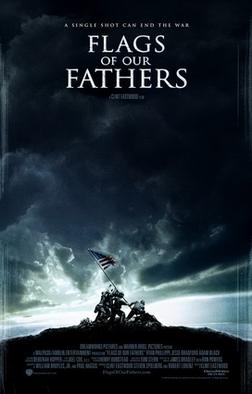
POSTER:  Excellent!  Could not be better.  How can you go wrong using that photo?  A+

TRAILER:   Well balanced.  Hits the themes effectively.  Only hints at the combat so it's not your typical adrenalin-fueled trailer.  That's a good thing.  A+ 


Thursday, August 9, 2012

DUELING MOVIES: "Lebanon" vs. "Beaufort"


                The Lebanon War has been fodder for three significant war movies:  “Lebanon”, “Beaufort”, and “Waltz with Bashir”.  Two of them are good movies, one is a masterpiece.  All three are Israeli films with subtitles.  The Lebanon War began June, 1982 when the Israeli Army invaded southern Lebanon.  The goals were to expel the PLO, remove Syrian influence, and install a pro-Israel, Christian government.  The war was messy with the IDF battling the PLO, Syrian Army, and Muslim Lebanese.  The Israelis occupied southern Lebanon and surrounded the PLO in West Beirut.  A negotiated free passage was arranged for the PLO to evacuate Lebanon.  Things began to sour for Israel after the assassination of the Christian they had put into power – Bachir Gemayel.  The outrage that resulted from Israeli complicity in the massacres in the Sabra and Shatila Palestinian refugee camps, forced the IDF to pull out of Beirut.  The Israelis remained in southern Lebanon for another eighteen years.  The guerrilla war waged by Shi’a militant groups eroded Israeli public support for the war.  In 1985, most of the IDF was withdrawn from the country, but Israel retained control of an eight mile wide security zone along the border.
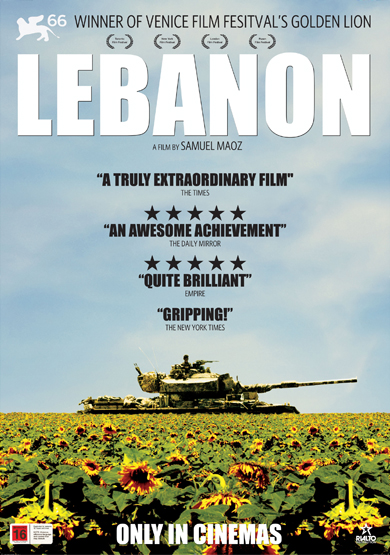
                “Lebanon” is set on the first day of the war.  It is an autobiographical tale of a tank gunner and his comrades in a Merkava tank.  Virtually the entire movie takes place inside the tank or views from inside the tank.  The movie opens with Shmulik’s (Yoav Donat) arrival as a new crew member.  The movie quickly developes into a small unit movie.  The crew of four is dysfunctional.  Azzi (Itay Tiran) is the tank commander who is not comfortable with the responsibility.  Hertzel (Oshri Cohen), the loader, is a mouthy malcontent.  Yigal (Michael Moshonov), the driver, is tightly wound.  
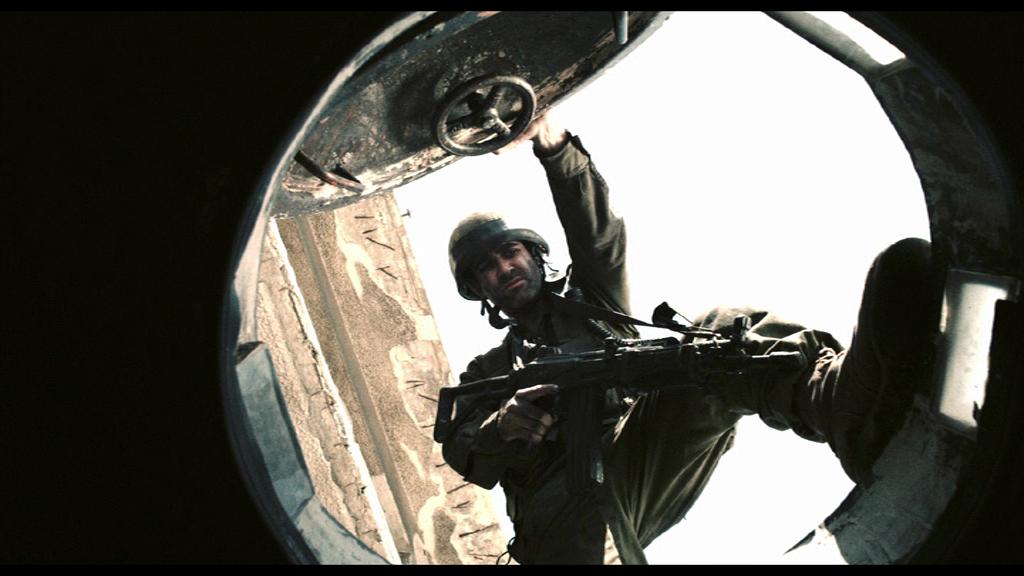
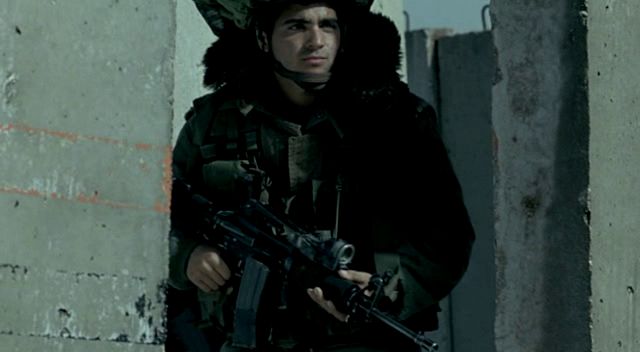
Gamil from guess where
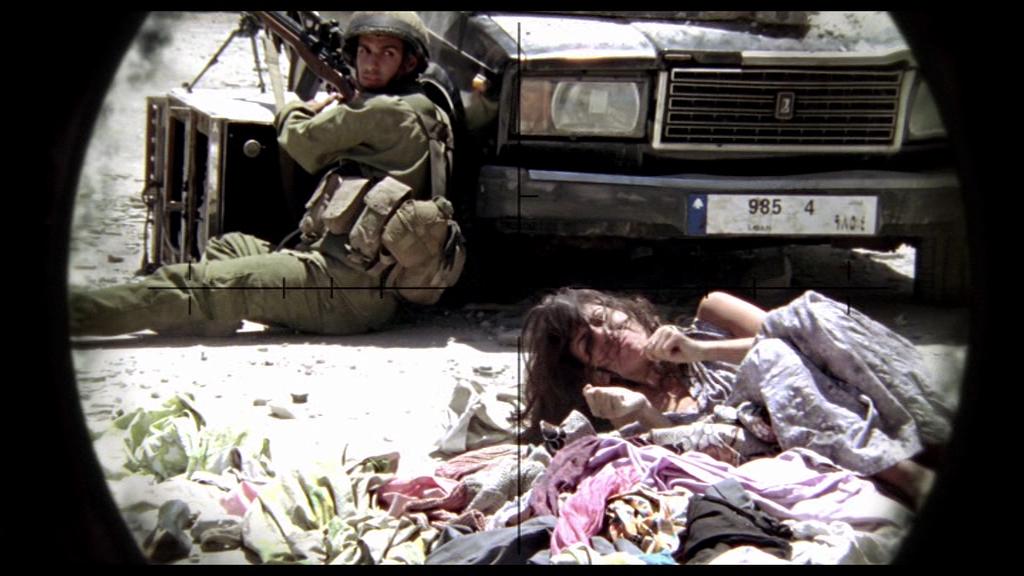
 The tank is ordered to support a paratrooper unit led by gung-ho Gamil (Zohar Shtranza).  The tank does not mesh well with the elite paratroopers.  Shmulik freezes in their first action and cannot bring himself to fire on a car and a paratrooper is killed as a result.  He had never fired at a human target before.  The dead body is placed in the tank.  Later (having learned his lesson), Shmulik does not hesitate to fire on a truck which turns out to be driven by an innocent chicken farmer.  War is hell and confusing.
war through a gunsight
war can be confusing
                They move into a town.  There are dead civilians everywhere.  Gamil calls for the use of phosphorous shells (but since they are against international law) he refers to the weapon as “flaming smoke”.  They begin to encounter “terrorists” as they call them.  A Syrian fires an RPG at the tank and dazes them.  He is captured and chained inside the tank.  At this point, the crew wants out.  They are not heroes.  Even Gamil panics as they get surrounded.  The paratroopers are saved by following a Mercedes driven by some Christian Lebanese.  The tank is left behind and comes under fire. Yigal loses it and starts crying for his mom.  Shmulik is forced to take command and the tank plows forward. 
                “Lebanon” is based on the director’s (Samuel Maoz) experiences as a young tank gunner in the war.  He chooses to give us a “tank’s eye” view of war.  Much of the movie is seen through the tank’s sight.  The sound effect of the turret hydraulics adds an eerie touch. This POV approach is interesting.  What he sees, we see.  And what he sees is war undiluted.  The scenes inside the tank are also undiluted.  The inside of the tank (although too spacious) is appropriately groddy.  It is hot, they are sweating.  The themes are the corrupting influence of war, the fogginess of combat, and conscripts don’t always develop into hardened veterans.  The movie does not show IDF soldiers in a positive light.  The criticism of this depiction seems to be warranted because really no one  (including Gamil) lives up to the image of the disciplined, tough Israeli soldier.
Libratti
                “Beaufort” takes place at the end of the war.  Beaufort was an old Crusader fort captured by the Israelis early in the war.  It became a strategic position in the security zone and was occupied by an Israeli garrison for eighteen years until withdrawn from in 2000.  The movie is based on the eponymous novel and covers the last few weeks.  It concentrates on the commanding officer, a twenty-something named Liraz Libratti (Oshri Cohen), but it falls firmly in the small unit subgenre and the “who will survive?” subsubgenre.
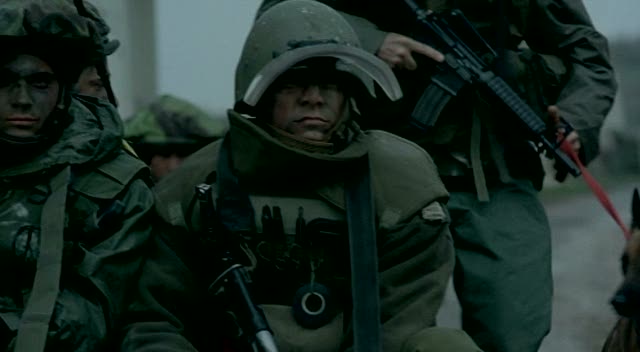
Ziv dressed for a job
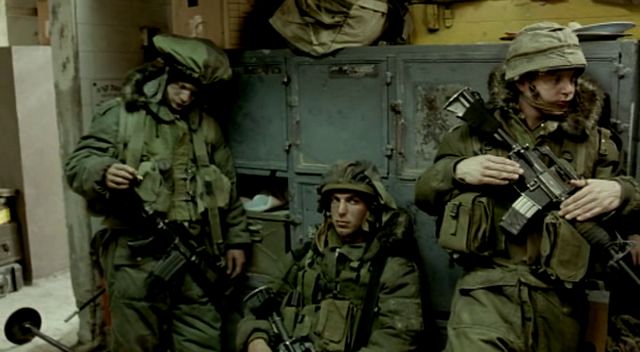
waiting out a mortar barrage
                The movie opens with the arrival of a bomb disposal expert named Ziv.  He is helicoptered in to disarm a “device” threatening their supply route.  Ziv proceeds to get lost in the labyrinthian corridors of the fort.  His encounter with the bomb is reminiscent of the opening of “The Hurt Locker”.  After this journey outside the fort the movie settles into the claustrophobic confines of the installation.  The men are looking forward to going home, but the enemy (Hezbollah) are intent on making it look like their tails are between their legs as they leave.  The faceless enemy use rockets against the outposts.  It becomes apparent that not all of them will be going home alive.  There are similarities to the documentary "Restrepo".
                As losses mount and abandonment of the fort becomes more likely, disillusionment develops as Libratti and others question what was the point of holding the fort to begin with.  This aspect of the film reminded me of "Hamburger Hill"  This is amplified by the rumor that the fort was originally assaulted in a case of miscommunication after the high command had countermanded the order.  The situation has a latter part of Vietnam feel to it as the soldiers reference the public’s increasing opposition to the buffer zone.  The Four Mothers Movement (an anti-war organization created by mothers of IDF soldiers killed or stuck in Lebanon that put pressure on the government to fulfill it's promised withdrawal)  is specifically mentioned and Ziv’s father gives an interview lamenting his failure to instill an “instinct of fear” in his son.
                Although Libratti is the main character, the unit of heterogeneous soldiers is fleshed out.  They are a bit stereotyped, but not embarrassingly so.  Libratti is the most complex.  When we first meet him both his men and the audience question his leadership qualities, but although he does make some mistakes, his loyalty to his men and sincerity become apparent.  The second strongest personality is Koris (Itay Tiran) who is the clichéd cynical, embittered soldier.  He clashes with Libratti and argues that a good officer would disobey bad orders.  Oshri (Eli Eltonyo) is the friendly romantic.  Shpitzer (Arthur Faradjev) is the guy who could have been a classical pianist.  You get the idea.
                “Beaufort” is well acted.  The soldiers behave more realistically than the tank crew of “Lebanon”.  The dialogue is stronger and there is some soldier humor.  The cinematography is interesting, although not unorthodox like in “Lebanon”.  There is some effective use of hand-held to follow the movement of the men.  They are similarly claustrophobic.  It is more political and more of a message movie.  The message is the futility of war and how politics can even effect a small unit.  In spite of this, “Beaufort” was not as controversial as “Lebanon” because it questions the leaders, not the soldiers.  Whereas “Lebanon” traces the disintegration of a unit under pressure, “Beaufort” concentrates on coping.  Both are studies in command, but Libratti’s evolution is much more interesting and logical than that of Jamil and Azzi.
                In conclusion, “Lebanon” and “Beaufort” are good companions.  I knew very little about the Lebanon War before viewing them.  These movies (plus some research) have been good tutorials.  You can clearly see why the war has been called Israel’s Vietnam War.
Grades:  Lebanon =  B
               Beaufort =  A- 
Lebanon trailer

Lebanon full movie


Beaufort trailer


Saturday, August 4, 2012

LIVE: Age of Heroes


DEAR FOLLOWERS, I AM NOW ON TWITTER - @warmoviebuff
I will tweet not only when I post, but whenever I watch a new war movie I will tweet a mini-review.  Also, please follow my compadre: @AboutWarMovies
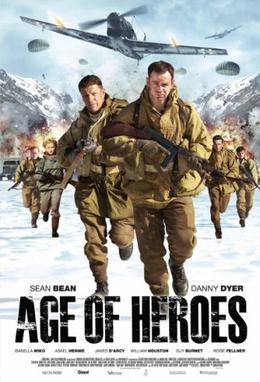
This is my third "Live" review.  A live review is a stream of consciousness review of a movie.  I jot down thoughts as I am watching and then clean them up for my readers.  Being a big Sean Bean fan I was attracted to a recent movie of his entitled "Age of Heroes".  SPOILER ALERT:  I cover the whole movie, stop wherever you want and then jump to the last paragraph.  Here goes:

Credits - I don't recognize anyone but Bean  /  France May, 1940;  hand held, looks like "Lost Battalion" style;  5 Brits on the run, none is SB;  the wounded one gets killed - convenient for more rapid movement;  the obligatory "we're all gonna die" dude  /  they run into some other Brits led by a stuffy twit of an officer - he orders them to stay and join their last stand because he has been ordered to hold;  Raines insists its suicidal and plans to move on to Dunkirk (he's not a coward, he's just sensible) - head butts the twit;  wasn't the twit right?  orders is orders - you can't have the enlisted deciding what makes sense  /  Naval Institute at White Hall -  there's SB (he's looking kinda old, I guess so am I);  he's a Maj. Jones of the Royal Marines - he's ruffled feathers, naturally;  an intel type named Fleming (I later found out it's Ian) tells him of Operation Grendal and introduces him to an American (first Where Eagles Dare (WED from here) ripoff) named Steinar;  something about German radar taking out British bombers ( you know - this mission will win the war);  all they have to do is infiltrate Norway and steal radar technology (wait - didn't the British have a clear advantage in radar technolgy?);  subgenre - suicide mission!;  some uncomfortable looks from Fleming when he asks about Jones' pregnant wife (or is the dude just constipated?)  /  Grace does not want Jones to go (baby on the way is war movie speak for you ain't coming back)  /  Jones goes to a military prison (with the requisite sadistic guards) to pick up one of his select team (Sid);  Raines is there because of his head butting the officer, he wants to be a commando too so he grabs a gun and takes Jones hostage which of course wins Jones' admiration (?) and a spot on the team (if he promises to behave)  /  training segment -  the sergeant (Mac) is a tough SOB who will make men of them;  6 guys besides Mac and Jones - who will survive?  not many, I bet;  time for a montage - hiking, rapeling, boxing, etc.;  "Pain is just weakness leaving the body" (I think I'll use that in the weight room);  Raines screws up by being a crack shot, but a dick about it - Jones almost washes him out but then he wouldn't get redemption, would he?  /  Fleming comes to brief and brings a radar geek with him - it's actually a anti-jamming device they are going after and he will know it when he sees it;  Fleming to Jones - don't let geek get captured, Fleming to Raines - kill geek if it comes to it;  mission outlined - I wonder if everything will go according to plan  /  paradrop without parachute training (these guys are hard core);  glitch #1 -  German night fighter Swiss cheeses plane and an expendable is killed (suddenly, nice touch) one down  /  glitch #2 - they land far off course;  glitch #3 - they lost most of their equipment;  snow on the ground (WED) and broken neck (WED);  geek is already captured - end of movie?  nope, he's rescued;  they are being tracked (easily what with the lack of white gear) by a handsome, charming, but malevolent Nazi  the movie has subtitles - a bit too classy for this movie;  they meet their contact - it's a girl! (WED)  she's cute, but can she be trusted?;  she takes them to a farm to get explosives - the farmer is less than thrilled considering their tracks in the snow lead right to his family (sorry, dude - be a patriot)  /  after they leave the Germans arrive, they wouldn't kill that lovely family would they - the music says yes;  wow, that's some serious killing - I hate that German and can't wait for his bloody death  /  the radar site -  checking things out via binocular;  explosions via dynamite for distracting (WED);  lots of dead Germans (WED), our guys seem charmed;  geek gets the intel;  oh there goes someone and another is captured (who? can't tell) - down to 7 now;  no naval pick-up, have to go to Sweden (Christ, what next?!)  /  return to the farm - hey, where is everyone?;  Nazis arrive and they have Sid and torture him to get them to come out meanwhile they stand in the open clearly shootable;  Jones opens fire but neglects to target Nazi guy (drat!);  fire fight - no grenades because the Germans want to take them alive;  Jones shoots Sid (6 left) to put him out of his misery (anguished look)  /  escaping -  Steinar is killed; Raines prepares to slash throat when geek and girl (disobeying orders, of course) come rescue him because he is not redeemed yet;  Jones and Mac stay as rear guard and argue who will sacrifice themself, neither convinces the other (looks bad for Jones' newborn)  /  jump to Raines, geek, and girl on top of a mountain - "that's Sweden";  swelling music - the end;  30% survival rate - pretty standard;  hey, what about the bloody death of the Nazi?  boo!  Well, at least we did not have to see Bean die.

Entertaining B-movie.  Pretty well acted (especially Bean, of course!)  Poor character development, we don't learn much about the men and thus do not care.  The cinematography is actually above average.  Action is satisfactory and inconsistently graphic.  Unsatisfactory ending (did they run out of film?)  Typical dialogue.  No comic relief - take's itself too seriously.  Unobtrusive sound track.  Watch it if you are a man and don't have anything better to do.

grade =  C

the trailer


the whole movie


Wednesday, August 1, 2012

#31 - Schindler's List (1993)


BACK-STORY:  “Schindler’s List” was released in 1993 and immediately took a position among the great movies of any genre.  It was produced and directed by Steven Spielberg.  Modestly, he tried to convince Martin Scorsese, Roman Polanski, and Billy Wilder to direct the pic, but for various reasons they turned him down.  Spielberg refused to make any “blood money” for the film.  The movie is based on the novel Schindler’s Ark by Thomas Keneally.  Keneally was inspired to write the book by one of the Schindlerjuden (“Schlinder Jews”).  The movie was shot on location in Krakow, Poland.  The scenes at Auschwitz used a replica outside the camp because Spielberg was refused permission to film in the camp.  The film won numerous awards.  It was awarded Oscars for Picture, Director, Adapted Screenplay, Cinematography, Art Direction, Editing, and Original Score.  Liam Neeson was nominated for Best Actor and Ralph Fiennes for Best Supporting Actor.  It was the most expensive black and white film made up to then (topping “The Longest Day”).  It had been 33 years since a black and white movie had won Best Picture (“The Apartment”).  It is #8 on AFIs latest list of greatest American motion pictures.

OPENING:  The movie opens with words telling us that after the fall of Poland, Jews were ordered to register and relocate to major cities.  Krakow was one of those cities.  Oskar Schindler (Neeson) strolls into the film nattily dressed and exuding confidence.  He goes to a night club and schmoozes some local Nazis.  He is a playa and a free-spender.
SUMMARY:  Schindler meets a Jewish accountant named Itzhak Stern (Ben Kingsley).  Schindler proposes a scheme where wealthy Jewish men will invest in a factory making war supplies.  Stern will run the firm and Schindler will be the front man.  He wants to make money.  At first Stern is repulsed by Schindler and turns him down, but soon he has an unexplained change of heart and the company is up and running.
                Schindler is an amoral cad.  He takes over the apartment of a wealthy Jewish family and does not think twice about why it is available.  He is also a grand womanizer.  He and his wife have “an arrangement”.  He is greedy and credits the war for his success.  He is very good at playing the game.  He bribes and flatters Nazi officials for them to look the other way.

               Stern begins rounding up workers from the Plaszow labor camp.  Schindler likes this because the workers are cheaper.  The Nazis are outsourcing them.  An awkward relationship develops between the two men and Schindler rescues Stern from being deported to a death camp.  He scolds Stern by telling him “what if I got here five minutes later, then where would I be.”

                SS-Lieutenant Amon Goeth arrives to take command of Plaszow.  The movie steps up to another level when Goeth agrees with the suggestion of a female Jewish engineer and then immediately has her executed for making the suggestion.  This powerful scene warns you to fasten your seat belt.  Goeth is going to be one of the most fascinatingly repulsive characters in any movie.  This is hammered in by his balcony sniping of Jewish inmates from his mansion overlooking the camp.
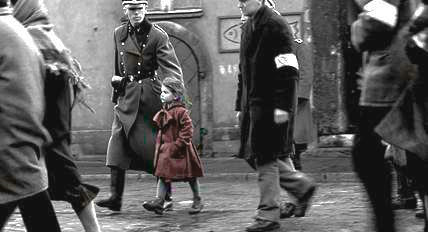
the little girl in the red coat
                The next extended scene is the famous clearing of the Krakow ghetto under Goeth’s supervision.  The chaos, fear, and helplessness of the Jewish families is powerfully depicted.  There are many memorable small touches and several appalling visuals like Jewish men being lined up in a row so one bullet can kill several at a time.  Schindler witnesses this from a hill overlooking the ghetto.  His (and our) attention is drawn to a little girl in a red coat who wanders through the hellish environment.  This departure from the stark black and white cinematography is genius.  The scene closes with the horrific blinking buildings as the Nazi death squads locate and dispatch Jews who had hidden until after dark.  Pathetically, they thought they had safely weathered the storm.
Goeth having target practice
                Schindler buddies up to Goeth and gets him to allow Schindler to open a sub-camp at his factory .  Schindler is in the process of changing from viewing his workers as pawns to make profit to human beings worth saving.  He takes particular interest in saving Goeth’s Jewish housekeeper Helen (Embeth Davidtz) who lives under constant fear of the mercurial Goeth’s moods.  Schindler even manages to convince Goeth to use his power to forgive rather than punish.  Goeth tries saying “I pardon you”, but it does not take.
                Although the movie is not set in a death camp, Spielberg manages to get in a scene with the selection process.  It's a depiction of naked Jews having to jog in front of doctors.  As the “healthy” evidence the joy of surviving they are whiplashed by the singing of the children who are being driven away in trucks.  This is audience manipulation at its best.  It is a Spielberg movie, after all.
                At this point the transformation (beatification?) is complete.  Schindler cons Goeth into spraying water on boxcars full of Jews waiting on the tracks to go to Auschwitz.  Goeth tellingly accuses Schindler of being cruel.  The other Nazis find this act of humanity to be laughable.  Schindler is now risking his life, but he gets in trouble for something seemingly banal.   He kisses a young Jewish woman at his birthday party.  This is where the schmoozing comes in handy as Schindler’s Nazi “buddies” bail him out. 
                When Schindler finds out the whole camp is being sent to Auschwitz, he convinces Goeth (with the help of a huge amount of money) to give him his workers.  Thus is born the famous “list”.  Each name on the list is going to cost him money, but Oskar prods Izhak to add more and more.  Schindler opens a new plant in his home town in Czechoslovakia.  He warns the Nazi guards to lay off the prisoners and insists on making defective artillery shells.  Transformation complete.     Unfortunately, the train transporting the women gets routed to Auschwitz in a seemingly contrived plot development that allows Spielberg to delve into the horrors of a death camp.  Mission accomplished.  The night arrival adds a nightmarish and ominous aspect.  This is amped up when the women are sent to the “showers”.  This could have resulted in the most horrific scene in cinema history.
CLOSING:  The war comes to an end.  Schindler makes a speech to the guards shaming them into leaving without harming the Jews.  Now the Jews are free and Schindler is on the run as a potential war criminal.  And he’s broke.  Stern and some of the others collect whatever gold they can get their hands on and fashion a ring with a Talmudic inscription:  “Whosoever saves one life saves the world entire.”  Schindler gives a tearful going away speech that laments not having done more. 
                In a slightly hokey post script, the actors and the actual survivors they portray lay stones on the grave of Schindler.  It may be hokey, but it is an excellent way to end the film and goes beyond the usual “this is what happened to them” blurbs you sometimes see at the end of movies.  It also lends credibility to the film.
RATINGS: 
Acting – A+
Action -  N/A
Accuracy -  B
Realism -  A
Plot -  A

Overall -  A

WOULD CHICKS DIG IT?  Yes.  It is not your standard testosterone driven war movie.  It can be intense at times and certainly is emotionally draining.  This is a warning to males and females.
HISTORICAL ACCURACY:  This is a difficult movie to analyze for historical accuracy.  There is contradictory evidence on many of the incidents in the film.  However, based on my research, it appears that the movie is factually accurate for the most part.  Keneally is a reputable author and his novel was well researched.  He understandably labeled the book a novel because he invented dialogue.  This is not particularly unusual in the field of historical fiction.  Also, the Schlinderjuden have verified the accuracy of the film.
                Oskar Schindler’s personality and modus vivendi are realistic.  If anything, he was a bigger cad than Neeson portrays him as.  Emilie was certainly a forgiving wife.  This was no one woman man.  Neeson gets the charm right.  What is downplayed a bit in the film is Schindler’s voluntary involvement with the Nazis prior to Krakow.  The movie leads you to believe he was a Nazi just because it was good for business.  This overlooks his more active role in the Abwehr (German intelligence) before arriving in Krakow.
                The role of Stern is apparently close to the real Stern.   The “partnership” angle may be overplayed.  There is evidence that the list was more the work of a Marcel Goldberg and may not have had a lot of input from Schindler.  Goldberg was a loathsome figure who accepted bribes to get people on the list which resulted in people being removed from the list.  The Schindlerjuden did not have fond memories of him and he would have made a poor character in this film.  Some critics claim Schindler was in jail for bribing Goeth at the time the list was compiled and that Stern was not working for him any more at the time.  I lean toward Spielberg’s take on this issue.
                Goeth is accurately portrayed.  The essentials are there.  He did snipe at inmates, but from a hill (his house did not have line of sight to the camp).  The evil "haunted mansion on the hill" was justified in the film.  When Goeth was executed after the war for war crimes, it was specifically for killing over 500 Jews personally.  It could be argued that the real Goeth was more evil and without any redeeming qualities.  It is highly unlikely that Schindler was able to even temporarily humanize him.  As far as his creepy relationship with his Jewish housekeeper Helen, she appears to be a fictional character.
                The depiction of the massacre in the Krakow ghetto is realistic.  There even was a little girl in a red coat although the movie does not try to be accurate on her.  She survived.  Living conditions in the camp are well done.  The scene in Auschwitz gives a good idea of what that camp must have been like.
                The time line is admirably correct.  The movie does not take events out of sequence.  There is a simplifying of how quickly his first plant went from having a few Jewish workers to all Jewish workers, but this is cinematically excusable.  
                With regard to the anecdotal events in the film, they are a mixed lot.  Several are obviously fictional:  Schindler rescuing Stern from deportation, Schindler witnessing the ghetto evacuation from a hill, the Jewish engineer execution.  The kissing of the Jewess at the birthday party is true, however.
                The most problematical scene is the women being shipped to Auschwitz.  It appears to be added to the film for emotional manipulation.  It is based on an incident at the same time of some women being rerouted to a camp called Gross-Rosen.  A name that doesn’t quite have the impact of Auschwitz, does it?  As to the women being shoved into what appears to be a gas chamber, that is almost surely bull shit.  Highly effective bull shit.
                Interestingly, the movie does not go far enough in the redemption area.  Schindler’s progression to sainthood may seem Hollywoodized, but it leaves out all the efforts he made for his workers beyond giving them the security of employment.  He spent his own money providing them food, clothing, and medical care.  The movie underplays his encouragement of their religious rituals which included Jewish burial rites.  Most significantly, the screenwriter chose to leave out an incident where Schindler accepted shipment of two boxcars of literally frozen Jews and personally aided their recovery.  One less justifiable omission is the role that Emilie played at the second plant.  She achieved sainthood herself by cooking for the workers (who got 2,000 calories as opposed to the usual 900) and caring for the sick.  The movie gives her nothing to do except stoically support her philandering husband.
                Speaking of Hollywoodizing, the closing pushes the limits of realism.  Not surprising for a Spielberg film.  The bit about the ring (as someone sniffed, you can’t melt gold the way they did) and the final speech are on the cheesy side.  It might have been a good idea to tack on the actual survivor scene to leave that as the last image.
CRITIQUE:  Is it possible to make a film about the Holocaust that shows its horrors and yet is inspirational and has a happy ending?  This would seem undoable without hitting a hornet’s nest worth of derision.  Amazingly, Spielberg has pulled it off.  The achievement is awe-inspiring.  This is especially impressive because Spielberg stepped out of his comfort zone to make a movie that was not aimed at 14 year old boys.  It is really his first adult movie and he deserved to be rewarded for it. 
                The movie is technically top notch.  The choice to go black and white was a daring gamble that pays off big time.  It is now hard to imagine the movie in color.  The cinematography was an easy choice for the Oscar.  The lighting enhances the lensing.  The look of the film is not ostentatious, however.  You do not marvel at what you are seeing, you just register its proficiency.  John Williams (who at first thought he was not up to the seriousness of the film) is nicely understated and does not push emotional buttons like you hear in many epic movies (including some of Spielberg’s more recent films).  His Oscar was deserved.  It was his last victory.
                The acting is fantastic.  Neeson gives his best performance.  He nails the complex personality of Schindler.  Schindler’s redemption arc must not have been easy to play.  The character is refreshingly multi-dimensional .  Neeson even handles the final speech without marring the rest of his restrained work.  Ralph Fiennes matches him.  Fiennes gained almost thirty pounds by drinking a lot of beer to get ready for the role.  He is the embodiment of malevolence.  AFI placed Goeth at #15 on its list of Top 50 Villains (Goeth is the highest nonfiction character).  Kingsley has a less flashy role, but his portrayal of the wary and wily Stern is perfect.  The supporting cast is solid.  Special note goes to Embeth Davidtz as Helen Hirsh who lives in constant fear of Goeth’s mood swings.  The scene where he soliloquys to a petrified, very vulnerable Helen and goes from positing that Jews are not subhuman vermin to ruthlessly beating her is a strong scene with great acting.  There are several scenes in the movie that showcase the talents of the cast. 
                The plot is linear and traditional.  There are surprises within the structure, but the general flow is toward your typical Spielberg positive ending.  Thankfully, the ending is relatively true so it does not come off as contrived.  Although there is no evidence for it, you would think Spielberg looked hard for a Holocaust script that had a happy ending.  Those are pretty rare.  (“Escape from Sobibor” had already been filmed.)  The themes are fairly clear.  Obviously redemption is one of them.  Some others are that evil exists and can’t be cured.  One man can make a difference is another.  Lastly, the movie emphasizes the role of conscience in human behavior.  Goeth’s lack of conscience makes him, not Helen, subhuman.  The film is thought-provoking.  You can’t watch the movie without wondering what you would have done in the situations presented in it.
CONCLUSION:  “Schindler’s List” is the best Holocaust movie.  You can argue that it is not relentlessly bleak enough to truly replicate the horror, but that would have defeated the purpose of reaching a mass audience.  As a high school teacher I have no problem with this compromise.  The movie has enough horror to teach fools that the Holocaust was horrific.  There is nothing wrong with having positive role models in a Holocaust film.  Once again (I feel like a broken record), if you consider "Schindler's List" to be a war movie it is clearly underrated at #31.  However, I have to admit that when I think of war movies, I do not think of this movie.
POSTER:   Simple, effective, but inaccurate.  grade =  C  

the trailer


TRAILER:  The movie has no color and the trailer has no dialogue.  The trailer is unclear what the movie is about (it looks like a concentartion camp movie), but it is intriguing.  grade = A   

the girl in red scene