Showing posts with label Flags of Our Fathers. Show all posts

Saturday, August 11, 2012

#30 - FLAGS OF OUR FATHERS (2006)


BACK-STORY:  “Flags of Our Fathers” is a war movie directed by Clint Eastwood.  It was released in 2006.  It is based on the bestseller by James Bradley and Ron Powers.  The film tells the story of the famous flag-raising on Iwo Jima and the individual stories of the flag-raisers.  It is the rare Hollywood production that not only came in under cost ($55 million compared to a budget of $80 million), but was filmed in almost half the time scheduled.  Seventy six year old directors apparently don’t like to waste time or money.  (This is movie making by your grumpy old grandpa.)  The Iwo Jima beach scenes were filmed in Iceland.  The film did well with critics, but performed weakly at the box office.  It is a companion piece with “Letters from Iwo Jima” which Eastwood filmed the same year.  “Flags” was nominated for Academy Awards for  Sound and Sound Editing.
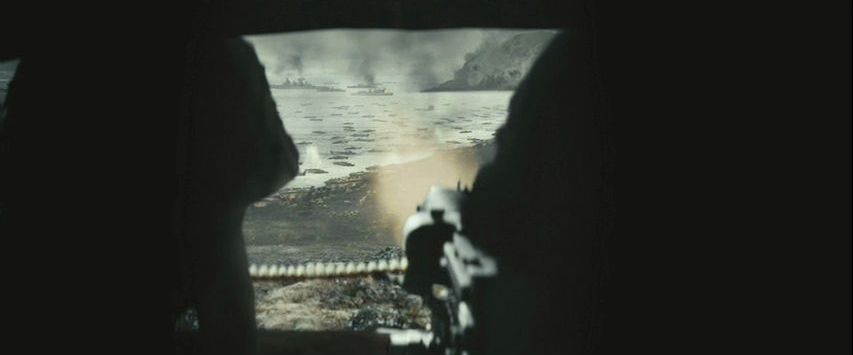
the Japanese POV
OPENING:  James Bradley, Jr. (Tom McCarthy) is interviewing veterans to learn more about the story of his father who he found out was one of the Iwo Jima flag-raisers only after his death.  A voiceover from a veteran opines that “every jackass thinks he knows what war is like”.  This movie will apparently try to give us jackasses a cinematic approximation of the real thing.  Our first clue as to the nonlinear nature of the film comes with the development of the famous picture and its dispersal to hometown newspapers throughout the land.  One of those newspapers finds the doorstep of Harlon Black’s home where his mom insists that the caption is wrong and her son is in the picture.
SUMMARY:  Iwo Jima looks like a fireworks show.  Wait, it’s not Iwo – it’s Soldier’s Field in Chicago and three of the flag-raisers are reenacting the raising.  Flashbacks show us how they got there.  The rest of this summary will convert the screenplay into a linear structure.  In reality, the movie jumps around a lot.
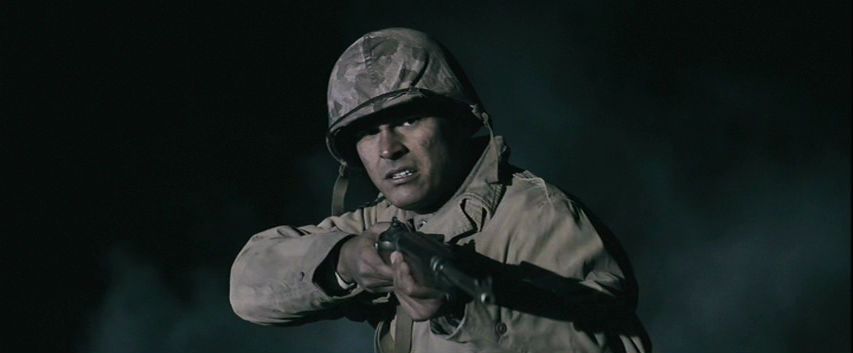


Hayes (Beach) intervenes in a bayonetting of buddies
                
           The unit trained at Camp Tarawa in Hawaii in October, 1944.  A few months later they are on a transport off the small volcanic island of Iwo Jima.  The soldier talk is authentic.  The movie nails the ribbing type of humor associated with the American military.  This will be the first piece of pre-war Japanese soil for Americans to target.  They are briefed on how difficult the task will be, but the impressive bombardment lulls many of the Marines into thinking (hoping?) it will be a cake walk.  The easy landing seems to confirm the optimism.  This is no “Saving Private Ryan”, but wait…  Those crafty Nips are hiding in bunkers, pill boxes, and spider holes and open fire when the Marines begin to advance inland.  Here we go.  Few war movies have done a better job showing how peer pressure and the desire to “get it done” motivated American soldiers to walk into the maws of death.   We follow a squad of riflemen as they navigate through the hellish landscape.  “Doc” Bradley (Ryan Phillippe), a Navy corpsman, rescues several wounded soldiers (and is later awarded the Navy Cross).  Their platoon is later ordered to advance up Mount Suribachi to plant a flag.   Six members of the squad put up the second flag and Joe Rosenthal snaps a picture that will resonate across America and make the six men famous and three of them celebrities.  The three non-celebrities are killed on the island, along with other members of the squad.    Especially noteworthy is the death of Bradley’s best buddie Iggy (Jamie Bell) who was sharing a fox hole with Doc when he disappears.  Doc’s subsequent discovery of the body leaves it to our imagination what the Japanese did to him. 

that ought to do it, battle over


                The surviving three are whisked off to the States to participate in a war bonds drive.  They meet Pres. Truman who tells them they “fought for a mountain in the Pacific, now let’s fight for a mountain of cash”.   Bradley is unenthusiastic, but dutiful.  Rene Gagnon (Jesse Bradford) is excited about his celebrity status and hopes to profit from it.  Ira Hayes (Adam Beach) is already suffering from combat fatigue (as PTSD was called back then) and is very uncomfortable with his new role.  Through flashbacks, the film shows incidents that justify Hayes’ mental state.  He starts drinking heavily and becomes a liability and embarrassment to the drive.  The three “heroes” are being handled by an unctuous government flack who is using them to raise money and morale.  The contrast between the hellish war front and the garish home front is jarring.  Hayes, in particular, prefers the dangers of combat to the racism he encounters in America.  He is suffering from a classic case of survivor’s guilt. 
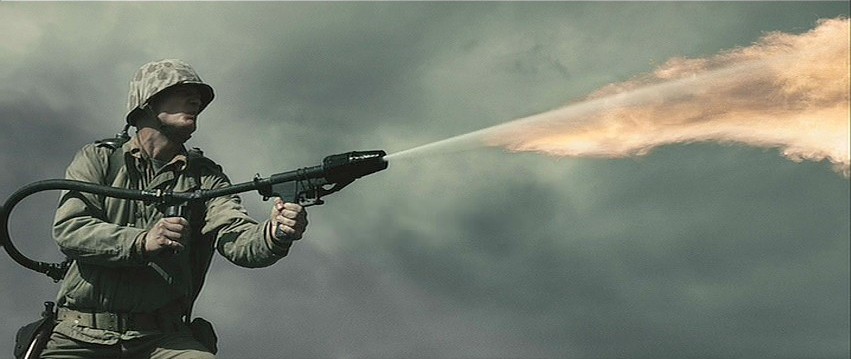
all's fair ...
                In the aftermath of the war, the three men’s paths diverge.  Bradley has a normal life as a funeral director, but refuses to talk about the war and agonizes over Iggy’s death.  Gagnon becomes a has-been school janitor.  Hayes continues his downward trajectory and dies of alcoholism.
CLOSING:  In one last flashback, the remainder of the unit that raised the flag get some down time and are allowed to go swimming at a beach far from the fighting.  They shed their clothes symbolic of shedding the war.
RATINGS:
Acting -  B
Action -  7/10
Accuracy – A
Realism -  A
Plot -  A

Overall -  A-

WOULD CHICKS DIG IT?  Yes.  The movie is balanced between graphic war violence and home front scenes.  It is certainly more balanced than “Saving Private Ryan”, for instance.  Females are underplayed.  You have Gagnon’s gold-digging girlfriend and Black’s grieving mother.

HISTORICAL ACCURACY:  “Flags of Our Fathers” is based on a non-fiction book by one of the flag-raisers.  We can assume Bradley and Powers did their research and since the movie takes few liberties with the book, the film is one of the most accurate war movies ever made.

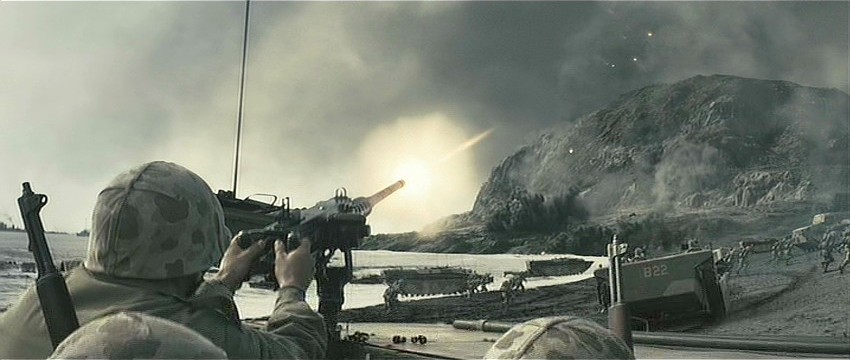
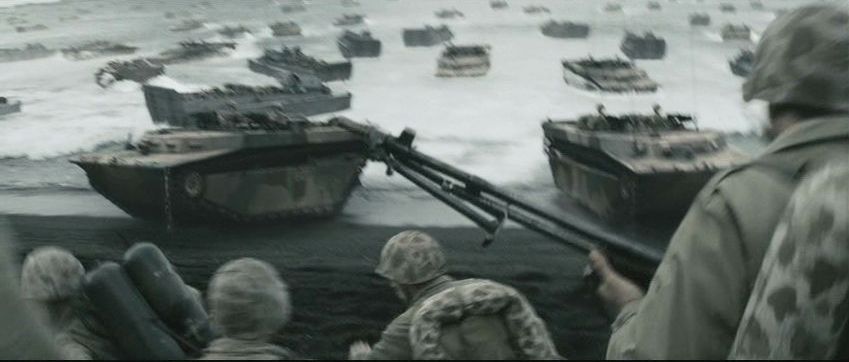
                The Iwo landing by the Marines is close to the real thing.  Eastwood wisely decided not to outdo the opening assault of “Saving Private Ryan”, hopefully because he knew the Iwo landing was unopposed.  The movie accurately depicts how the enemy waited for the Marines to move off the beaches before opening fire.  The POV shots from the pill boxes and from the frowning heights of Mount Suribachi clearly show the lack of cover the Marines faced.  Iceland fills in well for the bleak landscape of Iwo.  The military hardware is authentic.  Even the Japanese weapons are appropriate.  The CGI renditions of the fleet and the Corsairs are satisfactory.

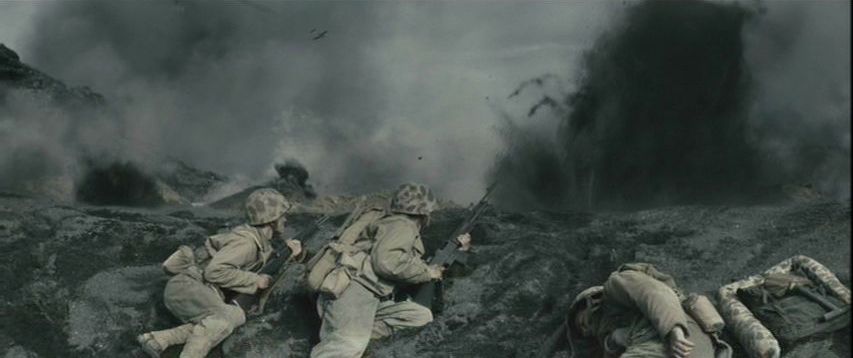
the slope of Suribachi
                The combat is realistic with the night actions standing out.  The randomness of death is apparent.  The film accurately depicts each of the deaths of the main characters.  Eastwood does not give the actors stirring last words.  If the death was instant, it is shown that way in the movie.  None dies heroically.   You have to credit the screenwriters for sticking to the book when it comes to the deaths.

                The flag-raising incident could not have been better.  Even to the extent that the guy who plays Joe Rosenthal is a dead-ringer for the photographer.  This segment of the film could be shown in American History classrooms with no caveats.  The movie includes the subplot of the Harlon Black / Hank Hansen confusion to good effect.  A little surprisingly, only fleeting mention is made to the myth that Rosenthal staged the photo.

                The home front bond tour is well done.  One possible flaw is the movie has the bond director Gerber (John Slattery) giving an impassioned plea that if the trio does not give their all the government will go bankrupt and the war will be lost.  He throws in the claim that the public is tiring of the war and badly needs a morale boost.  It is hard to tell if the writers believed this nonsense or whether Gerber is supposed to be spouting bull shit.  Regardless, it could fool a modern audience.  In fact, the bond drive was important financially, but hardly a tipping point.  As far as civilian morale, the public was definitely tired, but certainly not contemplating giving up when the light at the end of the tunnel was clear.

                The attitudes and personalities of the trio are true to life.  They seem to be stereotypes, but they reflect their portrayals in the book.  Gagnon does come off as a bit slimy, but it is not surprising that one of the three would be selfish and blinded by celebrity.  Bradley is a little saintly, but that sounds like many medics.  Hayes is the most famous of the three so there was less chance to tamper with his life.  He even had his own movie called “The Outsider”.  The movie has him turning to alcohol because of the bond tour when in reality he was already a heavy drinker.  I also found evidence that he did not mind participating in the drive, but did not like the speeches and press.  His mistreatment as a Native American reflects the prejudice of the times.   The seemingly unbelievable 1,300 mile trek to inform the Blacks of their son’s role is based on fact.  Sadly, his death is the way it happened.


wow, the military loaned a lot of landing craft
                There are a few incidents that I can comment on.  There really was a man overboard incident where the fleet could not stop to pick him up.  Iggy’s death (which had such a long-term impact on Bradley) follows the book, but leaves out the torture aspect (only hinting at it).  The movie uses CGI to hit one of the battleships supporting the landing.  No battleship was actually hit.  Here’s another inaccuracy – noone lights up a cigarette until the 1:17 mark!  War movies have come a long way.
                Now let me address the Spike Lee controversy.  Lee criticized the movie for ignoring the participation of African-American Marines in the Battle of Iwo Jima.  This may have been a publicity stunt to create buzz for his upcoming "Miracle at St. Anna" ( a vastly inferior war film, by the way).  Eastwood took umbrage and there was a rather silly snit.  Lee pointed out that no blacks appear in the movie and this denigrates their role in the battle.  Eastwood countered with the argument that his film was about the flag-raising and there were no blacks involved in that.  I come down on Eastwood’s side on this.  Lee is correct that there were African-Americans on Iwo, but unfortunately they were relegated to supply roles.  Had Eastwood thrown in a shot of blacks unloading ammunition, that would have been condescending and too obviously an example of political correctness.  Having blacks in the thick of the fighting and/or involved in the flag-raising would have been a feel good mockery of history.  Of course, it doesn’t help Eastwood’s case when he showcases some war dogs.


CRITIQUE:  The structure of the film is interesting.  It is a good example of the method of "in media res".  This is when a director starts the movie in the middle or end and then uses flashbacks and flashforwards.  “Flags” is very non-linear and actually follows three threads – the battle, the bond drive, and Bradley’s quest to research the book.  This concept works well and is not confusing.  The Bradley interviewing veterans scenes are the weakest, but necessary.  One questionable decision was to reveal the three survivors early on.  From that point on the suspense was not who would survive but how the other members of the squad would die.

                There are several themes that pop up.  One is the use of patriotism to manipulate individuals and the public as a whole.  In this case the media is a willing partner of the government.  We see the power of these two to create heroes.  If you think things have changed, remember Jessica Lynch and Pat Tillman?  A second is the gap between the war front and the home front.  What the soldiers face and what the home front is going through and what the home front imagines the soldiers are going through is a wide gap.  I might add that although I doubt it was a conscious decision by the makers, the movie clearly contrasts the WWII home front involvement in the war with the lack of involvement of the home front during the Iraq War.  Necessity versus ignorance.  By far the biggest theme is “what is heroism?”   The film strongly suggests that the three flag-raisers who died were heroes and the three survivors were not (which all three would have agreed with).  This “only the dead were heroes” approach is standard, but belies reality.  Bradley, for example, won the Navy Cross for his bravery in saving wounded.  He was definitely a hero!

                The movie is very technically sound.  Eastwood is a great director and it shows in this movie.  The cinematography is great.  He uses a variety of shots.  There is some off-center, hand-helds, and POVs.  The scenes on the island are muted in color and this contrasts with the colorful home front scenes.  The sound effects are amazing.  This must have been close to the way the battle actually sounded.  Eastwood’s soundtrack is sparse, but effective (like the man himself).  Some good period songs (ex. “Any Bonds Today”) are included.

                The acting is top notch.  Adam Beach deserved an Academy Award nomination for his portrayal of Hayes.  Bradford is also strong as the star-struck Gagnon.  This “hero” takes a beating in the screenplay and I felt sorry for him.  He is used to hammer home the theme that just raising a flag does not make you a hero.  One good thing – Gagnon gets to make the strongest “we’re not the real heroes” comment in the film.   The rest of the cast is solid.

                The action is excellent.  Once the bullets start flying, it’s very reminiscent of the “Saving Private Ryan” style and foreshadows combat in the miniseries “The Pacific”.  The violence is graphic, but not outlandish.  A flamethrower takes out a pill box.  A severed head lands on Hayes.  Horrific sights abound.

CONCLUSION:  “Flags of Our Fathers” seems to be nestled in an appropriate position at #30.  It is a very good, but not great war film.  Eastwood took a bestselling nonfiction book about the most famous photo of WWII and did it justice.  The movie did not get a lot of love from critics, but it is hard to imagine how the movie could have been better in interpreting the book.  In fact, the movie is better than the book.  I liked the nonlinear structure.  It added some pizzazz.  The book was boring after they left the island.


                The greatest strength of the movie and its main claim to a potentially high spot on my eventual 100 Best War Movies list is it accurately brings to the screen an important military event that the public should know about.  The movie may be criticizing hero worship, but several of the protagonists were legitimate heroes and deserve to be known.  More than sixty years after Iwo Jima, it is doubtful many Americans have heard of Ira Hayes much less the other five men.  Hell, many are probably not that familiar with the flag raising itself.
 
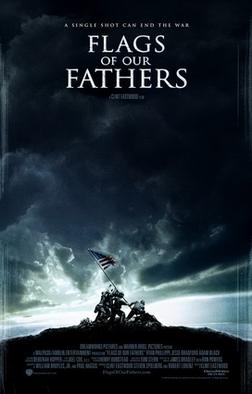
POSTER:  Excellent!  Could not be better.  How can you go wrong using that photo?  A+

TRAILER:   Well balanced.  Hits the themes effectively.  Only hints at the combat so it's not your typical adrenalin-fueled trailer.  That's a good thing.  A+ 


Tuesday, April 5, 2011

QUARTERFINALS II

The Hurt Locker (1) vs. The Great Raid (14)


CHARACTER DEVELOPMENT: “The Hurt Locker” develops only three characters – the lone wolf Sgt. Will James, the by the book Sgt. J.T. Sanborn, and typical grunt Specialist Owen Eldridge. This trio is fleshed out over the course of the film. We know their attitudes and emotions. The key to the movie is the conflict between James and Sanborn, with Eldridge caught in the middle. “The Great Raid” has more characters to juggle because of the trio of story lines. The movie develops nurse/resistance member Margaret Utinsky, POW Joseph Fiennes, and mission leaders Henry Mucci and Robert Prince. The romance between Utinsky and Fiennes is thrown in and ill-fitting. Mucci is your typical gruff disciplinarian and Prince is the idealistic subordinate. Nothing special about them.

Score at the end of the first period: Hurt – 9 Raid – 7

DIALOGUE: Hurt won the Academy Award for Original Screenplay and deserved it. The dialogue is cracking. The dialogue between James and Sanborn seethes. The dialogue is sparse which is consistent with soldier talk. Raid is an old school style movie in many ways, including the dialogue. There is nothing special here. The words placed in the characters mouths are words a Hollywood screenwriter thinks a soldier would say. That is not to say the dialogue is laughable, it’s just not noteworthy.

Half-time score: Hurt – 18 Raid – 14

PLAUSIBILITY: Hurt has been criticized for making James too much of a adrenalin junkie who gets his fix by flouting common sense safety protocols. There is some truth to this. Although the movie is fictional and thus can go beyond reason to make its case that war is a drug, there are events in the movie that are highly implausible. For example, three bomb techs taking separate alleys at night to chase insurgent bomber(s) makes no sense. It is apparent that bomb disposal experts must be different than normal people, but someone as mentally unstable as James would not last long in the military in that specialty. Raid is based on an actual commando mission and is sourced from two excellent books. The love story is implausible, but the events in the raid itself are close to the real deal. So real, that many viewers probably were disappointed with its “tell it like it was” instead of “rev it up” plot.

Score after three periods: Hurt – 24 Raid – 22

PLOT: “The Hurt Locker” won the Best Picture award. It flows from action scene to action scene propelling the arc of James as an increasingly loose cannon. The suspense is palpable. The opening is memorable in its unorthodoxy. The close book ends it well. In between we learn to admire as well as abhor the main character. The plot of “The Great Raid” reads more like a history lesson with a pedestrian romance throw in. The movie lacks pizzazz, but the build-up to the attack is smooth and the attack itself is well-written and accurate.

Final score: The Hurt Locker  – 33    The Great Raid – 29

Black Hawk Down (4) vs. Flags of Our Fathers (5)

CHARACTER DEVELOPMENT: BHD is not really character driven. It develops the character of the Rangers versus the Delta Force more than individual soldiers. It is a true ensemble cast with Josh Hartnett as the lead, but certainly he does not dominate. We do not get to know the soldiers very well, but the movie does not have time for that. We do recognize some tried and true stereotypes. The gruff sergeant (in this case actually a Lt. Col. McKnight), the sad sack Blackburn, the desk jockey turned warrior Grimes, the lone wolf Hooten, etc. Flags does an excellent job developing the three surviving flag raisers. They are distinct personalities. The tragic decline of Ira Hayes is particularly poignant. The other members of the unit are also well drawn. The government officials are stock characters, however.

Score after first period: BHD – 7 Flags – 9

DIALOGUE: Both movies come from well-respected best sellers and are true to their sources. The conversations feel real and unforced. They also reflect how soldiers talk in and out of combat. If you watch both movies you will get a clear impression of how soldier talk and interact. It is fascinating to see how soldier dialogue has changed from Iwo Jima to Somalia. Slight edge to BHD because it does not have the cynically patriotic handlers that Flags has.

Half-time score: BHD – 16 Flags 17

PLAUSIBILITY: Both movies make sense and have no laughable scenes. They are true to books that have not been criticized for overhyping their topics, Slight edge to BHD for showing the fog of war and the difficulty of hitting moving targets in urban combat.

Score at the end of three: BHD – 26 Flags – 25


PLOT: Flags is a nonlinear retelling of the men who raised the flag as well as the bond tour the survivors went on. the back and forth scenes are effectively arranged. This means the audience is whiplashed from high intensity combat action scenes influenced by Saving Private Ryan and the introspective scenes on the home front. This makes the movie more interesting, but a bit bipolar. BHD is linear in structure. It builds to the battle which dominates the second half of the movie. The shifts from the command centers to the boots on the ground are instructive in clearing up the fog of war for the audience. The Battle of Mogadishu could not have been handled better, unless you question the lack of coverage of the enemy point of view. But then again, Clint Eastwood had to film an entire separate movie to accomplish that for the Battle of Iwo Jima.

Final score: Black Hawk Down – 35 Flags of Our Fathers - 33

Friday, March 25, 2011

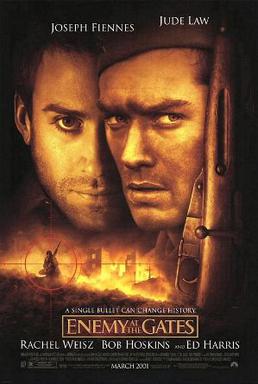
MARCH MADNESS: "Flags of Our Fathers" (5) vs. "Enemy at the Gates" (12)


ACTING: “Flags” does not have an A-List cast. The main characters: Ryan Phillippe as James Bradley, Jesse Bradford as Rene Gragnon, and Adam Beach as Ira Hayes, are very good. Director Clint Eastwood made an excellent decision to not load the story down with famous stars. Beach is especially poignant in portraying the troubled Hayes. “Enemy” has showier leads. Jude Law as Vasily Zaitsev and Joseph Fiennes as Danilov are fine with Danilov being less believable. Bob Hoskins brings the proper bombast to the role of Nikita Khrushchev. Rachel Weisz as female sniper Tanya is too well-coiffed and beautiful for the role. She also makes no attempt at a Russian accent. Ed Harris steals the acting honors with the coldly efficient and malevolent Major Konig.


Score at the end of the first period: Flags – 9 Enemy – 8

REALISM: “Flags” attempts to authentically depict the terrors of combat in the Pacific and the media circus on the home front that confronted the flag-raising heroes. The combat has the feel of “Saving Private Ryan” and is appropriately chaotic, explosive, and graphic. The fighting is vicious and sometimes hand-to-hand with bayonets. The bond drive on the home front is a mixture of cynicism and ultrapatriotism. It’s laid on a bit thick, but not in a ridiculous way. “Enemy” has chosen to set a love triangle in the middle of the greatest battle of WWII. It’s small world approach to the character’s encounters defies credulity. The city of Stalingrad, while appropriately a shambles, appears to be empty save for the maneuverings of the featured characters. It also relies on some amazing pieces of luck to advance the two main foes to their final confrontation.

Score at half: Flags – 18 Enemy – 14

ACCURACY: “Flags” is based on the book by James Bradley and Ron Powers. The movie takes few liberties with the narrative. It is about as accurate as you can find. I could find no major flaws in it. The landing is true in its depiction of the Japanese allowing the Marines to come inland a bit before opening fire. Marine tactics are true to their style. The deaths of the three flag-raisers who did not survive are accurate. Even the small touches like Harlon Black’s mother recognizing his butt in the picture are true. “Enemy” has numerous problems with historical accuracy. The movie was inspired by a small portion of William Craig’s study of the battle. Craig added the legendary duel between Zaitsev and Konig to his story basing it on Soviet records which obviously were subject to communist propaganda. The movie takes this already dubious legend and ramps it up to a love triangle/snipers duel. I was surprised to find that there actually was a Sacha who was a double agent and was hanged by the Germans (of course not in the way depicted). I was stunned to find that there was a female sniper named Tanya and she apparently had a relationship with Zaitsev (although even the Soviet historians did not go as far as having them live happily ever after as the movie implies). Generally speaking, the movie does a poor job as a tutorial on the Battle of Stalingrad. You get no idea what the big picture is. It also goes overboard in showing Russian soldiers being forced to make suicide attacks.

Score at the end of three: Flags – 28 Enemy – 20

ENTERTAINMENT VALUE: “Flags” is an excellent blend of exciting action and character development. It manages to tell the story of the flag-raising while also giving a clear picture of what Iwo Jima was like and what the home front in 1945 was like. Eastwood examines the question: what is a hero? He indicts the government’s manipulation of heroes for morale-boosting and fund-raising purposes. He does not glamorize war and shows the randomness of death on the battlefield. The most respected soldier (Make Strank) is killed by friendly fire. The movie also explores post traumatic stress disorder through the tragedy of Hayes. Its nonlinear structure is effective. “Enemy” is stronger as pure entertainment. It is obvious the producers sacrificed accuracy for entertainment. The set pieces are well done. It has a strong female character. (There is a very erotic scene that has no nudity in it.) It has some very suspenseful cat and mouse scenes. It concentrates on snipers – the coolest of the cool. The soundtrack by James Horner fits the scenes perfectly. Unlike “Flags”, it is not trying to enlighten its audience. It is fun in a cliché-ridden, good guy wins, sort of way.

FINAL SCORE: Flags – 36 Enemy - 29

March Madness rules
Jarhead (8) vs. 300 (9)
We Were Soldiers (7) vs. Defiance (12) 
Master and Commander (6) vs. Troy (11)

Tuesday, March 15, 2011

"March Madness"

With the NCAA basketball tournament starting this week I got the idea to have a bracket to determine the best war movie made since 2001. I chose the competitors and seeded them based on Rotten Tomatoes. The first round matches will be based on acting, accuracy, entertainment value, and realism. Each category will be on a scale of 1-10. After the first round, victory will be based on my judgment. Here are the matchups:


1 - The Hurt Locker
16 - Pearl Harbor

3 - Inglorious Basterds
14 - The Great Raid

5 - Flags of Our Fathers
12 - Enemy at the Gates

7 - We Were Soldiers
10 - Defiance

8 - Jarhead
9 - 300

6 -  Master and Commander
11 - Troy

4 - Black Hawk Down
13 - Kingdom of Heaven

2 - Letters from Iwo Jima
15 - Flyboys

I will post the "game" summaries periodically starting Thursday. Feel free to make predictions and criticisms.