Thursday, December 20, 2012

#21 - The Dirty Dozen (1967)


BACK-STORY:  “The Dirty Dozen” created the template for an entire genre of motley crew, suicide mission movies.  It’s influence has been substantial.  The movie was released in 1967 and was part of the wave of more realistically gritty war movies like “Patton”.  Director Robert Aldrich adapted it from the bestselling novel by E.M. Nathanson, but made substantial changes.  The film was made in England and took seven months to complete.  Production included the construction of a chateau that was 240 ft wide and 50 ft high, surrounded with 5,400 sq. yds. of heather, 400 ferns, 450 shrubs, 30 spruce trees and 6 weeping willows.  It turned out to be so substantially built that it could not be easily blown up so they had to construct a flimsier section for the climactic scene.
                The cast was all-starish.  The studio wanted John Wayne for the Reisman role,  but Aldrich wisely insisted on Marvin (Wayne made “The Green Berets” instead).  Jim Brown was still playing football, but when the owner of the Browns gave him an ultimatum – football or moviemaking – he announced his premature retirement.  A huge mistake admitted by the owner later.  Trini Lopez was cast because he was a hot pop singer at that time (“Lemon Tree”).  When he decided his singing career was more important than the completion of the movie, his character suffers a premature death.  The dozen actors were supposed to be divided between the stars and the “who the hell is that” group (known as the Back Six).  However, one of the Back Six broke out to become a rising star.  When Clint Walker refused to do the impersonating the general scene, the unknown Donald Sutherland was tabbed and parleyed it into higher billing and a role in a little film called “MASH”.  Many of the cast were WWII veterans:  Marvin (Marines – wounded on Saipan), Savalas (Army), Bronson (Army), Borgnine (Navy), and Walker (Merchant Marine).
                The movie was a huge hit with audiences and with some critics.  It was nominated for four Oscars;  Best Supporting Actor (John Cassavetes), Editing, Sound, and Sound Effects (won).
OPENING:  Major Reisman (Lee Marvin) is treated to a military execution.  The prisoner was condemned by a court-martial and is hanged.  The scene is short, but impactful.  This will not be an old-school WWII movie.
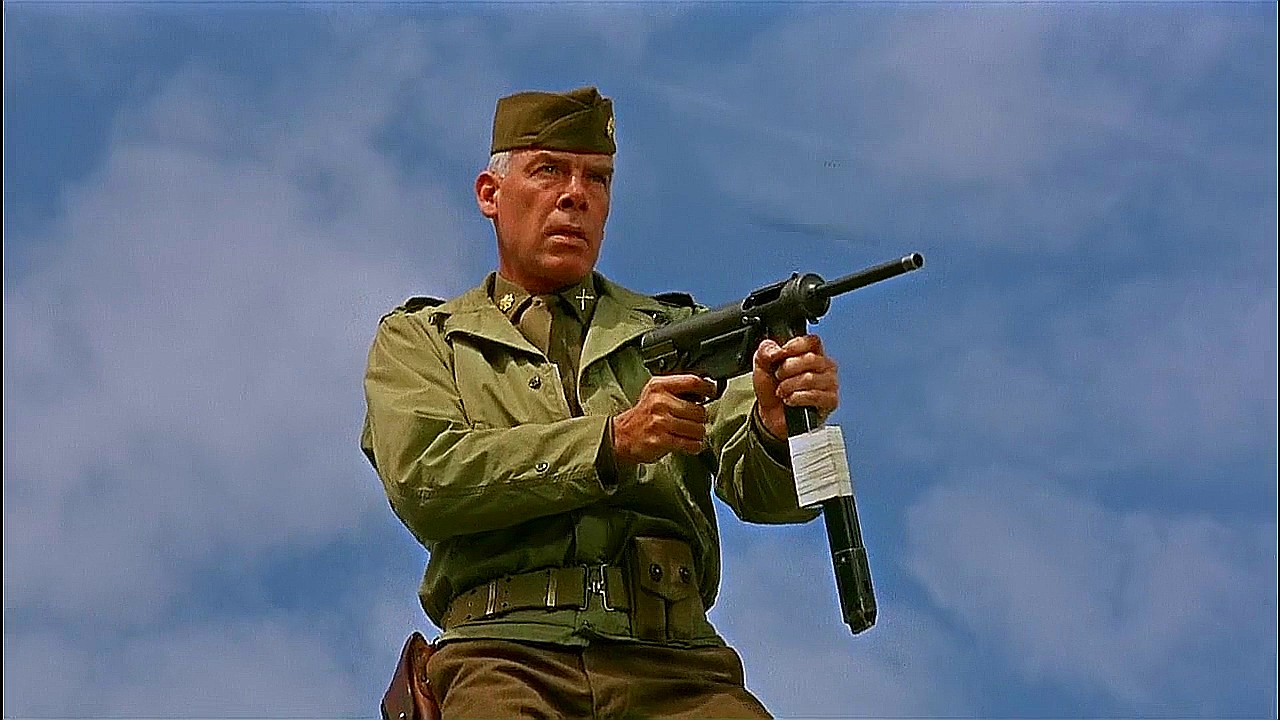
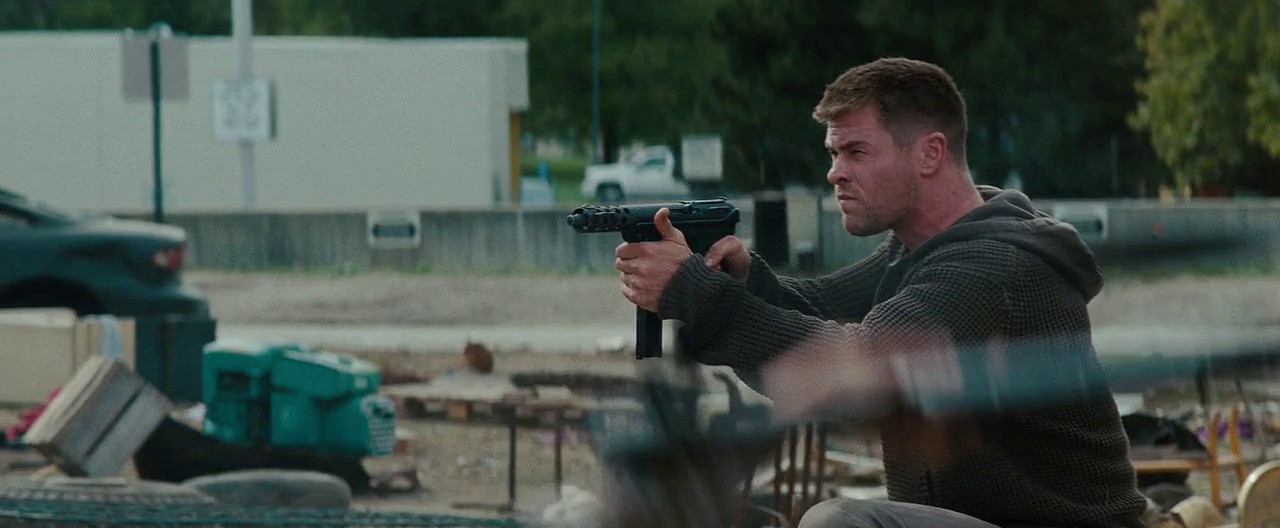
Reisman armed with the "official weapon of the Dirty Dozen"
SUMMARY:  Reisman is called to a meeting with Gen. Worden (Ernest Borgnine).  It is established that Reisman is a loose cannon, insubordinate, wise-ass.  Perfect role model for the anti-authority, anti-establishment Sixties’ generation.  He is “volunteered” for Operation Amnesty.  It’s a mission designed by a “lunatic” that involves taking a dozen convicts on a suicide mission to kill as many German staff officers as possible in a French chateau.  Military intelligence, as they say.  Piece of cake.
                Reisman goes to meet the twelve in their cells.  We get a little background on some.  They are a heterogeneous group, of course.  Franko (John Cassavetes) is a malcontent petty hood.  Wladislaw (Charles Bronson) is a stoical Pole.  Jefferson (Brown) is an uppity black.  Posey (Clint Walker) is a hillbilly who doesn’t like to be pushed.  Maggot (Telly Savalas) is a psychopathic, Bible-thumping, woman-hater.  (Just like the U.S. Army as depicted in some Vietnam War movies.)  Reisman explains the deal.  If you live, you get a commutation.  If anyone screws up in training, everyone goes back to jail.
                They build a compound in the countryside as a bonding exercise.  Please overlook the fact that getting this group of individualistic, rule-breakers to construct buildings with no discernible skill is quite unrealistic.  The construction does allow for some slapstick-type humor which gives Sutherland a chance to emerge.  Next comes the training.  Franko pockets some wire-cutters (there is a shocking lack of tool security by the guards) and attempts to escape.  He is stopped by Wladislaw and Jefferson in a show of white/black teamwork.  Later, Franko leads a rebellion against their spartan conditions which unites the dozen and results in revocation of grooming privileges.  They are now the “dirty dozen”, get it?
                A visit to the parachute training school run by Reisman’s nemesis Col. Breed (Robert Ryan) allows for more humor as Pinckley (Sutherland) impersonates a general inspecting Breed’s troops.  Pinckley:  “Where are you from, son?”  Soldier:  “Madison City, Missouri, sir.”  Pinckley:  “Never heard of it.”  (Watch the expression on the soldier’s face.  Priceless).  Breed sics two goons wearing decidedly unmilitary hair cuts on Wladislaw in the latrine.  He is rescued by Jefferson and Posey.  Bonding accomplished.  That’s all from parachute training school.
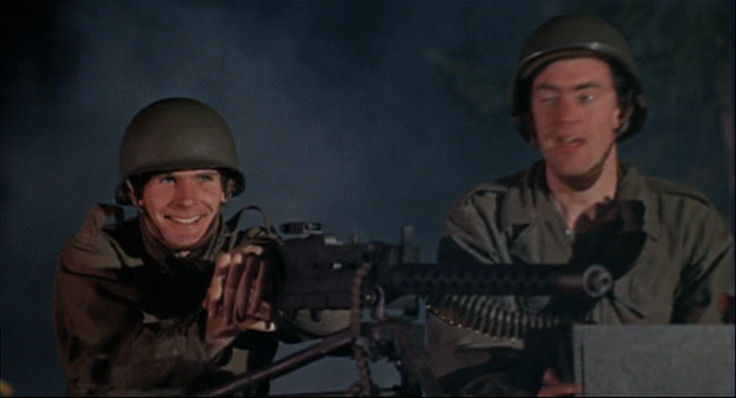
"Can you believe we're in this movie?"
                Back at camp, Trini Lopez sings a song about a “Bramble Bush” (apparently he was big on songs about flora) because the audience demanded it.  (See Ricky Nelson in “Rio Bravo”.)  The song became a hit, by the way.  Reisman brings in some hookers as a reward for all their hard work at sublimating their bestial instincts.  Hopefully eight women being shared by eleven men fueled by alcohol (Maggot is wisely left on guard duty) won’t ruin six weeks of character development.
                Gen. Worden agrees that the dozen will get the green light for their mission if they can prove themselves at the upcoming war games.  They have to seize Col. Breed’s headquarters.  Spoiler alert:  they cheat.  They change arm bands to infiltrate enemy lines.  They hijack an ambulance allowing Jefferson to have one of the great lines in war movie history.  When the ambulance driver complains about him wearing the opposition’s arm band he deadpans:  “That’s right – we’re traitors.”  The capture of Breed is a highlight of the movie and brings the training section to an exhilarating close.
                Having passed the test, it’s go time.  At a last supper set up to resemble the Da Vinci painting (and predating the MASH scene), the team goes over the mission.  Maggot plays the part of Judas in a nifty bit of foreshadowing.  Reisman has famously broken the plan into a mnemonic device.  Here is the entire list for those of you who have not seen the movie twenty times.
1.        Down to the road block, we've just begun
2.        The guards are through
3.        The Major's men are on a spree
4.        Major and Wladislaw go through the door
5.        Pinkley stays out in the drive
6.        The Major gives the rope a fix
7.        Wladislaw throws the hook to heaven
8.        Jimenez has got a date
9.        The other guys go up the line
10.     Sawyer and Lever are in the pen
11.     Posey guards points five and seven
12.     Wladislaw and the Major go down to delve
13.     Franko goes up without being seen
14.     Zero-hour - Jimenez cuts the cable, Franko cuts the phone
15.     Franko goes in where the others have been
16.     We all come out like it's Halloween
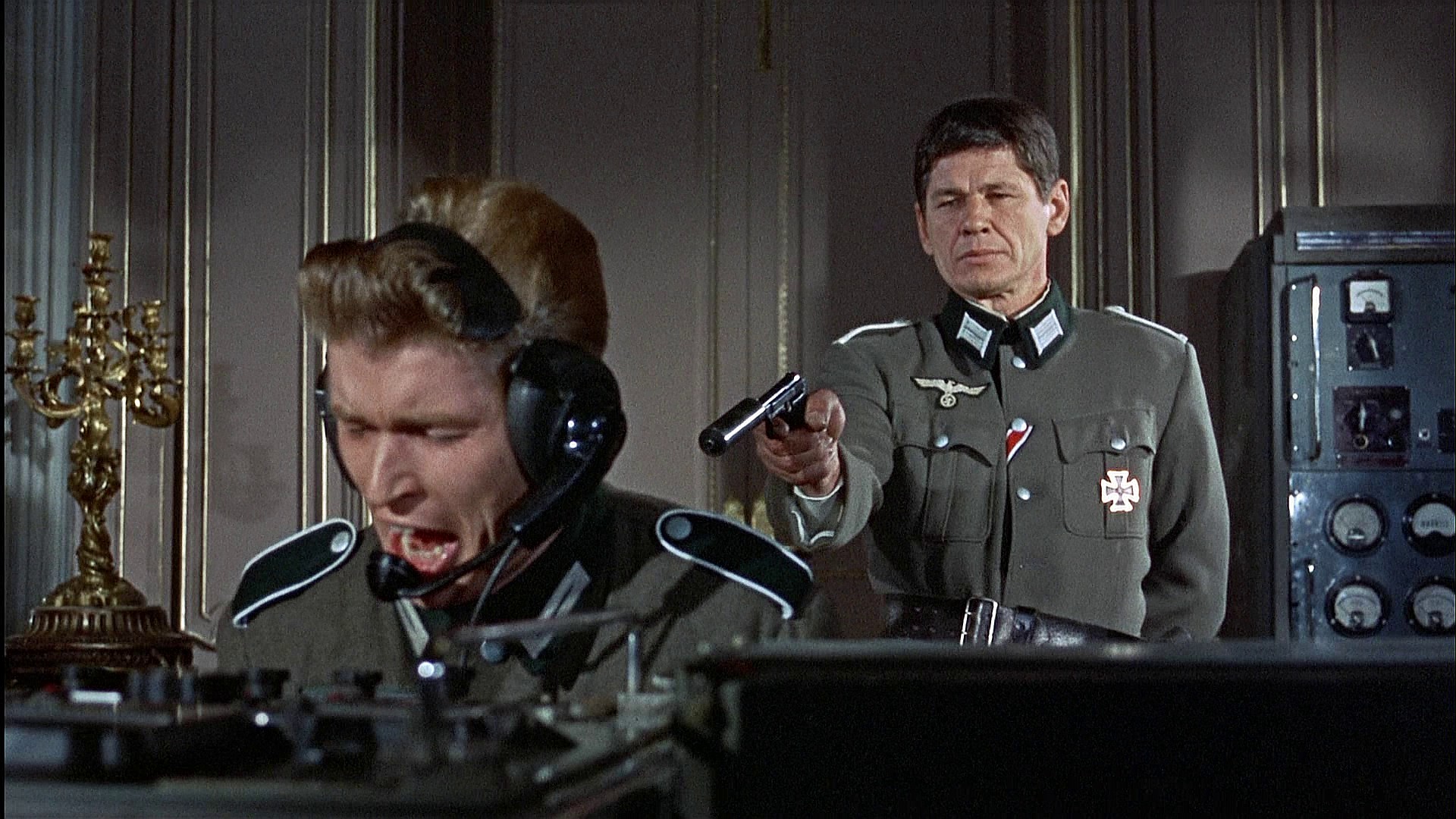
Wladislaw does some silencing
                They drop behind enemy lines and now there are eleven since Jimenez breaks his neck in a lemon tree.  Those who guessed that they would all survive, sorry.  That is one impressive chateau.  Reisman and Wladislaw enter disguised as German officers.  Meanwhile, the others hop to their tasks. Some of them are positioned outside the chateau.  Wouldn’t you think that might be a good role for the clearly unstable Maggot?  Instead, Reisman’s plan calls for him to sneak into the upstairs where he proceeds to stab a strumpet and open fire on Jefferson.  What a Judas!  Let the premature killing of Germans begin.  Or let the grease guns start greasing.
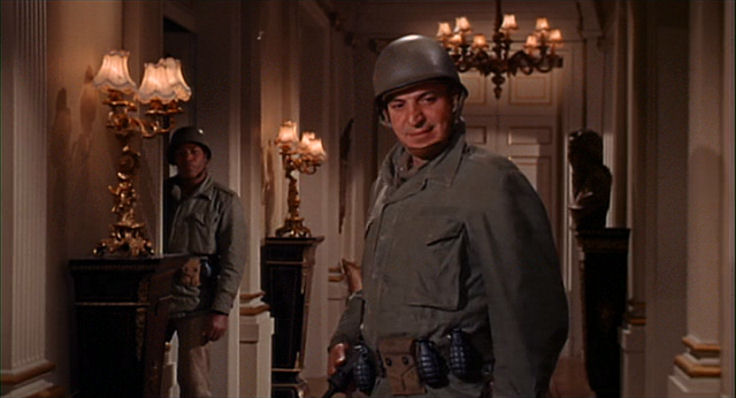
A guy named Maggot loose in a Nazi brothel
                Who will survive among our intrepid psychopaths?  We care, but not about how many of German women will be killed.  The German officers and their gals have taken refuge in the secure bunker leaving their lackeys to be grease gun fodder.  They take some of the dozen with them, especially the Back Six.  Not specifying, but here is the sequence:  2.  killed by German machine gun fire 3. killed by friendly fire  4.  blown up by his two grenades that created six explosions taking out the chateau’s antenna   5.  killed by German sniper  6.  killed after slaughtering German reinforcements  7.  presumed dead with #6  (although not shown – probably in his contract)  8 & 9.  killed while foolishly thinking they will make the sequel by escaping in a motor boat …  10.  If you don’t know how Jefferson dies, you are not a male between the ages of 50-70.  And by the way, he didn’t make it this time either.  Damn it!  11.  killed while exalting over his survival. 
                The climax involves some gasoline and hand grenades that turn the cozy bunker into an inferno and provide the requisite Hollywood explosions.  The survivors drive off into the night to link up with the D-Day invasion forces.
CLOSING:  The three survivors are in a hospital room awaiting their trial for war crimes.  Just kidding.  We won the war, so any killing of civilians was condoned.

RATINGS:
Acting =  B
Action =  8/10
Accuracy =  N/A
Realism =  D
Plot =  A

Overall =  B+

WOULD CHICKS DIG IT?  Surprisingly, many did.  I guess we would classify them as “bad girls”.  Seriously, the cast is very manly.  There is humor.  The violence is not too bloody, although it was pretty intense for the 1960s.  The language is pretty tame.  It’s not really a date movie.  Guys will enjoy it, but might regret exposing their girl to so much virileness.   

HISTORICAL ACCURACY:  You’re joking, right?  Not according to author E.M. Nathanson who claims he “heard" about the use of convicts for special missions.  So much for research.  Some judges and draft boards may have put petty criminals in uniform, but there is no record of condemned soldiers being given a second chance.  Later, someone dug up the story of the “Filthy Thirteen” to pacify people like me.  The “Filthy Thirteen” was a pathfinder unit that did not like to do things like salute officers, groom properly, or remain sober when not on a mission.  Basically the WWII version of a Vietnam War LRP unit.  Sadly, they were not convicts forced to go on suicide missions.  Boring!
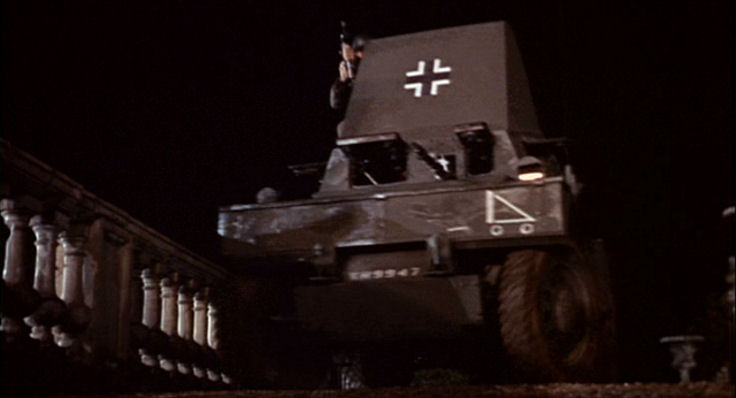
the Popemobile
                There are few inaccuracies that the audience could care less about.  First, the Army did not hang any soldier during the war.  The only soldier executed was Pvt. Eddie Slovik for desertion and that was by firing squad.  Can’t really blame the movie for setting the stage with that opening scene, however.  We need to care that Maggot could get hung.  Second, it seems that not every American soldier was armed with a grease gun.  Go figure.  They are so wicked looking.  Didn’t we want to scare the Germans?  By the way, anyone with any knowledge of WWII weaponry can tell you that the grease gun was notoriously inaccurate.  Not in the hands of these guys.  Reisman is able to cut a rope inches below one of his charges.  Woe be it to any German within its range.  In the commentary track that I listened to, Dale Dye nearly had a conniption over its depiction.  Third, they had to face a German vehicle that looked like the Popemobile.  Who designed that prop?  It had some eye holes that were vulnerable to the accurate fire of grease guns.
CRITIQUE:  “The Dirty Dozen” has several strong aspects to it.  The acting is very good.  Marvin is the perfect Reisman.  He plays him with the right amount of bravado and steely insubordination.  The scene where he is briefed on the mission by Gen. Worden and his lackey establishes him as an intriguing character.  His wise-ass comments are cynically resonant.  Reisman is very much a 1960s war movie archetype.  He reminds me of Steiner from “Cross of Iron”.  The rest of the name actors are good.  Savalas is very creepy as Maggot.  It shows his range that his other famous role was Kojak.   Bronson is charismatic and likeable.  Brown does a remarkable job in his first major role.  He does not look like an amateur.  Richard Jaeckel gets a well-deserved turn as Reisman’s second in command.  Cassavettes steals the honors with his characterization of Franko.  You can tell he is trying to steal the camera’s attention away from the others.  It is obvious he created his own character beyond the script. He deserved the Academy Award nomination. 
                The film is technically sound.  The cinematography is workmanlike, but not outside the box.  There are no wow visuals in the film.  The score is perfect for a macho film like this.  It is not pompous or overly patriotic (although it does make use of some familiar martial music).  It does not dominate any of the scenes and is used to punctuate rather than pontificate.  The sound effects are outstanding.  I’m referring to the explosions, of course.
                One strange thing about the film is the lack of graphic bloodshed.  The deaths are not “signal touchdown as you twirl” style, but they are not splatteringly realistic either.  Interestingly, “Bonnie and Clyde” came out the same year.  One of them was revolutionary in depicting gunshot wounds.  Similar to this issue is the unsoldierly tame language.  Regular Gis, let alone thugs like these, must have snickered at the curses issuing from the dozens’ mouths.  “Dirty” does not refer to their vocabulary.  Some of their curses include:  creeps, pig face, crumb, slob, bum.  Apparently, “lovers” substituted for “assholes”.  This was the late sixties, for gosh darn sakes!  Take off the gloves.
                As far as the plot, you know going in that you will have to suspend disbelief.  Very little of what happens has any foothold in reality.  It was fun to listen to Dale Dye’s commentary which takes the movie to task on numerous issues.  Basically, the movie would not have been made if he had been the technical adviser.  And yet, he is a big fan.  The whole Maggot subplot is beyond ridiculous, but fun.  You could really say that about the whole movie.  In this respect it does not differ from “The Guns of Navarone” and other movies of this genre.  And truly, it is less ridiculous than its most recent descendant -  “Inglorious Basterds”.
                The movie has the theme of military planners can sometimes be lunatics,  but if you put an ass-kicking, rule-breaker in charge the plan will be successful.  Similar to "The Eagle Has Landed" in this respect.  Another theme is even incorrigible criminals can be molded into a team (if the choice is mold or be hanged).  One theme that is not apparent is that war is Hell.  This is the rare major war movie that is not clearly anti-war.  It basically glorifies in the warrior ethos.  Aldrich’s statement that he wanted people “to know that war is hell” is a crock of crap.  Most of the target audience did not leave the theater detesting war.  If they were teary eyed, it was because of Jefferson’s failed run (reminiscent of Von Ryan’s, by the way), not due to the slaughter of trapped German officers and their paramours.  That slaughter is a troubling aspect of the film.  The unit is not conflicted about this task.  In fact, the best word for their facial expressions is gleeful.  It’s a bit perplexing that few critics focused on this war crime.  To paraphrase, if you win the war, there is no such thing as a war crime.  (Ask the bombers of Dresden.)  That usually refers to avoiding a trial, not to depicting the “good guys” committing one with no consequences in a movie.
CONCLUSION:  “The Dirty Dozen” is one of the great guy movies in the war movie genre.  It is required viewing for men of my generation.  It created a template for numerous imitators and some of them are superior to the original.  I feel that “Kelly’s Heroes” and “Where Eagles Dare” are better and more entertaining and yet neither made the Greatest 100.  “The Dirty Dozen” obviously swayed the nostalgic-minded panel.  I’m not interested in nostalgia.  I am simply judging the movies on how good they are.  This one is good, but not great.
 
the trailer
 
TRAILER:  The trailer is very good.  It outlines the mission and identifies all the main characters.  I especially like how they quote from the actor's as to how they interpreted their characters.  A 

the execution scene
 
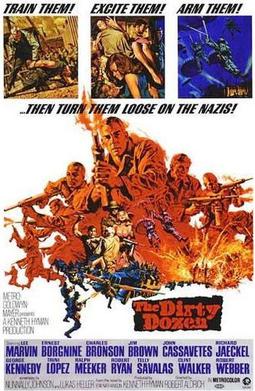
POSTER:  The poster is very busy.  I love the "Excite them!" part.  Until I saw the poster I had no idea that the night with the prostitutes is what fueled their slaughter of the Germans.  Those strumpets were actually quite patriotic.  C 
 
PRECURSOR?  Check out my earlier review of "The Secret Invasion" and decide whether Altman should have been sued for plagiarism.
 

Friday, December 14, 2012

FORGOTTEN GEM? Fixed Bayonets!


              “Fixed Bayonets” was Samuel Fuller’s second Korean War movie after “Steel Helmet”.  It was released in 1951 and is dedicated to the “Queen of Battles – the U.S. Infantry”.  Fuller was a decorated veteran of the Big Red One in WWII.  His “Big Red One” has autobiographical elements.  The Army insisted that Medal of Honor winner Raymond Harvey be technical adviser after Fuller had stepped on Army toes in “Steel Helmet”.  Harvey and Fuller became close friends during production.  The theme of the movie is:  “It takes more than brains – you’ve got to have guts to lead”.  The film is set in the initial stages of the retreat from the Chinese intervention of 1951.
 
                The film opens with a general ordering a platoon of 48 men to fight a rearguard action to screen the withdrawal of the main unit.   As the rest pull out, the faces on the platoon indicate that they realize they are on a suicide mission.  They set up a road block and send out patrols.  When not on guard duty, the focus squad of soldiers (which include James Dean in his first role) huddle in a cave away from the frigid weather.  The unofficial commander of the squad is the crusty Sgt. Rock (you heard me) played by “Steel Helmet”s Gene Evans.  The main character is a Cpl. Denno (Richard Basehart).  Denno is tormented by his inability to kill other human beings.  He had been demoted for this and chastises himself for his reluctance.  He also has a great fear of having to command men in battle.  With the chain of command being whittled down, Denno’s fear is closing in on him.  He even risks his life in a minefield to rescue an officer so he will not have to move up the chain.  The dirty rat dies anyhow!  Before you know it, Denno is in command.  Surprise!  He rises to the occasion.  Surprise!
                Denno is transformed by the circumstances.  He quells a revolt of the men who want to abandon the road block early.  “I’ll clobber the first guy that tries to bug out!”  He’s a leader now, but can he kill?  An enemy tank provides an opportunity for redemption.  Denno kills a scout and they take out the tank with several RPGs.  Unfortunately, a second tank arrives and it’s time to go.  Will they make it back to their main unit?
                “Fixed Bayonets!” is gritty partly because it is low budget.  The sound stages are not going to fool anyone.  Neither is the fake snow.  However, kudos for being one of the first war movies to emphasize the effects of freezing weather on combatants.  Another effect of the low budget is the feeling that most of the scenes were done with few takes.  The movie has an almost quaint quality to it.  I would guess that audiences cut it some slack since it was covering events that were set in the very year that the movie was made.
                The acting is fine.  Evans builds on his amazing performance in “Steel Helmet”.  The two movies were the height of his career.  Every character actor should have such on their resume.  He gets a great death scene.  “I told you, I’m dead”.  Basehart is also good.  His character arc is realistic and not maudlin.  It is very predictable, however.  The rest of the cast is average.
                The dialogue is a strength.  The movie is not verbose.  The soldier talk is well rendered.  Not surprising given the overseeing by Fuller and Harvey.  The interaction in the cave is a highlight.  There is a foot massaging orgy that only a Fuller film would depict.  The unit dynamics are reminiscent of “A Walk in the Sun”.  There is a camaraderie that is evident and does not seem forced.  There is a soldiers’ thoughts segment similar to “Guadalcanal Diary”.  A little corny, but with some humor.  Speaking of dialogue, one flaw is the appalling lack of noise discipline by our rearguard heroes.  They do a lot of shouting.
                The plot is too predictable.  Although the film does not beat you over the head with clichés, it has some obvious ones.  The best example is the redemption theme.  The killing off of the officers to eventually get to Denno was necessary and somewhat suspenseful.  I have to say that for a director who made a point of insisting his war movies were designed to make future wars more unlikely, Denno’s quick evolution to a killer tends to dilute that message.  Perhaps he should have remained the coward that he imagined himself to be.  But then, that would have contradicted the main theme of men rising to leadership when it is thrust upon them.  
                The movie has some good action scenes, but the low budget does not lend itself to anything spectacular.  There is a realistic artillery bombardment with good sound effects.  The minefield scene tends to drag on and does not have Denno using proper tactics to avoid blowing himself up.  Surprising since movie audiences had been tutored on the proper technique of slanted knife probing from numerous other war movies.  And boy, when they set up some dummies to fool the Chinese, those Chinese mortarmen are incredibly accurate in taking them out.
                “Fixed Bayonets!” is an entertaining war film.  It is a step down from “Steel Helmet”.  If you did not know it, you would assume “Steel Helmet” was made after “Fixed Bayonets!”  Where “Steel Helmet” was a revelation and put Fuller on the map, I find “Fixed Bayonets!” to be a bit disappointing.  It is well remembered by critics which means I feel it is overrated.  Considering the competition from other Korean War movies, it is relatively good.  The war did not exactly bring out the best in Hollywood.

Grade =  B-

the full movie


POSTER -  Check out that poster.  Did the artist even see the movie?  It is another example of studios gearing their advertisements to what they think the audience wants to see rather than what is actually on the screen.  One has to wonder what Fuller thought of the studio's approach to marketing what he clearly meant to be a film that deglamourized war.  "Their story ALL GLORY".  Are you kidding me?!  Glory is the one word Fuller would not have wanted to be associated with the film.  Here is the apporopriate slogan:  "Bayonets all bloody... Hearts and feet frozen... Their story ALL SURVIVAL"
 

Sunday, December 9, 2012

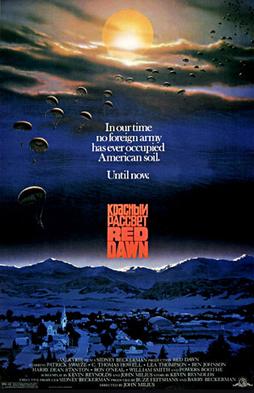
DUELING MOVIES: Red Dawn (1984) vs. Red Dawn (2012)


                Oh, the things a war movie blogger has to do.  One of them is going to see the rare war movie release realizing that it will most likely be terrible (ex. “Battleship”).  I had put off seeing the new “Red Dawn” because it seems a useless remake of a bad film and I have been very busy with soccer.  However, I could not let my public down so I bit the bullet and headed for the theater.  Being a masochist, I also watched the original (which I have to admit I had not seen due to the terrible reviews it got when it came out).  What a day!  I have cemented my place in war movie heaven by spending some time in war movie hell.

"Wolverines!"
                “Red Dawn” (1984) actually has a pretty good reputation.  Apparently there were a large number of high school boys who saw it in 1984 and there are a lot of conservatives today that remember it fondly since it fit their fantasy of World War III.  It is definitely a curio from the Cold War days.  Specifically, the Russians in Afghanistan days.  The opening scrawl confusingly explains that NATO has dissolved, Mexico has gone communist, and the Warsaw Pact is on the move.  Before you know it, Cuban paratroopers are landing in Calumet, Colorado.  An idyllically all-American town that is of great strategic importance, I suppose.  A few high school boys join the slightly older Jed (Patrick Swayse) in the outdoors.  The crew includes his brother Matt (Charlie Sheen).  After some hand-wringing (and crying), they decide to become survivalists.  The movie is probably required viewing for militias.
Dirty Dance with this you commie bastard
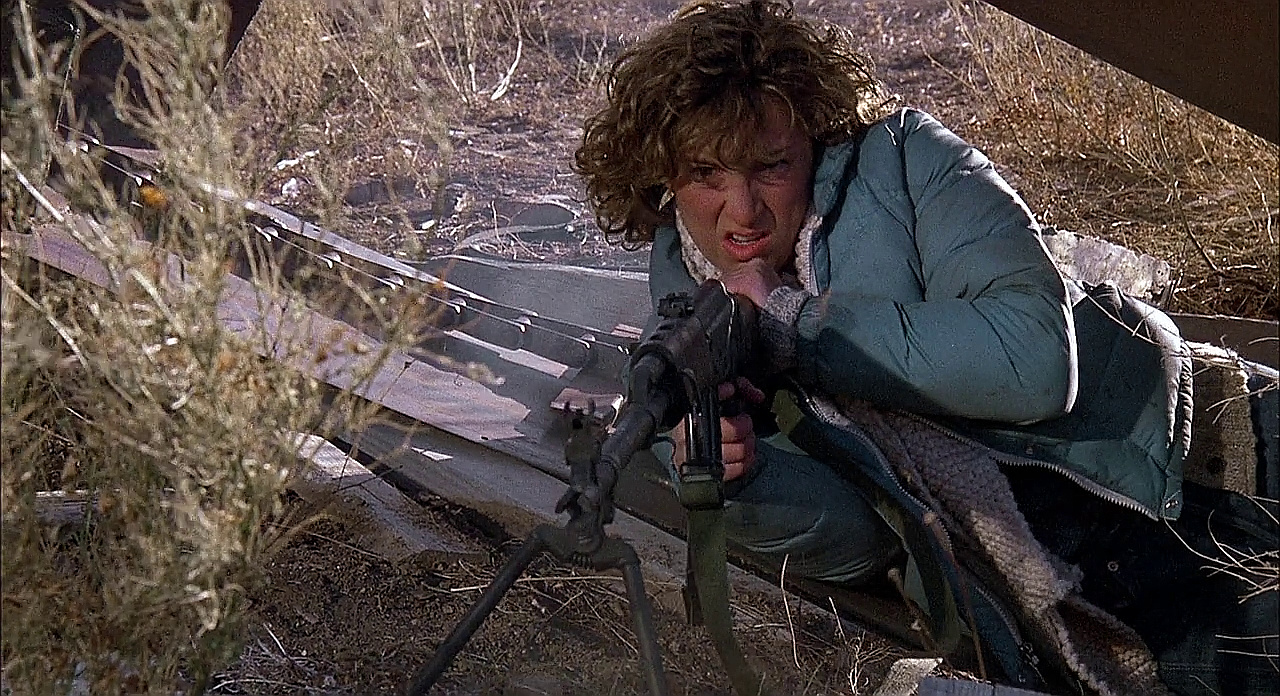
                The town is under occupation and any adults (like Jed and Matt’s father) with balls are in a re-education camp.  Books are being burned.  The weasely mayor is collaborating (he is a liberal).  There are three villains:  the Cuban Col. Bella (who is now on the receiving end of insurgency), a Soviet adviser (who believes in several eyes for an eye), and a counterterrorist expert Col. Strelnikov (the menacing William Smith) brought in to hunt down the insurgents.  When the gang (called the “Wolverines”) kills three Soviets, the commies react by executing civilians including Jed and Matt’s father.  It’s on now.  They are joined by two girls (Lea Thompson and Jennifer Gray) who insist on being treated equally and refuse to do the dishes as teenage boys in the audience snicker.  There is a montage of attacks (including on a Soviet tank crew that stops at a gas station to fill up with regular).
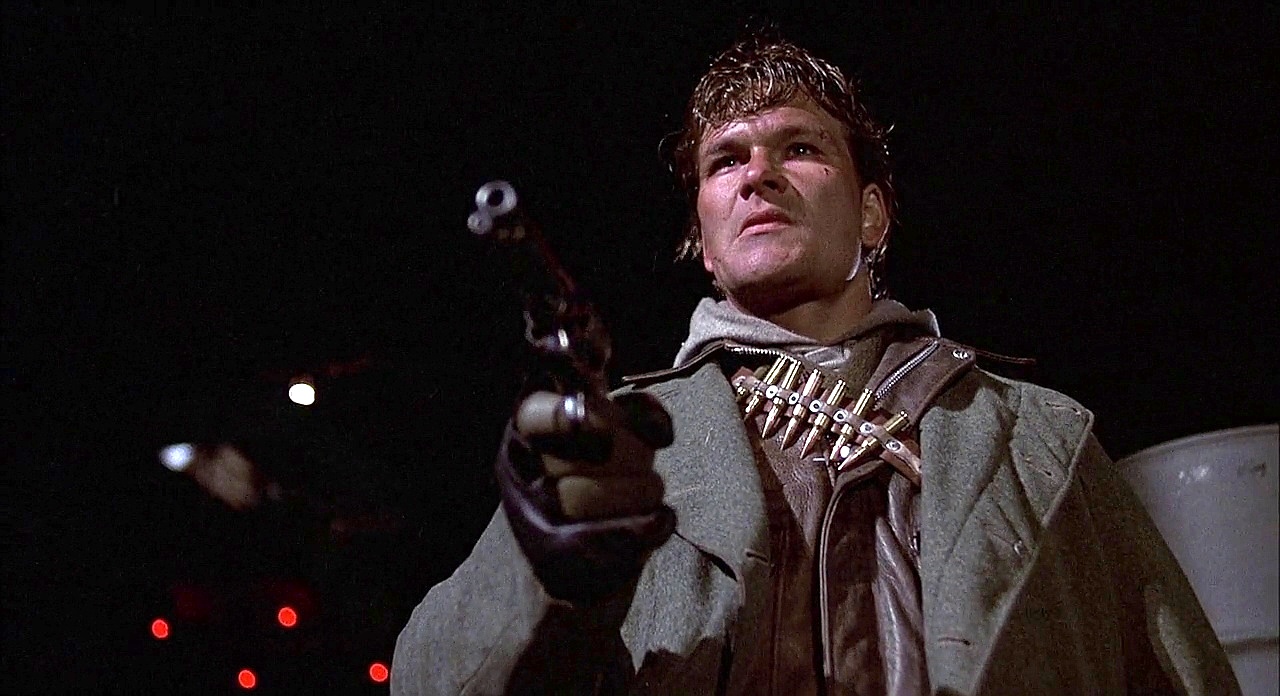
Jed draws down on Strelnikov
                The director brings in Powers Boothe as a downed pilot to provide acting lessons and fill in the audience with how all this conquest came about.  Coming from him it almost seems plausible.  There are some bloody fire fights with old school deaths.  The movie supposedly set a record for body counts, especially for the first PG-13 rated film.  They keep getting whittled down, including the execution of one of their own (the mayor’s son) for swallowing a homing bug.  A couple more go in a surprise attack by vicious looking Soviet choppers straight out of Afghanistan.  The final set piece is Jed and Matt’s two man assault on enemy headquarters as cover for the escape of Danny and Erica to Free America.  Would you believe there is a duel between Jed and Strelnikov?  And an encounter with Bella?  
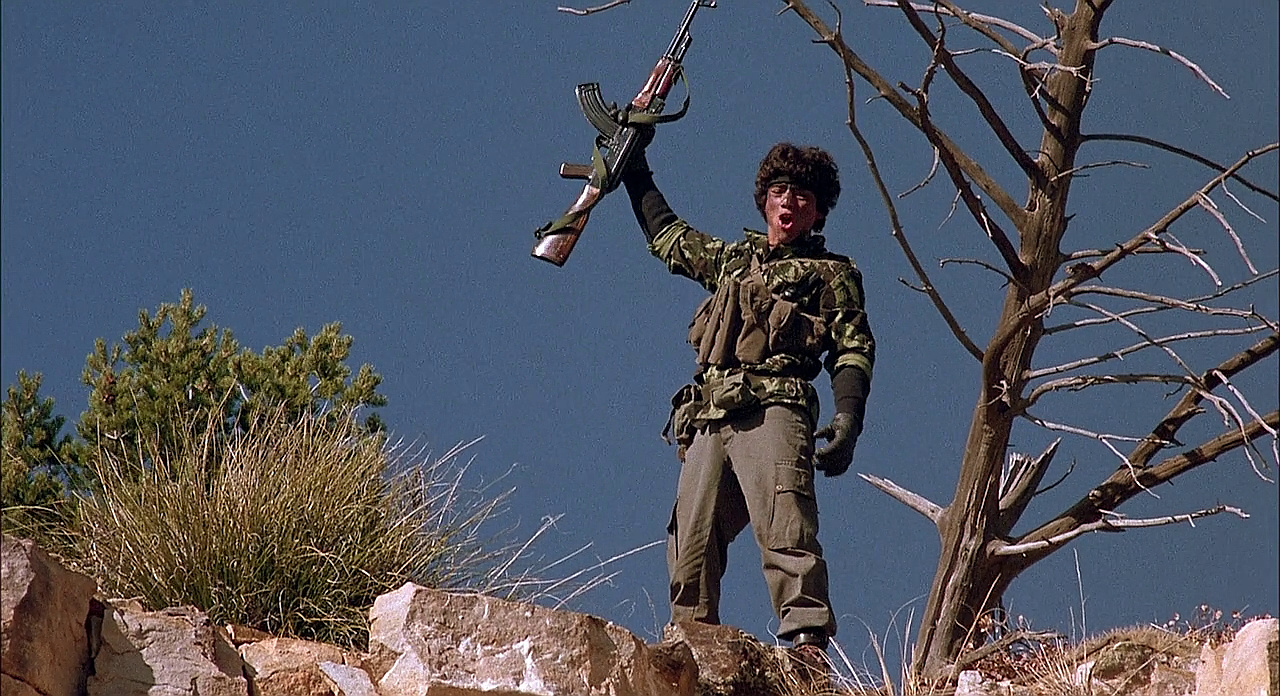
Jed ambushs some Orientals
             “Red Dawn” (2012) has the same basic premise and some familiar elements, but differs in many ways, including tone.  The causes of the war are even more WTFish.  Something about all American forces being abroad putting out conflicts and this allows the North Koreans (with their fourth largest army in the world) to swoop in.  Their secret weapon is an electro-magnetic pulse thingy.  Who cares?  Not 14 year old boys.  The brothers are fleshed out a lot more.  Jed (Chris Hemsworth) is a Marine on leave.  Matt (Josh Peck) is the starting high school quarterback.  They are at odds with each other, naturally.  Matt is not a team player.  Each is also given a love interest.  Matt’s is the head cheerleader, surprise!  All he cares about is rescuing her and she isn’t even Megan Fox.  The gang is more heterogeneous and the girls are treated equally from the start.  We get a montage of training  instead of attacks.  Five minutes of montage can transform high schoolers into killing machines.
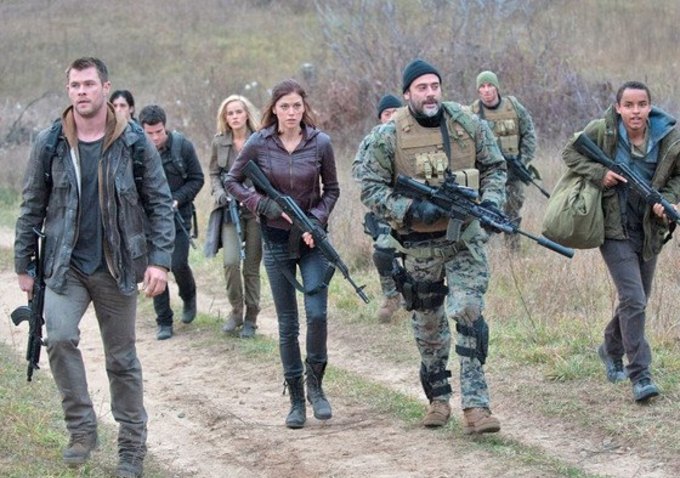
Wolverines + Special Forces
                The main villain is a Col. Cho.  He is your typical inscrutable oriental villain.  The kind you can’t wait to see die in a nasty way.  The movie also throws in a Russian spetsnaz and a slimy collaborating teen.  Don’t look forward to their cathartic deaths.  Instead of one downed airman, this version drops in three crusty Special Forces types to teach and learn from the Wolverines.
                The big finale also involves an assault on the headquarters, but with the purpose of acquiring a black box that will change the course of the war.  Or so we are vaguely informed.  There is a massive expenditure of ammo and the grand entrance of a tank through the wall of the headquarters.  Hey, it could happen.  There is a much cooler confrontation between Jed and Cho than between Jed and Strelnikov in the original.  
                How to compare the movies?  1984 has more explosions than 2012 (30-23) which is surprising.  2012 has many more crash-crazy car chases.  1984 drowns 2012 in tears.  It is one of the weepiest movies I have ever seen.  Even after they become tough warriors, they still bawl at the drop of a hat.  And I’m not talking about the girls.  There is a scene where Swayse and Sheen cry as they see their father for the last time that is hilarious!  
 
                1984 has many more terrible acting performances.  You can argue that Swayse and Sheen became good actors, but they certainly are not there yet.  The movie is one of the most poorly acted films I have ever seen.  The dialogue does not help.  At one point one of the gang actually says “Things are different now”.  You think?  The acting in 2012 is tolerable.  Hemsworth dominates every scene.  He is charismatic.  The rest of the cast does not stand out, but does not embarrass itself (except Peck who is wooden).  The dialogue has some groaners.  They are told “you made a difference”.  One of the special forces stoically states “it’s a good day to die”.  There’s the usual “I’m not going to leave you” altruism and the “you fucked with the wrong family” epithet for a villain.  You also get several talkie dysfunctional brothers’ dialogues.  Kudos to 2012 for one unexpected death similar to Samuel Jackson’s in “Deep Blue Sea”.

                Cinematography goes to 2012 unless you get sick watching hand-held, quick cutting, video gamesque camerawork.  1984 is fairly tame in that respect.  It doesn’t even have the slo-mo the 1980s are noted for.  The score duel goes to 2012 also.  It is revved up and surprisingly does not have a slew of soundtrack worthy hits.  1984 is more cheesily backed.
 
                As far as realism, why argue whether dog shit or cat poop smells worse?  With that said, no plot could top North f***ing Korea invading the U.S.  And you put clips of Obama to imply this could happen in the near future!  In for a penny…  Of course, as you might already know, the original villains were the Chinese until the makers were contacted by Walmart (I only made up the Walmart part).  Why couldn’t these high schoolers battle aliens or zombies?  Something that could actually happen.  By the way, how does a North Korean fighter jet participate in a battle in America?  Did it launch from one of those North Korean aircraft carriers?  1984 also featured enemy jets, by the way.

                In conclusion, “Red Dawn” (1984) was worse than I expected and “Red Dawn” (2012) was better.  2012 has some good action of the modern frenetic variety.  The kind where you don’t have the foggiest idea who just got killed, but you’re pretty sure it should be everyone.  It improves upon the original in almost every way and does not suffer from the common "what the hell is the purpose of this remake" conundrum.  It’s just a shame it had to demonize those nice North Koreans.  I hope it doesn’t piss them off to where they might invade us.  The makers of the film will be held accountable if that happens.  It is not wise to poke a chihuahua.

Red Dawn (1984) =  D
Red Dawn (2012) =  C+


Tuesday, December 4, 2012

CLASSIC or ANTIQUE? Throne of Blood


                “Throne of Blood” was released in 1957 in black and white.  It is the retelling of MacBeth by acclaimed Japanese director Akira Kurosawa.  It was originally entitled “Spider Web Castle”.  (“Oh what a tangled web we weave…”)  The film opens with a foggy view of the destroyed castle, but when the fog lifts the castle is intact – what a nifty way to flash back!  Two generals named Washizu (Toshiro Mifune) and Miki have just defeated an invasion.  They get lost in “Spider’s Web Forest”, naturally.  They encounter an evil spirit which predicts that Washizu will become ruler and pass the throne on to Miki’s son. After an extended silly period of riding back and forth, they return to Lord Tzusuki castle and are shocked to be promoted just as the spirit said.

Asaji
                Washizu’s wife Asaji (Isuzu Yamada) is a creepy schemer.  She encourages Washizu to preemptively kill Tzusuki before he finds out about the prophecy (from Miki).  Guess who’s coming to dinner?  The camera stays on Asaji as Washizu goes off to do the deed.  When he returns with a bloody spear, she puts it with the guards who she had slipped a mickey to in order to shift the blame.  Next up her big sleeved kimono is to remove Miki and his son.  She lies and tells Washizu that she is pregnant.  This unhinges Washizu who hosts a banquet for Miki where he proceeds to hallucinate the appearance of Miki’s ghost and then proceeds to try to kill it.  Could he look more guilty?

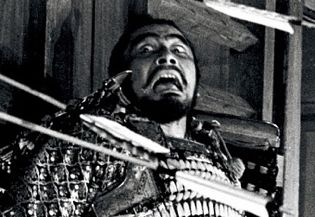
Washizu
                The chickens come home to roost as Washizu’s enemies approach his castle.  Washizu visits the spirit to get a prophecy update and is assured that he cannot be defeated unless the trees of the forest attack him.  Washizu boosts the morale of his men with this guarantee of victory.  He returns home to find Asaji feverishly trying to wash bloodstains off her hands.  Oh. well, at least there is no chance of trees attacking.  Oops!  Here comes the forest.  (Actually the enemy has cut down trees and is using them for cover.)  This is the last straw for Washizu’s fed-up garrison.  They pelt him with a barrage of arrows until one goes through his neck and he dies looking like a pin cushion.

                The movie is bizarrely interesting.  It bears the marks of Kurosawa’s genius and attention to detail.  He filmed much of it on the slopes of Mount Fuji.  It is a very foggy movie.  There are a lot of shots through the branches of trees which I am sure has some point to it because the cinematography has been lauded.  Most impressively, the arrows fired at (but not hitting) Mifune are actual arrows fired by archers .  Mifune’s movements were choreographed and he waved his arms to show the archers which direction he was heading in next.  This death scene is one of the most remarkable in movie history.

                The acting is top notch, especially Mifune and Yamada.  The plot is Shakepearean with a Japanese twist. One twist is the spare dialogue.  Kurosawa plants the MacBeth plot in Fifteenth Century Japan during the period called Sengoku Jidai (“The Age of the Country at War”).  This era of political chaos featured wars between rival clans marked by treachery and assassinations.  He also blends in elements of Noh Theater like the flutish music, bare sets, and the formalized performances.  It is a fascinating film, but not really a war movie.  Classic or antique?  Definitely a classic.

GRADE =  B

RANKING OF KUROSAWA WAR MOVIES:

1.   Seven Samurai
2.   Yojimbo
3.   Ran
4.  Throne of Blood
5.   Kagemusha


the trailer

riding in the forest