Saturday, March 12, 2016

CRACKER? Troy (2004)


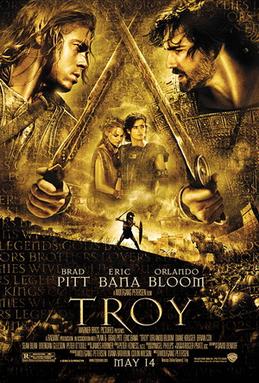
                I recently taught “The Iliad” for the fortieth time in my Western Civilization class, so I decided to rewatch “Troy” and review it with an eye to how close the movie retells the epic poem.   It seems appropriate that a web site that reviews war movies should examine a movie based on the first war story in Western literature.  Before you say “what took you so long?”, I want to point out that I did review the movie as part of my Best War Movie of the 21st Century Tournament.  (It defeated “The Last Samurai”, but lost to “Master and Commander”.)  This review will concentrate on the plot. So if you haven’t read “The Iliad” - spoiler alert.  And, come on, get that off your bucket list!  And, if you think watching this movie takes the place of reading Homer’s incredibly long poem, think again.  (But high school students trying to avoid reading the poem and using my review instead, you’re welcome!)

                “Troy” is actually the story of the entire Trojan War whereas “The Iliad” covers just six months in the ninth year.  A title card introduces the movie with background information pre-war.  King Agamemnon (Brian Cox) has united the Greek cities into a loose alliance, except for Thessaly. His brother Menelaus (Brendan Gleeson) is negotiating peace with Princes Hector (Eric Bana) and Paris (Orlando Bloom) of Troy. While the King of Sparta is making peace, his brother is making war with Thessaly.  Instead of a bloody battle, it is decided that each army will put up a champion for a duel.  Agamemnon’s champ is Achilles (Brad Pitt), which is awkward because they despise each other.  The duel ends with Achilles doing his signature move.  Meanwhile, back in Sparta, Menelaus’ wife Helen (Diane Kruger) is showing Paris more than the normal hospitality.  This could end up ramming (this is Ancient Greece) the peace treaty.  Especially when Helen elopes with Paris.  When Hector finds out, he decides bro and his ho before the entire population of Troy.  Menelaus goes crying to big brother, who uses the cuckolding as an excuse to conquer Troy.  If that is going to happen, the Greeks will need their main man Achilles.  Odysseus (Sean Bean) convinces Achilles to accompany the expedition in spite of it being suicidal for Achilles.  Achilles’ mother points out that it is better to die a glorious death and be remembered forever than to provide her with grandchildren.  Odysseus points out that since he is being played by Sean Bean, he is committing suicide also.
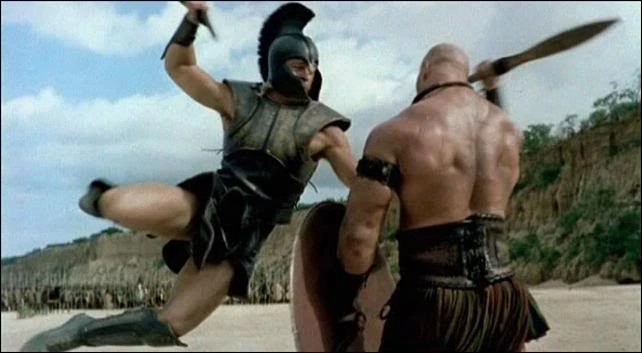
the move - as described by Homer

                Achilles leads the beach assault.  He and his Myrmidons avoid the fire arrows by getting into a testudo.  Romans, take note.  Achilles is a killing machine and the entire Trojan army retreats from him.  To add insult to injury, he desecrates the Temple of Apollo.  Hector rides to the rescue and finds out why Achilles is the J.J. Watts of the Greek army.  Achilles nobly spares Hector’s life because it is too early in the movie for that duel.  Or as Achilles puts it:  “It’s too early in the day for killing princes”.  The victory celebration is marred by Achilles and Agamemnon debating who deserves credit for the win.  Agamemnon’s argument is the king determines who gets the credit – and that would be me.  Achilles responds with:  “War is young men dying and old men talking”.  Oh, snap!  To emphasize where the power lies, Agamemnon insists on taking a beautiful captive girl named Briseis (Rose Byrne – Angelina Jolie not available?) away from Achilles and makes it clear she will not be just dusting his tent.  Achilles is so upset he says “you sack of wine!”  He’s more of a physical fighter than a verbal taunter.  Until his sex slave is returned, he will not kill any more thousands of Trojans.

                At a Trojan council meeting, Paris stops the debating by proposing a duel with Menelaus to end the war.  (The royal family rushes to place bets on Menelaus.)  The duel between the vengeance-minded brute and the wimpy, ladies-man goes as you would expect.  End of war and end of movie, right?  Except that the winner dies and the war continues with a phalanx battle.  Trojan archers from the city walls turn the tide and the Greeks retreat.  This would never have happened if Achilles were here, so Agamemnon returns Briseis who is so grateful to have that weight lifted from her chest that she falls in love with Achilles. Good sex is not enough to rekindle Achilles' blood-lust.  A night attack using fire-balls (Spartacus take note) puts the Greeks on the brink of having to accept that a semi-hot chick might not be returning with them.

                When the daylight comes, Achilles best buddy Patroclus (Garrett Hedlund) sneaks off in Achilles’ armor and leads a counterattack.  Like on a playground, everyone gathers around for the duel between the faux Achilles and Hector.  Patroclus may look like Achilles, but…  Achilles is not going to take this well.  But on the plus side, Achilles will stop his pouting and return to slaughtering.  But first, he has some unfinished business with Hector.  Achilles calls Hector out (literally) and they have the type of fight that you would expect from two superstar actors who refuse to use stuntmen and rely on robotic choreography.  The duel turns when Hector trips over the only rock located on the plain outside Troy.  In a great act of poor sportsmanship, Achilles drags the corpse back to the camp.  ( I assume this was not in the original script, but was an idea that came to the ever-competitive Pitt.)  Later, King Priam (Peter O’Toole) comes to beg his son’s body back and prove that he can still act circles around these young whippersnappers.  Patroclus is cremated in the third funeral pyre scene in the movie.  At this rate they are going to run out of coins to put on eyes.  This, by the way, is where “The Iliad” ends, but the movie goes on to conclude the war because too many theatergoers have money riding on who wins the war.
ladies, he wants you

                Odysseus (Sean Bean is still alive!) gets a bright idea for a way into the city.  The horse does look like it was built from ship timbers.  Nice prop!  Paris wants to burn it, but being the most unpopular man in Troy, no one listens.  During the night, Achilles and other sneaky Greeks initiate the sack of Troy.  Achilles is not interested in the fun stuff – looting, raping, killing.  He is on a quest to rescue Briseis.  Andromache and Helen escape, along with Aeneas – a character introduced so intellectuals can feel superior to the rest of the audience.  Google him.  Agamemnon stabs Priam in the back (literally).  And as though that does not bring enough hisses, he moves on to abusing Briseis.  She stabs him in the neck.  It’s like a gift for her boy-friend Achilles.  But before he can thank her, Paris puts an arrow in his ankle.  Lucky inaccurate shot!  The next three shots are more accurate.  Who wants to see Achilles die from an errant arrow to the ankle?  Paris and Briseis escape.  He knows a way out – he would!  Another funeral pyre.  Sean Bean survives!  Maybe there will be a sequel featuring Odysseus.  Is there a story that could be adapted into a screenplay?
a Trump rally

                My belief is that a movie should improve upon the book it is based upon.  “Troy” is a mixed bag in that respect.  It jettisons the ridiculous role played by the gods in the war, but then the screenplay changes the deaths of virtually every main character and messes with the ending in a move purely aimed at satisfying the audience.  In many ways the movie treats the audience as dummies.  This includes the simplistic theme of glory equals immortality.  This differs from Homer’s theme of “the wrath of Achilles” because Brad Pitt can’t be seen playing a jerk.  In reality, Achilles is one of the great heels in history.  The movie plays into the common ignorant belief that he was a hero.  For this reason, Pitt’s Achilles does not commit atrocities like cutting the throats of twelve prisoners at Patroclus’ funeral as he does in “The Iliad”.  The transformation of Achilles to an empathetic, lady-rescuer is laughable.   Although Achilles is not quite the brute of “The Iliad”, the other characters are spot on in their personalities.  The movie insists on making Agamemnon into a supervillain which is beyond Homer’s depiction of him as a dick.  The cast is all-star and they do a good job.  At least the men do, the female characters are weaker.  The biggest problem being the key role of Helen.  A little known Diane Kruger was cast and she is not up to playing the most beautiful woman in the Ancient World.  (Why not the modern “face that launched a thousand ships” – Jennifer Anniston?  Another case of a Pitt veto?)
she's pretty, but a thousand ships?

                “Troy” has all the strengths and weaknesses of an epic.  Director Wolfgang Petersen (“Das Boot”) knows how to make crowd-pleasing, big budget blockbusters.  He uses CGI well for the fleet and army scenes, but there are still a lot of extras in the film.  The sets are kitschy.  Basically what a modern interior designer imagined a Trojan palace would have looked like.  The dialogue matches the look.  It is pompous and heavy-handed.  “I will remember your name”.  (Because that is the theme of this movie.)  “I hate Achilles”.  (In case my scowl is not clear enough.)  The cinematography is showy.  There is a tracking shot over the beach that cribs from “The Longest Day”.  There is a sudden appearance of POV when Paris fights Menelaus.  Petersen can’t force explosions in, but he does manage to get rolling fire balls.  (Fire – the go-to effect until Alfred Noble revolutionized action movies.)  The score is what you would expect.  James Horner took over after test audiences found Gabriel Yared’s work too old-fashioned. I found Horner’s work too “Enemy at the Gates”.  Is it okay to plagiarize from yourself?  He actually was accused by some critics of stealing from several classical composers.

                As a combat film, the movie is visceral, but anachronistic.  If you read Homer, most of the fighting involves individual duels.  The movie stops to reenact the key duels, but the rest of the combat is basically a Hollywood melee.  The Greeks did not fight this way at that time.  The movie also pays lip service to the use of chariots, but in the “Iliad” every prominent warrior used a chariot to move to and retreat from the battlefield.  The role of archery is ginned up because Hollywood loves blizzards.  Hollywood also loves twists.  This explains why the Homer-challenged are fooled into thinking Hector has killed Achilles.  One good thing about the combat is it is not repetitive, like in Homer.  Each battle scene is different.  And they are spaced out so the movie does have a nice flow and no long boring stretches. 
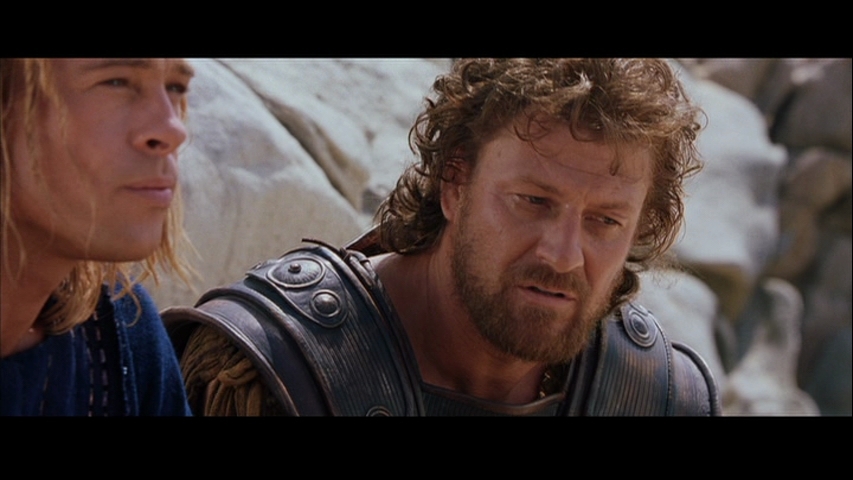
"it's not so bad - dying, the gods know I've
done it enough times"

                “Troy” will not make my 100 Best War Movies list.  It is a great example of how Hollywood tampers with classic literature to make it more appealing to modern audiences.  I will be doing a “Homer vs. Hollywood” post in the future, but as a preview, “Troy” is far from a Cliff Notes version of “The Iliad”.  Please do not watch it and then take reading “The Iliad” off your bucket list.


GRADE  =  C   


Saturday, March 5, 2016

NOW SHOWING: Whiskey, Tango, Foxtrot


                “Whiskey, Tango, Foxtrot” is a dramedy about a female journalist in Afghanistan from 2003-2006.  It is based on the memoir “The Taliban Shuffle: Strange Days in Afghanistan and Pakistan” by Kim Barker. The movie assures us it is “based on a true story”.   It was directed by the team of Glenn Ficarra and John Requa.  The movie was a pet project of Tina Fey who was interested in Barker’s story early on after someone mentioned to her that she would be ideal for the role.  The movie was made by her production company and produced by mentor Lorne Michaels. 

                The movie opens with a cocaine fueled party in Kabul in 2006.  The partiers are journalists blowing off steam.  They are interrupted by a nearby explosion.  At this point the film drops back to 2003 to start our heroines arc.  Kay (Fey) is a network news peon who decides to volunteer for reporting from Afghanistan because she qualifies as “unmarried and childless”.  All she has is a steady boyfriend who is supportive of her career move.  They can make it work.  Sure, why not?  Before you can say cancel the wedding plans, she is corkscrew landing at Kabul International Airport (KIA – get it?) to avoid missiles.  She is assigned an interpreter/fixer named Fahim (Christopher Abbott).  No Afghan actors available in Santa Fe?

                Kay is introduced to the denizens of the frat house the journalists live in.  This boys club includes one other female named Tanya (Margot Robbie) who does not want the audience to go to the trouble of discovering that she is a male war correspondent sexually, so she comes right out and asks Kim if she can sleep with her security detail.  She suggests Kay take advantage of the fact that women who are marginally sexy in the States are 10s in Afghanistan.  This movie might have a great effect on American women booking trips to Kabul.  (Especially those that consider Tina Fey to be a dog.)

                Kay’s first embed is at a forward operational base.  She does the requisite “where you from soldier?” interviews and becomes friends with a Marine who insists he does not believe in chambering his weapon.  This bizarre inclusion in the montage will come back as a major plot point.  She also strikes up a relationship with a General Hollander (Billy Bob Thornton) who admonishes her to not take advantage of her sudden rise on the female rating scale to have sex with his Marines.  By this time in the war, a typical mission is to investigate the blowing up of a well in a village.  On the way back, their convoy is ambushed and Kay uses the sudden rush of adrenalin to get film of a Javelin missile taking out a Toyota Taliban tank.  This act of balls earns her the generals respect and the explosion earns her air time.

                The second embed also involves a sabotaged well, but this time it’s not the Taliban to blame.  It’s a Tina Fey movie so we need to have some social commentary of the female rights variety.  This is followed by a trip to a school destroyed because of its female students.  As time goes on she goes from “what the hell have I gotten myself into?” to “when do I get my next fix of whizzing shrapnel?”  She has also evolved amorally and strikes up a relationship with the previously “not in a million years” rake Iain (Martin Freeman).  Their relationship has as bright a future as Afghanistan.  And her relationship with girlfriend Tanya is equally solid.  A BFF (bitch friend fortheduration) wouldn’t be as competitive as a male colleague, would she?  Nor would your male lover, right?

                Some will make their decision to watch this movie based on their feelings toward Tina Fey.  In my case, I love her, so it was a no-brainer.  If you consider her to be a raging liberal feminist, chill out because she is not using the movie as a forum for her loathsome views.  The movie is surprisingly light on political commentary. It does not question our involvement in Afghanistan. It does not even question why we are still there.  Instead, there is a theme of America losing interest in the war.  If anything the movie is pro-military.  All of the Marines are positive characters, including one who gives his legs for his country.  In another surprise, General Hollanek is super cool.  His periodic appearances really juice up the movie.  Although their relationship starts predictably rocky, he turns out to a leader who is willing to adjust his views when confronted by new information provided by Kim.  He also gets some kickass lines.  When Kim asks him how the war is going, he describes it as like “fucking a gorilla, you keep going until the gorilla wants to stop.”  The movie is also pro-journalism, but it does portray war correspondents as stereotypically hard partiers (like WWI fighter pilots).  It updates the cliché of journalists being ruthlessly competitive for scoops to include female war correspondents.  Throw in a bit of the anything for a scoop mentality.

                “Whiskey, Tango, Foxtrot” aims at the easy target of network news, but it does not hit the target with an RPG.  It is more subtle than that.  The two biggest gets by Kim and Tanya both involve explosions caught on film - with the definite implication that no explosion, no air time.  However, when Kay confronts her boss about lack of coverage of Afghanistan, her boss logically explains that if the public is not interested…  The movie does not so much criticize as state facts.  Hopefully the movie will remind the public that we still have troops in the god-forsaken country.  And the gorilla still insists on being fucked.

                The movie is well made.  The  Santa Fe sets look like a Middle Eastern country.  There are some attempts at local color.  Fahim gets a Muslim wedding.  Kay dresses in a burkha (“the blue prison") to infiltrate a medieval “discussion” of modern technology.  The movie also makes token efforts to give us a taste of Afghan culture.  There is a running joke that if you put a turban on Kay, she would be a mighty fine boy - worthy of intercourse with an Afghan leader.  Speaking of jokes, the movie is more drama than comedy, but there are many humorous lines.  The movie eschews slapstick.  Although it’s closest equivalent in war movies is “MASH”, it is not as broad or subversive.  It is also not as episodic.  “WTF” has more of a traditional storyline and this is a weakness because some of the plot is cliché and predictable.  Since it’s been a while since we had a significant addition to the war journalism subgenre (and none on Afghanistan), the clichés are not that stale.  Another similar weakness is the predictability.  All four of the principal relationships end as you would expect.  This makes the movie more comfortable than daring.  But maybe this was because they were so true to the book.  Just kidding.

                A strength of the film is the cast.  Whatever your visceral reaction to Fey, she is quite good in a mainly dramatic role.  That does not mean she does not showcase her famous snarky brand of humor.  Robbie is good as her slutty gal pal and gives one a chance to ponder if the Fox News bunnies were similarly bedded when they embedded.  Freeman is fun as the wolfish MacKelpie.  Thornton comes off best as General Hollanek.  The character could have easily been a caricature.  It says a lot for Fey that she would let him steal their scenes and allow him to get some of the best lines.  His character also balances the strong female characters.

                “Whiskey, Tango, Foxtrot” (good, if inaccurate, change of title) is a worthy addition to the war journalism subgenre.  It does have two brief combat scenes to help it qualify as a war movie.  The Marine raid to rescue a hostage is especially well done and different enough from the night vision/POV style currently in vogue.  As Kay points out to Hollanek, America needs a reminder that it’s not just the Special Forces that conduct raids.  I won’t complain that the whole hostage scenario was probably invented to get some more action into the film.


GRADE = B

Wednesday, March 2, 2016

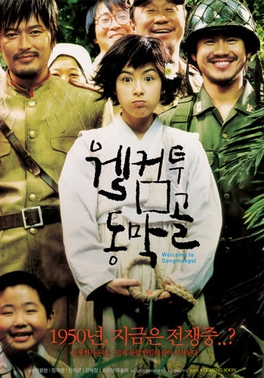
SHOULD I READ IT? Welcome to Dongmakgol (2005)


                “Welcome to Dongmakgol” (also known as “Battle Ground 625” – don’t ask) is a South Korean movie that was released in 2005.  It was based on a play and was the directorial debut for Park Kwang-hyun.  The film was a commercial and critical success and received numerous awards including the Korean Award for Best Picture.  It was South Korea’s submission for Best Foreign Picture for the Academy Awards.

                The movie is set in South Korea in September, 1950.  A background crawl relates that in the aftermath of Inchon many North Korean soldiers are hiding in the hills and the U.S.A.F. is indiscriminately bombing civilian areas.  An American pilot named Smith (Steve Taschler) crashes through a blizzard of butterflies ( a recurring motif) and is brought to an idyllic village where the people are unaware of the war.  They don’t even know what guns are.  Meanwhile, he is joined by a trio of North Koreans who are escaping an ambush that left their entire unit decimated.  They are led to the village by a strange girl named Yeo-Il (Kang Hye-jung).  She is basically the village idiot.  Arriving that same day are two ROK soldiers which results in a Mexican stand-off between the enemies.  The hours-long confrontation ends when a grenade goes off turning the village’s corn supply into pop corn.  It’s that kind of movie.  An uneasy truce ensues and the soldiers bond over the hunt for a wild boar.  The frenemies go native and everyone lives happily ever after.  Not.  An American unit is sent to rescue Smith before the village is scheduled to be bombed off the face of the Earth.  How will the sextet save their paradise?

                The critics were enamored with the symbolic aspects of the plot.  I found the themes to be bludgeoning.  The village represents the world if there were no war and weapons.  We could all live in harmony and happily ever after.  War corrupts, but if you can escape from it you can be reborn.  War also makes humans hate other humans.  If it were not for war we would all be brothers.  Oh, brother!   War speaks for itself as being terrible.  That’s why almost all war movies are anti-war.  I don’t need heavy-handed bull crap to show me this.  Besides the heavy-handed themes, the film is also painfully predictable and bends over backwards to ensure the obligatory conclusion.

                Director Park throws numerous paint filled balloons at his canvas.  Broad humor, bizarre characters, melodrama, action, tragedy – you name it.  Basically everything except what I love in Korean war movies – the outlandish battle scenes.  The montage of elements wowed the critics and Korean audiences, but as a reviewer of war movies as war movies (not as entertainment), I was unimpressed and was left with a neck ache from all the head-shaking.  The acting is poor and distracting.  You don’t expect nuance in Korean actors, especially in their war movies, but the actors here are just second rate.  To a large degree, your impression of the movie will depend on how you view the character of Yeo-Il.  We used to call that kind of person retarded.  I would never say that today.  Let’s just say she is endearingly moronic.  I could not tolerate her.  But I did not like Forrest Gump (that’s right, I said it) either, so maybe it’s just me.  By the way, the actress won the Korean Best Actress Award.  Gah!  The one American actor was not exactly a huge get by the casting director.  He is terrible, but should thank his agent.  The film is no great shakes technically either.  The budget doubled during production, but it could not have been due to special effects.  The CGI is cartoonish, especially the aircraft.  The music is generic and simplistic.

I am a big fan of Korean war movies.  They are always memorable and have such a bold style.  Some of my favorites are:  Taegukgi, The Front Line, My Way, and Joint Security Area.  "Welcome to Dongmakgol" does not deserve to be included with those pictures.  It is a dud.  It eschews the balls to the wall action of the others to go in a surreal direction and be allegorical.  It is difficult to like the others and find a spot for this film.  Damn it, this movie broke my streak of good Korean war movies.  Oh well, bring on “Silmado”!


GRADE =  F  

Thursday, February 25, 2016

Birdsong (2012)


                “Birdsong” is based on the novel by Sebastian Faulks.   It was set in WWI and is a love story.  It was first put on as a play and in 2012 the BBC made a TV miniseries out of it. It appeared on PBS Masterpiece.  The director was Philip Martin.  The movie differs from the book in several aspects, most significantly in the fact that it omits the section set in the 1970s.

                The movie is told in flashback.  Stephen Wraysford (Eddie Redmayne) is a British officer on the Western Front.  His men have the unique job of guarding tunnelers who are mining the German front lines. This is a dangerous job that involves flooding below the ground and German infiltration. He flashes back to his ill-fated affair before the war with the wife of his boss. Before the affair falls apart, Stephen suffers the deaths of two of his men.  At one point, he is ordered to go down in the tunnel and gets wounded in a firefight when the Germans break through the wall.  This is inter-cut with his consummation of the affair.  That romantic moment ends with a “what have we just done?” moment.  Although Stephen is down on the war and down on going down into a tunnel, he wants to return to the front from his hospital bed.  “This isn’t a war, it’s an exercise in how much men can be degraded”.  But can I please get back to it?  How upper class British of him.

follow this upper class twit into no man's land
                The movie continues to bounce between the war and the romance.  The romance is rockier than the war.  Isabelle (Clemence Poesy) suddenly breaks up with him and does not give him a reason.  When we later find out what the reason was, it’s ridiculous.  So are a lot of the plot developments in the movie.  There is the clicheish scene where Stephen disagrees with a general’s optimistic prediction of the upcoming assault.  The bombardment will do the trick – the wire will be cut and the dugouts will be obliterated.  The mines will open up a hole that the men will stroll through.  Oh, you British generals.  The attack is decidedly macro and follows Stephen like the camera followed Dax in “Paths of Glory”.  Much of what happens is awkward, narrative-wise.  The movie then jumps two years to the end of the war.  There is a big revelation concerning the end of the affair.  Stephen is still in the mining business although the war is literally on it lasts legs.  If you are going to spend months digging a mine and stuffing it with explosives, you want your money’s worth regardless of the fact that it will have no effect on the outcome.

One of these guys looks like a soldier and
the other is Eddie Redmayne

                This movie was a disappointment for me.  WWI does lend itself to quality plays, but there have also been some real duds like “The Trench”.  But I have to admit that my opinion of the movie was colored by my distaste for the lead actor.  Redmayne has gone on to a spectacular career, but I still don’t like looking at his face.  It is just creepy to me.  I don’t dispute he has become a competent actor, but in this movie he is blah.  It does not help that this milquetoast with the femme face manages to bed a hot mom.  Unrealistic much?  On the plus side, Clemence Poesy is hot.  What would have been realistic is if she had broken up with him when she finally got a close look at who she had left her husband and kids for.  The rest of the cast is BBC appropriate.  Although the plot has several head-scratching developments, the flashback format does work.  It is rare for me to long for flashbacks away from the war, this movie is an exception because the war scenes are so unrealistic.  If you want to see a movie highlighting British tunneling efforts, watch the vastly superior “Beneath Hill 49”.


GRADE  =  C-