Tuesday, June 13, 2017

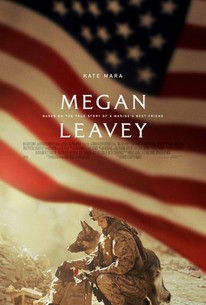
NOW SHOWING: Megan Leavey (2017)


“Megan Leavey” is this summer’s feel-good war dog movie.  In a summer full of super heroes, we have here a real hero.  And heroine.  The movie is “’based on a true story” about a Marine Corporal and her Military Police K9 dog.  It was directed by Gabrilla Cowperthwaite.  It took four screenwriters to finish the script which is never a good sign.  However, that is not likely to discourage the viewing public.

The movie opens in New York state in 2001.  Megan Leavey (Kate Mara) is living a dead-end life after the death of her best friend.  Her family life is a mess and then one day she gets a wild hair and joins the Marines.  It’s off to Parris Island for a short training montage.  A graduation celebratory pee in the bushes gets the PFC put on a **** detail which is literal because she has to clean out the kennels of the K9 unit.  There she meets a dog named Rex who is not looking to make any friends.  As in most cinematic romances, you just know these two will get together.  Thankfully the movie eschews the lover’s triangle.  Before you know it, the duo is off to Iraq.  After a couple of routine missions to establish the resumé of a military working dog, Meagan and Rex reach their epiphany by way of an IED.  Is this the end of a great friendship?

I wanted to like “Megan Leavey”.  I love war movies and I love dogs, so it seemed like a natural fit for me.  And I am not saying I disliked it.  It is a nice little movie and deserves to do well at the box office.  My problem is that it has an unsatisfactory feel to it.  The word that comes to mind is “shallow”.  Although it clocks in at almost two hours, parts of it seem cursory.  Even the montages are truncated.  Megan develops a reputation as a problem with no evidence presented.  Megan bonds with Rex with little difficulty.  Training is barely touched on.  The divorced parents pop up to assure us that Megan is better off risking her life in Iraq than being around them.  In Iraq, we get only brief tastes of the hazardous duties of Megan and Rex.  The movie has some giant time jumps that give the false impression that war for a bomb-sniffing dog team is long stretches between cinematic-worthy suspense.  To tell you the truth, the movie does not make a strong case for Megan and/or Rex being a hero.   The movie throws in a romantic interest for Megan which is perfunctory.  I could best describe the movie as the Cliff’s Notes version of the story.

I’m not trying to be the grinch who stole your feel-good movie of the summer.  The movie is nicely made with decent acting.  Obviously,  Kate Mara is solid and the unidentified dog actor is fine.  Does it make sense to say they lacked chemistry?  Rex usually appears less than thrilled to see her.  Probably that soldier thing where they don’t want to get too invested in a friendship.  The cast is fine, but wastes three as the father, mother, and stepfather (Bradley Whitford, Edie Falco, and Will Patton).  More time with the dog and less with the glum-inflictors would have been a good decision.  The dialogue does not stand out and there are no memorable lines.  However, the movie is not schmaltzy and does not jerk tears.  It certainly had the potential to require tissues if it had carried the “true story” to its completion (see below).   While I am not a big fan of tearjerkers, this movie would have been better if it stuck to the true story better.  Or fleshed out what it decided to cover.

Take a break from the usual bombastic summer fare and you’ll leave the theater feeling good.  Just don’t expect an Academy Award nominations.  And don’t go home and shame your dog.  

GRADE  =  C

HISTORICAL ACCURACY: Megan Leavey did not escape a dead-end life by joining the Marines.  She was not depressed over the loss of her best friend.  In fact, she was in college when she was inspired by 9/11 to serve her country.  She was not punished by being sent to the K9 unit.  She volunteered for the Military Police and was assigned Rex.  He was not a problem dog.  He had already been to Iraq with his original handler.  Sgt. Mike Dowling took Rex to Iraq in the first deployment of military dogs since the Vietnam War.  He later wrote a well-received book entitled Sergeant Rex:  The Unbreakable Bond Between a Marine and his Military Working Dog.  The book chronicles their adventures In Iraq and covers how Dowding helped Rex overcome his fear of explosions and gunfire.  (Although Dowling has publicly expressed his support for the movie, I have to wonder about his feelings about being written out of it.)   I am unclear how Leavey became the dog’s handler, but she must have taken over in Iraq.  They did not meet when Leavey was training to be a dog handler.  The two spent two tours together.  First in Fallujah in 2005 and the second in Ramadi in 2006.  The IED incident occurred during the second tour.  The movie accurate depicts it.  Leavey and Rex both took about a year to recover.  Leavey decided not to reenlist and wanted to adopt Rex at this point, but the Marines logically turned her down because Rex had recovered to the point where he could resume his duties.  The adoption was not foiled by a bitchy veterinarian as shown in the movie.  Several years passed (much longer than the movie implies) and Rex developed a facial palsy that ended his working career.  It was at this point that Leavey reinitiated her adoption attempts.  She did contact Sen. Schumer from New York, although not personally as shown in the movie.  The Senator did facilitate the reunion.  Leavey and Rex made the national news and were honored at Yankee Stadium.  Unfortunately, they had only a few months together before Rex passed away in 2012.  Now you can break out those hankies.

I think most would agree that the movie would have been better if it had adhered to the real story.  Remove the lame plotting about Leavey escaping her crappy family and substitute her having to take over a dog that was already bonded to a male handler.  I think that cinematic dynamic would have worked better.  And add more from the one hundred plus missions the trio did in Iraq.  Close with the big finish of Rex dying.  Not a dry eye in the house.


Thursday, June 8, 2017

#16 - Picture, Quote, Movie


"Vodka is a luxury we have. Caviar is a luxury we have. Time is not."


What movie?  It was released in 1964 at the height of the Cold War. The director was the esteemed Stanley Kubrick using a screenplay adapting the thriller Red Alert . The movie was originally meant to be serious, but Kubrick transformed it into a black comedy. The U.S. Air Force did not cooperate with the production because of the screenplay.

Saturday, June 3, 2017

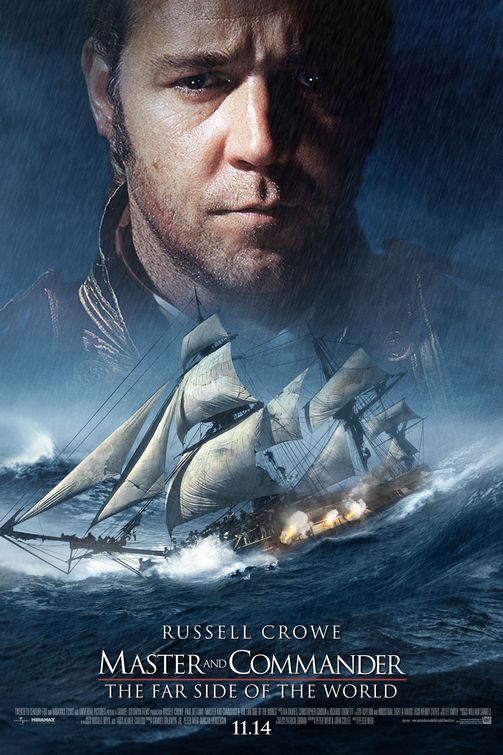
Master and Commander (2003)


                Someone finally had the nerve to try to bring Patrick O’Brian to the screen.  For you non-literary types, O’Brian was an acclaimed writer of nautical fiction.  He wrote a series of novels set in the Napoleonic Wars.  The main characters were a British captain named Jack Aubrey and a ship’s doctor/espionage agent named Stephen Maturin.  They are best friends although of very different personalities.  In the novels, their relationship takes precedence over traditional plotting.  O’Brian had a way with words that resulted in a legion of fans.  I am not among them.  This is surprising because I am a big fan of Napoleonic naval warfare fiction.  I love the Horatio Hornblower series, for instance.  I have never been able to get into O’Brian, although I have read the first book.  I guess I just prefer traditional plotting.  And more ship-to-ship combat.  Peter Weir (“Gallipoli”) took on the task of adapting O’Brian.  He wisely decided to start in the middle of the series with book 10 – “The Far Side of the World”.  He also wisely decided to stick to a traditional narrative structure. 

                The effort that went into the film is truly incredible.  Weir was able to convince the studios to invest $150 million in a movie that had a sketchy market.  In the cinematic world of “Fast and Furious”, who wanted to see a movie about fighting frigates?  Thankfully, enough to make a profit, but not enough to warrant a sequel.  Much of the cost went into Weir’s obsession with making the movie as perfect a depiction of Napoleonic naval warfare as possible.  Weir bought a replica ship called the “Rose” for $1.5 million and then had extensive changes made to it to portray the HMS Surprise.  It was used for the sailing scenes.  A full scale model on a gimbal in a giant water tank (the same one used for “Titanic”) was also used in the filming.  27 miles of rope were on the model.  The costume department made 1,900 pairs of shoes, over 2,000 costumes, and around 2,000 hats.  The prop department was fixated with getting even the tiniest details accurate, including items that would not even make it onto film.  The efforts paid off as the movie was rewarded with ten Academy Award nominations including Best Picture and Best Director.  It won for Best Cinematography and Best Sound Editing.

                “April, 1805, Napoleon is master of Europe and only the British fleet stands before him – oceans are now battlefields.”  The HMS Surprise is cruising off the coast of Brazil.  It is a 28-gun frigate commanded by Capt. Jack Aubrey (Russell Crowe).  His crew of 197 call him “Lucky Jack” because he has always brought them success.  His mission is to intercept a French privateer named the Acheron which has been raiding British commerce.  The French frigate is American-made and has 44 guns.  In naval combat, it was all about the number of guns and America made some very stout warships.  For this reason, the Surprise is the underdog.  It doesn’t help that in their first encounter the Acheron surprises its hunter and kicks its butt.  This battle takes place within the first ten minutes of the movie.  So much for developing the Aubrey/Maturin relationship.  Weir will let us figure it out as we go along.  One thing we learn early about Aubrey is he is not the type to give up after an ass-whipping.  Instead of returning to port for repairs, they will continue pursuit and repair themselves along the way.  As far as Maturin (Paul Bettany), we learn that he is a way better doctor than you would expect on a warship. (In other words, he is not a drunken hack.)  He is also a man of the Enlightenment and not enamored with the ways of the Royal Navy.  This is the key difference between him and his warrior best friend.  The only thing they really have in common is love of music.  Aubrey plays the violin and Maturin plays the cello.

                The movie is not just a buddy film.  It also has a touch of the chase film in it.  You know the chase is going to end in a show-stopping duel, but to get to that scene we get some entertaining subplots.  The Surprise survives a horrific storm, although not every character survives.  Midshipman Hollum (Lee Ingleby) gets a reputation as a Jonah (the naval equivalent of a jinx) and this has to be resolved to continue the voyage.  Maturin has to operate on himself after an accident on board.  The operation takes place on the Galapagos Islands!  Join the Royal Navy (or get impressed into it) and see the world.  And kill people.  That last is a reference to the climactic battle which is well worth the wait.

                The attention to detail in “Master and Commander” is astounding.  This is one movie that I have to single out the suits for allowing Weir to make the movie his way.  I would guess the movie could have been made for $50 million less and still have been good.  And much of this effort was to impress the rather small community of Napoleonic naval warfare nuts.  It is a shame that the average viewer did not have a clue what went into making the film.  Unless you did research, you would not have known that the movie used a replica, a full-scale model in a tank, and a smaller model.  We just assume CGI these days.  I defy you to tell which is which in the movie.  The sets are authentic to the time period.  The verisimilitude is noteworthy.  This is especially true for below decks.  (With one caveat, the ceilings were a lofty five feet, which was higher than on an actual frigate.)

                The cast bought into Weir’s vision.  They went through a two-week boot camp that included gun training, swordsmanship, and practice in working the ship.  That included going up the rigging.  The speaking roles were given to mostly British stage actors that Americans would not recognize, but they are uniformly excellent.  (Weir’s decision to confine the movie to the ship resulted in no speaking roles for women.  This is the rare nautical film with no romance.) The script gives fair treatment to the tars as well as the officers.  Several characters get to shine, including two of the young midshipmen.  Special mention must be made of the extras.  The casting director combed the world for faces that would reflect the cosmopolitan nature of a British crew.  They knew their roles as crewmen of a frigate and they knew their actions on the peripheries of scenes would enhance instead of detract from the authenticity of the movie.  With this said, clearly the movie depends on the performances of the two leads. 


                Crowe was the perfect choice for Aubrey.  He has the commanding presence of a captain.  Aubrey is one of the great characters of literature and Crowe is up to it.  (By the way, he does not look like the literary Lucky Jack.) I learned new respect for Crowe when I discovered he learned how to play the violin for his role.  He has the physicality for the action scenes.  Bettany is a match.  Maturin is the more intriguing character as he is unique on board the ship.  The man of science amongst the military men.  The scenes in the officer’s mess are great for the banter of seamen, but also because Maturin squirms and sometimes makes cynical remarks about the military ethos.  A subplot involves Aubrey and Maturin’s disagreement about the dictatorial nature of a captain’s power.  The movie does take the time to provoke some thinking.  As in the tradition of cinematic captains, is Aubrey too reckless?  Bettany shines and gets some show-stopping scenes like when he traverses one of the Galapagos Island searching for specimens.  (The movie was the first non-documentary to be allowed to film there.)  He takes acting honors with his self-surgery for a bullet wound.  (A scene that appears in the novel “HMS Surprise”.) 

                “Master and Commander” closes with one of the great combat scenes in war movie history.  It is almost seven minutes of total mayhem.  The exchange of cannonballs is followed by a boarding that results in a melee.  The choreography must have taken weeks.  It’s all very believable and graphic.  This is followed by a twisty ending that left fans expecting a sequel which has sadly not materialized.

                Will “Master and Commander” crack my 100 Best War Movies list?  After reading this review, what do you think?  It is certainly the best movie for teaching details about Napoleonic naval warfare.  See below.

GRADE  =  A

Napoleonic Warfare Details from “Master and Commander”

1.       Cannons on Royal Navy ships had nicknames like “Jumping Billy” and “Sudden Death”
2.       They used a lead weight to measure fathoms and a rope with knots to measure the ship’s speed.
3.       “Beat to quarters” meant prepare for combat.
4.       Young boys called “powder monkeys” had the job of bringing powder bags to the cannons during battle.
5.       Before a battle, the captain’s valuables would be put In boats towed behind the ship.
6.       The “weather gauge” was important.  It meant your ship was upwind of its opponent.
7.       Corpses were stitched up in their hammocks for burial at sea.  The last stitch was put through the nose to be sure they were dead.
8.       Plates for food were square (as in “square meals”).
9.       Men kept their possessions in sea chests.
10.    Sailors saluted by touching their knuckles to their forehead.
11.    Sailors were given a ration of “grog” which was a mixture of rum and water.
12.    Some of the sailors were “impressed” which means they were forcibly enrolled into the service or tricked into it.
13.    “Boarding pikes” were used by boarding parties.
14.    Capt. Aubrey inspires his crew by saying “For England, for home, and for the prize”.  “The prize” is a reference to capturing an enemy ship which when returned to England would result in the crew sharing in “prize money”.
15.    Boarding parties used grenades. 
16.    One of the boarders carries a Nock gun which is a multi-barreled flintlock smoothbore with one hell of a kick.
17.    A surrendering captain would offer his sword.
18.    A “prize crew” consisting of one of the officers and a few of the men would sail the captured ship back to a friendly port.

19.    Sailors could be badly wounded or even killed by splinters created by cannon balls hitting the wooden ships.

Thursday, June 1, 2017

#15 - Picture, Quote, Movie


QUOTE:  "Very pretty.....but can they fight?"

WHAT MOVIE?  It is a political thriller released in 1962 during the Cuban Missile Crisis which is appropriate because it taps into the Red Scare hysteria of that time. It is based on a novel by Richard Condon and is faithful to the book. It was directed by John Frankenheimer and showcases his style of unusual camera angles and symbolism (notice all the images of Lincoln). The movie was supposedly taken out of circulation because of its proximity to the Kennedy assassination. There is also the possibility that Oswald saw the film and was inspired by it.