Saturday, January 4, 2014

Day 11 - Heartbreak Ridge (1986)


On the eleventh day of Christmas, my true love gave to me – eleven gyrenes a reconning
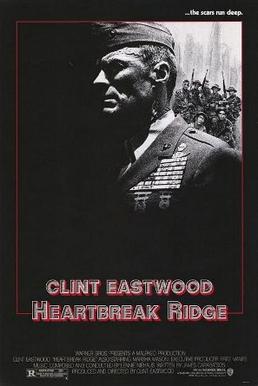


                “Heartbreak Ridge” is named after an actual battle in the Korean War, but it has nothing to do with that battle, unfortunately.  It was released in 1986 and was directed and produced by Clint Eastwood.  Part of it was filmed on the island of Grenada.  Eastwood got limited Pentagon support due to the fact that the main character drank, was divorced, had a potty mouth, and used unorthodox training methods.  The Marine Corps disowned the film because of the language.  The movie was nominated for an Oscar for Sound (I’m assuming that was not for the sound of the words coming out of the men’s mouths).  It was a big hit and critics were kind.

                We meet Gunny Highway (Eastwood) in a jail cell telling war stories.  He’s a warrior without a war.  He soon meets Stitch Jones (Mario Peebles) who is a lover who is not interested in war.  Surprise, he is in the platoon that Highway has been assigned to shape up.  The heterogeneous unit (black playa, two Hispanics, Italian paisano, hick, he-man, etc.) is in need of discipline and motivation.  They remind of the men in “Stripes”, except this movie is not supposed to be a comedy.  (Shockingly, “Stripes” came out five years earlier and thus is not the parody of this movie that you would assume.)   Highway’s commanding officer Maj. Powers (Everett McGill) takes an instant dislike to Highway (completely disregarding the fact that the gunny is a Medal of Honor recipient).  Powers is an ambitious asshole Annapolis grad who considers Highway to be a dinosaur.  “This is the new Marine Corps and you are an anachronism – old timer.”  Theme established:  old versus new, veteran versus greenie-weinie.

                Highway puts the platoon through some tough physical training.  There is a running gag that involves Highway forcing the men to work out shirtless.  Hilarious (not) and WTF.  What do these men do in training?  Rappelling, obstacle course, live fire, and the shooting range.  Highway handles the mutiny of his wussies by beating he-man.  R-E-S-P-E-C-T is inevitable.  Meanwhile, Highway is trying to rekindle with his wife Aggie (Marsha Mason).  It’s a rocky road but you don’t need a map to tell where it’s going.

                Highway continues to butt heads with Powers who uses the Recon Platoon to make his platoon look elite.  This leads to a melee between the two units culminating in a tie-breaker bout between Highway and Powers.  Bonding complete, now all they need is a war to consummate. 

                The Recon Platoon is sent to Grenada to liberate the Medical School.  On the way they use a bulldozer to take a bridge.  Later, they have a “last stand” against the vaunted Cuban army.  One guy has to die so the movie can claim realism.  (This is the kind of movie where even one death in the unit is a surprise.)  They use a phone and credit card to call in air support.  Powers calls Highway’s pushing forward disobedience.  Highway calls it initiative.  What will the general call it?  The men return to an anti-Vietnam War welcome.  Guess who’s waiting for Highway?

                Have you ever re-watched a movie that you were not impressed with as a teenager and found you were wrong about it?  This is not one of those times.  I invariably find that my first impressions are correct in cases like this.  If I did not like a war movie when I was a naïve teenager, it’s unlikely to gain respect now that I analyze them critically.  “Heartbreak Ridge” is a terrible movie.  Even Grenada deserved better.  The acting is poor, other than Eastwood, and even he is not at the top of his game.  He sways between gruffly  growling and petulantly pining.  Peebles is aggravating as the rocker wannabe and Powers needs a mustache to twirl.  The ensemble mugs its way through the film.  Speaking of which, in the combat scenes they look like actors playing soldier.  There obviously was no boot camp for this group.  Maybe that’s why there is a lack of action in the movie.  You sit through almost two hours just to get to Grenada, for Christ’s sake.   

                The dialogue is a weakness.  Although the screenplay was by a Vietnam veteran, the words he puts in the soldiers’ mouths do not ring true.  Many of the lines are smack talk aimed at fourteen year old boys.  A good drinking game would be to take a drink every time you feel the urge to say “oh, snap!”  The writer appears to have bought a copy of “101 Great Military Insults” and attempted to cram all of them into the script.  Here are a few of my favorite lines:

                Highway:  “I eat concertina wire and piss napalm and I can put a round in a flea’s ass at 200 meters.”
                Choozoo:  “If your brain was half as smart as your mouth, skunk stool, you’d be a frickin’ twenty star general by now.”
                Highway:  “You pump the neighbor’s dog again, Jakes?   Or are you always slack-jawed and silly in the afternoon?”
                Highway:  “Why don't I bend you over the table there... send you home with the "I just pumped the neighbor's cat" look on your face.”
                 Highway:  “If you pull another shithead stunt like that again, the only thing that'll beat you to the brig is the headlights on the ambulance you'll be riding in.  

And by the way, much of the dialogue is homophobic in a cringe-inducing way.  Highway nicknames the Italian “Fag –eddi”.  There’s a lot of high school locker room humor in the film.

                The movie is full of clichés.  The warrior who is out of place in peacetime.  The clash of generations.  Molding recalcitrant charges into a lean mean fighting machine.  The incompetent glory-hound standing in the way of the pure warrior.  Military life trumps home life.

                Surprisingly, the movie is fairly accurate for a film that makes no claim to be based on a true story.  There was a Heartbreak Ridge which was a typical Korean War hill assault with frontal tactics that resulted in high casualties and the acquisition of some worthless real estate after attacks and counterattacks by stubborn commanders.  Similar to Pork Chop Hill.  Three real incidents from Grenada are portrayed in the movie.  The use of the bulldozer was based on an action taken by future head of Central Command, Capt. John Abizaid.  The Medical School was liberated as depicted, but by Army Rangers.  The phone call for air support was a famous anecdote from the conflict and was the incident that inspired the screenwriter to develop the script.

                Christmas gift?  No, you shit-bird, queer-bait, maggot.

Grade =  D   

Friday, January 3, 2014

Day 10 - The Cockleshell Heroes (1955)


On the tenth day of Christmas, my true love gave to me – ten cockleshell heroes a kayaking
 

                “The Cockleshell Heroes” is the story of Operation Frankton from WWII.  The operation was a famous British commando raid on the port of Bordeaux in 1942.  The canoes the Royal Marines used were codenamed “cockles” to attempt to place mines on ships in the port.  The film fits comfortably into the suicide mission subgenre.  In fact, the mission is borderline insane and yet based on an  actual mission.  You have to admire those British balls.  It was directed by Jose Ferrer, who also stars in it.  He walked out on the film when the producer added some humor to the script.  The movie was a box office success and is considered a classic.

                Maj. Stringer (Ferrer) has a plan for an audacious raid on blockade runners at Bordeaux.   He is a “team coach” and does not think the men need any of that silly hard-core training.  Being a civilian in wolf's clothing, he has this quaint belief in democracy. His exec Capt. Thompson (Trevor Howard) is old school and their relationship is awkward.  Thompson does not like temporary warriors who are glory-hounds.  When the first practice mission is a flop, Stringer surprisingly agrees that Thompson was right and initiates a standard war movie training program that culminates with the obligatory bonding through brawling scene in a pub with some sailors.

                They are transported to the French coast by submarine so why not throw in a depth charge scene?  They are not in any real danger since the German depth charges explode on contact with the water.  It does afford the opportunity for one of the men to get a concussion so the desk-bound Thompson can go on the mission.  They launch in broad daylight.  10 men in 5 cockles.  One of the canoes flounders and the crew are captured.  And now there are eight.  The Germans give them a questionnaire to fill out.  Damned Nazis!  The remaining eight hide during the day, but leave before dark.  (The lighting budget must not have been enough.)  Since it is so light, one of the canoes is spotted and a sentry shoots a rower and his partner blows up the fake patrol boat.  The crew of the third boat are caught, but blow up their pursuers to allow the rest to proceed.  Sacrifice – a suicide mission staple.  The last two canoes complete the mission in broad daylight.  Only Stringer and his mate make it to Spain.  The four captives are executed by firing squad.

                The film is fairly accurate.  It gets the basics right and does a service to the participants.  However, it does jazz up the tale quite a bit.  Stringer is based on Maj. Hasler who led the mission and served as a technical advisor.  His exec Capt. Stewart did not go on the mission and I will assume (until I do my History or Hollywood research) that there was no personality and philosophy clash.  The mission was not as exciting or suspenseful as the film, of course.  There was no submarine episode.  No Germans were killed by the intrepid Marines, so the patrol boat and pursuer scenes were faux.  The planting of the mines was not as fraught with peril and did not have the explosive payoff the movie implies.  In reality, several ships were damaged, but none seriously and the raid was not a game changer.  The executions of the captives is true, although not timed with the explosions.

                “The Cockleshell Heroes” is another cult movie that only cult members get.  In my opinion, it is nothing special.  In that respect, it reminds me of “The Devil’s Brigade”.  Frankly, it lacks suspense and character development.  Stringer and Thompson are developed, but the rest of the squad is cursorily handled.  You get the class clown, the cuckolded husband, and the gruff trainer.  Each has his moments, but we don’t really care about them.  The acting is below average although Howard dominates his screen time (which apparently was expanded by the producer who felt Ferrer was hogging the camera).  There is no scene chewing, thankfully.  More distressingly, there is little action and what there is is poorly staged.  And don’t accuse me of being a hypocrite – if you are going to jazz up the historical fiction, make it entertaining!  I feel a documentary would be more entertaining.

                Speaking of entertainment, one reason Ferrer was incensed with the rewrite was because humor was forced into the film.  That humor is blatantly low brow which may have gone over well with British audiences in 1955, but is definitely dated now.  There is also a sing-along that is barf-worthy.  The movie is ridden with clichés.  You even get the redemption arc with Thompson getting to overcome his career-stunting false accusation of cowardice in WWI.  The interservice pub brawl (which is a bit rare for a British movie) is another example.   Another trope is the defiant captives (who scrawl “Rule Brittania!” and “Drop dead!” on their questionnaires).  At least the command clash does have a welcome twist to it.

                Christmas stocking stuffer?  I know I’m going to get lumps of coal from all its fans, but this movie is not very good.  Hey, I like “The Secret Invasion” so I get the guilty pleasure vibe.  This movie just did not float my cockle.

Grade =  C-
P.S.  Check out the babe in the poster.  In truth, this movie has no prominent female roles.

Thursday, January 2, 2014

Day 9 - The Fighting Seabees (1944)


On the ninth day of Christmas, my true love gave to me – nine Seabees a constructing 


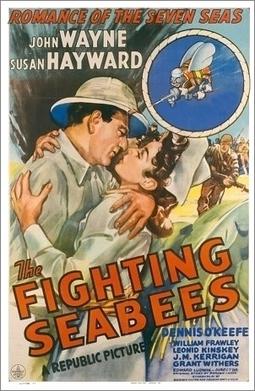
                “The Fighting Seabees” was a WWII flag-waver that fired up audiences in 1944.  It was directed by Edward Ludwig, but who cares since it stars John Wayne.  The film is dedicated to the Civil Engineer Corps and the Construction Battalions (CBs = Seabees) which “fired the imagination of the world with their colorful exploits throughout the Seven Seas.”  If you are hoping for a history lesson to go along with the lauding, forget it because the movie is highly fictionalized.

                Wayne plays Wedge (awesome name!) Donovan who owns a construction company that has been doing airfield building in the Pacific.  He is very upset with the fact that the Navy did not allow him to arm his men and they had several killed recently.  The Navy liaison Lt. Commander Yarrow (Dennis O’Keefe) tries to explain the reason for this sensible rule, but Donovan argues that if you can work construction you can kill “Tojo and his bug-eyed monkeys”.  He also throws in this classic line:  “If you can drink, you can fight.”  Love triangle alert:  Donovan takes an interest in Yarrow’s girl Connie (Susan Hayward).  She’s a journalist which gives the movie an excuse to have her follow Donovan to tropic islands.

                Donovan gets a new airstrip job on Island X-14.  They go without needing “no stinking training.”  When a Japanese force invades the island (using apparently stolen Higgins boats), Donovan mother-hens his men and Connie into a shelter but when strafing kills three idiots standing around outside, the gloves are off and the guns are out.  The Seabees come storming onto the battlefield like a mob of pissed off hillbillies and foul up a planned kick-ass ambush by Yarrow.  To make matters worse, the abandoned but curious Connie gets wounded.  The combination of dead men and wounded starlet leaves Wedge contrite and willing to do it the Navy way.  He is made a Lt. Commander because he is John Wayne.

                Recruitment and training montage complete with the “Song of the Seabees”.  More romance as Yarrow gradually realizes it’s hopeless to compete with a guy named Wedge (plus he’s John Wayne, for God’s sake).  The love triangle heads off to island number two.  The Seabees encounter sniper problems which culminate in the death of Eddie Powers (William Frawley of “Lucy” fame) while singing an Irish song.  It’s on now!  Donovan disobeys orders and takes almost his entire battalion into the jungle to sniper-hunt.  Wouldn’t you know the scheming little monkeys choose this moment to attack the lightly defended airstrip.  Yarrow is wounded in the defense, but Donovan leads a counterattack that does not dissuade Yarrow from threatening him with court-martial for disobeying orders.  Wedge doesn’t seem too concerned because he’s read the script.  He knows there’s no court or courting in his future.  But there is a fiery bulldozer ride.

                I am a big John Wayne fan (men of my generation are required by law), but I had never seen this movie partly because I figured constructing airfields would be boring to watch.  I was wrong about that as this movie has more action than most war movies.  It’s Old School with touchdown signaling deaths and no blood, but still fun to watch.  You get to see a Japanese sniper in a tree killed by a grenade and another grabbed by a clamshell bucket (previously only seen in the play-rooms of toddlers).  Just suspend reality.  The movie keeps the fourteen year old boys happy and the construction scenes with all the heavy machinery keep the four year old boys happy as well.  Some of the kudos for action are cancelled by the romance, unfortunately.  Too much mushy.  However, it is a bit unconventional as O’Keefe does not put up much of a fight and Donovan does not want to poach so you wonder who will be saddled with this vivacious, sexy, intelligent dame.  The movie solves the dilemma in a predictable way.

                The acting is fine.  Wayne plays Wayne, of course.  We do get to see him do the jitterbug, so he does stretch a bit.  Susan Hayward is one of his better leading ladies and holds her own in a sassy way.  O’Keefe is a bit stiff, but it’s a thankless role.  The ensemble of hard-hats is fine with some recognizable character actors like Frawley and Paul Fix (the Marshall in “Rifleman”).  The dialogue of the crew is pretty witty.  Unfortunately, other than the big three, there is little character development other than they are all alcoholics and brawlers.  The music alternates between rousing and sappy romance.  This is the kind of movie where the men sing a song.  When is the last time a war movie had that?

                The biggest problem with the film is it is laughable historically speaking.  The Construction Battalions were created in WWII and recruited from civilian construction workers (the average age was 37), but they went through extensive training from the beginning and there was no controversy about arming the men.  In fact, the slogan of the Seabees was “We build, we fight.”  They were often under fire and had to fight on Pacific Islands.  They deserved the movie and probably did not complain too much about the implausibilities.

                Christmas gift?  Gifts –  a toy gun and a Tonka truck.

Grade =  C

Wednesday, January 1, 2014

Day 8 - Bravo Two Zero (1999)


  On the eighth day of Christmas, my true love gave to me – eight commandoes a scud-hunting

                “Bravo Two Zero” is the true story of an ill-fated SAS (British special forces) mission during the Persian Gulf War.  It was a BBC production and was based on the book by one of the members of the squad who wrote under the pseudonym Andy McNab.  The movie fits clearly into the lost patrol subgenre and the “who will survive?” scenario.

                The film begins with a cursory introduction to the men as they go off to war.  Andy (Sean Bean) speaks for all of them when he says:  “Every soldier hopes for a major war in his lifetime.”  They are elite soldiers, but have that good ole boys vibe.  This means they party hard, prank each other, and love their mates more than their mates.  Their mission is to be dropped behind Iraqi lines to disrupt the MSR (main supply route) and hunt Scuds.  Piece of cake, right?  Wrong.  First, radio problems create foreboding.  Second, they are discovered by a patriotic shepherd boy and the trek is on.  They are chased by an Iraqi unit that includes armored personnel carriers.  The ensuing firefight proves that eight British commandoes can handle ten times their number in Iraqis (with no losses to the good guys).    Hell, they even counterattack to force the enemy to run!   A decision is made to head for the Syrian border.

                During a sand storm, three of the unit get separated from the other five.  McNab’s five hijack a taxi in a ridiculous move that just happens to be based on the truth, so there.  The funniest moment in the film occurs in the cab as Dinger (Steve Nicolson) interprets an Iraqi song playing on the radio:  “My husband has breath like a goat / His penis is small and covered with black heads / Nowadays I sleep with the goats / They have much bigger penises and are twice as intelligent.”  This is typical of the humor found in the film.  I personally found the movie to be effectively humorous and true to the crude humor of soldiers.  When the taxi reaches a checkpoint, we get another fire-fight with no losses.  That is about to change, unfortunately. The five’s next obstacle is an enemy camp adjacent to a bridge.  Complications ensue resulting in us following only Andy.  He is sniffing the border when he is captured.  The last third of the film deals with his interrogation/torture by the Nazis, I mean Iraqis.  The questioning is brutal because he is suspected of being a demon, I mean Israeli.  Will he crack?

                I watched this movie thinking I was getting the straight dope (or as close as a war movie can dish it) about a famous military incident.  An incident that the British public is apparently well-appraised of.  Well, it turns out this is just one version of what happened because the McNab book was just the first telling of the story.  Two other members of the squad wrote conflicting accounts and then a reporter weighed in with the “true story”.  Now I’m confused.  It does seem likely that McNab “enhanced” his story almost as though he was writing a screenplay for a war movie “based on a true story”.

                As entertainment, the movie is pretty good for a made for TV production.  The acting is good by the ensemble with Sean Bean being his usual dependable self.  The other guys are appealing and the camaraderie is sincere.  They behave and talk like soldiers.  In fact, the soldier talk is so slang intensive that you have to be familiar with British military slang to understand a lot of it.  To make matters worse for your average American viewer, the accents are quite thick.  The action is good with realistic small unit tactics.  They use covering fire and advance in sections, for instance.  The movie is accurate in how many of the eight survived, but quite possibly exaggerated the expendable nature of the enemy soldiers.  This is fine for the action lovers.  There are plenty of Iraqi deaths to not feel guilty about.  Speaking of which, the movie actually has a sympathetic Iraqi character in the form of a general who chases the unit and then shows his respect with some green hard candies (a running gag – in a war movie!)

                Christmas present?  It’s jolly good, chap.  I enjoyed it, but then I’m not neutral because it has Sean Bean in it.  I have a bromance for him.  Thus I can understand why his men would follow McNab into an Iraqi desert.
Grade =  B