Friday, June 14, 2013

DUELING MOVIES: None But the Brave vs. Hell in the Pacific


VS.


                There are two war movies that posit Americans and Japanese being thrust together on islands in the Pacific in WWII.  “None But the Brave” (1965) brings together two platoons and “Hell in the Pacific” involves two men.  Both movies focus on the clash of cultures and the difficulties of peaceful coexistence between enemies that do not understand each other.  Which is stronger:  the urge for survival or the hatred and fear of someone different than you?
                “None But the Brave” was a vanity project of Frank Sinatra.  He produced the film and it was the only movie he directed.  Thankfully, he did not write it as well.  It is set on one of the Solomon Islands.  The movie is narrated by the Japanese commander of a cut-off unit.  Kuroki (Taysuya Yamihashi) is a warrior/pacifist who is humane, but has a martinet second in command (representing all the other Japanese officers in WWII films).  They are building a boat to get off the island when an American unit arrives via a shot down C-47 (in a painfully poor special effect).  The Americans are heterogeneously clichéd.  The Air Force Capt. Bourke (Clint Walker) takes command due to rank.  The Marine Lt. Blair (Tommy Sands) is green, but gung-ho.  There is a cigar-chomping, jerk of a sergeant (Brad Dexter).  Sinatra plays the boozing, wise-cracking Chief Pharmacist Mate. 
                The movie revolves around two sets of conflicts.  The conflict between the two forces and disagreements between the commanders and their subordinates.    The conflict within the units is basically because Bourke and Kuroki want to avoid bloodshed and their seconds want to carry on the war.  The hot heads win out so we can have some action.   The boat gets blown up, forcing them to realize they are all stuck.  There are mutual acts of humaneness like Sinatra amputating the leg of a wounded Japanese.  Later, Kuroki saves the LTs life.  A storm forces them to work together to save the well.  Hey, this just might work…  Unfortunately, when an American rescue ship looms on the horizon, the Japanese ambush the evacuating Americans even though they had promised not to reveal the presence of the Japanese on the island .  This leads to the climatic fire-fight which results in the film's “nobody ever wins” conclusion.
                “Hell in the Pacific” was directed by John Boorman and was released three years later.  Toshiro Mifune is stranded alone on an island (the movie was filmed on one of the Palau Islands) when Lee Marvin crash lands.  Their hatred and distrust are palpable from the beginning.  There are a series of back and forth incidents involving fresh water and fish.  They are not willing to share and would rather destroy what the other has.  Each has the opportunity to kill the other, but backs off.  Eventually, they agree to coexist, but still clearly hate each other.  They build a raft, but disagree over construction.  Language is a barrier.  They leave and manage to overcome the rough surf.  Even through a montage of laying around on the raft, they still have little affection for each other.  They arrive at a new island and find a deserted Japanese camp.  Finally some camaraderie develops over the food and sake, but it is short-lived as each is reminded of the cultural gulf between them.
                Besides the obvious similarities in themes, the movies share the emphasis on the language barrier.  Both eschew subtitles for the Japanese to give the audience a feel for the confusion and misunderstandings of the two sides.  This is effective, but especially in the case of “None”, it can be more confusing than effective.  “None” is more interested in examining the differences in command and warrior ethos, whereas “Hell” is more personal.  Mifune and Marvin do not so much represent their nation’s attitudes as they represent two nut cases thrust together.  Mifune could just as easily have been a cantankerous German.
                “None” may have a better template, but it is the inferior film.  It is poorly acted with absolutely horrendous dialogue.     At one point, Bourke tells Kuroki “Aw shove it, and don’t forget to duck”.  WTF  Does this make sense to anyone?  The soldier talk is laughable (at least we don’t have to understand what the Japanese are saying).  The narration is sappy with ridiculous emphasis on pronunciation of the Rs and Ls.  It is also riven with clichés.  For example, the green, gung-ho lieutenant who gets his battle, but regrets it.  Sinatra hams it up, but surprisingly lets Walker lead.  The movie does have a good action scene in the battle over the boat and the portrayal of the Japanese enlisted is sympathetic.
                “Hell” is better, but could have been a hell of a lot better.  It is thought-provoking and well-acted (of course with Mifune and Marvin), but unrealistic.  For example, two guys in such terrible shape could not have survived the raft adventure.  Some of the vignettes are silly.  Marvin throws bullets into Mifune’s fire and they go off like a machine gun.  Later, he pees on the Japanese.  Some of the interactions are a bit slap-stick.  The cinematography is good, but the score is bizarre.  It does avoid clichés as both of the men are dislikable and borderline insane.  You can’t root for either or both.  The ambiguous ending is off-putting, but appropriate.
                Both movies have the same pious anti-war message.  Each seduces us with the idea that enemies can coexist and learn to respect each other, but then pulls out the rug to hammer its “war is uncivilized” conclusion.  The duel is between the ridiculous and the unrealistic.  Go with the unrealistic because it has two great actors chewing the scenery instead of a bunch of bad actors playing army men.
None But the Brave = D-
Hell in the Pacific = C


Tuesday, June 11, 2013

SHOULD I READ IT? Ivan's Childhood (1962)


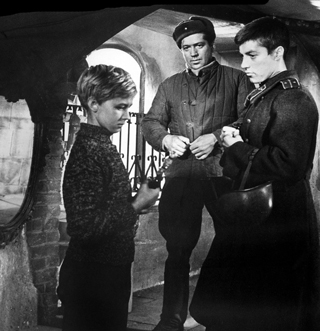
             “Ivan’s Childhood” was the first feature film of acclaimed Soviet director Andrei Tarkovsky who also helped write the screenplay based on a short story.  It was released in 1962 and was publically and critically acclaimed.  It won the Golden Lion award at the Venice Film Festival.  The movie is similar to “The Cranes Are Flying” and “Ballad of a Soldier” in depicting the horrors of war on the innocent.  It is the tale of twelve year old Ivan Bondarev (Nikolai Burlyayev) who was orphaned during the Great Patriotic War when his mother and sister were killed by the Germans.  It is set on the Eastern Front circa 1943.
Ivan, Kholin, and Galtsev
                Ivan arrives at a Red Army camp after crossing a bleak landscape and swimming a river.  He insists on making contact with headquarters which seems laughable to Lt. Galtsev (Evgeny Zharikov) until it turns out that Ivan is a valuable spy and scout.  Galtsev and Capt. Kholin (Valentin Zubkov) “adopt” the serious little warrior and he stays with them in their room.
                There is a subplot involving a medical assistant named Masha (Valentina Malyavina) and her messing with the dynamics of Galtsev and Kholin.  Kholin tries to put the moves on her and Galtsev is interested, but shy.  She manages to keep her hair nice which was a feat on the Eastern Front. Later, there is a record player in the room that plays a song about her.  WTF – yeah, it’s that kind of movie.
                Galtsev and Kholin want to save Ivan by sending him off to military school.  Ivan threatens to run away and join a partisan unit if they try.  He wants revenge for his family.  They back down and the trio cross the river in a boat to drop off Ivan for his next reconnoiter.  Galtsev and Kholin return with two Soviet corpses.  Masha arrives at the bunker to say goodbye.

                The movie jumps to Berlin with the Soviets celebrating.  There is actual footage of the Chancellery building and the corpses of the Goebbels family.  The audience is invited to ponder the contrast between the Goebbels kids and Ivan.  Galtsev roots around in documents and finds evidence about the fate of Ivan.  The movie flashes back to when Ivan was young and innocent.

                This is an artsy movie.  Not everyone will like it.  I was kind of torn by it.  The plot is not good and the nonlinear structure could be confusing.  There are lots of flashbacks and some of them are weird.  In fact, from the very beginning of the film you will know you are in for something unusual.  There is a dream sequence that is surreal.  Ivan is riding in the back of a truck with a girl in the rain.  The truck is full of apples.  Some of the apples spill out onto a beach.  Horses eat them.  Get it?  I didn’t.  Much of the film is cryptic or makes no sense.  The eerie music fits the mood of the film.

                The film is worth watching because of the cinematography by Vadim Yusov.  He uses his whole bag of tricks and the movie is a visual treat.  There are POV shots, hand-held, off center, odd angle.  Some scenes have action in front right and back left.  One really cool scene has characters each at a different level – foreground, middle, and background.  There are lots of distant shots.  The plot may be bizarre and unsatisfactory, but I was intrigued by the visuals.

                The acting is adequate.  Burlyayev does a good job in portraying Ivan as a boy who has been damaged by his experiences.  He has been twisted into a fanatical and cocky warrior.  War and the killing of your family can have that effect.  You don’t see any of Ivan’s revenge, however.  The movie has little action and none of it is graphic.  This is an intellectual movie aimed at intellectuals (and considering some of its biggest fans included Ingmar Bergman and Jean-Paul Sartre, mission accomplished!).

                Should you read it?  I think this review should make it clear whether it is a movie you might enjoy.  I’m glad I experienced it, but I have to say it is not in a league with “The Cranes Are Flying” or “Ballad of a Soldier”.

grade =  B-


Saturday, June 8, 2013

FORGOTTEN GEM? Overlord (1975)


                 Sometimes someone you deeply respect recommends a war movie that had never heard of.  In gratitude and out of respect, you find and watch the film.  Unfortunately, you sometimes find out that your comrade and you have differing opinions on said film.  But that’s what makes the world go round, right?
                “Overlord” is an obscure film by director Stuart Cooper released in 1975.  It is about a young British soldier named Beddows (Brian Stirner).  He has a premonition that the war will not end well for him and the movie takes us on his journey from boot camp to bullet.  Supposedly the boot camp scenes influenced Kubrick’s “Full Metal Jacket”.  If so it must have motivated Kubrick to not be lame.  In Beddows boot camp, screw-ups are not severely punished.  Must have been nice to be in the British Army back then.  However, Beddows is put in a cell because he falls down a hill trying to catch up with his squad.  Seems inconsistent, no?
                Beddows goes through assault training.  He meets a girl and shockingly she bares her breasts.  This is the kind of movie where after watching a half hour of it you would bet your life there will be no nudity.  Unfortunately, there would need to be an orgy to make up for the rest of the film.  It has the requisite camp montage – mess call, playing cards, etc.  Finally, it’s off to D-Day in an amazingly stable landing craft.  His premonition comes true as does my early vibe that this movie sucks.
                Cooper has been patted on the back for his copious use of archival footage from the Imperial War Museum.  The footage is pretty well blended although it is obvious when we are watching it.  As the movie went on I began to realize that a large amount of the footage was unrelated to the story!  I guess it’s because I have seen so many WWII documentaries.  Perhaps this faux pas does not bother the average viewer, but I found it embarrassingly sloppy.  Some of the footage is of American soldiers and much of it is from aircraft (even some gun camera footage of shoot downs).  I can only guess that Stirner chose clips that had similar quality regardless of the content.
                It is possible to make a good low budget war movie.  “84 Charle Mopic” is a great example of this.  However, most of the time low budget equates to bad.  An example would be “Everyman’s War”.  Heck, “Overlord” was so low budget half of the movie was free footage from a museum and the actors should have worked for minimum wage.  “Overlord” won the Special Jury Prize at the 25th Berlin International Film Festival.  WTF.
 
grade =  F
For an alternative review, go to All About War Movies
 

Thursday, June 6, 2013

BOOK / MOVIE: The Short Timers / Full Metal Jacket


         I recently reviewed “Full Metal Jacket” and then read the book it’s based on (again).  The movie is based on The Short Timers by Gustav Harford.  The book is amazing and is in some ways better than the movie.  I highly recommend it as a companion to the movie, especially since it carries the story beyond the movie. 
 
          I thought others might like to know how the movie differs from the book (especially because the book is hard to find) and what happens in the book after the events in the movie.  Spoiler alert from here.  The following are differences in the book and my judgment of whether the movie or book is better.

1.  Leonard (Pyle) is a skinny red neck.  Movie

2.  DI Gerheim is less imaginative in his verbal abuse, but Ermey did use many of his lines.  Gerheim uses a lot more physical abuse.  For example, Greheim almost drowns Pyle in a toilet that he had the squad leaders pee in.   Movie

3.  On graduation day, Pyle is given the outstanding recruit and marksmanship awards.  Movie

4.  Pyle is in his bunk when the climactic moment occurs.  He is not malevolent, just crazy.  He is in love with his rifle.  Gerheim does chew him a new one, but his last words are that he is proud of the killing machine he has created.  Movie

5.  Joker first reunites with Cowboy in a movie theater that is showing “The Green Berets”.  Here is where the Joker / Animal Mother hatred begins.  The dynamic between the two characters is more involved in the book.  Book

6.  The book spends more time on how the Marines manipulated the press coverage of the war.  The author, Gustav Hasford, was a Combat Correspondent.  Book

7.  The book has a scene where Joker and the other correspondents light some rats on fire in a game called “the rat race”.  The funeral is when they sing “Mickey Mouse”.  Book

8.  There is no defense of the entrance to the base.  Movie

9.  Animal Mother is more of a psychopath in the book.  He kills a platoon leader (Short Round) in a fragging incident.  Movie

10.  There are two sniper incidents in the book.  The movie mashes them up.  The first, set in Hue, involves a tank blasting buildings as the squad goes house to house looking for the sniper that killed T.H.E. Rock.  Although the book mentions that the sniper picks off a bunch of men that go after him.  This story is told to Joker, not featured in the book.  The sniper is a girl and Rafter Man does kill her with Joker finishing her off.  The action takes place on a roof-top.  Cowboy was wounded, but not killed.  Animal Mother cuts her head off and waves it around.  Movie

Here are some of the things that happen after the movie concludes.

1.  Rafter Man (he got the name from drunkenly falling from the rafters onto a general’s table during a show) is killed when he is run over by a tank on the road out of Hue.

2.  Joker gets busted to private because of his peace symbol and is assigned to the Lust Hog Squad which is at Khe Sanh.  Cowboy is still in command.  Cowboy has developed into an excellent leader.

3.  The squad is sent out on a long patrol.  During a rest break, Joker pulls a knife on Animal Mother.  Alice (black point man similar to Eight Ball in the movie) gets hit by a sniper in a similar situation to in the movie except it is set in the jungle.  The Doc goes to him and gets wounded.  The New Guy charges out and gets hit.  At this point, Cowboy puts Joker in command and orders him to pull back the squad.  Cowboy runs out to put the men out of their misery with his pistol and then Joker shoots him because the sniper prevents Cowboy from killing himself.  The squad pulls back. 


The sequel to "The Short Timers" is entitled "The Phantom Blooper".  It basically has three parts.

1.  Joker is at Khe Sanh and the siege is coming to an end.  He has become hardened and cynical.  He is in tight with the "bloods" who are heavily into dope and bucking authority.  There is rumor of an American who has switched sides and uses his M-79 against the Marines in the base - the Phantom Blooper.  Joker gets captured.

2.  Joker gets chummy with the Viet Cong holding him in a village.  He plans to escape, but meanwhile plays collaborator.  We get a heavy dose of Viet Cong culture.  He goes on a mission with them.  The village gets assaulted to rescue him and he fights against the Americans.  Joker is wounded and liberated.

3.  Returning home, Joker has trouble transitioning.  At the end he is planning to return to Vietnam.

This was supposed to be the second in a trilogy, but Hasford died.