Showing posts with label Stalingrad. Show all posts

Friday, December 9, 2022

LIFE AND FATE (television series)


                        “Life and Fate” is a Russian television series that is available on Amazon Prime.  It is based on the novel by Vasily Grossman.  Grossman, a Russian Jew, was a war correspondent during WWII.  He was an eyewitness to many battles, including Stalingrad.  The novel has been compared to “War and Peace”.  It is sprawling (871 pages) with many characters.  The novel was controversial because of its criticisms of the Stalinist system.  It equated Nazi totalitarianism with Soviet totalitarianism.   The KGB confiscated the manuscript and all his notes, but he had given copies to two friends and it was smuggled to the West where it was published in 1980.  (He had finished it in 1960.)  It was finally published in Russia in 1988 as part of Gorbachev’s glasnost policy. 

                        The series is twelve parts and does a good job covering the book.  The book has basically three threads:  a nuclear scientist and his work in the scientific community, Soviet soldiers in the Battle of Stalingrad, and life in the Nazi concentration camps and Soviet gulags.  The movie omits the concentration camp scenes.  The main character is Victor Shtrum who represents Grossman.  He is a nuclear physicist who is Jewish, but his brilliant theories cause his bosses to overlook that.  It’s his dedication to pure science over doctrinal science that gets him in trouble.  He is a pompous jerk, but a man of principle.  Most of the episodes jump back and forth between Shtrum, his family,  and science friends and the fighting men in Stalingrad.  Much of the Stalingrad scenes involve the defense of a house (probably based on Pavlov’s house).  The “house manager” is a rogue warrior named Grekov.  He butts heads with a commissar named Krymov.  Shtrum’s stepson is one of Grekov’s men.  There is a love triangle involving a pretty radio operator.  The house is surrounded by Germans and under constant attack.  Another main character is Novikov, who commands a tank battalion in the counteroffensive.  Both Krymov and Novikov will end up accused of being less than staunch Stalinists.  Their lack of guilt is a damning indictment of the military justice system.

                        I have recently been taking advantage of Amazon Prime’s stock of Russian war series.  Previously, I watched “The Dawns Here Are Quiet” and “Night Swallows”.  Those two evince the two extremes of quality in Russian TV productions.  “Life and Fate” is closer to “Dawns” and probably had a higher budget.  It looks like a lot of money and effort went into it.  This is especially true of the Stalingrad sets.  The rubble is impressive.  The action matches it as the combat scenes are exhilarating.  This is actually a weakness because when the series shifts from House 6/1 to the Shtrum’s family and friends, there is a let-down.  It is jarring to go from gritty war drama to soap opera.  Plus, Shtrum is not an appealing character.  (He was not meant to be.)  And the scientific discussions are dry.  There is a love affair involving Shtrum and the wife of his best friend, but it is tepid.  Midway through, Shtrum gets transferred back to Moscow and has conflicts with his doctrinaire bosses.  His thread becomes more interesting right around the time that House 6/1 falls and all the intriguing characters that make up Grekov’s unit leave the show.  The second half concentrates on politics as Shtrum, Krymov, and Novikov all run into problems with the authorities.  In the case of Krymov, this is dripping with irony as he is a hard-core communist.  Shtrum gets to stand up for his principles.  Novikov finds out that victory is trumped by stepping on apparatchik toes.

                        Having not read the doorstopper Russian novel, I can’t say how well the series mirrors the book.  It appears to tone down the anti-Stalinist theme.  In fact, Stalin comes riding to the rescue of Shtrum’s career at a moment when those pesky principles get him in trouble.  The movie is far from a comedy, but it is amusing to watch how the same people who were condemning Shtrum for his breakthrough theory being off the reservation suddenly become fawners when the phone call for the great leader becomes known.  It is equally ironic, but less amusing, to watch Krymov get tortured by his commissar peers. 

                        For war movie fans, the reason to watch is the sequences in Stalingrad.  The characters defending the house are intriguing and you care about their fates.  A miniseries based on Pavlov’s House would be great, thank you.   It is a microcosm of the battle and does an excellent job depicting the harshness of the combat and the living conditions.  You may not care what happens to some Soviet egg-heads, but you will care about what happens to the grunts.  The series pulls no punches.  It’s not combat porn, but it is visceral.  For instance, there is a scene where the Soviets bomb a German unit gathering for a ceremony.  The randomness of death is a focus of the series.

                        “Life and Fate” is not as good as “The Dawns Here Are Quiet”, but it is a cut above the usual Russian TV series.    It is an epic based on an epic.  The best thing about it is the next time you are invited to the Russian embassy for a formal dinner, you won’t have to read the book.  You can spend a lot less time and effort by watching the series and still hold an informed conversation about one of the most famous Russian novels of the 20th Century. Don’t just watch the combat scenes, you Neanderthal.

GRADE =  B-

Saturday, November 3, 2018

STALINGRAD (2013)


                I recently read the book Stalingrad: How the Red Army Triumphed by Michael K. Jones.  I have had an interest in the battle since I was a teenager when I read Enemy at the Gates by William Craig.  Although the battle has many fascinating aspects, the two most famous legends are those of the sniper duel and Pavlov’s House.  Craig’s coverage of Vasily Zaitsev’s duel with a German sniper became the basis for the movie “Enemy at the Gates”.  The movie used a lot of artistic license to expand a tale that may have been mostly propaganda swallowed by Craig to begin with.  I was intrigued by the tale of Pavlov’s House and looked for any movie that featured it.  I discovered that a movie called “Stalingrad” that was released in 2013 was based on the incident.

                The movie takes the basics of Pavlov’s House and turns it into dual love stories.  Pavlov is called Sgt. Gromov (Pyotr Fyodorov) in the movie.  He and four others assault the building and take it in a blaze of gunfire and grenades.  The unit consists of a vengeance-minded warrior, a class clownish sniper, a famous tenor, a reluctant spotter, and the gruff Gromov.  They encounter a young woman named Katya (Maria Smolnikova) who lives alone in the building.  The men develop a fondness for her.  At one point they go to a lot of trouble to give her a hot bath and a cobbled birthday cake for her birthday.  Sergey (Sergey Bondarchuk, Jr.) falls in love with her.  The quintet is joined by a few others for the defense of the house.  Meanwhile, on the other side of no man’s land, the Germans are desperate to regain the strategic position.  Hauptmann Kahn (Thomas Kretschmann) is tasked with this by his evil Nazi boss.  Kahn is a good German who is disillusioned with the war.  He is having a creepy love affair with a Russian hottie named Masha (Yanina Studilina) who reminds him of his wife.  This all builds to the inevitable final German assault on the building. 

                I have already reviewed this movie so I am going to concentrate on how it jibes with the story of Pavlov’s House.  This analysis is problematical because it is hard to separate reality from propaganda when dealing with the incident.  Clearly, any movie would concentrate on the propaganda version.  A good story is a good story.  The official version is that Sgt. Pavlov and a small reconnaissance platoon stormed the building losing thirty men and being left with only six.  The battle took three hours and was a room to room orgy of grenades and machine guns.  The four-story apartment building was located at a strategic part of the front and created a salient in the German line.  It overlooked a square and blocked German attempts to reach the Volga River in this area.  The movie does a good job with the setting.  Pavlov discovered that there were civilians that were taking refuge in the basement.  He was joined by reinforcements led by a Lt. Afanasiyev, so Pavlov was only briefly in command.  Reinforcements arrived by way of a trench dug to connect to another building.  According to official reports, the defenders numbered about two dozen and they represented the variety of soldiers in the Soviet infantry.  The Soviets quickly recognized the morale value of a successful and gallant example of Stalin’s Order 227 which called for “not one step back”.  Early on, the Soviets began referring to the building as “Pavlov’s House”.  Actually, the true hero was a Capt. Naumov who was in command for most of the 58 day siege.  The house was assaulted numerous times by the Germans, but a combination of heavy machine guns, grenades, and an anti-tank rifle (at least a dozen German tanks were taken out) kept them at bay.  Naumov was killed and Pavlov was wounded and evacuated after an attack on a nearby building.

                Recent scholarship shows even Anthony Beevor’s acclaimed Stalingrad exaggerated the incident.  Apparently, Pavlov and five others snuck into the house and disposed of about a dozen Germans as they were chilling.  They did find civilians in the basement, in fact they told the patrol about the Germans upstairs.  The six men were reinforced within hours by Afanasiyev.  For most of the siege, the defenders totaled well above two dozen.  They were well-armed.  And they were predominantly Russian, not a mixture of ethnicities.  And they were not all infantry.  And the Germans never came close to retaking the building.  The Soviet propaganda left out the extensive barbed wire and anti-tank and anti-personnel mines surrounding the house.  Soviet artillery support also was downplayed because it was a big part of the success of the garrison in beating off attacks.  That did not fit the narrative of a small band of brothers holding out against incredible odds.

                The Battle of Stalingrad has been the grist for several movies.  Besides this one and “Enemy at the Gates”, there are the highly regarded “Stalingrad” (1993) and “Stalingrad:  Dogs Do You Want to Die?”  “Enemy” is the most closely similar in that it because it also covers a legend and it shoe-horns a romance in.  It has the luxury of being able to get away with more artistic license because the sniper duel is vaguely historical.  “Enemy” has its haters (I am not one), but it clearly is a better movie than “Stalingrad” (2013).  If you watch it for a tutorial on Pavlov’s House, you won’t even get the propaganda version.  The civilians in the basement are replaced by one lovable young lady.  None of the fighting reflects the actual battle.  It does attempt to portray both sides, but the Kahn character and his romance is ludicrous.  The combat is highly unrealistic and does a disservice to the actual battle (or even the propaganda battle).  The audience the movie was aimed at was clearly not history buffs.

                I recently read a novel about the incident entitled Pavlov’s House by Russell Burgess.  Being a novel, it clearly takes liberties with the story, but it adheres to the legend much better than “Stalingrad” (2013).   There is plenty of action and the romance makes a lot more sense.  There is female character who is based on Mariya Ulyanova, who may have actually taken part in the defense.  Someday a good movie may be made about Pavlov’s House.  The screenwriter would be wise to adapt this book. 

MOVIE  =  D
ACTUAL STORY  =  A
PROPAGANDA VERSION  =  A+

Monday, March 3, 2014

NOW SHOWING: Stalingrad (2013)


                “Stalingrad” is a Russian movie directed by Fedor Bondarchuk (son of the legendary Sergei who was responsible for the masterpiece “War and Peace”).  It is the most costly Russian film to date at $30 million.  It was the first Russian movie filmed in IMAX 3D technology.  It was Russia’s submission for Best Foreign Language film for the Academy Awards, but was not nominated.  It did win awards in Russia and was a big hit.

                The movie is based on the famous defense of Pavlov’s House during the battle.  The house was actually an apartment building located next to the Volga River.  For a month, Sgt. Pavlov and a platoon of Red Army soldiers held out against numerous German assaults.

                The movie opens very strangely so don’t leave the theater thinking you have wandered into the wrong movie.  The first scene is in Japan after the recent tsunami.  A Russian is helping to rescue victims that are buried in rubble.  He refers to being the son of one mother and five fathers.  This leads to a flashback to Stalingrad in November, 1942.

                Sgt. Gramov (Pyotr Fyodorov) leads a squad of scouts across the Volga to infiltrate a building strategically located on the river bank.  The building had been possessed by the Germans who have been pushed back across the open square.  The lone inhabitant of the apartments is a chaste young lady named Katya (Maria Smolnikova).  She refuses to leave her home and develops a sisterly relationship with the five squad members.  Meanwhile on the German side, Hauptmann Kahn (Thomas Kretschmann) is involved with a trampy Russian woman named Masha (Yanina Studilina).  This puts him in hot water with his commanding officer.  To get out of this dilemma, he must take the building for der Fuhrer.  Gramov and his comrades must hold the building for sister Katya and Mother Russia.

                The action is almost totally confined to the square and the set is amazing.  It took six months to construct and it is very authentic looking.  War movie lovers will recognize the fountain where Vasily makes his first kill in “Enemy at the Gates”.  From this confined space the plot lays out the two romances and the assaults.  The assaults are in a style similar to recent South Korean cinema like “Tae Guk Gi” and “My Way”.  Or Bondarchuk’s own “The 9th Company”.  He attempts to top himself with the opening crossing of the Volga which has a feel similar to “Enemy at the Gates”, but amps up when Kahn triggers a massive gas explosion that does not stop the patriotic Russians who literally charge the Germans while aflame!  The ridiculousness of this bodes well for the camp potential of the rest of the film.  Unfortunately, the expected onslaught of mindless violence with little exposition does not pan out.  Large stretches of the film are devoted to the relationship that develops between the five scouts and Katya.  The men become protective of her and there may be more than sisterly love developing.   Paralleling this is Kahn’s twisted affair with Masha (who reminds him of his deceased wife).  She despises him, partly because she is marked as a collaborator by her people.  This may not be a Hollywood movie, but you may be able to guess where this dysfunctional relationship is going.

                When the violence comes it is pretty visceral, but not revolutionary and sadly, truncated.  There is a lot of random slo-mo and some graphic effects.  There is surprisingly little bloodshed and in one crucial scene a main character is machine gunned in the back with no blood and not even bullet holes.  The scenes are action-packed, but tend to come to abrupt ends that make little sense.  The movie is also tactically unsound.  The Germans do not use artillery support most of the time and only call in tanks towards the end for the big final assault.  One of the five is a sniper who apparently does not believe in shooting all the easy targets that fill his scope as the Germans routinely expose themselves.  In fact, the first victim of his weapon is shot by Katya!  The only other victim is a female (after he passes up a shot at a German officer).  It’s stupid things like this that make the movie aggravating.  Other implausibilities include one of the scouts being a famous tenor which results in a song for Katya’s birthday.  There is also the calling in of an air raid that arrives almost immediately and defies the German control of the air.

                The acting is a strength of the movie.  Kretschmann is the only actor I recognized.  He played in the 1993 “Stalingrad” and had a nice role in “Downfall”.  He stands out, but his character is similar to the others in their lack of development.  We get little background on the men or women.  The dialogue does not help as it is boring and does not ring like soldier talk.  It is not salty for a modern war film and does not have the edgy humor you would expect from comrades in a sticky situation.

                As far as accuracy, the movie does not claim to be the true story of the Pavlov House although the basics are there.  Gromov fits Pavlov.  In reality, the building was much more stoutly fortified with machine guns in each window and an effectively used anti-tank gun on the roof.  The shortages of food and water that beset the defenders are not highlighted in the film.  The building survived the battle, as did Pavlov.  The truth is that a movie more literally based on the defense of the building would have been much better than this movie.  Don’t hold your breath until another movie based on Stalingrad appears. 

                The biggest problem and the scary aspect of the movie is that it reminds me of a throw-back to Soviet movies before the Khruschev thaw.  The film comes off as an Old School propaganda piece complete with the bombastic score.  Bondarchuk tries to avoid ass-kissing accusations by having one Russian slightly leering and psychopathic and by having one German (Kahn) love-stricken.  He’s not fooling anyone.  The movie is a puff piece with bells and whistles.  It is troublesome that the movie is a step backward from “9th Company”.  For decades Russian filmmakers have produced war films that did not toe the party line, now we get a big budget movie that must be a favorite of Putin.  Is it a coincidence that this ode to Mother Russia comes out as Putin dreams of recreating the Soviet Union?

                I was hoping “Stalingrad” would be a guilty pleasure and an improvement over the previous four movies on the battle, alas it is neither.  The IMAX 3D visuals are cool, but not awesome.  The movie makes the huge mistakes of reminding one of “Enemy at the Gates” which had a much stronger plot and “Tae Guk Gi” which had much more violence in quantity and quality.

Grade =  D

Saturday, May 28, 2011

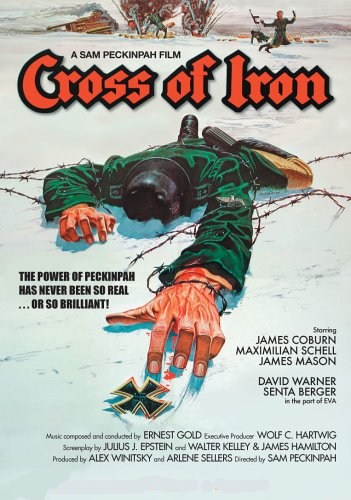
#64 - CROSS OF IRON


BACK-STORY: “Cross of Iron” is a war movie set on the Eastern Front in World War II. It is told from a German point of view. The action takes place in the Taman Peninsula in the Caucasus in 1943. The Germans are in the midst of their retreat from Stalingrad. The film was Sam Peckinpah’s last great feature and his only war movie. He supposedly was heavily drinking during the shoot. The movie is based on the novel The Willing Flesh by Willi Heinrich. The movie follows the book fairly closely. The movie was filmed on location in Yugoslavia with the cooperation of the Yugoslavian army. Because the production ran out of money, the ending had to be improvised. The release met with mixed reviews and it did not do well at the box office. It’s reputation has been rising over the years, however.


OPENING: The opening credits roll over German war footage with a German children’s song in the background. Corporal Steiner (James Coburn) and his squad sneak up on a Russian mortar post and kill their opponents in the slow motion typical of a Peckinpah film. They capture a Russian boy and bring him back.

SUMMARY: Capt. Stransky (Maximilian Schell) arrives to take command of the battalion and meets with Gen. Brandt (James Mason) and Capt. Kiesel (David Warner). Stransky is an aristocratic Prussian who has requested a transfer from France specifically so he can win an Iron Cross. Brandt is disillusioned and points out that the German soldier is simply fighting for his life, not for medals. They recommend Stransky make use of Steiner. The cynical, embittered Keisel says “Steiner is a myth. Men like him are our last hope and in that sense he is truly a dangerous man.”

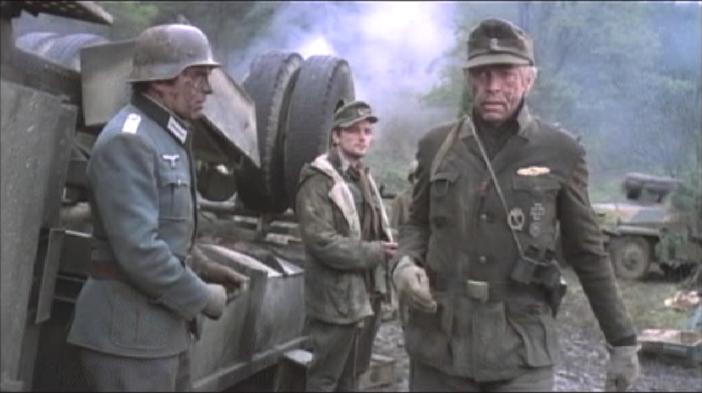
Stransky, Meyer, and Steiner
When Stransky meets Steiner, he is angered by Steiner’s lack of respect for his “superior” (in rank and social status) officer. Steiner simply tolerates Stransky as the latest in a long line of clueless officers. When Stransky insists the orders to take no prisoners be carried out by shooting the boy, Steiner refuses, but the confrontation is diffused when one of the squad members promises to do it. He lies and later Steiner releases the boy and points homeward. The boy is immediately killed by attacking Russians. Oh, the irony.

The attack is a major one with frantic battle action. There are more slow motion deaths and lots of explosions. There is hand-to-hand combat and Steiner is wounded. His respected platoon leader Lt. Meyer is killed leading a counterattack. Later, Stransky (who cowered in his bunker during the battle) claims he led the successful counterattack and deserves the Iron Cross.

Steiner ends up in a hospital which results in some surreal scenes as he hallucinates and sees old comrades. He has an affair with a nurse (Senta Berger). In a telling scene, a general arrives with propaganda film crew to show the wonderful treatment of the men, but once the shots are done the banquet is reserved for the visiting officers. When Steiner is recovered enough (in his opinion), he abandons the nurse in favor of a return to his unit (cliché alert).

When Steiner returns to the squad’s bunker, he finds some of his men are dead and they now have a Nazi Party member attached to them. In a great scene, Steiner is called before Brandt to verify Stransky’s leading the counterattack. Stransky has two eyewitnesses – Steiner and a homosexual adjutant named Treibig who he is blackmailing. Brandt suspects Stransky is lying and wants Steiner to confirm his suspicions. Steiner surprises him by asking for more time. Brandt peevishly points out that he has tolerated a lot of insubordination from Steiner, prompting an outburst from Steiner in which he proclaims that he does not care that Brandt is “enlightened”. He hates all officers and, in fact, the whole army.

The Germans are forced to retreat, but Stransky sees an opportunity to silence Steiner by not passing on the order. The Russians move in with tanks. The squad takes refuge in a factory, but a tank simply plows through the wall. They escape through a tunnel. The action is intense.

They are on the run and moving cross country to try to reach German lines. They reach a village and take a unit of Russian female soldiers captive. The Party worm attempts to rape one of the women, but gets his genitalia bitten off and kills her. The scene is unique in that the women are treated sympathetically. When they kill one of the Germans who was distracted, Steiner does not retaliate. They would have done the same, I suppose. Steiner even gives them the Party guy as a parting gift.

They reach the German lines but still have to cross no man’s land. They send a message warning the Germans not to shoot as they are coming in, but Stransky gets his toadie Treibig to open fire on these “Russians” coming through the wire. Several members are killed in graphic, slow motion deaths. Steiner guns down Treibig and goes looking for Stransky.

CLOSING: The Russians choose this moment to launch an attack. Lots of explosions and flying debris. It’s as though Peckinpah added an Indian attack to the showdown scene of a one of his westerns. Steiner tracks down Stransky amidst all the chaos, but decides not to kill him. Instead, they go out together to fight. Steiner has shamed Stransky into earning the Iron Cross. The movie ends with Stransky fumbling with reloading his machine gun and Steiner laughing at him.

RATINGS:

Action - 9


Acting - 9


Accuracy - 8


Realism - 8


Plot - 8


Overall – 8

WOULD CHICKS DIG IT? This is a very manly movie. It is unlikely your significant other will enjoy it. There is only one significant female character and she is treated like a piece of meat. The movie is very grimy and gritty. It pulls no punches. The scene with the Russian female soldiers is admirably nonsexist, but most women would find it discomforting. Besides, how many women are Sam Peckinpah fans?

ACCURACY: Willi Heinrich was a veteran of the Eastern Front and was wounded five times so he knew of which he wrote. The book is probably partly autobiographical. It is also claimed the book is based on the experiences of the decorated soldier Johannsch Werdfeger who won two Iron Crosses.

The movie does not claim to be a true story. The battles are generic and represent typical battles during the Taman Peninsula campaign. The fighting is realistic in a Hollywood sort of way. Peckinpah does stage chaos well. The sets are appropriately decimated. The deaths appropriately random.

The movie is helped in its realism by the authentic weapons. The Russian tanks are T34/85’s on loan from the Yugoslavian Army. I won’t quibble with the fact that that particular model was not in use in 1943. The small arms are accurate. One flaw is the use of F4U Corsairs to represent Russian fighter-bombers. Gull wings – did they think we would not notice?

The small unit dynamics of the squad, especially in the bunker scenes ring true. The soldier banter is realistic. The comradery is what you expect for a squad that had gone through all they went through. The attitudes of the enlisted and the officers in the German army circa 1943 are well displayed. The cynicism and defeatism is apparent.

CRITIQUE: “Cross of Iron” is a special movie. There is no other war movie quite like it. It has the Peckinpah touch throughout it – the trademark slow motion violence, the iconoclastic anti-hero, the lack of respect for authority. An American war movie concentrating on Germans on the Eastern Front is unique.

The movie is certainly action-packed with lots of explosions. It is a great combat movie and has several combat scenes that are among the best filmed. It does have its exposition parts (which are necessary to develop the conflict between Steiner and Stransky and to explain Brandt’s role in the triangle), but the movie is definitely not wordy.

The movie is an excellent depiction of small unit warfare, but it also gives a taste of command. Brandt is a sympathetic soldiers-general and Keisel represents another type – the cynical staff officer. Stransky is yet another type – the chicken-hearted glory hound. Steiner portrays the hardened NCO who cares more for the survival of his men than the “big picture”. The movie is refreshingly free of the stereotyped evil Nazis. Stransky is not a Nazi – he is an aristocrat who is fighting for his family honor, not Hitler.

The acting is outstanding. Coburn deserved an Academy Award nomination and has one of his best roles. He is perfect as Steiner. He is ably supported by Mason, Warner, and Schell. I especially enjoyed Warner’s cynical Keisel. He is riveting whenever he appears. Schell is appropriately loathsome. The unknown actors who make up the squad also do a good job.

The ending has drawn mixed reviews. I personally did not like it. I found it out of character that after killing Treibig, Steiner does not kill the more despicable Stransky. Why would he suddenly change his mind? Then Stransky in a character-flip does not kill Steiner when he turns his back on him. Either one of these character shifts would be hard to swallow, but both? I did not mind the abrupt halt to the movie.

CONCLUSION: If you want a war movie that is adrenalin-fueled and well-acted, try “Cross of Iron”. It is not subtle, but it is not one-dimensional either. It is definitely underrated at #64. It seems incredible that it is only two places higher than “Castle Keep”! I feel confident it will be in the top fifty of my 100 Best War Movies list.  By the way, that is a great movie poster.


COMING UP:  I will be reviewing the History Channel special on "Gettysburg" on May 30 at 9 EST.

Friday, March 25, 2011

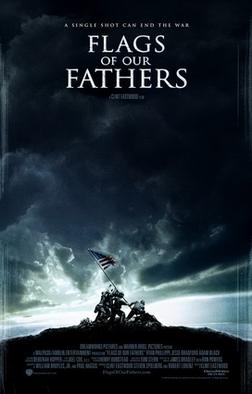
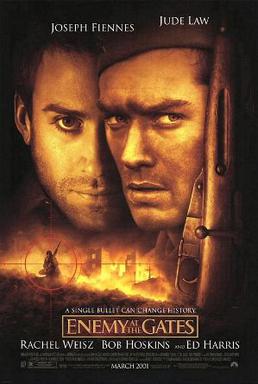
MARCH MADNESS: "Flags of Our Fathers" (5) vs. "Enemy at the Gates" (12)


ACTING: “Flags” does not have an A-List cast. The main characters: Ryan Phillippe as James Bradley, Jesse Bradford as Rene Gragnon, and Adam Beach as Ira Hayes, are very good. Director Clint Eastwood made an excellent decision to not load the story down with famous stars. Beach is especially poignant in portraying the troubled Hayes. “Enemy” has showier leads. Jude Law as Vasily Zaitsev and Joseph Fiennes as Danilov are fine with Danilov being less believable. Bob Hoskins brings the proper bombast to the role of Nikita Khrushchev. Rachel Weisz as female sniper Tanya is too well-coiffed and beautiful for the role. She also makes no attempt at a Russian accent. Ed Harris steals the acting honors with the coldly efficient and malevolent Major Konig.


Score at the end of the first period: Flags – 9 Enemy – 8

REALISM: “Flags” attempts to authentically depict the terrors of combat in the Pacific and the media circus on the home front that confronted the flag-raising heroes. The combat has the feel of “Saving Private Ryan” and is appropriately chaotic, explosive, and graphic. The fighting is vicious and sometimes hand-to-hand with bayonets. The bond drive on the home front is a mixture of cynicism and ultrapatriotism. It’s laid on a bit thick, but not in a ridiculous way. “Enemy” has chosen to set a love triangle in the middle of the greatest battle of WWII. It’s small world approach to the character’s encounters defies credulity. The city of Stalingrad, while appropriately a shambles, appears to be empty save for the maneuverings of the featured characters. It also relies on some amazing pieces of luck to advance the two main foes to their final confrontation.

Score at half: Flags – 18 Enemy – 14

ACCURACY: “Flags” is based on the book by James Bradley and Ron Powers. The movie takes few liberties with the narrative. It is about as accurate as you can find. I could find no major flaws in it. The landing is true in its depiction of the Japanese allowing the Marines to come inland a bit before opening fire. Marine tactics are true to their style. The deaths of the three flag-raisers who did not survive are accurate. Even the small touches like Harlon Black’s mother recognizing his butt in the picture are true. “Enemy” has numerous problems with historical accuracy. The movie was inspired by a small portion of William Craig’s study of the battle. Craig added the legendary duel between Zaitsev and Konig to his story basing it on Soviet records which obviously were subject to communist propaganda. The movie takes this already dubious legend and ramps it up to a love triangle/snipers duel. I was surprised to find that there actually was a Sacha who was a double agent and was hanged by the Germans (of course not in the way depicted). I was stunned to find that there was a female sniper named Tanya and she apparently had a relationship with Zaitsev (although even the Soviet historians did not go as far as having them live happily ever after as the movie implies). Generally speaking, the movie does a poor job as a tutorial on the Battle of Stalingrad. You get no idea what the big picture is. It also goes overboard in showing Russian soldiers being forced to make suicide attacks.

Score at the end of three: Flags – 28 Enemy – 20

ENTERTAINMENT VALUE: “Flags” is an excellent blend of exciting action and character development. It manages to tell the story of the flag-raising while also giving a clear picture of what Iwo Jima was like and what the home front in 1945 was like. Eastwood examines the question: what is a hero? He indicts the government’s manipulation of heroes for morale-boosting and fund-raising purposes. He does not glamorize war and shows the randomness of death on the battlefield. The most respected soldier (Make Strank) is killed by friendly fire. The movie also explores post traumatic stress disorder through the tragedy of Hayes. Its nonlinear structure is effective. “Enemy” is stronger as pure entertainment. It is obvious the producers sacrificed accuracy for entertainment. The set pieces are well done. It has a strong female character. (There is a very erotic scene that has no nudity in it.) It has some very suspenseful cat and mouse scenes. It concentrates on snipers – the coolest of the cool. The soundtrack by James Horner fits the scenes perfectly. Unlike “Flags”, it is not trying to enlighten its audience. It is fun in a cliché-ridden, good guy wins, sort of way.

FINAL SCORE: Flags – 36 Enemy - 29

March Madness rules
Jarhead (8) vs. 300 (9)
We Were Soldiers (7) vs. Defiance (12) 
Master and Commander (6) vs. Troy (11)