Showing posts with label The Big Red One. Show all posts

Tuesday, March 26, 2013

THE BIG RED ONE (3) vs. THE DESERT RATS (14)

 
VS.
 
 
THE BIG RED ONE (3) vs. THE DESERT RATS (14)
ACTING:


     “The Big Red One” is essentially a five actor movie. Lee Marvin plays a grizzled sergeant (he was 56 years old at the time) in charge of a squad that consists of four guys who can not be killed (or even wounded) and a series of cannon fodder replacements. Marvin is very good, as usual. He has the weary father-figure down pat. Unfortunately, he completely dominates the other four who range from barely registering (Kelly Ward as Johnson) to inconsistent (Robert Carradine as Zab ) to semi-charismatic (Bobby Di Cicco as Vinci) and earnestly bad (Mark Hammill as Griff).

     “The Desert Rats” is a Richard Burton movie. He plays British Capt. MacRoberts who given the task of cracking the whip on an undisciplined Australian unit. Burton is above this kind of material but he is game and takes the role seriously. The only other actor that makes an impression is Robert Newton as MacRoberts ex-scholmaster Bartlett. Newton plays a cowardly drunkard who refuses to run because it would be dishonorable. It is a poignantly effective performance. James Mason makes a welcome appearance as Rommel to (A) showcase an exchange between Mason and Burton (well done) and to (B) scuff up his portrayal from “The Desert Fox” (this Rommel is less likeable).

FIRST QUARTER SCORE:
The Big Red One     7
The Desert Rats       8


CLICHES:

     “The Big Red One” is a small unit (very small unit) movie. The squad (actually 1/3 of a squad) is heterogeneous. Johnson is a farm boy, Vinci is the wise-cracking Italian-American, Zab is the budding writer from Brooklyn, and Griff is the sharpshooter who can’t kill. The group is led by a hero (the Sarge), but they are not moving forward to accomplish a particular objective. There is a chronicler in the form of the narrator Zab (who represents Samuel Fuller). The movie does not alternate between opposites like action and rest, instead it is a series of vignettes. There is a redemption figure in Griff, but that subplot is surprisingly incomplete. There is no conflict within the group or over command. In conclusion, other than the stock characters the film avoids clichés.

     “The Desert Rats” has some familiar characters and situations. There are two redemption arcs: Carstairs who is almost court-martialed by MacRoberts and Bartlett. Both resolutions are predictable. MacNamara is the stock character who builds a unit using tough love which at first causes resentment but eventually results in respect. The unit is not clichely heterogeneous because few characters are developed. MacNamara is the hero and leader, but the role is not really forced upon him. The movie alternates combat with exposition.

HALF TIME SCORE:
The Big Red One       14
The Desert Rats         14


PLOT:

     The plot of BR1 can best be described as: a small squad led by an old sergeant go from Operation Torch to the end of the war while experiencing a series of incidents. The vignettes range from interesting (the liberation of the death camp) to bizarre (the insane asylum) to ridiculous (the ambush at the crucifix). It’s like Samuel Fuller kept a notebook of ideas for war movie scenes and then made a movie that included all of those ideas, good and bad. The scenes could have been put in any order. The movie is entertaining, but several of the mini-stories are painful for an intelligent war movie fan to watch. It’s one of those movies that tends to fall apart upon repeat viewing, but kudos for being different.

      The plot of TDR is much more standard. It flows from green, undisciplined unit being broken and trained by a tough leader to become confident, disciplined veterans led by a more understanding leader. Throw in combat sequences to prove the evolution and to add action. Nothing you haven’t seen before, but well done and not hackneyed. Very predictable, however.

THIRD QUARTER SCORE:
The Big Red One          20
The Desert Rats            21


COMBAT:

     BR1 has surprisingly little combat for such a long movie (I watched the extended version) and the scale is small because of budget constraints. You get the impression this squad is fighting the war by itself. Most of the scenes are the “guns and grenades” variety. When the movie moves into a combat sequence it is usually PG intense, but brief. Compare it to “Cross of Iron” that was made three years earlier and you can see that Fuller was still clinging to Old School combat. There is a fire-fight for the Torch landing, an extended attack on an African town that features a French cavalry charge (WTF) and the smallest tank in war movie history, the D-Day landing featuring a Bangalore Torpedo relay, the ambush at the crucifix, the insane asylum shoot-out, and the liberation of the death camp. Each is fairly intense, but most are too brief. The tactics and weaponry are fine.

      TDR has only two battle set pieces, but they are both excellent. The first is defense against a German Panzer attack during a sand-storm. The artillery barrage is realistic (the movie has great sound and explosion effects). The deaths are reasonable. There is a cool duel between a German tank and an anti-tank gun. The other action sequence involves a commando raid on a German munitions dump. A “guns and grenades” at night spectacle. Both scenes are better than anything in BR1, but BR1 puts the unit in combat more frequently.

SCORE AT THE END OF REGULATION:
The Big Red One        27
The Desert Rats          27


OVERTIME: Director

      BR1 was directed by Samuel Fuller. It is semi-autobiographical as Fuller served in the 1st Division and participated in Operations Torch, Husky, and Overlord. His unit fought through France, Belgium, and Czechoslovakia. He was involved in the liberation of the Falkenau concentration camp. He was awarded the Bronze Star, Silver Star, and Purple Heart. He went on to a legendary career as a filmmaker. He was noted for gritty B-movies which he made with low budgets. These included “Steel Helmet”, “Fixed Bayonets!”, and “Merrill’s Marauders”. “The Big Red One” has many of the attributes of a B-movie even though it was by far his biggest film.

       TDR was directed by Robert Wise. Wise was a much more mainstream director than Fuller. He was also much more highly acclaimed. He won two Best Director Oscars. His other war movies were “Run Silent, Run Deep” and “The Sand Pebbles” (for which he was nominated for Best Director).

FINAL SCORE:
The Big Red One       36
The Desert Rats         33

COLOR ANALYSIS:

      This was a shocker. BR1 has a strong reputation among critics and war movie fans and TDR has been largely forgotten. But the tournament is all about the match-ups. Plot and combat did not play to BR1’s strengths and TDR had just enough talent to take the match to overtime. In the end, Samuel Fuller pulls his movie through to the second round.

Sunday, February 27, 2011

#71 - The Big Red One


BACK-STORY: “The Big Red One” is a war movie set in WWII – Europe. It follows a sergeant and his squad from North Africa to Sicily to D-Day and beyond. At the end they liberate a concentration camp. The movie is loosely based on the writer/director Samuel Fuller’s experiences with the 1st Division in WWII. The character Zab represents Fuller. The movie was released in 1980 with a substantial amount left on the cutting room floor. In 2004, the director’s cut was released almost doubling the length of the film.  It was entitled "The Big Red One:  The Reconstruction".  This is the version that I am reviewing. The movie stars Lee Marvin in arguably his best role. Marvin was a veteran of WWII.  He served in the Marines and was wounded at Saipan.


OPENING SCENE: In stark black and white, the movie opens on the last day of WWI. A black horse attacks the Sergeant (Marvin) and soon after a German soldier approaches trying to surrender, but he stabs him to death under a wooden crucifix. When he returns to an accurately depicted dugout, his commander informs him the war has been over for four hours. Oops! Maybe that’s why the German was not threatening me in any way. Oh, well, "c'est la guerre" (or that was la guerre five hours ago).

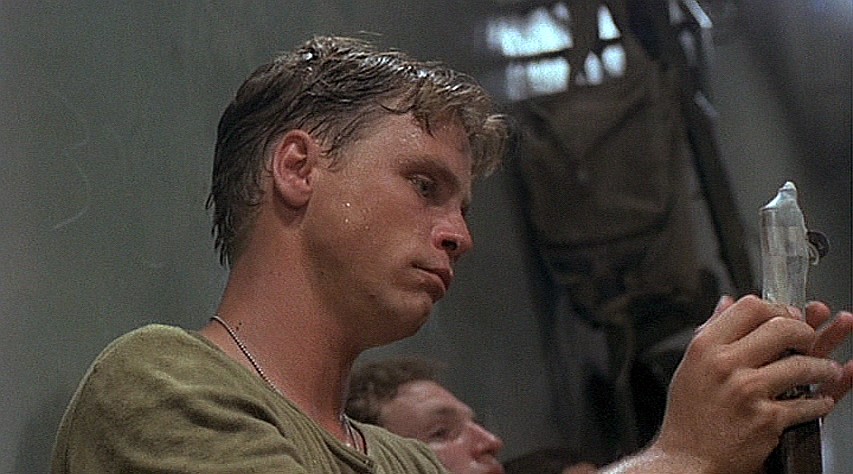
Griff prepares his gun for safe sex
SUMMARY: The movie jumps 24 years to a troop transport involved in Operation Torch. Narration is provided by Private Zab (Robert Carradine) who is a member of your typically heterogeneous rifle squad led by the Sergeant. They are sweating! They talk like soldiers do before they are going to risk their lives. Lots of ribbing and bravado. They authentically place condoms over their rifle barrels to keep the sand and seawater out.

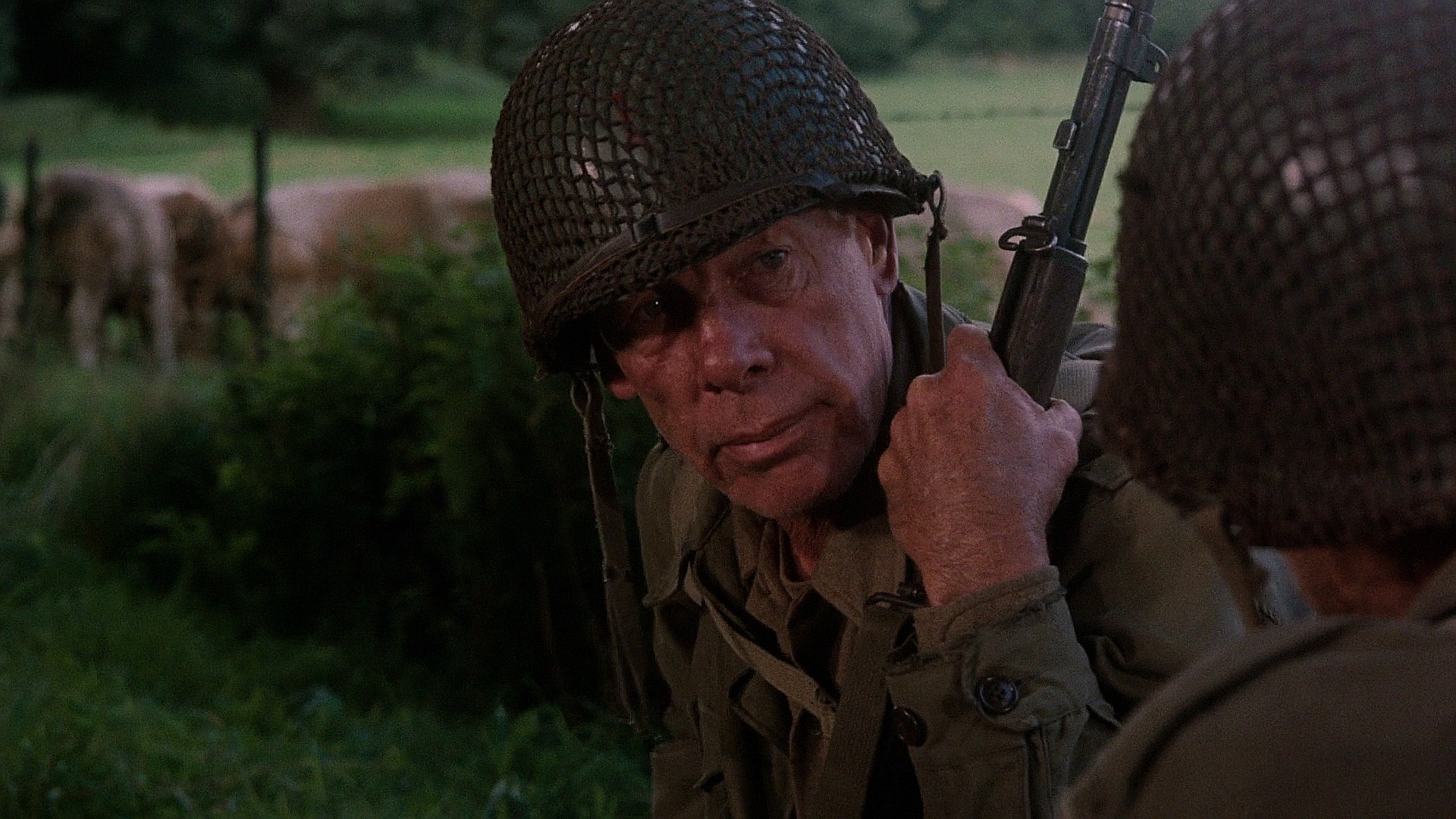
the gruff, but lovable, Sergeant
     The movie follows the exploits of the Sergeant and his “Four Horsemen”. Besides the aspiring novelist Zab and the sharpshooter who refuses to shoot humans Griff (Mark Hammill), there is Vinci (Bobby DiCicco) playing the obligatory Italian-American and the farm-boy Johnson (Kelly Ward). Our heroes need a villain so their paths will cross those of a fanatical Nazi named Schroeder. We know he is a bad-ass when we meet him he has a potato-masher in his boot and he murders another soldier for criticizing the war effort.

     Since the film was low budget, the Torch landing is a little cheesy and unrealistic. This is compounded by a silly exchange between the Americans and the Vichy French via megaphones. From here the film settles into its episodic nature. Scenes of the squad chilling and soldier-bantering are interspersed with action scenes. One of the themes is revealed to be the inability of Griff (Mark Hammill) to kill. The Sergeant opines that “We don’t murder, we kill. You don’t murder animals, you kill ‘em.”
     Some of the episodes are surrealistic. At one point the squad is rescued by a French cavalry charge in a town! They battle the smallest tank in war movie history which despite its miniature size blows up like the Fourth of July when Zab tosses in a grenade.

     At the Battle of Kasserine Pass, our boys bury themselves to survive the overrunning Panzers (actually Israeli Sherman tanks, but the other equipment and uniforms appear authentic). Griff panics and runs precipitating a rout in which the Sarge is wounded by Schroeder. When he returns from the hospital, there is a touching reunion with his four charges and we are introduced to the theme that these five are inseparable and unkillable. The same cannot be said for the replacements who periodically grace the screen for brief life spans. They should have come with “dead meat” stamped on their foreheads.

the squad stalking Schroeder
     In a typically bizarre scene, the five hide in a cave during a German counterattack and when a naval bombardment causes Germans to take refuge in the cave (one at a time), they kill each as they enter like in an old Three Stooges flick. In another, a boy with his dead mother’s body takes them to a German gun position in exchange for a decent burial for his mom.

     From Sicily, they move on to Normandy. The low budget makes the invasion look like it was done by one squad, but this fits the squad-level view of the movie. You won’t mistake this scene for “Saving Private Ryan”. In a scene similar to one in “The Longest Day”, they use a Bangalore torpedo relay to open up the beach. No covering fire, the rest just watch as each relayer gets shot. Griff is #8 and goes chicken again so the Sarge has to shoot at him. Tough love, but it works because when the explosion occurs the battle is won and we can move on to the next scene.  The movie conveniently ignores that the busting of the barbed wire was followed by the scaling of the bluff and the taking out of bunkers, etc. to actually open up the beach.

     In probably one of the most famous scenes, Schroeder sets up an ambush at the very same crucifix from the opening! The Germans lay around a tank playing dead while Schroeder hides behind Christ. Somehow Schroeder has figured out this is the one unit in the American army that will not plunder dead German bodies for souvenirs and important papers. The Sarge is not fooled and uses the tank’s machine gun to wipe out the krauts. Schroeder escapes, of course. A Frenchman on a motorcycle arrives with his pregnant wife and the GIs assist the birth inside the tank using ammo belts for stirrups.  In a move to get giggles from 12 year old boys, the guys encourage the woman to push the baby out by chanting “poo-say” (hee! hee! get it?).

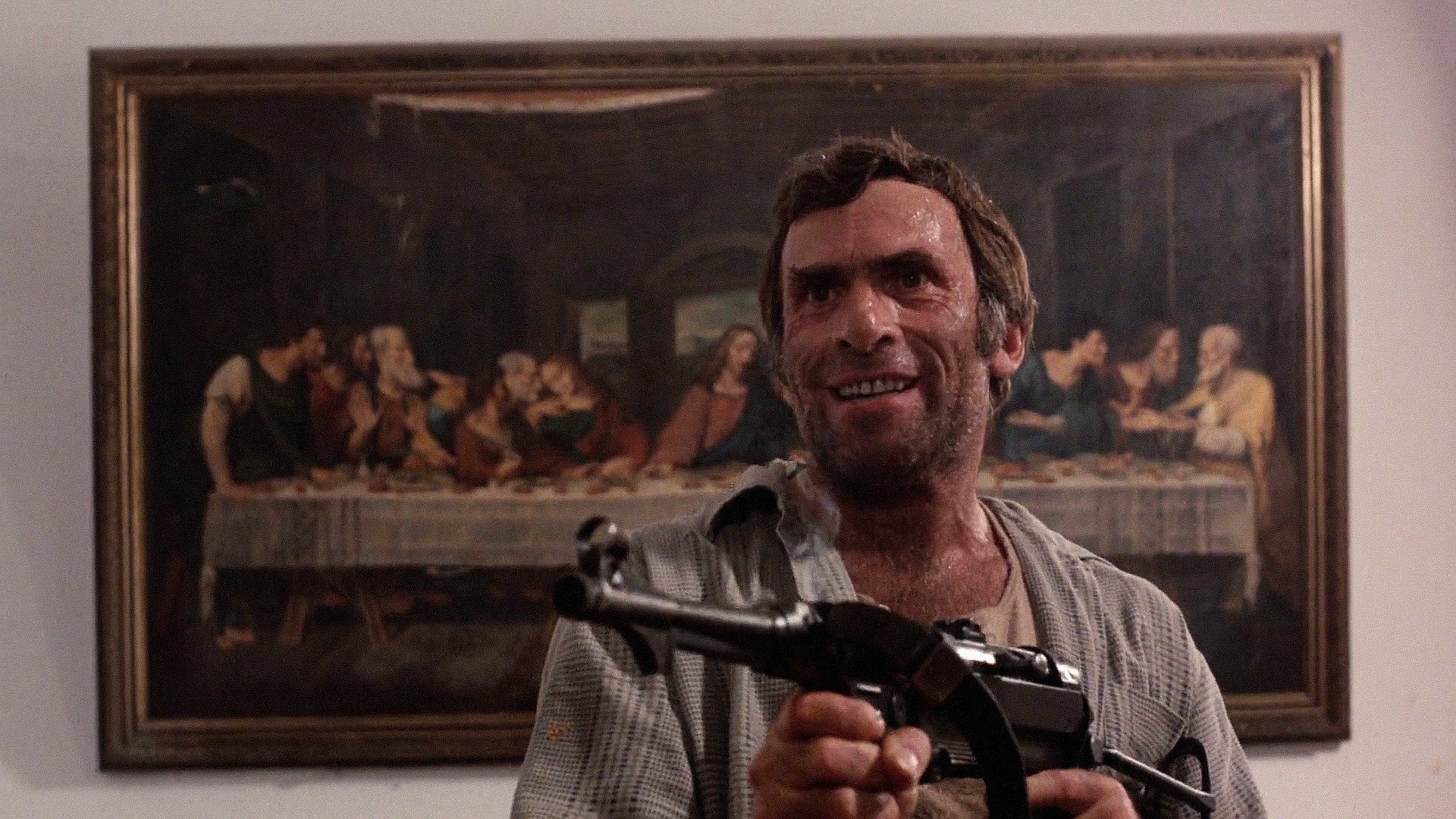
"I am one of you, I am sane"
     Next, our heroes go after some Germans using an insane asylum as a forward artillery observing post. A fire-fight breaks out during which one inmate grabs a machine gun and opens random fire proclaiming “I am one of you, I am sane”. Heavy-handed, much?

     In the Heurtgen Forest, they undergo tree bursts, but do not deign to dig in. The theme of a crass attitude toward the dead is explored. They take out one small artillery piece with a bazooka and suddenly the bombardment ends. The longest lasting replacement (Keiser) is killed in a foggy forest by a sniper who presumably passed up chances to kill the other five.

FINAL SCENE: The guys help liberate Falkenau concentration camp in Czechoslovakia. They have to assault the camp and kill the guards. Griff corners a Nazi hiding in one of the ovens and empties a clip into the German's face. Griff finally can kill! It’s a powerful scene partly abated by the fact that Mark Hammill cannot act.
    
     Meanwhile, the Sergeant befriends a little Jewish boy who he walks around on his shoulders until he dies. Very poignant. It’s full circle time as Schroeder appears (small world, eh?) ready to surrender. This is the same fanatical Nazi who had murdered a German woman he had just slept with for criticizing Hitler. He is clearly unarmed and has his hands up, but the Sarge knifes him anyway. Would you believe the Sarge is immediately informed that the war is over? This has to be the least surprising case of déjà vu in war movie history. This time the Sarge makes amends for his senseless murder in WWI by working feverishly to preserve the life of the despicable Schroeder. Go figure. In a line straight from Moe Howard, the Sergeant proclaims that “you’re going to live if I have to blow your brains out!” Zab (Fuller) adds the postscript: “I’m going to dedicate my book to the survivors. Surviving is the only glory in war, if you know what I mean.”

RATINGS:

Action – 7


Acting – 7


Accuracy – 6


Realism – 7


Plot – 7


Overall – 7

WOULD CHICKS DIG IT? Possibly. The cast is attractive. Lee Marvin is a commanding presence. The violence is not graphic. There are a few female characters including a French Resistance fighter in the insane asylum. The movie has a light touch at times and has emotional moments involving children.

ACCURACY: “The Big Red One” is a personal story and a small unit tale, so historical accuracy is not really a factor.  Much of the historical incidents are handled in a simplistic manner.  For example, the Torch invasion where the French open fire, but once their commander is killed, it's all hugs and kisses between the new allies. One could argue that the landing at Omaha Beach was much busier and complex than the movie implies, but the low budget of the film and the emphasis on following just five soldiers makes that a moot point. The 1st Division did fight in the different locales shown in the film. It did liberate the concentration camp.  The arms and equipment (with the exception of the German tanks) are authentic.

CRITIQUE: “The Big Red One” plays as a series of weird vignettes. They are all interesting and move the narrative along and although each of them may have been based on an actual incident, it is highly unlikely than any squad would have had all these incidents happen to them. In fact, some of the scenes (e.g., the tank birth and the insane asylum) seem unlikely to have happened to anyone. The movie gets cred because supposedly it is autobiographical, but it is telling that the companion book by Fuller is a novel. Two minor incidents are based on Fuller’s experiences: when Zab discovers Keiser reading a novel written by Zab and when Zab acts as a runner to inform their colonel that they have broken through on Omaha Beach. That’s pretty puny to back up the claim that the movie is based on fact.

     The film is strongest in its depiction of soldier life. The dialogue rings true. The relationships are realistic, including the paternal attitude of the sergeant and the refusal to bond with replacements. Fuller throws in little details that make the movie feel authentic. Things like the condoms on the rifle barrels, salt peter in the food to lower libido, and an “appearance” by “Axis Sally”.

     Fuller has a sparse style. Some scenes end abruptly. It gives the movie something of an episodic feel. One begins to wonder what mess the squad will get into next. The battles are small-scale and end quickly. The battles are meant to be gritty, but the movie is firmly in the old school style, pre-“Saving Private Ryan”. Deaths are usually bloodless and of the “hands throw in the air” variety. In the D-Day landing scene, we get a shot of a soldier whose intestines are exposed, but zero other graphic shots.

     The use of the Schroeder character to have a foil for the five is misguided, but typical of a B movie (which the movie has been described as). It reminds me of the main German character in “Saving Private Ryan”, but Speilberg did not go overboard like Fuller does. Meeting up with this one Nazi several times really strains credulity. Another problem is the important theme of Griff’s cowardice is never resolved. Another theme, war is brutal and arbitrary in dealing out death, is undercut by the survival of all five. In fact, only the sergeant even gets wounded. The movie would have much more powerful if one of the five had been killed. The deaths of most replacements is exaggerated, the invulnerability of the five is unrealistic.

CONCLUSION: “The Big Red One” is an entertaining and in many ways amusing war movie. Marvin is marvelous and the young actors are competent. It does a good job of informing the viewer about what it was like to be in a rifle squad in the 1st Division in WWII. However, on close examination, the movie does not hold up well. Much of it is implausible. Some of the incidents seem unlikely to have happened to any squad, much less to the same squad. This would be less of an issue if the movie was not touted as based on Fuller’s experiences.  It's a fun movie, but undoubtedly overrated by many critics.


Next up:  #70 -  Hail the Conquering Hero