Showing posts with label March Madness WWII Combat Movies. Show all posts

Saturday, April 13, 2013

MARCH MADNESS FINALS


VS.
 
FINALS

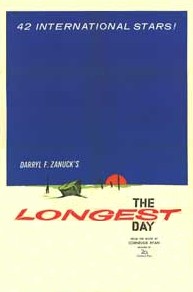
SAVING PRIVATE RYAN vs. THE LONGEST DAY

            This is the third annual finals of the March Madness War Movies Tournament.  This year’s competition was to determine the best WWII ground combat movie.  Sixteen movies entered the tournament and after watching all sixteen, reviewing them, and comparing them in various categories, we are down to the last two.  There were some surprises along the way, but we ended up with the two top seeds in the finals.

             It’s a fascinating match-up.  One is an Old School battle epic classic with an all-star cast that was filmed in black and white.  The other is from the modern VioLingo School that uses all the bells and whistles available today.  Interestingly, the two finalists are both about D-Day and they present a macroview (TLD) and a microview (SPR).  They make perfect companions for not only educating and entertaining the audience, but for recognizing the participants in Operation Overlord.   

            The tournament always concludes with a recap of the movies’ past scores.  It comes down to the calculator.

                                          TLD                                      SPR

Acting                                 9                                          10

Cliches                                8                                           6

Plot                                    10                                          8

Combat                               9                                         10

Realism                               8                                          9

Dialogue                             8                                          9

Soldier Behavior               9                                          8

Entertainment Value      10                                        10

Technical Advisors          10      Effects                      10

Educational Value           10      Characters                8

Balance                              10      Deaths                     10

Accuracy                             8        Implausibilities      6


Total                                  109                                      103


COLOR ANALYSIS:

            Congratulations to “The Longest Day” for winning this year’s tournament.  The Finals was pretty competitive, but TLD was the comfortable winner.  While TLD was consistently strong in all the categories, SPR was let down by two areas where it has gotten a lot of criticism from war movie fans:  clichés and plausibility.  The spectacular acting and combat makes it one of the great war movies, but it does have some cringe-inducing elements (e.g., the evil German) to please the general public.

            TLD has no weaknesses as a war movie.  I am sure there are non-purists that gripe about the black and white, the length, and the fact that you have to read subtitles!  But from a war movie fan’s standpoint, it is hard to see how it could be better given when it was made.  I am not even sure a modern remake would be superior.  The combat would be more realistic, but we have SPR to cover that.  Watch them together.


Thursday, April 11, 2013

THE FINAL FOUR

SAVING PRIVATE RYAN (1) vs.
WHEN TRUMPETS FADE (9)

SOUND AND VISUAL EFFECTS:

         “Saving Private Ryan” won Academy Awards for Cinematography, Sound Effects Editing, Sound Mixing, and Film Editing. It won BAFTAs for Best Sound and Best Special Effects. The opening combat scene is a tour de force. Spielberg used amputees to realistically depict dismemberments. The most amazing shots are the underwater shots which included men being hit by bullets. The sounds of battle have seldom been better done. Listen for the bullets ricocheting off the beach obstacles. The monstrous roar of the Tiger tanks in the final battle is straight out of a horror movie. It could be argued that SPR has the best sound and visual effects of any war movie.

         “When Trumpets Fade” was a low budget film and was on the opposite end of the spectrum with regard to money available for effects. With that said, they got a lot of bang for their bucks. The film came out in 1998 (the same year as SPR), so you can not accuse the director (John Irvin of “Hamburger Hill” fame) of cribbing. Irvin gets the environment right. The men are wallowing in mud or moving through a foggy forest landscape. The most impressive effects are the explosions from mines and artillery. It is the first movie I can recall that has realistic tree bursts. (Later topped in “Band of Brothers”.) The hellish landscape of the river crossing is perhaps overdone, but still impressive.

 
FIRST QUARTER SCORE:
Saving Private Ryan 10
When Trumpets Fade 8


CHARACTER DEVELOPMENT:

          SPR is a small unit dynamics movie. The ensemble is an interesting one and of average clicheness. One interesting aspect of the character development is the mystery of Capt. Miller’s background which is held until a dramatic moment in the film. Before we learn Miller was a teacher, we subtly learn he suffers from combat stress and does not follow orders without being cynical about them. He also is human and makes mistakes (e.g., the assault on the radar station and allowing the German to live). None of the other squad members gets a back-story, but they all get their moments to flesh out their characters. I would not call them multi-dimensional, but they are not cardboard. Their deaths are all heart-tugging because we know enough about each to care.

          WTF (oops, I’ll call it “Trumpets” from here on) also concentrates on a small unit, but includes some second tier characters from the officer class (Capt. Pritchett is particularly intriguing). Manning is the main character and we learn little about why he has the type of personality he has. There are clear implications that his cynicism and anti-authority attitude was based on losing his previous squad and best friend. Other than Manning, the other characters are pretty one-dimensional, but do represent some interesting types. Each character develops in relation to Manning.


HALF TIME SCORE:
Saving Private Ryan 18
When Trumpets Fade 14


DEATHS:

           SPR set the gold standard for war movie deaths. It is firmly in the tradition of the patrol unit / “who will survive?” trope. This type of thing has been done many times before and doubtless will be done again. One thing that sets SPR apart from a movie like “Cross of Iron” is the gut-wrenching quality of the deaths of the unit members. The stand-out here is the death of the medic Wade. Not only is the acting terrific by Giovanni Ribisi, but the scenario is unique. Even Vin Diesel gets a death scene not worthy of his acting skills. Mellish’s death is very powerful and tough to watch. The movie concludes with one of the great surprise deaths in war movie history.

          “Trumpets” opens with a scene that is opposite in style to the opening of SPR. In SPR we get an inspired choreography of death, “Trumpets” features the death of one man – Manning’s buddy Bobby (Jeffrey Donovan of “Burn Notice”). It is poignant and has some similarities to Wade’s. Another death has Manning shooting a squad member who is panicking. Not as powerful, but thought provoking. The movie comes full circle in the end to mirror the opening scene which is a bit heavy-handed, but effective.


THIRD QUARTER SCORE:
Saving Private Ryan 28
When Trumpets Fade 22


IMPLAUSIBILITIES:

          The one major weakness of SPR is the implausibilities in the plot. I am not referring to the overall construct of a mission to rescue a single soldier after the deaths of his brothers. That fantasy is firmly backed by the actual story of the Nieland brothers and besides, the movie is clearly fictional. It is plausible that the high command (in this case Gen. Marshall himself) would have ordered the mission. With that said, there are several Spielsbergian moments in the film that were obviously put in to advance the plot. Someone has to die in Neuville to establish the “who will survive?” theme. It was wise to kill off Vin Diesel early, but having him take the little girl was ridiculous. Miller’s decision to assault the radar station can only logically be explained as a way to kill Wade, start the evil German arc, and introduce some unit dysfunctionality. In reality, the reason Miller gives for going off-mission to lead an attack that would certainly get at least one of his group killed would only make sense if Miller was incompetent and clueless. After developing the idea that Miller was grudgingly following orders to accomplish a mission he disagreed with, it made absolutely no sense for him to risk the mission like he did. Worse, the scene begins the extremely implausible arc that has the freed German killing two members of the squad and himself being killed by his biggest supporter. Can you say IRONIC? Pure Spielberg! Pure bull shit.

 
           “Trumpets’ is also fictional and also manipulative of the audience. The opening and closing scenes are supposed to be ironic. The central construct that a reluctant and openly insubordinate warrior would be promoted by men who obviously disdain his attitude is ridiculous, but clearly necessary for plot development. The decision of the trio (all of whom dislike Manning) to go on a suicide mission with him strains credulity. Sanderson’s (the fat guy) survival is not likely, but you have to give credit for breaking the “fat guy always dies” cliché. Where SPR would still be great without its implausibilities, “Trumpets” could not exist without its Hollywoodisms. By the way, “Trumpets” also has a recurring German character, but his limited appearances do not seem forced.

FINAL SCORE:
Saving Private Ryan 34
When Trumpets Fade 30


COLOR ANALYSIS:

           It was a nice run for the Cinderella “When Trumpets Fade”, but it just did not have the power to overcome such a heavyweight. The performance of “Trumpets” does give hope to all those low budget war movies out there. It is possible to go toe-to-toe with the megamovies. However, it is extremely important to have a great script and great acting if you want to stand out and “Trumpets” has those ingredients. It helps to be different. With that said, SPR is the superior movie and deserved to win. It has its detractors and some will feel that “Trumpets” should have pulled the upset, but SPR overcomes its implausibilities with brilliance in many other categories and money does buy great effects, great actors, and a great director.
 
THE LONGEST DAY (2) vs. A BRIDGE TOO FAR (5)

SOURCE MATERIAL AND TECHNICAL ADVISERS:

          Both movies are based on books by Cornelius Ryan. They are both classics. I consulted Amazon and found that TLD has a rating of 4.8 compared to ABTF’s 4.7. As far as military consultants/technical advisers, TLD had 24. The standouts were Gen. Blumentritt, Lt. Gen. Gavin, Maj. Howard, Col. Priller, Maj. Kieffer, and Lucie Rommel. ABTF had 6 consultants. They included Gen. Gavin, Lt. Gen. Horrocks, and Maj. Gen. Urquhart. Of course, ABTF was made in 1977 so fewer participants were still alive.
 
FIRST QUARTER SCORE:
The Longest Day 10
A Bridge Too Far 9


EDUCATIONAL VALUE:

          “The Longest Day” came out eighteen years after D-Day. It was the perfect time to come out with the definitive take on the famous battle. The movie is sometimes described as a docudrama which is a testament to its educational value because it is inaccurate to equate it with a documentary. The brilliance of the movie is in its presentation of the background incidents before the landings. The audience is clearly apprised of allied strategy and German confusion. Amazingly, this preparatory information (the first fifty three minutes of the film) is done in an entertaining manner. Almost seventy years later, there is still no better film for telling the story of D-Day to a movie audience. On a personal note, I have shown this movie to my students and even though it is in black and white and educational, they enjoy it.


         “A Bridge Too Far” is very similar to TLD in structure and goals. It deserves credit for bringing recognition to a much less known campaign. Plus because it was a loss, it took guts to make the movie from a financial stand point. I found that it does not do as good a job of “teaching” the battle. There is much less strategy coverage. More than with TLD, you would need to know more about the subject going in to truly understand what is happening. Still, since most intelligent people had at least a vague idea about D-Day, but few knew anything about “Operation Market Garden”, ABTF certainly did a great service to history.
 
HALF TIME SCORE:
The Longest Day 20
A Bridge Too Far 17


BALANCE:

           This category refers to three things: opposing sides, Allies, and brass to boots. TLD establishes a pattern early of covering both the Anglo-American perspective and the Germans. I did not use a stop watch, but it appears that in the 53 minute opening act the movie gives equal treatment to the leadership of both sides. Obviously, once the landings begin, we get less coverage of the German perspective, but they are still interweaved into the narrative. As far as the Allies, I can’t see where there could have been much complaint from the British about the movie being too “American”. Unlike other American-made war films, this film does not give the impression the Yanks won the war by themselves. The Ste. Mere Eglise scenes are balanced by the Pegasus Bridge sequences. The Omaha Beach scenes are balanced by action on Sword. The French get the attack on Ouistreham and nice coverage of the Resistance. Only the Canadians have a right to complain. Of the seven major events (Pegasus Bridge, Ste. Mere Eglise, Omaha, Sword, Utah, Pointe Du Hoc, Ouistreham) reenacted in the movie, four are American efforts. That seems fair. As far as coverage of command versus soldiers, the movie is very strong. There are numerous “grunts” depicted (Schultz, Steele, Fuller, Pluskat) along with the commanders (Howard, Lovat, Cota, Vandervort).


            ABTF was obviously modeled after TLD. The structure of jumping back and forth between the British command and the German generals who were going to be affected is similar, although the movie does not spend as much time with the Germans. The movie is fairly balanced between the Americans and British. The director was British (Richard Attenborough) and the key audience was American so that is not surprising. It appears he throws in the river crossing to let Americans have some action, to add a grand set piece, and to justify Robert Redford’s salary. The Dutch Resistance gets its due (although it is not comparable to TLD’s coverage of the French and it does not have Janine). When it comes to brass versus boots, “Bridge” is heavily command-centric. There is really only one common soldier character (Dohun) and he appears and disappears in one segment. Whereas in TLD, several grunts are introduced early and then are tracked throughout the film.
 
THIRD QUARTER SCORE:
The Longest Day 30
A Bridge Too Far 25


ACCURACY:

           TLD is based on a well-researched book, but Ryan was not trying to write the definitive history of Operation Overlord. He was writing a history of the battle from the perspective of the participants. The book is a collection of vignettes surrounded by the facts of the invasion. It is macrohistory from a microhistory perspective. Certainly a documentary like the D-Day episode of the “World at War” series is more accurate. However, if you get your history from Hollywood (which unfortunately is the case for most), TLD is as good as it’s going to get and much more entertaining than a documentary. There are some inaccuracies, but most are minor. Some examples include that Rupert was actually a sand-filled dummy and the battle noises were provided by paratroopers that dropped with them. There was no casino any more in Ouistreham (it had been replaced by a bunker) and there were no nuns. The 82nd Airborne had the clickers, not the 101st. Small stuff like that. There is one major howler. In the film, Omaha beach is “won” by blowing a hole in a concrete wall and it’s on to Berlin. This is way too simplistic and short-changes the heroic small group actions that actually got the forces onto the bluff.


           “Bridge” is very similar to TLD on the accuracy front. Not surprising since it came from a book by the same author. It has the same strength of retelling history in an entertaining and informative way with mostly minor Hollywoodisms. One example of the influence of Hollywood is the Dohun scene which tweaks the real story in several ways to make it more entertaining. In comparison, the battle for the Arnhem Bridge is more accurate than TLD’s Omaha Beach reenactment. Plus, you can argue “Bridge” gets more leniency because it chooses to bring light to a fairly obscure campaign. I also think that unlike TLD, “Bridge’s” military consultants were on set to make sure Attenborough did not stray far from reality. Gen. Urquhart described the film as a “reasonably accurate spectacular”.


FINAL SCORE:
The Longest Day 38
A Bridge Too Far 33


COLOR ANALYSIS:

            The father of epic battle reenactments defeated one of his sons. The apple did not fall far from the tree. Of all the war epics that concentrate on a battle, these are the two that are most alike. I would argue that the only movie in the subgenre that is superior to “A Bridge Too Far” is “The Longest Day”. “Bridge” was an admirable effort to duplicate its progenitor, but its subject matter is just not as compelling.


THE FINAL MATCHUP:
Saving Private Ryan (1) vs.
The Longest Day (2)

Monday, April 8, 2013

THE ELITE EIGHT!

A BRIDGE TOO FAR (5) vs. CROSS OF IRON (7)

REALISM:

         “A Bridge Too Far” is the true story of the ill-fated Operation Market Garden. The movie focuses on the command level and is based on a well-researched book by Cornelius Ryan. The movie gives balanced coverage to the opposing sides. It is very realistic in portraying how plans do not survive the initiation of battle. It also does a good job of depicting that the worst case scenario will often trump wishful thinking. On an historical note, the movie proves that Montgomery was very unrealistic when he assumed a British armored unit could bash its way to Arnhem over one road.

          “Cross of Iron” attempts to portray combat on the Eastern Front during the period when things were collapsing for the Wehrmacht. The nature of the combat is realistically portrayed. It is desperate and nightmarish. The main characters are stock, but they did exist in the German army. The movie does include a highly unrealistic (although entertaining) scene involving Russian women soldiers. Steiner’s unit treats them as respected enemies when in reality the German army was particularly vile towards female combatants. The ending confrontation between Steiner and Stransky is also unrealistic.

FIRST QUARTER SCORE:
Bridge 10
Cross    7


DIALOGUE:

          Much of the dialogue in “Bridge” is straight from the book. This means it is true to what the historical persons said. William Goldman, an Academy Award winning screenwriter adapted the book. The dialogue is not pompous although much of it comes from the mouths of generals. Best line: “Ah, I suppose you're wondering why I called you here. I want to tell you that I've decided to cross the river like George Washington; standing in the prow of the boat.” (Maj. Cook (Robert Redford) before the river crossing)

         “Cross” had three screenwriters. The dialogue takes a back seat to the action, but the verbal confrontations between the main characters are well done. Steiner has some cynical gems, Stransky gets to be upper class snobbish, and Kiesel is wearily realistic about the war. Best line: “I believe God is a sadist, but probably doesn't even know it.” (Steiner)

FIRST HALF SCORE:
Bridge      18
Cross        15


SOLDIER BEHAVIOR:

         “Bridge” does not have a lot of soldier behavior. If you are looking for how generals behave, this is the movie for you. The only notable enlisted man is Sgt. Eddie Dohun (James Caan). Supposedly director Richard Attenborough put the extras through the first pre-war movie boot camp and it shows as the actions by the soldiers is a big improvement over Old School movies. Although mostly anonymous, the soldiers act like soldiers in battle

         “Cross” is a small unit movie and quite a bit of time is spent with German grunts. It turns out they are pretty much like regular soldiers in any army in WWII (well, maybe not the Japanese). Their interaction in their dugout rings true. They love each other (except for the Nazi stoolie). They do their duty resignedly and are fighting for each other, not for Hitler. Steiner makes a point of saying he hates all officers.

THIRD QUARTER SCORE:
Bridge       25
Cross         23


ENTERTAINMENT VALUE:

         “Bridge” is an epic war movie about one of the most fascinating campaigns of WWII. It has an all-star cast and the acting is very good. There are big, well-staged battle scenes and if you don’t already know the story, some suspense. The only drawback is that it does cover a loss which means there is no happy ending. If you are not a war movie fan or admire historical accuracy, the movie could leave you cold.

        “Cross” is a very different movie than “Bridge”. It is not as clinical. It is grimy and gritty like war can be. It is also packed with amazingly visceral combat and a great central character. Steiner is one of war movies’ best anti-heroes. The problem is that you have to be into Peckinpah style violence. The movie is certainly not aimed at females.

FINAL SCORE:
A BRIDGE TOO FAR         32
CROSS OF IRON                31


COLOR ANALYSIS:

          Very interesting match-up between two very different movies. Basically “Bridge” won because it was slightly better at being an epic battle reenactment than “Cross” is at being a combat film. If you like both films, you are a true war movie lover.
 
SAVING PRIVATE RYAN (1) vs. MERRILL’S MARAUDERS (13)

REALISM:

          “Saving Private Ryan” was lauded as the most realistic combat film ever made. The opening scene on Omaha Beach is truly the closest audiences have come to the realities of an amphibious assault. Actual amputees were used for the numerous dismemberments. The closing scene is similar in its attempts to put you in the middle of combat and although it has some flaws (the tanks not using their machine guns, for instance), it is also better than any previous cinematic combat. The FUBAR nature of the mission certainly rings true. The movie has some problems with plausibility (e.g., the recurring German).

          “Merrill’s Marauders” is actually pretty realistic for a 1962 Old School movie. The soldiers are sweaty, grimy, and exhausted (although not enough). However, the deaths are silly and the combat is tactically unsound.

FIRST QUARTER SCORE:
Saving Private Ryan         9
Merrill’s Marauders        7


DIALOGUE:

          “Saving Private Ryan” is not remembered for its dialogue. In fact, in one of the most powerful scenes (when Mrs. Ryan is notified about her sons’ deaths), there is not a spoken word. The movie does have some nice dialogue. Robert Rodat’s script was nominated for Best Original Screenplay. Much of the dialogue is terse and the most famous line is simply: “Earn this.” The monologues are well done, especially when Wade describes pretending to be asleep when his mother would come home and when Miller finally reveals his previous life. Best line: “This Ryan better be worth it. He'd better go home and cure some disease or invent a longer-lasting lightbulb or something. 'Cause the truth is, I wouldn't trade 10 Ryans for one Vecchio or one Caparzo.” (Miller)

          “Merrill’s Marauders” is average in dialogue. Although Samuel Fuller wrote some of it, it is not as gritty as you would hope. In fact, some of it is pretty trite. The movie closes with the doctor saying: “What sort of men are these? How can they do it? But they did it”. Gag! The soldier chatter is particularly lame, but thankfully sparse. The most memorable line is Merrill’s inspirational: “When you’re at the end of your rope all you have to do is have one foot step out in front of the other.”

FIRST HALF SCORE:
Saving Private Ryan      18
Merrill’s Marauders      14


SOLDIER BEHAVIOR:

          SPR is famous for the boot camp the actors were put through by Dale Dye in preparation for their roles. Matt Damon (Ryan) was purposely left out so he would be treated subconsciously as an outsider. For a movie that attempts to be as close to reality as possible, the actors do not come off as like they are playing army men. They gripe a lot and question the mission. They do not want to accept the new guy (Upham) and never really bond with him. They respect Capt. Miller, but only grudgingly follow him when he issues questionable orders.

         MM also highlights the typical soldier grousing. Both films include the realistic “why us again?” whining. The best scene is when Lt. Stockton reveals to his platoon that they are not going on R&R and instead have a long slog ahead of them. The men wander off dejectedly. Their interaction has some forced dysfunctionality involving a jerk named “Chowhound”. The lack of noise discipline is a disconcerting behavior.

THIRD QUARTER SCORE:
Saving Private Ryan      26
Merrill’s Marauders      20


ENTERTAINMENT VALUE:

         SPR was a huge success. It was the highest grossing domestic film of the year. It’s appeal cut across many demographic groups. Although there are no female characters, many women enjoyed the movie. Although some have complained about plot contrivances, there is no debate that Spielberg is a master at manipulating the emotions of his audiences. Unlike many of his later efforts, SPR is fairly constrained in this aspect. The blend of intense combat with a human interest story was masterful.

         MM is above average entertainment, but is mainly aimed at war movie lovers. The film wears well in a classic war film way. It does not break any new ground and what it does to entertain the audience is standard, but effective. Viewing it will leave you satisfied, but unlikely to stay in the theater for a second viewing. And I doubt there was much buzz surrounding the film.

FINAL SCORE:
Saving Private Ryan      35
Merrill’s Marauders      27


COLOR ANALYSIS:

         This match-up went as expected. SPR is just too talent-laden for a mid-major like MM. In virtually any category, SPR is easily superior. It will take a special film to take down the #1 seed, not an above average Old School classic.
 
THE BIG RED ONE (3) vs. WHEN TRUMPETS FADE (9)

REALISM:

          Although semi-autobiographical, “The Big Red Line” is chock full of implausibilities. It is not realistic that a competent sergeant would not have been promoted after three years of combat. It is unrealistic that the four main squad members would not even suffer a wound in three years. Helping a woman give birth in a tank. Old German villagers blocking the path of armed American soldiers. A soldier eating with them in the Ardennes turns out to be a German plant. Their paths cross several times with the same bad Nazi. Not to mention virtually all the combat scenes. Compare BR1’s Huertgen Forest scene with the one’s in “When Trumpets Fade”.

         “When Trumpets Fade” is billed as a grittily realistic view of the Battle of Huertgen Forest. While BR1 takes a decidedly light approach to the war, WTF (just a coincidence) is relentlessly grim. The war in Europe for a rifle squad was somewhere in the middle, but certainly closer to what is depicted in “Trumpets” than what is shown in BR1. It is probably unrealistic for an openly reluctant warrior like Manning to get promoted, much less for him to lead daring missions behind enemy lines. However, the hellish nature of the terrain and the attritive combat is close to what one of the most horrendous battles of WWII was like. Compare the artillery fire here to that of BR1. This movie also has a bad Nazi character, but his appearances are limited and plausible.

FIRST QUARTER SCORE:
The Big Red One                6
When Trumpet’s Fade       8


DIALOGUE:

          BR1’s dialogue could best be described as sappy. Watch the tank birthing scene and see if you don’t cringe. The movie includes such gems as “Did I kill the guy who killed me?” (Kaiser – the dead meat replacement who survived long enough for you to wonder.) “Ben Franklin was never in a rifle squad”. (Griff) And of course the crème de la crème is: “You’re gonna live even if I have to blow your brains out.” (Moe Howard - I mean the Sarge) Much of the soldier dialogue is satisfactory and Zab’s narration is appropriate for a hack writer. Best line: “I’m sane… I’m one of you.” (one of the insane asylum inmates as he sprays bullets from a machine gun)

          “Trumpets” is from the VioLingo school which means it tries to get soldier lingo down. You hear lines like “get your s*** together” and “I’m not taking a bullet for anybody” (Manning). The dialogue would best be described as cynical. The interplay between the soldier’s is the opposite of Old School films like “A Walk in the Sun” (which has great dialogue) although interestingly “Trumpets” cribs the “nobody dies” mantra. Best line: “This is your first big chance to stay alive; don’t f*** it up.” (Manning to Sanderson)

HALF TIME SCORE:
The Big Red One                12
When Trumpets Fade        17


SOLDIER BEHAVIOR:

           One of the strengths of BR1 is the way the soldiers behave seems authentic. The bond between the “four horsemen” is typical of those forged in battle. They rib each other a lot and look out for each other. This is typical of American soldiers in any war. Their ostracism of replacements is a common attitude for seasoned vets. One of the men (Griff) can’t kill in combat (studies have shown this was common). Another (Vinci) gets upset when he, a veteran, is put on point. Overall, not bad.

           “Trumpets” has a lot of Vietnam-type soldier behavior which may seem anachronistic until you realize that the Battle of Huertgen Forest probably caused the kind of cynical, survivalistic behavior we normally associate with Vietnam. The soldier’s realize they are cannon fodder, but they grudgingly follow orders. Sometimes they panic and run. Some of them crack under the stress of combat (another similarity to the otherwise tonally opposite “Walk in the Sun”).

THIRD QUARTER SCORE:
The Big Red One                20
When Trumpets Fade        25


ENTERTAINMENT VALUE:

            If you can suspend reality, BR1 is a pretty entertaining movie. It is a series of vignettes involving some likeable characters. It has a good blend of combat, camaraderie, and corn pone. It takes the comfort of Old School and adds a little bit of modern so it can appeal to the Baby Boomers. For those with limited attention spans the scenes are bite sized and varied.

           “Trumpets” is a made for HBO movie and is not well known. I saw it when it was originally put in HBO rotation and was amazed at how good it was considering the limited budget. The movie is clearly not aimed at a mass audience. No female appears in the film. It’s main character is a modern anti-hero who is not likeable. If you are a war movie lover, it is a revelation. It is different and passionate in its desire to be iconoclastic. The opening and closing are powerful. In between, it packs in great performances and visceral action.

FINAL SCORE:
The Big Red One              27
When Trumpets Fade      34


COLOR ANALYSIS:

           On paper this was an upset, but it should not come as a surprise as BR1 was clearly overrated at #3 and “Trumpets” was equally underrated at #9. Members of the war movie lovers’ community will probably not be shocked by the results and some probably won a lot of money from rubes who were taken in by Fuller’s magnus opus and were not familiar with the obscure “Trumpets”.
 
THE LONGEST DAY (2) vs. ATTACK! (11)

REALISM:

            “The Longest Day” was constrained in reality because of what was acceptable in 1962. Because it closely covers a non-fiction war classic, the events are realistically depicted, but the combat is too tame. Just compare TLD’s Omaha Beach landing to the gold standard set by “Saving Private Ryan”. Still, if you added blood, the combat scenes could fit well in a modern war movie. The action scenes are a bit simplistic and not as chaotic and confusing as the real thing, but at least the film tries to show this in a 1962 sort of way.

             “Attack!” is based on a play which means it was not originally designed to be realistic in its action scenes. It does a pretty good job in spite of that. The attack on the house on the edge of town is realistic in tactics. The German counterattack (supposedly during the Battle of the Bulge) is not representative of that battle, but that was not the point. One would hope the dysfunctionality in the unit is exaggerated and not typical of the Army. However, you have to assume there were officers like Cooney and Bartlett. Nepotism and incompetence can be found in any job. You can see why the Army would have felt the depiction of the officers was unrealistic. I don’t think fragging was a common solution to officer problems in WWII. That part of the plot would have been more comfortable in a Vietnam War movie.

FIRST QUARTER SCORE:
The Longest Day     8
Attack!                     6


DIALOGUE:

             Much of the dialogue in TLD comes directly from the book which means the screenwriters (who included Cornelius Ryan) were often directly quoting the real persons depicted in the movie. Since soldiers (even generals) are not noted for their speaking ability, much of the dialogue can best be described as workmanlike. This movie is far from being a play. The good thing is there is little pontificating in the film. It was made long enough after the war to where it did not have to be patriotic or propagandistic. Best line: "He's dead. I'm crippled. You're lost. Do you suppose it's always like that? I mean war." (Flight Officer Campbell)

              The two biggest strengths of “Attack!” are the acting and the dialogue. Since it was based on a play, the words have to do some heavy lifting. The dialogue can best be described as biting, especially coming from Costa. “ Listen to me, Cooney! If you put me and my men in a wringer - -if you send us out there and let us hang - -I swear, I swear by all that's holy, I'll come back. I'll come back and take this grenade and shove it down your throat and pull the pin!”

FIRST HALF SCORE:
The Longest Day      16
Attack!                      15


SOLDIER BEHAVIOR:

             Once again I have to come back to TLD being based on an admirably well researched book that used many interviews with both the decision makers and the doers. This means the behavior of both the brass and the boots rings true. The pressures of command are a theme that is explored well. The pre-battle activities of the soldiers is realistically depicted. Combat behavior is also well done although since it’s a 1962 film, we see little of the grimier side. The movie is not overly anti-war.

             “Attack!” chooses an unusual situation to create dramatic tension. The main characters are caricatures that service the cynicism of the plot. Within the parameters of the plot, the men behave realistically. A veteran like Costa could have easily said and did the things he did if confronted by a leader like Cooney. The behavior of the unit members, who were in a sense caught in the middle, makes sense.

THIRD QUARTER SCORE:
The Longest Day      25
Attack!                      22


ENTERTAINMENT VALUE:

              “The Longest Day” was a huge box office success and is fondly recalled fifty years later. It does not underestimate the intelligence of the viewers. The first 53 minutes are background to the invasion. That opening third flows smoothly and is not pedantic. The jumping around between the two sides and the brief introductions of the grunts that will be focused on is very effective. Once the combat kicks in the movie masterfully blends the brass perspective with the enlisted views. The common soldiers that the film follows (e.g., Schultz, Pluskat, Fuller, Steele) are all appealing characters. It is one of the few Old School movies that you can say would not be improved with a modern treatment.

             “Attack!” is entertaining partly because it is different. The combat is pedestrian, but the acting and dialogue make up for it. Jack Palance as Costa is mesmerizing and he is ably supported by some other capable actors like Lee Marvin and Eddie Albert (who also appears in TLD). The rest of the cast that includes Buddy Ebsen, Robert Strauss, William Smithers, and Richard F’in Jaekel (of course) add to the entertainment value. It is a movie that stays with you and few war movie lovers would regret seeing it.

FINAL SCORE:

The Longest Day     35
Attack!                     30


COLOR ANALYSIS:

               This was a very intriguing match-up. A epic versus what would pass today for an independent film. A movie that could almost be described as pro-war versus a movie that was not only anti-war, but anti-Army. It is a testament to the war movie genre that two movies so drastically different can coexist and be loved by the same people. There is a place for both in the canon. “Attack!” had a good run in the tournament, but midnight finally gonged for the Cinderella. It can take some consolation from the recognition it got and hopefully more people will become acquainted with this must-see film.

Saturday, April 6, 2013

SAVING PRIVATE RYAN (1) vs. MERRILL'S MARAUDERS (16)


VS.


SAVING PRIVATE RYAN (1) vs. GUADALCANAL DIARY (16)
ACTING:


         The acting in “Saving Private Ryan” is very good. Tom Hanks was nominated for Best Actor (he unbelievably lost to Roberto Benigni; the second biggest head-scratcher of the 1999 Academy Awards) and it is a nuanced portrayal of a reluctant warrior. The supporting cast is strong and there are no weak performances. Even Vin Diesel (thankfully not in the film long enough to do damage) ups his game and dies well. Speaking of which, SPR has the highest quality of death scenes that I have seen in a war movie.

          “Guadalcanal Diary” is a small unit movie with the usual suspects from 1940s war movies. William Bendix (“Taxi”) provides the comic relief, Anthony Quinn (“Soose”) is the ethnic character, LLoyd Nolan (Sgt. Malone) is the tough sergeant, Preston Foster (Father Donnelly) is the “father” figure. Most importantly, Richard F’in Jaeckel (“Chicken”) makes his acting debut. The acting is average. No one stands out, but no one embarrasses themselves either. They all make their country proud.

FIRST QUARTER SCORE:
Saving Private Ryan 10
Guadalcanal Diary     7


CLICHES:  

          SPR was lauded for creating a new style war movie when it came out and many of the masses swallowed this analysis. In reality, it merely puts a different spin on the classic war movie template. It is after all a hero leading a small unit on a mission. The hero is forced to assume command. The unit is heterogeneous with the ethnic dude (the Jew Mellish), the gruff sergeant (Horvath), the griper (Reiben), the humane medic (Wade), the religious bumpkin (sniper Jackson), and the newbie (Upham). Possibly as a joke (I hope) Spielberg even has Reiben‘s jacket labeled “Brooklyn”. That is either hilarious or pathetic. There is a conflict within the group between Reiben and Horvath that is resolved by external pressure. There is a ritual recalling the peaceful past (listening to the song on the gramophone). The movie clearly alternates from combat to rest/exposition. The movie does lack a redemption character.

          It is a little unfair to criticize GD for clichés when they were fresh for back then. It some ways it helped establish the template. However, it must be pointed out that many of the plot elements and characters had already been established by WWI movies like “All Quiet” and “The Lost Patrol”. It starts with a thank you to the USMC. There is a heterogeneous group (see above). There is an observer (the war correspondent, although he is underused). There is a mascot (a little dog). Episodes alternate between opposites (action to rest). Rituals like preparing weapons and mail call occur. They leave the battle as a new unit comes in. However, there is no reluctant leader or redemption character so it could have been worse.

HALF TIME SCORE:
Saving Private Ryan 16
Guadalcanal Diary   14


PLOT:

          SPR combines two standard war movie plot tropes. The first half is the patrol on a mission and the second half is a last stand. Both segments incorporate the “who will survive?” angle. Although not groundbreaking as far as those tried and true elements, the way the screenwriter handles them is quite good. The objective is certainly outside the box- a mission to rescue one soldier. The plot is very manipulative of the audience and takes advantage the non-war movie veterans who would find much of it fresh. It pulls all the emotional strings reaching a crescendo at the end. It throws in a German character to link key scenes and contive the ending. As ridiculously implausible as this arc is, it is not embarrassing like in “The Big Red One”. The flow from action to rest is very smooth. It is a real roller coaster ride, in a good way.

          GD is based on the famous non-fiction book by Richard Tregaski. This is part of the problem. The book is boring and the movie is too loyal to it. It flows from non-action to action, but it is not a roller coaster ride because the combat is brief and unsatisfying. The plot is more about character development, but you can have more balance between that and action than this film provides.

THIRD QUARTER SCORE:
Saving Private Ryan      24
Guadalcanal Diary         19


COMBAT:

          Although incorrectly credited with modernizing the war movie plot, SPR can be credited with taking war movie combat to a new level of realism. It is popular these days to downplay the greatness of the movie, but the opening scene is still the most amazing combat scene ever filmed and has not been topped after fifteen years and many challengers. That one scene will be remembered as a seminal moment in war movie history. It’s easy to forget that many WWII veterans vetted that scene as the closest cinema has come to the real thing. I also would like to remind everyone that Dale Dye was the technical advisor. What sometimes is overlooked is that the movie also has a great combat set piece at the end. The choreography of this intense last stand is laudable. The violence is as graphic as the opening plus the deaths are more emotional.

            The Battle of Guadalcanal was one of the most intense battles of the Pacific. You certainly would not get that impression from this movie. The unit lands on the first day (which granted was a day without much action in actuality) and they stay until Nov. 10. They are stationed at the air field which was under consistent attack throughout the period they were on the island. That was more than three months. In the actual campaign there were several noteworthy battles and yet the movie does little to recreate them. In fact, at one point the narrator refers to “weeks of constant fighting” which is news to the audience. Granted, the movie is not about combat. However, what little combat there is is underwhelming to say the least. There is the mission to capture a Japanese unit that results in an ambush with only one survivor and two hot pursuit type attacks that are brief and totally old school. It is asking too much for a 1943 movie to replicate the combat of SPR, but it is not asking too much for it to emulate “Wake Island” or “Bataan”.

FINAL SCORE:
Saving Private Ryan      34
Guadalcanal Diary        24


COLOR ANALYSIS:

          As with all #1 vs. #16 match-ups, this was a mismatch. You can say what you want about the sappiness of “Saving Private Ryan”, but its stronger elements overwhelmed “Guadalcanal Diary”. GD is a nice little movie and should be thankful just for making the tournament. In this case, David never had a chance against Goliath.

P.S. It's a lucky thing for SPR that the match did not end in a tie because I would have to give the edge to GD for its amazing poster. OMG I shirtless Marine hoisting a squirming "squint-eyed monkey" over his head! Priceless.

THE ELITE EIGHT

Saving Private Ryan (1) vs. Merrill's Marauders (13)
A Bridge Too Far (5) vs.  Cross of Iron (7)
The Longest Day (2) vs.  Attack! (11)
The Bug Red One (3) vs.  When Trumpets Fade (9)

Tuesday, March 26, 2013

THE BIG RED ONE (3) vs. THE DESERT RATS (14)

 
VS.
 
 
THE BIG RED ONE (3) vs. THE DESERT RATS (14)
ACTING:


     “The Big Red One” is essentially a five actor movie. Lee Marvin plays a grizzled sergeant (he was 56 years old at the time) in charge of a squad that consists of four guys who can not be killed (or even wounded) and a series of cannon fodder replacements. Marvin is very good, as usual. He has the weary father-figure down pat. Unfortunately, he completely dominates the other four who range from barely registering (Kelly Ward as Johnson) to inconsistent (Robert Carradine as Zab ) to semi-charismatic (Bobby Di Cicco as Vinci) and earnestly bad (Mark Hammill as Griff).

     “The Desert Rats” is a Richard Burton movie. He plays British Capt. MacRoberts who given the task of cracking the whip on an undisciplined Australian unit. Burton is above this kind of material but he is game and takes the role seriously. The only other actor that makes an impression is Robert Newton as MacRoberts ex-scholmaster Bartlett. Newton plays a cowardly drunkard who refuses to run because it would be dishonorable. It is a poignantly effective performance. James Mason makes a welcome appearance as Rommel to (A) showcase an exchange between Mason and Burton (well done) and to (B) scuff up his portrayal from “The Desert Fox” (this Rommel is less likeable).

FIRST QUARTER SCORE:
The Big Red One     7
The Desert Rats       8


CLICHES:

     “The Big Red One” is a small unit (very small unit) movie. The squad (actually 1/3 of a squad) is heterogeneous. Johnson is a farm boy, Vinci is the wise-cracking Italian-American, Zab is the budding writer from Brooklyn, and Griff is the sharpshooter who can’t kill. The group is led by a hero (the Sarge), but they are not moving forward to accomplish a particular objective. There is a chronicler in the form of the narrator Zab (who represents Samuel Fuller). The movie does not alternate between opposites like action and rest, instead it is a series of vignettes. There is a redemption figure in Griff, but that subplot is surprisingly incomplete. There is no conflict within the group or over command. In conclusion, other than the stock characters the film avoids clichés.

     “The Desert Rats” has some familiar characters and situations. There are two redemption arcs: Carstairs who is almost court-martialed by MacRoberts and Bartlett. Both resolutions are predictable. MacNamara is the stock character who builds a unit using tough love which at first causes resentment but eventually results in respect. The unit is not clichely heterogeneous because few characters are developed. MacNamara is the hero and leader, but the role is not really forced upon him. The movie alternates combat with exposition.

HALF TIME SCORE:
The Big Red One       14
The Desert Rats         14


PLOT:

     The plot of BR1 can best be described as: a small squad led by an old sergeant go from Operation Torch to the end of the war while experiencing a series of incidents. The vignettes range from interesting (the liberation of the death camp) to bizarre (the insane asylum) to ridiculous (the ambush at the crucifix). It’s like Samuel Fuller kept a notebook of ideas for war movie scenes and then made a movie that included all of those ideas, good and bad. The scenes could have been put in any order. The movie is entertaining, but several of the mini-stories are painful for an intelligent war movie fan to watch. It’s one of those movies that tends to fall apart upon repeat viewing, but kudos for being different.

      The plot of TDR is much more standard. It flows from green, undisciplined unit being broken and trained by a tough leader to become confident, disciplined veterans led by a more understanding leader. Throw in combat sequences to prove the evolution and to add action. Nothing you haven’t seen before, but well done and not hackneyed. Very predictable, however.

THIRD QUARTER SCORE:
The Big Red One          20
The Desert Rats            21


COMBAT:

     BR1 has surprisingly little combat for such a long movie (I watched the extended version) and the scale is small because of budget constraints. You get the impression this squad is fighting the war by itself. Most of the scenes are the “guns and grenades” variety. When the movie moves into a combat sequence it is usually PG intense, but brief. Compare it to “Cross of Iron” that was made three years earlier and you can see that Fuller was still clinging to Old School combat. There is a fire-fight for the Torch landing, an extended attack on an African town that features a French cavalry charge (WTF) and the smallest tank in war movie history, the D-Day landing featuring a Bangalore Torpedo relay, the ambush at the crucifix, the insane asylum shoot-out, and the liberation of the death camp. Each is fairly intense, but most are too brief. The tactics and weaponry are fine.

      TDR has only two battle set pieces, but they are both excellent. The first is defense against a German Panzer attack during a sand-storm. The artillery barrage is realistic (the movie has great sound and explosion effects). The deaths are reasonable. There is a cool duel between a German tank and an anti-tank gun. The other action sequence involves a commando raid on a German munitions dump. A “guns and grenades” at night spectacle. Both scenes are better than anything in BR1, but BR1 puts the unit in combat more frequently.

SCORE AT THE END OF REGULATION:
The Big Red One        27
The Desert Rats          27


OVERTIME: Director

      BR1 was directed by Samuel Fuller. It is semi-autobiographical as Fuller served in the 1st Division and participated in Operations Torch, Husky, and Overlord. His unit fought through France, Belgium, and Czechoslovakia. He was involved in the liberation of the Falkenau concentration camp. He was awarded the Bronze Star, Silver Star, and Purple Heart. He went on to a legendary career as a filmmaker. He was noted for gritty B-movies which he made with low budgets. These included “Steel Helmet”, “Fixed Bayonets!”, and “Merrill’s Marauders”. “The Big Red One” has many of the attributes of a B-movie even though it was by far his biggest film.

       TDR was directed by Robert Wise. Wise was a much more mainstream director than Fuller. He was also much more highly acclaimed. He won two Best Director Oscars. His other war movies were “Run Silent, Run Deep” and “The Sand Pebbles” (for which he was nominated for Best Director).

FINAL SCORE:
The Big Red One       36
The Desert Rats         33

COLOR ANALYSIS:

      This was a shocker. BR1 has a strong reputation among critics and war movie fans and TDR has been largely forgotten. But the tournament is all about the match-ups. Plot and combat did not play to BR1’s strengths and TDR had just enough talent to take the match to overtime. In the end, Samuel Fuller pulls his movie through to the second round.

Thursday, March 21, 2013

SANDS OF IWO JIMA (8) vs. WHEN TRUMPETS FADE (9)

 
VS.
 
 
ACTING:

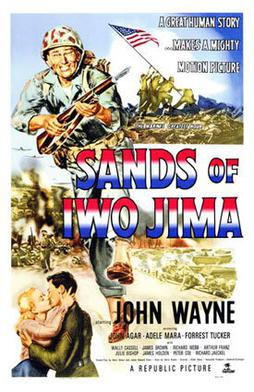
                 “Sands of Iwo Jima” is a John Wayne movie and he gives one of his best performances.  He was nominated for Best Actor.  Sgt. Stryker became his most iconic role and he brings the full force of his charisma to it.  The character is a bit more dimensional than his cowboy characters.  He gets to play tough, empathetic, drunk, morose, heroic.  He is outstanding.  The supporting cast is adequate and very old schoolish.  John Agar is the “I can’t live up to my dead father who happened to be a mentor for Stryker” so I will hate Stryker instead guy.  Forest Tucker is the Stryker foe.  Throw in an aggravating Italian Brooklynite for dubious comic relief.  The actual war heroes inserted into the cast can best be described as “not actors”.  

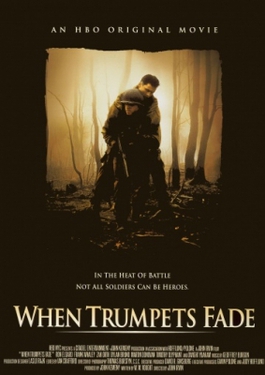
                “When Trumpets Fade” is dominated by Ron Eldard as the anti-hero David Manning.  It is a remarkable performance.  The character is far from stereotypical.  He is a survivor loaded with PTSD and a cynical anti-authority attitude who is thrust into an authority position.  Eldard plays him as a guy who would have despised Stryker.  The supporting cast is satisfactory.  Martin Donovan is excellent as Capt. Pritchett.  Zac Orth does good work as the "dead meat" Sanderson.

FIRST QUARTER:    
Sands of Iwo Jima         8           
When Trumpets Fade    8

CLICHES:

                 “Sands of Iwo Jima” is not an iconoclastic movie.  In fact, it helped set the template for war movies until the 1960s.  It begins with a dedication to the Marine Corps (and is virtually a recruiting film).  The unit is not as clearly defined as heterogeneous as in many similar movies, but it is still a small unit movie.  You have a hero and a defined mission (raising the flag).  Conflict in the unit (actually two – Stryker vs. Thomas, Stryker vs. Conway) is resolved.  You have the redemption in the form of Conway who has daddy issues and is a reluctant warrior.  You get rituals like a marriage and mail call.
                “When Trumpets Fade” was obviously made with cliché-busting in mind.  However, it is a war movie so you do have some familiar elements.  It has a dedication to the men who fought in the Hurtgen Forest.  There is a mission (actually two), but reluctantly led by an anti-hero.  You definitely have the leadership forced on the main character trope, but the twist is that he fights against it and is downright surly.  Does Manning get redemption?  He would certainly have sneered at that.  There are no rituals that I noticed.  Kudos for reversing the “fat guy with glasses must die” cliché.

HALFTIME SCORE: 
Sands of Iwo Jima         14       
When Trumpets Fade    16

PLOT: 

                “Sands of Iwo Jima” is your standard boot camp to battle flic.  Stryker inherits a motley group of Marines and trains them in a tough love way for the realities of battle.  Meanwhile, conflicts within the unit are developed so that combat can resolve them.  There are two battle scenes.  The first to establish heroism and the realities of war (Tarawa).  The second to show the success of the unit evolution as it accomplishes a mission (Iwo Jima).  The flow from training to off base to training to combat is smooth and entertaining, if predictable.
                “When Trumpets Fade” has an anti-hero thrust into command of a squad of replacements.  There is no training or bonding.  Manning does not want to lead and does not care about his charges.  The traditional early arc of a combat film is dispensed with.  The transitions are mainly from Manning encountering authority to combat sequences.  Similar to “Sands”, there are two main combat scenes.  Unlike “Sands”, these episodes are basically the suicide mission variety.  Both movies have the “who will survive?” vibe.

THIRD QUARTER:  
Sands of Iwo Jima        21
When Trumpets Fade   25

COMBAT:
                “Sands of Jima” has two big combat scenes- Tarawa and Iwo Jima.  In the first, Stryker takes out a bunker in typical John Wayne fashion.  Considering the potential inherent in the Battle of Tarawa, the movie is surprisingly lacking in action.  A promised night banzai charge never materializes (WTF?) and only the first day of the three day battle is shown.  Big letdown.  The Battle of Iwo Jima is more intense and satisfying although it relies substantially on actual footage (but very well used).  The violence is very old school.  There is little blood although we do get some bullet wounds.  Nothing women can’t handle.  However, men will probably cry (you know what I’m talking about, guys). 
                “When Trumpets Fade” is from the VioLingo school and intentionally pushes the envelope created by movies like “Sands”.  It also has two major combat sequences.  The first is the mission to take out the artillery battery.  Manning is forced to shoot one of the replacements who has freaked out and is causing the rest to panic.  Sanderson uses a flamethrower to roast the Germans.  The second mission is similar with the target being some emplaced tanks.  This time grenades and Thompsons and Garands are more de rigueur.  The movie throws in two larger group actions involving the graphic results of sustained artillery fire.  The wounds are graphic and bloody and there are numerous delimbings.  Plus two losers of battles with flamethrowers.

FINAL SCORE:  
Sands of Iwo Jima       27         
When Trumpets Fade  34

COLOR ANALYSIS:  This was a great match-up between Old School and VioLingo.  VioLingo is what I am trying out as my name for modern war movies that feature realistic violence and soldier talk and behavior.  The two movies could not be more opposite.  "Trumpets" is over the top in its "war is Hell" theme and "Sands" is one of the few war movies that is not definitively anti-war.  It is almost like Stryker's death was written in because the director decided it was needed to soften the film's glamorization of war.    Certainly, no one who watches "Trumpets" rushes out to join the Army, whereas many joined the Marines due to "Sands".  Another fascinating match-up was that of hero Stryker vs. anti-hero Manning.  The hero vs. anti-hero is a crucial difference between Old School and VioLingo.  It will be interesting to see how future bouts between these schools will turn out.  For example, "Guadalcanal Diary" against "Saving Private Ryan".