Sunday, March 23, 2014

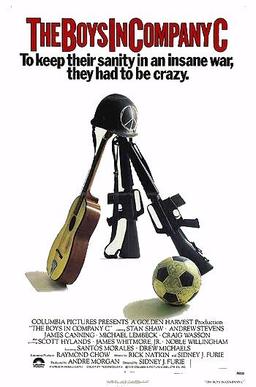
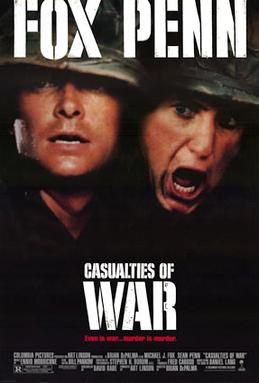
THE BOYS IN COMPANY C (11) vs. CASUALTIES OF WAR (6)


VS.


If you are new to the tournament, go to the opening post.

ACTING“The Boys in Company C” is an ensemble movie with a B-list cast of actors who probably thought they would become household names. Dream big, baby. The movie is dominated in the first 37 minutes by R. Lee Ermey as the Drill Sergeant in charge of training a motley crew of stock characters. Since the film was largely forgotten when it came out (including by Stanley Kubrick), people think Ermey was discovered for “Full Metal Jacket”. He is doing the same “acting” in this film. He is excellent, of course. However, the rest of the actors are embarrassingly bad. You would think it was their first movie. Several of the performances are grating, especially Andrew Stevens as Pike and Michael Lembeck (son of Harvey from “Stalag 17”) who plays the caricatured Italian wise-guy from Brooklyn. Argggh! D

“Casualties of War” has a much better cast. Michael J. Fox does an outstanding job playing the naïve, moralistic Eriksson. John C. Reilly (his first film), Don Patrick Harvey (playing his usual typecast bad guy), and John Leguizama (his second role) are solid. Thuy Thu Le is remarkable as the doomed Oanh (it was her only acting credit). Plus we get the bonus of Dale Dye in a fiery take on ass-covering brass. The only problem is the scene-chewing of Sean Penn as Sgt. Meserve. The performance has been praised, but not by me. His hammy portrayal of the villain is distracting. His emoting of faux grunt slang is the worst thing about the movie. Imagine a movie where he is the weak link in a cast with three comedians in their first substantial dramatic roles. A

FIRST QUARTER SCORE

Boys in Company C = 6
Casualties of War = 9


PLOT

“The Boys in Company C” covers a heterogeneous unit from boot camp to vignettes in Vietnam culminating in a soccer match. The plot is cliché-ridden and predictable. The characters are all stereotypes (the hippie, the ghetto drug dealer, the writer, the athlete, the ladies’ man). It’s painful to watch bad actors playing time-worn characters. The incidents in the movie are progressively ridiculous, culminating in the egregious soccer match. Every scene in the film has been done better in other films. F

“Casualties of War” is based on a true incident involving the rape and murder of a Vietnamese girl by a long range patrol. One member (Fox’s Eriksson) did not participate and was instrumental in bringing on a court-martial. It is a powerful tale well told. The movie is actually weakest in the set-up which attempts to establish the nature of the war and is too truncated in the trial phase, but the mission is the centerpiece and is strong. The theme of war’s corrupting influence and the moral that you must not compromise your principles are advanced efficiently. B

HALF TIME SCORE

Boys in Company C = 12
Casualties of War = 17


COMBAT

“Boys” is sometimes lauded for being one of the better Vietnam War movies and praised for its realism in reflecting the soldier experience. The combat scenes have some fair action, but they are Hollywood’s idea of Vietnam combat. We get the convoy ambush, patrol ambush, and the search and destroy mission. Lots of blanks are fired (from M-16s with banana clips) and there are plenty of explosions. All the unused ordnance is literally thrown in at the end to tack on a war is terrible theme. C

“Casualties” is not designed to be a combat movie and it shows. This is De Palma’s only war movie and he does not stage combat well. In the opening scene (which is a night ambush) Eriksson is sent out by himself to lock down a flank with a grenade launcher in the thick foliage! (Next time we see him he has a M-16. Good editing!) This is all to set up a ridiculous tunnel episode used for Meserve to save Eriksson’s life. (This is followed by Merserve referring to the ambush as a “mad f****** minute” – one of several of the inaccurate uses of slang in the movie.) The show piece of the latter half of the film is the assault on a VC base camp. The five man squad wipe out a much larger enemy force with the help of naval and air support. In the midst of the bells and whistles, we get a wrenching death. C

THIRD QUARTER SCORE

Boys in Company C = 18
Casualties of War = 24


REALISM

“Boys” is illogical and laughable. Once we get to Vietnam, the movie degenerates into a series of vignettes that are all ridiculous. A soldier steps on a mine in a rice paddy. A character plans to send dope back to the States in body bags. A general’s trailer is blown up with a claymore. And don’t get me started on the soccer game. These guys (who have never played soccer and do not practice) are competitive against a talented Vietnamese squad. Hey, American audience, soccer is so easy anyone can play it! D

“Casualties” is a pretty accurate rendition of the book it is based on. I have read the book so I can vouch for the realism of the film. The only major revision is with the attack on the base camp. No surprise that in reality the body count was much lower in reality. And no war-mongering Americans met ironic deaths in the process. Also, I would hazard that the complete lack of noise discipline for a long range patrol is a bit off. Sadly, the atrocity is not only factual, but not unrealistic. As far as Michael J. Fox playing a soldier, I won’t get into that. B

FINAL SCORE

Boys in Company C = 24
Casualties of War = 32


ANALYSIS:

“Boys” is highly thought of in some circles. It was the first significant post-war movie. It did poorly at the box office and some blame this on Americans not being ready for this type of film. And yet, the very next year marked the boom in Vietnam War films – starting with “The Deer Hunter” and “Apocalypse Now”. Obviously it did not flop because of the timing. It did poorly because it sucks. Compare it to “Go Tell the Spartans” (which came out the next year). “Casualties” is superior in every way and it is not an outstanding movie. It is significant and has a worthy cause. It also did not do well financially which proves that the public was not ready for dirty laundry as much as it did not want to see war as a farce.

Saturday, March 22, 2014

MARCH MADNESS 2014: Vietnam War Movies


vs.


                This year’s March Madness tournament is to determine the best Vietnam War movie.  In order to fairly judge the competitors, I limited the field to movies that have some combat in them.  This left out films like “Coming Home” and other mainly home front films.  Some other logical choices like “Rumor of War” were left out because I have no easy, legal access to them.  The seeding is based on their Rotten Tomatoes rating.  If they are too obscure to have a rating, I used my best judgment to seed them.  Here is the bracket:

1 -   Hamburger Hill

16 -  Under Heavy Fire


9 -   Go Tell the Spartans

8 -   Bat-21

 
4 -   The Deer Hunter

13 -  The Green Berets

 
12 -  Siege of Firebase Gloria

5 -    Platoon

 
5 -   Apocalypse Now

15 – The Tunnel Rats

 
10 -  We Were Soldiers

7 -    84 Charlie Mopic

 
3 -   Full Metal Jacket

14 -  Platoon Leader

 
11 -  Boys in Company C

6 -    Casualties of War

As usual, each matchup is divided into four quarters with each quarter being a different category where the film is judged on a scale of 1-10.  By the way, to prepare for the tournament I read the excellent book “Red Thunder, Black Lightning” by Eric Bergerud.  It is a study of the experiences of American soldiers in Vietnam concentrating on the 25th Infantry Division (the unit portrayed in “Platoon”).  There is a lot of oral history in it.  I also watched “The Anderson Platoon” documentary.  Although I have read extensively on Vietnam War fiction and nonfiction, I wanted to be on as solid ground as possible in analyzing how realistic the movies are.

Let the tournament begin and may the best film win!

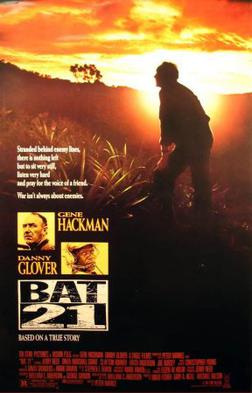
Bat-21  (9)  vs.  Go Tell the Spartans  (8)

ACTING:

                “Bat-21” is based on the true story of the rescue of a downed SAM countermeasure expert in the closing days of America’s involvement in the Vietnam War.  It is essentially a two actor movie with Gene Hackman playing Lt. Col. Hambleton and Danny Glover playing FAC Lt. Clark.  When Hambleton parachutes into enemy territory, Clark in his Skymaster (a propeller plane used for forward air control) maintains contact with him and aids in his rescue.  The two leads are their usual dependable selves although the characters are stock.  Hambleton is the REMF who wants a taste of action and Clark is the underappreciated, but dedicated trooper.  Jerry Reed has a good turn as Clark’s commanding officer who has to juggle common sense caution with the desire to turn Clark loose.  The rest of the cast is adequate with a grating performance by David Grant as Clark’s dauntless search and rescue chopper buddy.  B

                “Go Tell the Spartans” is a fictional tale of American military advisers in 1964.  A squad of Americans are ordered to take a small force of ARVN and local militia to garrison a supposedly strategic outpost in the middle of enemy territory.  The acting is a mixed bag.  A 65 year old Burt Lancaster, who was fully invested in the project (literally), has one of his best performances as the weary and cynical Lt. Col. Barker.  He dominates the movie.  The rest of the cast is an ensemble of thought-they-would-bes.  The performances vary from cringe-inducing to sincere, but forgettable.  Craig Wasson does a much better job one year removed from “The Boys in Company C” as the idealistic draftee that goes native.  C 

FIRST QUARTER:

Bat-21                                    8                             

Go Tell the Spartans           7

PLOT

                “Bat-21” is based on the remarkably resource intense, but wasteful rescue of Lt. Col. Hambleton.  The plot is very predictable.  You never doubt Hambleton will survive and Clark will be responsible for his rescue almost singlehandedly.  There is a character that is dead meat from the moment he enters.  The movie features the tired old trope of the brass holding back the seasoned vet (Clark).  Although surprisingly accurate in spots, the movie has the feel of implausibility throughout.  It has some good action and lots of low budget pyrotechnics.  The plot is obviously designed to evoke admiration for the spirit of American soldiers and does not question the war.  C

                “Go Tell the Spartans” is based on a novel entitled “Incident at Muc Wa”.  Although fictional, the plot fits American involvement in Vietnam in 1964.  The plot is cynical and anti-war.  Of course, in 1978 hindsight was easy, but the plot does accurately reflect the quagmire we were entering.  The ending is predictable, but the route to get there is not.  The movie deftly juggles the headquarters scenes with the scenes at the outpost.  B

HALFTIME SCORE

Bat-21                                    15

Go Tell the Spartans            15

COMBAT
 
                “Bat-21” has a surprising amount of action considering it is basically a rescue movie.  For example, Hambleton is forced to kill a civilian.  The big set piece involves two helicopters and a “deserted” ville that is laying in wait for them.  We get the unique view of a chopper dropping mines, which figure in the death of a main character, of course.  Much of the combat consists of air strikes by a Skymaster firing rockets and two F-5s (doing a poor imitation of F-4 Phantoms) dropping bombs they clearly do not have.  With that said, the film is much more a study of search and rescue than a film about combat in Vietnam.  D

                “Go Tell the Spartans” is low budget so the combat reflects this.  It does have more action than most Vietnam War movies.  There are a couple of night patrols that result in ambushes.  There is a big night assault by the Viet Cong on the outpost that expends a lot of blanks and explosions.  Air support is brought in.  It was too dark for me to tell if the fighters were actually carrying bombs.  The battle results in the usual extremely high percentage of dead to simply wounded.  There is also a melee as the survivors try to break out of the surrounded outpost.  C

 THIRD QUARTER SCORE

Bat-21                                    21

Go Tell the Spartans            22

REALISM
 
                For a movie based on a true story that is packed with the potential to be a great movie, “Bat-21” fumbles the premise by throwing in the usual Hollywood bull crap.  In order to concentrate on the relationship between Hambleton and Clark (which in reality did not exist), the movie gets overly melodramatic and features long dialogues presumably to give the enemy time to zero in on the transmissions.  Surprisingly, the movie tones down the effort to rescue Hambleton.  In reality, the military went to extraordinary measures to rescue downed air men and his is a classic case.  C

                “Go Tell the Spartans” is the most realistic take on the military advisers’ stage of U.S. involvement in Vietnam.  The characters may be stereotypes, but the scenario is true to the hair-pulling nature of the war.  For example, Barker has to bribe a corrupt ARVN general to get artillery support.  His commanding officer orders him to garrison an untenable location, confident that Americans can’t lose.  The movie is excellent in depicting the confusion of who the enemy was.  There is even a humorous dig at the McNamara-inspired use of statistics to determine enemy intentions.  The downbeat ending is realistic considering the situation.  B

FINAL SCORE

Bat – 21                                28

Go Tell the Spartans          30

ANALYSIS
 
            This was an interesting matchup between two movies set at opposite ends of the American experience in Vietnam.  The tone is also totally the opposite.  “Bat-21” is extolling the spirit of the American warrior and the comradeship of our soldiers.  Its central theme is how we would do almost anything to rescue our own.  It is an optimistic film.  “Go Tell the Spartans” has a cynical, we should have known better attitude.  Considering the nature of the war, it is more true to the war than “Bat-21”.  Simply put, “Go Tell the Spartans” is a better and certainly more important Vietnam War movie.

Wednesday, March 19, 2014

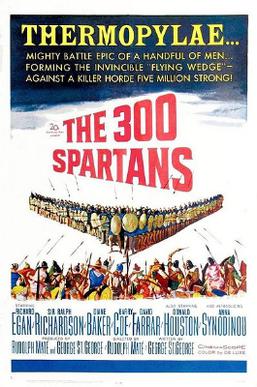
CLASSIC or ANTIQUE? The 300 Spartans (1962)


               Now that I have seen and reviewed "300:  Rise of an Empire",  I thought it would be appropriate to review the movie that inspired Frank Miller to create the graphic novel.  “The 300 Spartans” was made with the cooperation of the Greek government which provided 5,000 soldiers.  The film was shot near the site of Thermopylae.  It was directed by Rudolph Mate.  It was his only war movie.

                The credits roll over shots of the Acropolis.  The Persian Emperor Xerxes (David Farrar) marches into Greece with a variety of units.  A captured Greek spy sasses Xerxes about freedom versus slavery.  Cold War analogy.  A Greek traitor named Demaratus is an advisor to the Emperor.  He is also accompanied by a Greek queen named Artemisia (Anna Synodinou).  She is more than just an advisor, if you get my drift. 

                The Greeks are meeting at Corinth to discuss the invasion.  Themistocles (Ralph Richardson) argues for unity.  When a foe quotes the first Delphic prediction about blood running from the roofs, Themistocles counters with the second prediction referring to the “wooden walls”.  Later Themistocles and Leonidas (Richard Egan) discuss strategy using a model of Greece.  The Spartans will hold at the mountain pass of Thermopylae and Themistocles will bring the fleet.  Unfortunately, the Spartan council refuses to allow the Spartan army to go to war during a religious festival.  Leonidas defies them by taking his bodyguard of 300 men.   

                Phyllon (Barry Coe) is the son of a traitor, but engaged to the niece of Queen Gorgos of Sparta.  He wants to prove himself, but Leonidas refuses to take him along because of his father and to set up a redemption arc.  Phyllon and Ellas (Diane Baker) tag along.  The Spartans are joined by 700 Thespians.  The Greeks arrive at the pass and begin to fortify it.

                Leonidas leads a surprise night attack on Xerxes camp.  Phyllon sneaks into the group to begin his redemption.  They catch Xerxes with his pants down as he is canoodling with Artemisia.  As a result of the ass-whipping,  Xerxes executes all the camp followers to motivate his men.  Meanwhile, Leonidas gets the unwelcome news that the Spartan army will not be coming.  They are on their own.

                In the first Persian assault, the infantry advances in lines and the Spartans await in lines.  The Persian cavalry attacks through the infantry and the Spartan front line ducks!  The horsemen are trapped between the first and second lines and a melee results.  After this initial fight, Leonidas meets with Xerxes second in command.  “Our arrows will blot out the sun.”  Leonidas:  “Then we will fight in the shade.” 

                On day two the Persians send in chariots which are dealt with by archers and javelinmen.  Next it’s the Immortals with their wicker shields and short spears.  The Spartans fight in a phalanx.  Phyllon has pretended to be dead and then sets fire to hay behind the Immortals.  War epics love fire!

                A Greek traitor named Ephialtes visits Xerxes to tell him of a goat path to get behind the Spartans.  Leonidas sends Phyllon back to Sparta to inform them of the situation.  The Thespians stay thinking they will become famous for their sacrifice.  Oops!  Note the title of the movie.

                Spoiler alert if you are so ignorant that you don’t know the outcome of the battle.  Xerxes leads the final attack in his white chariot (shouldn’t it be black?).  Leonidas advances in a wedge shape.  Leonidas is killed and the remnants carry his body to a hill and form a circle around the corpse.  Xerxes offers them their lives if they give up the body.  They prefer a barrage of arrows.  Remember Thermopylae!

                I was pleasantly surprised at how accurate “The 300 Spartans” is.  You get the basic facts about the battle from the film, but a lot of the details are fudged.  The background is the strongest section.  Xerxes did march into Greece with a huge multi-ethnic army.  Greeks like Themistocles did view the struggle as freedom versus slavery (as posited by Herodotus).  The main characters are based on actual personages and are not caricatures.  Their relationships are Hollywoodized.  There is no evidence that Artemisia and Xerxes had an affair, but it is not beyond possible.  Themistocles and Leonidas did not meet to discuss strategy, but the strategy discussed is fairly close to what actually happened.  The movie does an admirable job fitting in the most famous quotes from Herodotus.  For example, the “fight in the shade” line.

                The movie veers away from history and military sense in the battle itself.  The raid on the Persian camp was crap, of course.  But necessary to redeem Phyllon.  There is no record of Xerxes killing the camp followers.  The battle is laughable in its tactics.  The narrowness of the pass did not lend itself to lines of infantry.  Plus the Spartans would have been in a phalanx anyway.  Given the nature of the terrain there would have been no use of cavalry or chariots by the Persians.  The Immortals are accurately dressed, but the Spartans look like legionaries.  The fire surprise is pure bull shit, just as it was in “Spartacus” and “Braveheart”.  The role and motivation of Ephialtes is fine and certainly closer to the truth than in “300”.  Xerxes may have had a white chariot, but he did not participate in the battle.  The death of Leonidas is as per Herodotus.  Overall I would give the film a C for accuracy. 

                “The 300 Spartans” is surprisingly not sucky.  Egan and Richardson do a good acting job, but the rest of the cast is low rate, especially the females.  However, nobody embarrasses themselves.  The romantic subplot is lame and perfunctory.  The dialogue is average, but gets points for borrowing from the ancient sources.  It was cool hearing the famous quotes.  Although the tactics are shaky, the action is pretty good.  The hand to hand is well done and the deaths are not laughable.

                “The 300 Spartans” is a fun companion to “300”.  It is entertaining in an early 1960’s B-movie sort of way.  Watching it and then comparing it to “300” could not be a bigger contrast between an Old School war movie and whatever the Hell “300” is. 

Grade =  C

Saturday, March 15, 2014

# 7 - La Grande Illusion (1937)


BACK-STORY:  “The Grand Illusion” is a film by the acclaimed French director Jean Renoir, son of the famous Impressionist painter.  He wrote the screenplay along with Charles Spaak.  Renoir was inspired by his own experiences as a reconnaissance pilot in WWI, but the film is far from autobiographical.  Von Stroheim wore Renoir’s uniform in the movie.  The title of the film was influenced by the book “The Great Illusion” by British economist Norman Angell.  Angell argued that war was useless because nations have common economic interests.  Good call, Norm!  The movie was famously banned in Italy and Germany.  Goebbels even had Renoir labeled “Cinematic Enemy #1” and attempted to have all copies of the prints destroyed.  Fortunately, a print was recovered by the U.S. Army (no, not by the Monuments Men) after the war and Renoir was able to accomplish a celebrated restoration.  The movie was the first foreign language film to be nominated for Best Picture at the Academy Awards.

OPENING SCENE:  In the bonne homme atmosphere of a base canteen, a French pilot Lt. Marechal (Jean Gabin) is called to the commander’s office and informed that he will be carrying a passenger on his next flight.  Capt. Boeldieu (Pierre Fresnay) is an upper class staff officer who wants a taste.  Jump to a German officer’s club where the ace Rauffenstein (Erich von Stroheim) is returning from shooting down a French plane.  You don’t suppose?  You guessed it. Rauffenstein invites his two victims to dinner and establishes a bond with Boeldieu because they are both aristocrats.  Marechal is accepted because he is a fellow knight of the air.

SUMMARY:  Boeldieu and Marechal are sent to a prison camp that reminds of a summer camp.  This is definitely not a WWII POW movie.  They are put in a room with a group of everymen who dine on non-slop with wine and cognac.  The fare is provided by a Jewish prisoner named Rosenthal (Marcel Dallo) who belies the stereotype of his race by sharing the contents of his parcels.  (These guys eat better than their guards, but the guards are cool with this.)  The men get along smashingly well and even tolerate the snooty Boldieu as he tolerates the unwashed.  Which reminds me to mention that one of the men gives Marechal a foot bath!  What’s the opposite of a POW movie cliché?  One of the prisoners is a barracks clown.  It is like if Lou Costello was in “The Great Escape”.


Rosenthal receives one of his wonderful parcels
                The men are digging a tunnel and dispose of the dirt in a manner similar to “The Great Escape” except that they do not seem to care if German guards see them disposing of the evidence.  Speaking of clichés, the camp receives a trunk of women’s clothes which allows them to stage a vaudeville show.  The clown sings a jaunty number and British soldiers do their impression of the Folies Bergere.  In the middle of the show word arrives that the French have retaken Fort Douaumont in the Battle of Verdun.  This prompts Marechal to lead the POWs in “Le Marseillaisse”.   (Note to “Casablanca”: copy this.)  Marechal is thrown is solitary for this act of taunting.  He goes a little stir crazy since he is deprived of the gourmet dining.


Boldieu cleverly hides his bag of dirt
                Just when we are primed for the big tunnel escape scene, the men get sent to another prison camp.  When told, they take it remarkably well.  None curse their infernal luck.  Boeldieu and Marechal end up in a converted castle run by … Rauffenstein!  He is disabled from war wounds (which make him literally stiff) and has been relegated to camp commandant.  He is happy to see Boeldieu who is a kindred soul (they both have monacles).  Raffenstein reads a list of escape attempts they made at the interim camps.  Marechal and Boldieu have been quite the artists, which is news to the audience.  Raffenstein gives them a tour of the very picturesque castle (filmed in an actual castle in Alsace)  and proclaims it “inescapable” (like every other prison camp in war movie history).


Boeldieu and Rauffenstein discuss aristocratic stuff
                The quarters are even more comfortable than the first camp.  Once again, their roommates are all swell guys.  One of them is Rosenthal!  He and Marechal concoct an escape plan involving a homemade rope, but they will need a distraction.  Boeldieu suggests they have all the inmates play flutes and raise a ruckus.  Apparently the Red Cross has sent them 50 flutes.  When stage one of the racket has succeeded, Boldieu buys more time with a command performance with his flute as he roams the upper reaches of the castle.  Rauffenstein is forced to fire on his soulmate and mortally wounds him.  Boeldieu gets a great death scene with the heartbroken Raffenstein by his bedside. He tells the German: “For the commoner, dying in a war is a tragedy.  But for you and me, it’s a good way out.”  He warns Raffy that the days of the aristocracy are coming to an end and their kind will have trouble adjusting to the new social order after the war.

My first blog GIF!  confiscation of the flutes
                Marechal and Rosenthal are on the lam, but the biggest problems they face are themselves.  They have a falling out until they realize that everyone in this movie is supposed to like each other.  They find refuge at a German farm belonging to a war widow named Ella (Dita Parlo) who has lost her husband at Verdun and two brothers in other battles.  She holds no grudges and falls in love with Marechal.  Who wouldn’t?  She has the cutest little girl who, sticking with the main theme of the movie, is not a brat.


War is Hell!
CLOSING SCENE:  Hard to believe, but Ella’s home is even better than the German POW camps.  Marechal and Rosenthal settle in long enough for a relationship to develop between Marechal and Ella.  But as we all know, bros before hoes in war movies.  Marechal and Rosenthal must be moving on to help win the war against Ella’s country.  Marechal promises to return after the war.  (Is this the Grand Illusion?)  The movie leaves us hanging as it ends with the duo making it to Switzerland ahead of a German squad that nicely restrains from shooting them.  This movie does not have Nazis, it has Nicies.

WOULD CHICKS DIG IT?  Sure.  There is no combat to offend anyone’s sensibilities.  There is bromance and romance. There is a cute little girl.  Jean Gabin was the French George Clooney of his day.  There are no villains to creep out anyone.

HISTORICAL ACCURACY:  The movie is not based on a true story, so historical accuracy is not a factor.  I was very curious about the portrayal of the prison camps because they were so different than what we are used to seeing in WWII POW movies.  It turns out that the relatively cushy life in the camps shown in the movie is fairly representative of reality.  The Germans did establish camps for officers (Offizierlagers) in castles, hotels, etc.  The officers got much better treatment than the enlisted.  They had more space, better food, and did not have to work.  They were allowed recreational activities like theatricals.  In some camps they were even allowed to go on walks outside the camp if they swore on their honor not to escape!  The Germans also had “reprisal camps” designed partly to punish escapees.  It seems likely that Marechal and Boldieu would have ended up in one of these instead of in the castle.  Rauffenstein is representative of the fact that commandants were sometimes disabled officers.  The camp guards did have a reputation for being humane so “Arthur” is typical.

                The diet of the prisoners was poor.  Not surprising because due to the Allied blockade the German people were suffering from malnutrition, too.  The prisoners did get to supplement their food with parcels from home, but it seems highly unlikely that Rosenthal’s family could have sent enough parcels to allow the meals the crew routinely eats in the camp.  Plus, the French prisoners were noted for receiving substantially less parcels than the British.

                The reference to Fort Douaumont seems accurate.  The fort did fall to the Germans in Feb., 1916 and then was recaptured by the French in Oct., 1916.  The movie’s time frame must be actually referring to the French recapturing part of the fort in May which they held only temporarily.

CRITIQUE:  “La Grande Illusion” is famous for its themes. Renoir was aiming at class divisions.  Specifically the gulf between the upper and lower classes.  Marechal, a mechanic before the war, and Boeldieu, a nobleman, represent the opposing classes.  Surprisingly, Renoir does not show the conflict between the classes.  These characters do not even have a rocky start before developing their friendship.  Even Rauffenstein treats the lower class inmates with respect, if disdain.  Renoir does not make the case that the two social classes can not live together, unless he is contrasting the egalitarian prison camp to peacetime society.  Boeldieu blends in easily with his prison mates and only rolls his eyes occasionally.  The Boldieu character is the least stereotyped in the movie.  Second least is Rauffenstein.  Stroheim had a reputation for playing villains so you do not expect him to be so humane.  Hell, he did not even mean to kill Boeldieu – he was aiming at his leg.  He is more stiffly (literally) upper class than the Frenchman, but only slightly so.  He has to work harder to tolerate the commoners, but he is not a pompous ass.  The subtheme is that the upper class sticks together.  Boeldieu and Rauffenstein feel a kinship that goes beyond national boundaries.  Renoir is making the case that in the future there will hopefully be no national boundaries and no class distinctions.  The movie makes this prediction.

                The movie has the technical hallmarks of a masterpiece.  The cinematography is not overblown, but shows the ability of a master.  He tends toward long takes with few cuts.  In other words, the opposite of a modern war movie.  When we are introduced to the first group of prisoners, they share a meal (food was important to Renoir) as the camera moves around the table.  There is a nice tracking shot during the theater rehearsal.  The camera pans over items in Raffenstein’s castle room to establish his Prussianness in the mise en scene.  The dialogue is nothing special.  You do not get the impression you are watching a play transferred to the cinema.  The music did not make an impression on me other than to notice there were large stretches where there was no background music to set the mood of the scene.

                The acting is a strength of the movie.  The cast is appealing, which is not surprising since all the characters are appealing.  Gabin has a lot of charisma – enough to get a German war widow (who he cannot communicate with) to fall in love with him in record time.  Fresnay is not as wooden as Boeldieu could have (should have?) been.  He does not twirl his mustache and his flute playing is transcendent.  Stroheim is good in playing against his usual villainy.  He had a lot of say in the character’s development.  Dallo is fine as Rosenthal and does not ham up the Jewishness of the character.  Rosenthal is an important cinematic figure given what was going on in Europe at the time.

I was not kidding about that foot bath!
CONCLUSION:   When I first watched “La Grande Illusion”, I wondered what the big deal was.  Then I watched the movie again with the commentary track by a cinema expert and I wonder less, but still I don’t get what the big deal is.  I understand what Renoir was trying to do, but I did not find it effective.  It is not genius to point out there was a class problem in Europe.  What is perplexing to me is why Renoir chose to make the upper class characters likeable and why the two classes get along so well in movie.  There is not a single negative character in this movie.    There is zero dysfunction.  How unrealistic!  Speaking of lack of reality, I know the depiction of the camps was accurate in the basics, but to portray them as better than being home with the wife was implausible.  I also found that the movie lacked suspense.  They dig a tunnel and then don’t get to use it. They escape from the castle and there are no shots fired and no pursuit. They hide out in a German farm house and no one comes banging on the door. I know it’s not “that kind of movie”, but that does not make it great entertainment (as many claim).  I suppose you could argue that it is a great movie, but I do not think it is a great war movie.  It is tremendously overrated and does not belong in the Top 10.  Discuss.

RATINGS: 

Acting =  A
Action =  4/10
Accuracy =  C
Realism =  C
Plot =  B

Overall =  C