Thursday, August 31, 2017

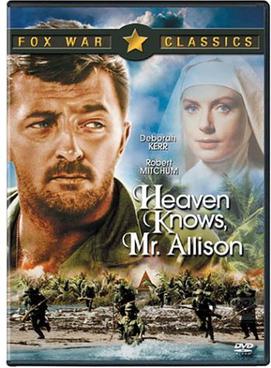
DUELING MOVIES: Heaven Knows, Mr. Allison (1957) vs. Father Goose (1964)


VS.


                “Heaven Knows, Mr. Allison” was based on a novel by Charles Shaw.  John Huston and John Lee Martin adapted the screenplay and Huston directed.  Huston and 20th Century Fox envisioned it as a successor to “The African Queen”.  You’ll enjoy it more if you forget that.  It stars Robert Mitchum and Deborah Kerr.  It was the first of their four screen pairings.  They became good friends during the filming as Mitchum bonded with her when she would curse while wearing her nun costume.  She gamely put up with the drunken binges of her director and co-star.  She ended up being nominated for Best Actress.  Huston and Martin were nominated for Best Adapted Screenplay.  It was a screenplay that was vetted by the National Legion of Decency.  The Catholic Church also had a hand in monitoring the production to protect the image of its nuns.  The movie was filmed on Trinidad and Tobago. The actors to portray the Japanese-speaking soldiers had to be brought in from a Japanese community in Brazil. 

                The movie opens with a stranded Cpl. Allison (Mitchum) coming ashore on a little island in the Pacific.  There is a deserted village, but he meets a lone nun named Sister Angela (Kerr) who maintains the church.  What Allison hopes is an Adam and Eve scenario ends when the Japanese arrive and the duo goes into hiding.  Close proximity and the tension of being prey could lead to something.  If the Catholic Church was not on the set.

                “Heaven Knows, Mr. Allison” was a popular movie, but as a war movie it is nothing to get excited about.  It is more of a character study than a war film.  There is little suspense, even when Allison sneaks into the Japanese camp.  This is a shame as the situation should have lent itself to some edging to the front of your seat.  The movie is too busy toying with the “will they or won’t they?” question.  The leads do have a lot of chemistry and Mitchum and Kerr were great actors, but the moral restraints placed on the script hindered a realistic portrayal of two beautiful people marooned on an island.  Actually, Kerr’s Angela is an authentic character.  Or, what the Catholic Church would have us believe is a typical nun.  As far as Mitchum’s gyrene, we get a family-friendly leatherneck.  He is one of the more saintly Marines you will run into in a war movie.  (Maybe the Marine Corps was on set also.)  Mitchum’s dialogue sounds phony and the romantic arc is unrealistic.  It is rushed due to cinematic time constraints.  We go from “hey lady, get real” to “I never realized how attractive you are” to “let’s make the best of the situation” to “marry me” to “admit it, you want it too” to “I respect you” too patly.  The “supervision” of the film caused a watering down of the theme comparing the Marine Corps to the Catholic Church.  The biggest problem with “Heaven Knows” is that the plot makes little sense.  Specifically, the actions of the Japanese are unrealistic.  (For instance, the Japanese actually invade the island twice!) At least they speak with no subtitles and are not demonized.

                “Father Goose” was Cary Grant’s second-to-last screen role.  He turned down the role of Henry Higgins in “My Fair Lady” because he wanted to play against his usual suave characters and instead play a role that was close to his actual personality.  Apparently, the real Grant  liked to dress like a bum and yell at kids to get off his lawn.  The movie was directed by Ralph Nelson (“Soldier Blue”).  The screenplay was an adaptation of the short story “A Place of Dragons” by S.H. Barnett.  Peter Stone and Frank Tarloff won an Oscar for the screenplay.  The movie was nominated for Film Editing and Sound.  The song “Pass Me By” was not nominated but was later a hit for Peggy Lee and was recorded by Frank Sinatra and others.  The movie was filmed in Jamaica.  It was a big hit.

                The movie opens in early 1942 with the Japanese rampaging through the Southwest Pacific.  Walter Eckland (Grant) is a loner who couldn’t care less about the war effort.  He is “recruited” by Commander Broughton (Trevor Howard) of the Royal Australian Navy to be a coast watcher.  The curmudgeonly Eckland is more civilian than most civilians, but he is given no choice.  He is deposited on a deserted island with a radio.  To get him to file periodic reports, Broughton has hidden whiskey bottles and reveals their locations only upon receipt of the reports.  When he is sent to rescue another coast watcher, Eckland instead is saddled with a school teacher named Catherine (Leslie Caron) and her seven girl charges.  The situation is reminiscent of Felix Unger moving in with Oscar except that Felix is a woman and she brings teenage girls with him.  Eckland tops Oscar by being not only a slob, but also an asshole.  Naturally, “Mother Goose” (Eckland’s code name) gets along with “Goody Two Shoes” like an old mutt with a Persian cat.  Eckland hurls a lot of invective such as “you should carry a tambouring and put fig leaves on statues”.  Oh, snap!  These two have as much chance of falling in love as that old mutt and the Persian cat.  Unless this is a movie.

                “Father Goose” is fluff, but it is well done fluff.  The confection has one prime ingredient – Cary Grant.  He has fun playing against type and Caron is an excellent foil.  They have chemistry and this makes the absolutely predictable romance watchable.  Like “Heaven Knows, Mr. Allison”, the romantic arc is too rushed, but hell, there’s a war going on.  In most ways, the movie is more of a romantic comedy than a war movie.  As far as the comedy part, the movie is fairly amusing.  Grant gets some funny lines (he had his writers on call), as does Howard.  Although it co-stars the venerable war movie stalwart Howard, his Boughton is mainly there to facilitate the comedy.  He seems to have had fun as well.  It’s not often you get to top a Cary Grant character.  His character is the key to making the movie above average.  For a comedy, it is surprisingly more suspenseful than “Heaven Knows”.  You’re not going to lose sleep, mind you.  Another surprise is that it actually has more of an “The African Queen” vibe than the other movie.  The two main characters are much closer to Charlie and Rose than Allison and Angela are.  Speaking of which, although the script is competent, it hardly deserved an Oscar.  (It beat out “Hard Day’s Night”!)  “The African Queen” was only nominated.

                Both movies are better as movies than war movies.  However, “Father Goose” is more entertaining and less unrealistic in its handling of an unrealistic situation.  At least, there were coast watchers that served in the Pacific.  I wouldn’t say that the movie honors them, however.  “Father Goose” is just more comfortable in the romantic comedy genre than “Heaven Knows, Mr. Allison” is in the romantic genre.  “Heaven Knows” was crippled by the production code and the blue noses and clergymen who scrutinized it.  It also fumbled the trapped scenario.  The two are very much of their times, but “Father Goose” would fit well into today’s rom-com environment.  “Heaven Knows” is too uptight to find a modern audience. 

GRADES:  Heaven Knows  =  C-

                  Father Goose  =  B-    

Monday, August 28, 2017

PICTURE, MOVIE, QUOTE #20


 WHAT MOVIE?  It is a biopic of the last years in the life of a famous German general. The movie was controversial because coming only six years after the war, it’s sympathetic portrayal of an enemy commander was greeted with anger by some critics and a number of veterans. One theory that has surfaced to explain the positive spin is the U.S. was in the Cold War and there was a need to show that there were good Germans. Interestingly, because of the criticisms, the same actors portrayal of the character several years later is less sympathetic.

QUOTE:  "The thing that's always worried me about being one of the few is the way we keep on getting fewer."

Thursday, August 24, 2017

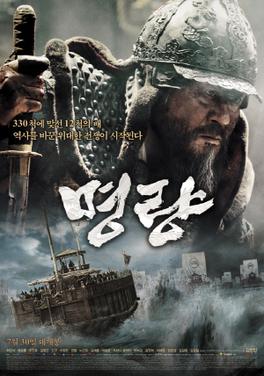
NAVAL COMBAT PORN: The Admiral: Roaring Currents (2014)


                “The Admiral:  Roaring Currents” is a South Korean war  movie that was directed and co-written by Kim Han-min (“War of the Arrows”).  It was titled “Battle of Myeongnyang, Whirlwind Sea” in South Korea.  It was a smash hit with 10 million viewers in the first twelve days.  It went  on to be the highest grossing South Korean film ever.  It won Best Picture at the Grand Bell Awards (like the Academy Awards).   It is based on the naval battle of Myeongnyang in 1597.  In the battle, the legendary Korean admiral Yi Sun-sin defeated a Japanese fleet of 300 warships with only 13 of his own.

                After a bad defeat, the recently imprisoned Yi Sun-sin is reinstated to command of the pitiful remnant of the Korean fleet.  Yi has been ordered to disband the fleet and join up with the army for a last stand against the invaders.  This seems like a good idea considering the morale of his sailors is rock-bottom and Yi is in ill health and seemingly apathetic.  Plus he has PTSD from his recent imprisonment.  On the other side, the Japanese commander in chief sends a pirate named Kurushima to light a fire under his admiral Todo.  Kurushima is a total bad-ass who has a grudge against Yi for killing his brother.  He also has a henchman named Haru who is a sharpshooter. 
                 At his camp, everyone is depressed and Yi is morose.  Things can’t get any worse. Except they do.  One of his subordinates, Bae Seol, is a traitor who attempts to assassinate Yi and successfully destroys the only Turtle boat.  Damn, I was really looking forward to seeing that Turtle boat win the battle by itself!  Plus, this was a pretty short movie with an unsatisfying conclusion.  But wait, this insane admiral does not know the word quit.  He does some recon and discovers a place where the current is as insane as he is.  Perhaps he can lure the overconfident (and how can they help but be?) Japanese into a roaring trap.  Before you say “how can only 13 ships beat 300?”, be aware that at first only Yi is willing to take on the entire Japanese fleet.  Well, not actually the whole fleet, because only Kurushima’s contingent advances.  It still should be way more than is needed except that they are facing a dude named Yi and incidentally, there is a whirlpool.  What ensues is typical Korean mayhem, only this time on water.  And it lasts 61 minutes!

                As my readers know (both of them), I am a big fan of South Korean war movies.  They are the greatest practitioners of combat porn on planet Earth.  This is the first one set on the water that I have seen, so I was a little skeptical.  The battle is epic.  Just when you think it cannot get anymore gonzo, Kim Han-min steps it up a notch.  So a scene that starts out at a 10 on the combat porn scale, ends up at a 15.  Kim films the action with a variety of cinematography including slo-mo, of course.  There is abundant use of CGI, but it is amazingly seamless.  Kim did have the use of eight ships that were very detailed recreations of the period warships. The violence is graphic and relentless.  The choreography of the melees is outstanding.  There are a wide variety of weapons used.  Muskets, fire arrows, cannons, even a rocket.  There is a fireship loaded with gunpowder which you can imagine the explosion.  But the movie is not just action.  The plot is fine with the theme of make the enemy fear you and turn your men’s fears into courage.  Yi does not manage this with the usual cinematic charisma.  Choi Min-sik plays him as damaged, but driven.  He’s a magnetic actor and won the South Korean equivalent of the Oscar for Best Actor.  Plus the movie has a great villain in Kurushima, “The Pirate King”.  He’s so bad, the other Japanese don’t like him.  All this with a Hans Zimmeresque epic score.  The movie is surprisingly accurate in a "300" kind of way.  Granted, it’s a Korean war movie version of the events.  Like how “Godzilla” was the retelling of a lizard being found in a Tokyo sewer.

GRADE  =  A

HISTORICAL ACCURACY:    The background information that leads off the movie is accurate.  In the 16th Century, Toyotomi Hideyoshi united Japan and then decided to conquer Korea and possibly China.  The movie is set in his second invasion of Korea which began in 1597.  The Japanese army advanced northward and had the objective of capturing the Korean capital.  Admiral Yi Sun-sin won numerous victories against the Japanese fleet, which had the effect of slowing down the Japanese advance by cutting its supply lines to Japan.  Unfortunately, Yi was removed from command due to Japanese espionage and court intrigue.  He was tortured and demoted to a common soldier.  He was replaced by a rival who subsequently got his ass whipped at the Battle of Chilchonryang.  This defeat cost the Josean Navy around 200 ships.  Yi was reinstated, but had only 12 ships under his command.  Those ships had been saved by a captain named Bae Seol.  As the movie shows, Yi had problems beyond the small size of his force.  His sailors and commanders were justly demoralized and not exactly keen on another confrontation.  In fact, the government strongly urged Yi to disband the fleet and take the crews to supplement the army.  Yi refused and many of his men thought he was nuts.  Bae Seol deserted, for instance.  Unlike in the movie, he did not try to assassinate Yi.  And there was no Turtle ship to set afire.  The inclusion of the Turtle ship was a nice nod the memory of Yi because he was credited with designing the iconic ships.   Bae was later caught and executed for desertion.

                Yi did scout out locations for the battle and decided on the Myeongryang Strait.  Besides the narrowness which would negate the size of the Japanese fleet, the current was ten knots.  Not only that but the current shifted around after three hours so at first the Japanese ships would be impelled forward into the Koreans and then would be forced rearward.  The strait was rife with eddies and whirlpools which would cause severe problems for maneuvering and swimming if any Japanese sailors went overboard or were on sinking ships.  In other words, it was the perfect location for what he had in mind.

                The Japanese fleet was actually about 130 warships (the movie’s number of 330 would have been arrived at by adding support vessels).  Kurushima was in command of the vanguard.  I found no evidence that he was considered to be a pirate and was not liked by the Japanese commander Todo Takatora.  Although the Japanese fleet included some sharpshooters, the Haru character is clearly fictional.  He would have been better placed in the Korean fleet because it relied on missile weapons and stand-off fighting whereas the Japanese tactic was to close in and board.

                As far as the battle itself, the movie gets the foundation right, but enhances the action in ways only a South Korean war movie can do.  On the day of the battle, Yi advanced his fleet and anchored at the northern end of the strait.  He then moved the flagship forward to provoke the battle.  This act of seeming suicide was probably due to the reluctance of the other twelve ships to accompany him.  Kurushima took the bait and accepted combat with his vanguard.  The rest of the Japanese warships held back, most likely because they were intimidated by the knowledge that it was Yi they were facing.  They had good reason to be awed as Yi’s ship was able to hold its own against numerous opponents by using it cannons, arrows, and larger size.  Seeing the flagship performing magnificently, the other ships gradually joined starting with An Wi.  Yi’s ship was not boarded, but An Wi did have to repel boarders.  The death of Kurushima did occur, but the circumstances are unclear.  The corpse of a Japanese general named Modashi was fished out of the water and decapitated.  His head was launched toward the enemy.  A second turning point occurred when the current shifted outward.  The Japanese ships lost headway and began to drift rearward.  They also began to collide with each other.  Cannon fire and ramming increased the panic of the Japanese.  There was no giant whirlpool.  Thirty ships were sunk in the melee.

                The result of the battle was morale was restored in the Korean navy and the military in general.  China’s navy came into the war to aid the Koreans.  Japan never did get to the capital.                

Saturday, August 19, 2017

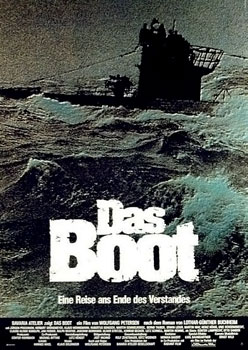
FINAL: #1 Das Boot vs. #2 Run Silent


VS.


                We have finally reached the end of the tournament.  I have to admit it was not a thrilling one.  There were a few minor upsets, but nothing shocking.  In the end, the two movies that critics consider the best of the subgenre ended up in the finals.   That was fairly predictable, especially for “Das Boot”.  Although suspense was missing, I enjoyed the opportunity to visit this subgenre and pass on some information about the various movies that comprise it.  It is a subgenre that was once a thriving one and occasionally returns as a branch of the action genre.  In my process of preparing for the tournament, I learned a lot about the history of WWII submarine warfare.  It is fascinating to me and it was interesting to see how submarine movies pass on that history.  Unfortunately, knowledge of how submarines fought makes enjoyment of the movies problematical.  Submarine movies exist mainly because movie makers see the potential for drama in a confined space.  They usually are not concerned with tactical or historical accuracy.  This means that what makes them entertaining for the masses makes them less so for history buffs like me.  As you can perceive by following the tournament, I do not think there are very many good submarine movies.  However, the tournament did give some recognition to some forgotten gems like “Above Us the Waves”, “We Dive at Dawn”, and “Hell and High Water”.  Although there is only one great movie in the subgenre, there are some other must-sees. 

                                                                             
PLOT:  Boot =  A  Run  =  C 
                                     
ACTING:  Boot  =  A+     Run  =  A
                                                
TACTICS:  Boot  =  B      Run  =  F
       
CLICHES:  Boot  =  B      Run  =  D
       
DIALOGUE:  Boot  =  B      Run  =  B 
  
ACTION:  Boot  =  B      Run  =  B 
           
SPECIAL EFFECTS:  Boot  =  C       Run  =  B
     
ACCURACY:  Boot  =  B      Run  =  C

CHARACTERS:  Boot  =  A       Run  =  B
  
REALISM:  Boot  =  A+      Run  =  D
                                               
SAILOR BEHAVIOR:  Boot  =  A+  Run  =  C

ENTERTAINMENT:  Boot  =  B  Run  =  B                                             

DAS BOOT  =  102
RUN SILENT  =  81

ANALYSIS:  No one should be surprised by the winner of the tournament.  “Das Boot” is an acclaimed movie that created quite a stir when it came out in 1981.  It is an adaptation of one of the best submarine novels and it was in the hands of a great director (Wolfgang Petersen) who was obsessed with the quality of the production.  The effort that went into the film was amazing and it shows.  The production costs were very high.  Petersen assembled an ace cast and one hell of a great cinematographer (Jost Vacano).  The movie was nominated for six Academy Awards including Director and Adapted Screenplay.  It still holds the record for most nominations for a German film.  It has a 98% rating on Rotten Tomatoes.  Most importantly, as far as war movie buffs are concerned, it avoided the clichés that make the subgenre so tiresome.  It also avoided the requirements of the action genre.  Even though it came late in the subgenre, it is a unique film.

                “Run Silent, Run Deep” should have been a worthy opponent.  It is also based on a great novel, but in this case the adaptation was poor.  It does have a decent cast and certainly star power with Gable and Lancaster.  However, the director (Robert Wise) was not sterling.  The big problem with the film is that in making the movie entertaining for the average viewer, it insults war movie lovers.  Not played for laughs, it still provides them if you know submarine warfare.  It is noteworthy that in spite of its flaws, it made it to the finals.  This speaks volumes for the weakness of the subgenre.


                Thank you to everyone who followed the tournament.  I am self-motivated, but it is still nice to know someone is following.  Now I have one year to ponder what the next tournament will be.