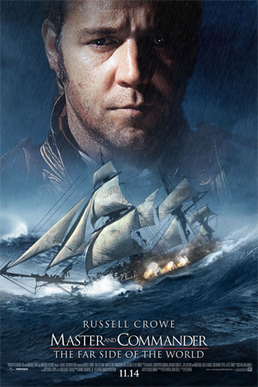
1. How would you describe Aubrey's
leadership style?
Aubrey is a crew’s captain.He empathizes with his men and understands
them.He recognizes their superstitions
like the whole “Jonah” thing.He also
believes in discipline and punishes one of the men who disrespected an
officer.It was obvious he understood
what motivated the sailor, but rules are rules.He refuses to reduce the grog ration to prevent future incidents because
he understands how important that treat is for the men.He is idolized by the men partly because he
is successful (which means more prize money for them) and he is considered to
be lucky.He clearly does not ask them
to do anything he would not do himself.
Aubrey also maintains a good relationship with his
officers.He drinks with them in a good
fellowship way and listens to them, although his decisions are final.The way he deals with Hollom is instructive.He tries to be sensitive, but is firm.Although he sees the crew’s viewpoint, he
tries to buck up Hollom and help him reach his potential.He trusts his subordinates and gives them
opportunities to lead.
2. Is Aubrey motivated more by pride or duty?
I have to say it’s mainly pride, he even admits he
has gone beyond his orders.At one point
he says after the enemy had gotten behind him a second time that he would not
let it happen again.Lucky for him his
leadership style has created a surplus of good will that he taps into.Great commander soften show this motivation,
including his idol Nelson.I have to add
that along with hubris, he also has great faith in his abilities.
3. Contrast the philosophies of Aubrey and Maturin? Who is right?
Although Aubrey treats his men fairly and is not the
type of martinet that was common in the Royal Navy back then, he certainly fits
the British model of a captain being all-powerful on his ship.Once he makes up his mind, he can be
stubborn.He also believes the end
justifies the means.For example, he
cheats to win the final battle.He knows
you don’t get in trouble if you win.Aubrey is the prototype man of war, Maturin is the man of science.
Maturin, being a doctor and a liberal intellectual, is
more concerned with the well-being of the crew than with the success of the
ship.He is a democrat on a ship which
is a dictatorship.He understands
this, but still can’t help but voice his “radical” opinions.He barely conceals his distaste for the
traditions of the Navy.He strongly
believes that scientific discovery trumps a single ship victory.
Both men are flexible in their philosophies which allows
them to be friends.Maturin abandons his
quest for “the white whale” in order to save his friends life.Maturin, obviously a pacifist, joins in the
boarding and even kills a Frenchman.It
is a fascinating relationship.
I personally think Maturin is right. Not only is the defeating of a single
French privateer unlikely to have any significance in the war, but for a 28 gun
ship to challenge a 44 is reckless. If Aubrey had failed (and he should have -
he had to cheat to win), it would not only have been disastrous to his crew, but
also to his career. Was Magellan (who travelled around the world, but lost the
majority of his men) more important than Darwin (who stopped in the Galapagos
Islands)?
MARCH WATCHALONG: Twelve O'Clock High
1. Was Maj. Gen. Pritchard right to relieve Davenport?
2. Describe Savage's leadership philosophy and style.
3. Was Savage right in the way he handled the unit?
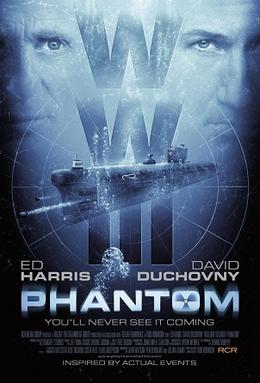
Did you know that we came close to WWIII in 1968?Neither did I.“Phantom” takes the disappearance of a Soviet
sub in the South Pacific that year to imagine a KGB plot to start a nuclear war
between the U.S. and Red China.Slap an “inspired
by actual events” label on it and run with it.This movie snuck up on me.I think I saw one commercial for it.I doubt it will be a blockbuster as it seems
to have been dumped in the doldrums of February.
The movie opens with a crusty,
worn-out Captain Demi (Ed Harris) anticipating retirement before the cryptic
admiral assigns him an old rust bucket that happens to have been his first
boat.The mission is classified and
mysterious.The Captain asks “do you
think we can be redeemed for the things we’ve done?”Wow, he just cameright out and mentioned redemption.Also, I think we can expect some back-story.
The sub takes on two KGB agents
and a special gizmo welded to the deck.The lead KGB agent named Bruni (David Duchovny) has a history with
Demi.More back-story coming.Capt. Demi has some demons to where I thought
maybe I had walked into a horror movie.He pops pills and drinks and has frenetic flashbacks that turn out to harken
back to an accident on his first cruise that resulted in numerous deaths.The incident also resulted in a brain injury
that gave him epilepsy which causes fits.For some reason, Harris insisted on acting for his pay check.Commendable.
An encounter with an American
sub establishes the Cold War submarine cat and mouse paradigm.They release noise makers and dive to
escape.Later, they encounter a tanker
and Bruni insists that Demi get close enough to scrape it.At this point the Captain is reluctantly following
orders, but he soon grows suspicious of Bruni’s motives.It turns out the device is called “The
Phantom” and is a type of cloaking device that mimics another ship’s sound
echo.
When Bruni decides to routinely
surface to report their position, Demi countermands the order and takes command
of the ship by gunpoint.The crew loyal
to the captain are locked up, but not monitored.You’d think the KGB would be good at
monitoring.Demi figures out that the
boat has gone rogue and Bruni wants to start a war.The good guys take three separate
actions.The Captain rigs a distress
signal to summon another warship.The
exec (William Fichtner) organizes the retaking of the boat.Our newly wed officer goes off to disable the
warhead.
The distress signal quickly brings
a Soviet attack sub that is apparently under orders to sink them, thus proving
the rogue theory.Bruni admits they are
trying to start a war by firing the nuke at the U.S. fleet and making them
think it came from a Chinese sub.The
reason is the U.S. has just developed something called “Dark Star” (not “Star
Wars”) that will shoot down all Soviet missiles and give the U.S. a first
strike capability which they will use because Bruni opines “that’s what we
would do”.Demi argues that America
would not do such a thing because they value life.His empathy for America does not sway the
hard core Commie who is bent on winning the Cold War before the Americans
can.But first, there’s that pesky
Soviet sub.Demi is given temporary
command to save them in the duel.He
does this by crippling the other sub (which strangely takes none of the
countermeasures they had taken earlier).
At this point the plot dissolves
into age-old sub clichés (hint:rivets
popping) and regular war movie cliches (wedding ring droppings), plot twists
(not everyone among the loyals can be trusted), wanton violence (to prove Bruni
is evil KGB), plot holes (exactly how did Bruni get the launch code?), and a
shootout to make it an action movie.We’re
all here today so I’m sure you can figure out the bad guys don’t win.Oh, and there is some redemption.
The movie was not as bad as I
expected.I don’t think that will make
much difference to the investors.There
was only one other person in the theater.After what happened with “K-19”, who the Hell would green light a Soviet
submarine movie?At least they didn’t waste
money on accents.The acting is actually
satisfactory.Harris is excellent, as
usual.He brings gravitas to the role.Fichtner is a likeable second.The problem is Duchovny.There is no chemistry between him and
Harris.He slums through the role.He’s no Gene Hackman to Denzel Washington (“Crimson
Tide” reference).Speaking of which,
this movie never seriously makes a case for Bruni’s point of view.There is no real conflict.
The set is good.The interior does look like that of an old
diesel sub.This could be one of the
most cramped subs in cinema.The
workings of the sub seem authentic. Maybe
they had a Russian technical advisor. If so, he didn’t help much with tactics.For example, the movie makes a big deal out
of launching “decoy torpedoes”.I’m no
expert, but I would think a decoy torpedo would be used to lure incoming
torpedoes away from the sub.However, in
this movie they are used to blow up the incoming ones.
The special effects are low rent.All the sub shots are in darkness and the
torpedo runs are straight out of a WWII sub movie.The CGI (I assume the subs were rendered this
way) are not jarring because of the darkness.The cinematography is nothing special.Typical sub stuff.Lots of
closeups.Some following through the
corridors. The soundtrack is
unobtrusive and just used to set the mood.
In conclusion, “Phantom” is an
average sub movie.I have seen much
worse and much better.It was adequate
entertainment and since I only invested $6.50 in it, it’s not my problem that
someone was idiotic enough to produce it.As I have said before in previous “Now Showing” posts, we war movie
lovers need to be thankful for whatever we get.
The
Flowers of War
is a novel by Geling Yan.It is set in
Nanking, China during the infamous “Rape of Nanking” in 1937.Japanese soldiers have taken over the city
and a multitude of atrocities are taking place.The soldiers are killing, raping, and looting.Thousands of Chinese civilians are
targeted.Corpses fill the streets.No one is safe even in the “Safety Zone”.
Father Engelmann is an American priest who
runs the St. Mary Magdalene mission.He
is sheltering around a dozen schoolgirls.He is aided by his Deacon named Fabio.His adopted “son” George is the simple-minded cook.With gunshots ringing consistently on the
outside, they pray that within the walls they will be safe.Things get more complicated when they are
joined by fourteen prostitutes and three Chinese soldiers.The mission is now very dysfunctional.The virginal, innocent girls are confronted
by the crass sexuality of the whores.There are several verbal and even physical confrontations between them.Although some of the girls are orphans and
from the lower class, part of the girl/whore dynamic involves culture
clash.The two groups are segregated
with the girls in the attic and the whores in the cellar ( a bit heavy-handed
in the symbolism ). There is also the
conflict between the pacifist Father Engelmann and the soldiers.The Father insists the soldiers give up their
arms in an attempt to keep the mission neutral, in case the Japanese come
calling.
The main character is one of the
schoolgirls named Shujuan.Her parents
abandoned her and went to America.She
has issues.The book develops several
other characters.The leader of the
prostitutes is Yumo.She is high-class
and has the power to seduce any man.She
is the conscience of the whores and tries to keep them in line.She becomes romantically involved with Major
Dai – one of the soldiers who escaped the destruction of his command to take
refuge in the mission.The other two
soldiers miraculously survived the mass slaughter of over 5,000 prisoners.The flashback is one of the most memorable of
the novel.
It’s just a matter of time
before the war finds them.Meanwhile,
there are problems with the lack of food and water.As time passes, the girls and the prostitutes
thaw toward each other.Shujuan spends
time watching them through a ventilation shaft.It’s eye-opening, but even more ear-opening.
All good things must come to an
end, however.Japanese soldiers arrive
and find the three soldiers.The
Japanese are thuggish and brutal.Father
Engelmann tries to stand up to them, but it is hopeless.None of the trio survives, but the females
are undiscovered.For now.Someone rats out the girls and the Japanese
return for them.Father Engelmann is
told they are wanted for entertainment at a party.He does not fall for that old one and manages
to delay the abduction.The solution is
simple math and involves the suddenly altruistic prostitutes.
The novel is surprisingly
good.Yan writes well with few
frills.The plot is not complicated, but
it is not predictable (except for the solution to the dilemma).The back-stories are interesting.The characters are appealingly drawn and you
care about them.Father Engelmann starts
off as priestily naïve about the Japanese, but he evolves into a hero.Yumo is the stereotypical prostitute with a
heart of gold, but she balances the whores with mouths of potty.Shujuan connects them together well.Yan writes teenage girl realistically.The main flaw is the implausibility of the
conclusion.Yan definitely stretches
credulity, but I have to admit it was satisfying.
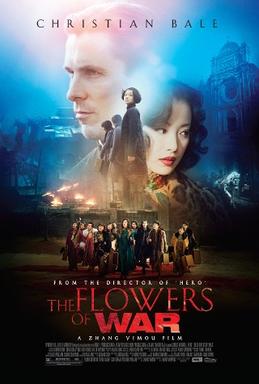
The movie “The Flowers of War”
was released in 2011 and was directed by Zhang Yimou with a huge budget.He used part of the funds to hire Christian
Bale to play the main character – American mortician John Miller.A Chinese film with an American hero, imagine
that.The movie was a major hit in China
and went on to become the top grossing movie in Chinese history.It was nominated for several awards, but was
not a favorite of critics.Although
Geling Yan helped with the screenplay, the plot is very different than the
novel.
In the movie, the schoolgirls
and Miller arrive at the mission after running through the chaotic
streets.Father Engelmann is already
dead and only George is there.Miller is
the stereotypical Yank – crass, money-hungry, alcohol-loving.He is in need of redemption, naturally.The prostitutes arrive soon after.They are basically as depicted in the
book.Since the version I watched lacked
subtitles, I can only assume their dialogue was similar to the book.A stunning beauty named Ni Ni plays
Yumo.Miller hits on her in an
embarrassing way.“There’s no coffee.
Let’s get liquored up”.(A line not
taken from the book.)Major Li (the
movie combines Major Dai and Sergeant Li) arrives with the wounded young
soldier,followed shortly by rampaging
Japanese vermin who chase the girls all over the mission with rape on their
minds.The Japanese are distracted by a
sniping Li and charge off to go 40 on 1.Li is a Chinese Rambo and takes most (if not all) of them with him in a
scene full of “Tae Guk Ri” spectacle with ridiculous explosions.The scene is cathartic and officially makes
the movie a war movie, but is nowhere in the book.
Miller decides to assume the
role of a priest.He shaves his scraggly
beard and hits the redemption road.A
new group of Japanese arrive led by the cultural (and seemingly human) Col.
Hasegawa.He apologizes for the previous
group and promises to return to hear the girls sing.He puts guards around the mission.Two of the whores manage to sneak out to get
some more pipa strings and to help advance the plot in two ways.First, Miller meets a friend who encourages
him to escape.No thanks, I want to go
to Heaven by continuing to masquerade as a priest.Second, we get another frenetic chase scene
culminating with a horrific glimpse at what will be in store for the girls if
they fall into Japanese hands.This
scene was briefly mentioned in the epilogue of the book.
After the girls sing angelically
for Hasegawa, he “invites” them to perform at a military celebration.Nothing to worry about.And yet…The girls climb to the top of the tower to commit suicide and are only
dissuaded when Yumo and the other prostitutes offer to take their places.Lucky thing Miller is a mortician who can
make whores look like virginal thirteen year olds!Unfortunately, there are thirteen girls and
only twelve whores.(This math problem
does not appear in the novel.)Someone
needs to volunteer to become Georgette.
I have posited in the past that movies
based on books can and should be better than their source material.And I would argue that a majority are.This movie does not fit my theory.One major inferiority is the Miller
character.If ever a character was
shoe-horned into a movie, this one is.He is nowhere to be found in the book and replaces the superior Father
Engelmann.The pre-redemption
personality is cringe-worthy and the redemption is cliché.The other huge flaw is the obvious attempt to
add “explosions” literally and figuratively.The director and screenwriter (the non-Yan one) must have found the book
boring.They added three action scenes
and subtracted the mundane lack of food and water aspects.The movie sacrifices realism for pizzaz.Check out the prostitutes’ hair.
Caroline (Beauty is a Sleeping
Cat’s “Literature and War Readalong”) suggested that if we did not read the
book, we could substitute the movie.Not
a good suggestion.The movie is
radically different from the book.Where
the book has an implausible ending, the movie is rife with
implausibilities.However, the movie
does have its strengths.The acting is
good, except for pre-priest Bale.The
Shijuan and Yumo characters are well-played and accurately reflect the novel.Both the girls and the prostitutes are fine
(I guess, since I could not understand a word they were saying).The movie is visually stunning.The cinematography pulls out all the bells
and whistles (hand-held, slo-mo, low angle, etc.)The combat is reminiscent of Korean war films
like “Tae Guk Ri”. Watch out for flying
debris!
In conclusion, definitely read
the book and if you get a chance and have Netflix Instant, watch the
movie.Make sure you do it in that
order!